

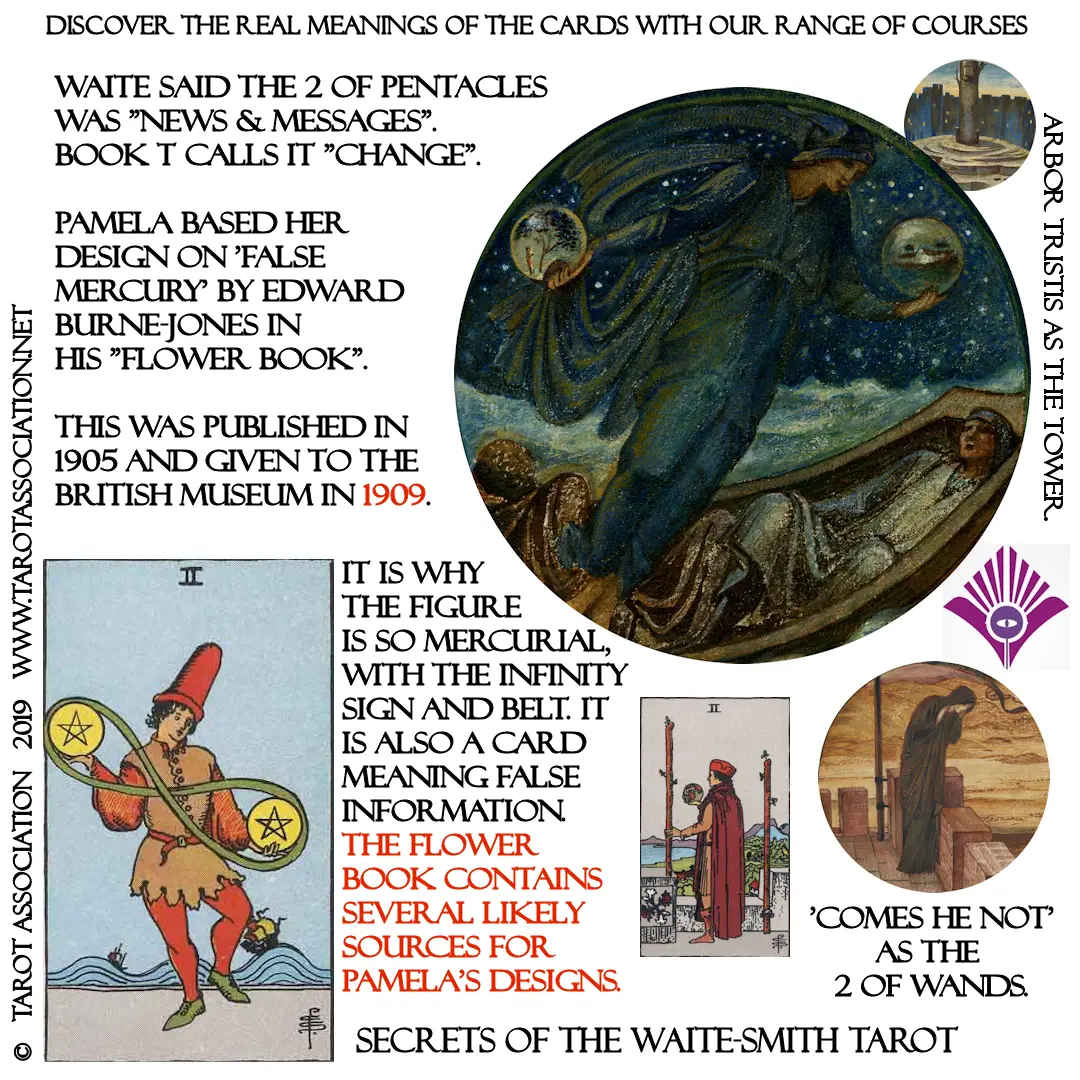
LONDON — For generations, tarot enthusiasts and professional readers have interpreted the Two of Pentacles as a lighthearted emblem of modern multitasking, financial budgeting, and the delicate art of balancing time and money. Often depicted as a jester juggling two coins amidst choppy ocean waves, the card is frequently prescribed to clients as advice on how to handle a busy schedule or weather minor economic fluctuations.
However, recent historical research into the foundational texts of modern tarot reveals a startling truth: the card’s conventional interpretation has become radically disconnected from its roots. Far from a benign exercise in time management, deep archival investigation suggests that the Two of Pentacles is, in fact, tarot’s original "gaslighting" card—a Victorian-era warning regarding deliberate deception, false messaging, and psychological manipulation.
Main Facts: Re-evaluating the Two of Pentacles
The reassessment of the Two of Pentacles stems from a re-examination of the Golden Dawn’s Book T, the seminal instruction manual written in the late 19th century that heavily informed both A.E. Waite’s Rider-Waite-Smith deck and Aleister Crowley’s Thoth deck. While contemporary interpretations emphasize equilibrium and adaptability, the Golden Dawn’s original definitions paint a far more erratic and turbulent picture.
According to foundational esoteric doctrine, the card corresponds to the Kabbalistic concept of Chockmah of Assiah (Wisdom of Action) and the astrological decan of Jupiter in Capricorn. In the Golden Dawn tradition, this manifests as "the harmony of change, alternation of gain and loss; weakness and strength; everchanging occupation; wandering, discontented with any fixed condition of things."
Rather than a steady juggling act, historical data reveals the card was designed to signify volatile shifts, unreliability, and conflicting communications. Pamela Colman Smith, the artistic genius behind the iconic Rider-Waite-Smith illustrations, deliberately selected imagery rooted in deception—specifically drawing from Victorian botanical lore to warn seekers against hidden agendas and misleading information.
Chronology: From Hermetic Roots to Victorian Inspiration
To understand how the Two of Pentacles evolved from a symbol of mercurial deception into a symbol of modern productivity, historians trace a clear timeline through late 19th- and early 20th-century occultism:
- Late 1880s–1890s: The Hermetic Order of the Golden Dawn formulates Book T, establishing the theoretical foundations, astrological correspondences, and elemental meanings for the minor arcana cards.
- 1909: A pivotal year for tarot history. A.E. Waite and artist Pamela Colman Smith visit the British Museum in London for inspiration, studying historical decks such as the Sola Busca Tarot.
- 1909 (Continued): Around this same period, a privately printed, illustrated botanical notebook by artist Edward Burne-Jones is gifted to the British Museum. In this journal, Burne-Jones illustrates popular plant names based on Latin translations and folklore.
- December 1909: The Rider-Waite-Smith tarot deck is published, featuring Smith’s illustration of a mercurial figure balancing spheres while standing before a storm-tossed boat—a direct visual adaptation of Burne-Jones’s drawing for "False Mercury."
- 2010s–Present: Modern researchers, including historians studying the Golden Dawn and the genesis of the Waite-Smith deck, begin uncovering the true literary and artistic sources behind Smith’s imagery, prompting a modern renaissance in traditional tarot scholarship.
Supporting Data: The Poisonous Plant and the "False Mercury"
The smoking gun behind the true meaning of the Two of Pentacles lies in Pamela Colman Smith’s direct artistic inspiration: Edward Burne-Jones’s depiction of "False Mercury."
Burne-Jones was illustrating Mercurialis perennis, commonly known in English folklore as "Dog’s Mercury." Unlike true mercury-bearing plants, this woodland perennial is highly toxic. In Victorian flower lore and Burne-Jones’s poetic notebook, the plant was personified as "False Mercury"—a deceitful figure that lures sailors or travelers toward treacherous shores by conjuring illusory visions of safety, home, and shelter during a storm.
This explains the specific elements of Smith’s illustration for the Two of Pentacles:
- The Mercurial Jester: Representing the messenger god, Mercury, who governs communication, intellect, and commerce.
- The False Promise: Just as the mythological Mercury can be a trickster, the "false" nature of the messenger points toward unreliable information.
- The Storm-Tossed Boat: Reflects the perilous environment of those who have been led astray by bad advice or manipulated realities.
When A.E. Waite authored his Pictorial Key to the Tarot, he struggled to explicitly reveal the secret Hermetic origins found in Book T, yet his written definitions preserved the card’s darker undercurrents. Waite categorized the card not merely as recreation, but crucially as "news and messages in writing, as obstacles, agitation, trouble, embroilment," noting in additional annotations that "troubles are more imaginary than real" and warning against "bad omen, ignorance, [and] injustice."
Official Responses and Esoteric Expert Perspectives
Modern tarot scholars and historians have increasingly advocated for a return to these older, more psychological layers of the Minor Arcana.
In collaborative works such as Secrets of the Waite-Smith Tarot (2015) and A New Dawn for Tarot (2014), researchers have emphasized that contemporary readers have sanitized the deck, stripping away the complex web of Renaissance magic, European folklore, and psychological warnings encoded by its creators.
"When we look past the modern pop-culture veneer of the tarot, we find a sophisticated system of psychological and spiritual diagnostics," notes one prominent esoteric historian. "The Two of Pentacles was never just about balancing your checkbook. It was a warning that the ground beneath your feet—specifically regarding what people are telling you—might be shifting due to intentional deception."
Experts argue that by reducing the card to a benign symbol of multitasking, readers miss vital cues regarding interpersonal manipulation and toxic environments.
Implications: Contemporary Readings and Practical Application
Reintegrating the original "gaslighting" definition of the Two of Pentacles transforms how the card functions across various areas of modern life during a tarot consultation.
Romance and Relationships
While surface-level readings may point toward the usual compromises required in a partnership, a deeper interpretation warns against deliberate miscommunication, gaslighting, or emotional manipulation. It serves as a prompt to carefully evaluate whether a partner is presenting an idealized, false reality to obscure erratic or harmful behavior.
Finance and Career
In professional and financial contexts, the card moves beyond simple time management. It actively cautions that someone may be misleading you regarding the true potential of an investment, a contract, or a workplace project. Practitioners advise getting every agreement in writing and scrutinizing corporate communications for hidden agendas.
The "Yes/No" Verdict
Despite its turbulent undertones, the Two of Pentacles retains a nuanced predictive quality in binary queries. Esoteric practitioners classify it as a qualified YES. The situation ultimately trends toward a harmonious outcome, but only after navigating a series of temporary setbacks, psychological tests, and shifting communications.
Ultimately, the rediscovered history of the Two of Pentacles offers a profound modern lesson: true balance cannot be achieved until one clears away the fog of deception and demands radical honesty in an ever-changing world.
