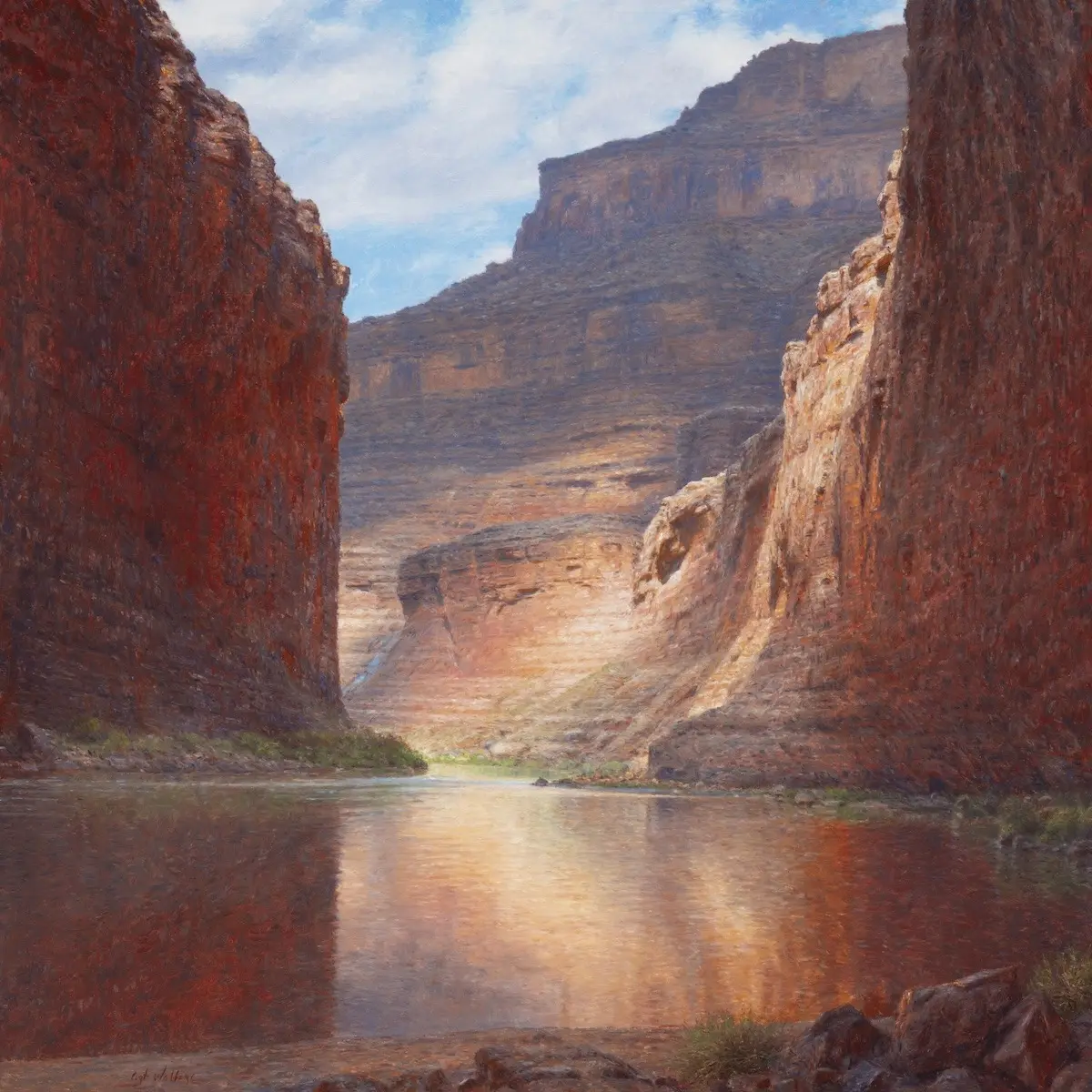
SEDONA, Ariz. — For more than half a century, the name Curt Walters has been inextricably linked to the majestic, shifting chasms of the Grand Canyon. Widely regarded as the preeminent living painter of America’s most iconic natural wonder, Walters has spent decades capturing its monumental scale, volatile weather patterns, and shifting chromatic moods. Now, art enthusiasts, historians, and collectors have a rare opportunity to witness the full breadth of his visionary career through a landmark, two-venue retrospective currently underway in Sedona, Arizona.
Titled A Lifetime in Art and running through November 30, the comprehensive exhibition is hosted by the Fine Art Museum of Sedona. It brings together 48 definitive works spanning from 1979 to the present day. Divided across two distinct locations in Sedona—a town Walters has proudly called home for 47 years—the exhibition serves as both a celebration of a master craftsman and a poignant reflection on the passage of time, artistic evolution, and the imperative of environmental preservation.
Main Facts: A Dual-Venue Retrospective in Sedona
The exhibition is strategically split across two prominent cultural hubs in Sedona, putting roughly two miles between them, yet bridging decades of creative output.
The primary exhibition space is housed within the Mary D. Fisher Fine Art Complex, which showcases Walters’ signature, large-scale grand canvases. Here, visitors are greeted by breathtaking vistas of the Grand Canyon rendered in rich oils, demonstrating the artist’s lifelong obsession with light, shadow, and atmosphere. Among the centerpieces of this venue is the recent masterpiece Instant Opus, a dramatic portrayal of an epic sunset lightning storm witnessed firsthand by Walters from Yavapai Point.
Two miles to the west, situated in a museum pop-up space behind the Sedona Heritage Museum, a complementary exhibition titled Impressions of Sedona 1980–2000 takes visitors on a localized journey. This companion showcase features plein air paintings and early works depicting the rugged red rock landscape surrounding Sedona during the decades when Walters first established his roots in the area.
Together, the two venues offer a sweeping narrative of an artist who chose to live in close proximity to his muses, allowing him to observe their geological and atmospheric transformations with intimate familiarity.
Chronology: From Teenage Aspiration to Master Painter
The story of Curt Walters as a painter of the American West began more than half a century ago, rooted in youthful fascination and rigorous dedication.
The Formative Years (1969–1970s)
In 1969, while still in his teens, Walters took his first definitive steps toward what would become a lifelong artistic crusade. A pivotal moment occurred during his youth when he first visited the Grand Canyon at age 19. During that formative trip, he encountered a striking diorama depicting Spanish conquistadors at the canyon’s edge—an image that etched itself permanently into his imagination and would resurface in his work decades later.
Establishing Roots in Sedona (1979–1980s)
By the late 1970s, Walters had relocated to Sedona, Arizona, finding a permanent home and studio base just a two-and-a-half-hour drive from the South Rim of the Grand Canyon. This strategic location allowed him to study the canyon under every conceivable seasonal shift, weather condition, and time of day. Works from this era, now featured in the Heritage Museum pop-up, capture the raw, untamed beauty of Sedona’s nascent artistic community and surrounding wilderness.
National Acclaim and Major Awards (1990s–Present)
As his technical prowess matured, Walters’ distinctive handling of light—often incorporating elements of tenebrism to emphasize dramatic contrasts—earned him widespread critical acclaim. He steadily amassed many of the Western art world’s most prestigious accolades. His mantle now boasts top awards from landmark events such as:
The Prix de West at Oklahoma City’s National Cowboy & Western Heritage Museum.
Quest for the West at the Eiteljorg Museum in Indianapolis.
Masters of the American West at the Autry Museum of the American West in Los Angeles.
The Retrospective and Family Tributes (September 2026)
The current retrospective kicked off with major opening receptions: the Mary D. Fisher Fine Art Complex opened its doors on September 4, followed by the Heritage Museum pop-up on September 18. Accompanying the physical art are multimedia projects spearheaded by Walters’ own family. Special screenings of Painting the Air—a documentary about the artist directed by his filmmaker daughter, Miranda Foreman—are being held across both venues. Concurrently, an illustrated biography titled Resilience: The Life History and Grand Canyon Art of Curt Walters, authored by his grandson Damien Foreman, provides an in-depth literary companion to the exhibition.
Supporting Data: Examining the Masterpieces
The 48 artworks curated for A Lifetime in Art represent the pinnacle of Walters’ career, bridging historical imagination, direct observation, and environmental lament.
Instant Opus (Oil on Canvas, 48 x 48 inches, 2020)
Displayed at the Mary D. Fisher Fine Art Complex, Instant Opus captures the raw, kinetic energy of a Grand Canyon monsoon and sunset. Walters recalls the harrowing yet exhilarating experience of witnessing the scene unfold from Yavapai Point:
"I was right there, with big bolts of lightning everywhere."
The canvas translates this atmospheric violence into a symphonic arrangement of electric light slicing through deep indigo and fiery orange chasms.
The Conquistador Series
Among the most surprising and ambitious works in the exhibition is a new historical series stemming from Walters’ childhood memory of the 1540 Spanish expedition. The paintings feature figures such as García López de Cárdenas—the Spaniard who led the first European party to discover the canyon—depicted in full military attire at the South Rim.
Walters explains the meticulous research and sheer joy that went into producing these works:
"The first time I visited the Canyon, at the age of 19, I saw an incredible diorama there of the conquistadors, and it just stuck in my head all these years. Now, I’ve collected all the costumes and saddles and bridles, and I have models coming to pose. I’m determined to do it. It’s a blast!"
Vicissitude (Oil on Canvas, 30 x 48 inches, 1993)
Representing the poignant historical landscape work housed at the Heritage Museum, Vicissitude portrays a vibrant field of yuccas in glorious springtime bloom, set against Sedona’s iconic red rock cliffs. Yet, the title itself hints at change and instability. Walters speaks of the location with palpable regret:
"That place doesn’t exist anymore. It’s now a shopping center and parking lot."
Official Responses and Artist Perspectives
Throughout his career, Walters has remained fiercely dedicated to authenticity. Rather than relying solely on photographs, he routinely immerses himself in the environments he paints, enduring extreme weather, setting up plein air easels on precarious precipices, and investing in historical props to ensure accuracy in his narrative works.
Curators and organizers of the Fine Art Museum of Sedona note that mounting a retrospective of this scale required years of coordination, bringing together loans from private collectors, museums, and Walters’ personal archives. The dual-venue approach was deliberately chosen to reflect the dual nature of his artistic identity: the localized, intimate observer of Sedona’s changing landscape on one hand, and the monumental, cosmic interpreter of the Grand Canyon on the other.
Furthermore, the involvement of second and third generations of the Walters-Foreman family—through Miranda Foreman’s documentary and Damien Foreman’s biography—transforms the exhibition into a generational legacy project. It highlights not only an individual artist’s triumphs in the studio, but also the enduring cultural impact of a family living in close dialogue with the American Southwest.
Implications: A Call for Environmental and Cultural Preservation
Beyond their aesthetic brilliance, the works in A Lifetime in Art carry a subtle yet urgent subtext. Through pieces like Vicissitude, Walters confronts viewers with the fragility of the American landscape in the face of relentless commercial development and urban sprawl.
By juxtaposing pristine, timeless views of the Grand Canyon with lost local vistas in Sedona, the exhibition acts as an implicit conservation plea. It reminds audiences that natural wonders and fragile ecosystems are not infinite. They require active stewardship, appreciation, and cultural memory to survive.
As visitors walk through the galleries at the Mary D. Fisher Fine Art Complex and the Sedona Heritage Museum through November 30, they are invited to do more than simply admire technical mastery. They are challenged to see the American landscape through the eyes of a man who has dedicated his entire life to recording its grandeur—and to recognize the shared responsibility of protecting what remains.
Exhibition Details
Event:A Lifetime in Art (Retrospective of Curt Walters)
Locations:
Mary D. Fisher Fine Art Complex (Main Exhibition)
Sedona Heritage Museum Pop-Up (Impressions of Sedona 1980–2000)