

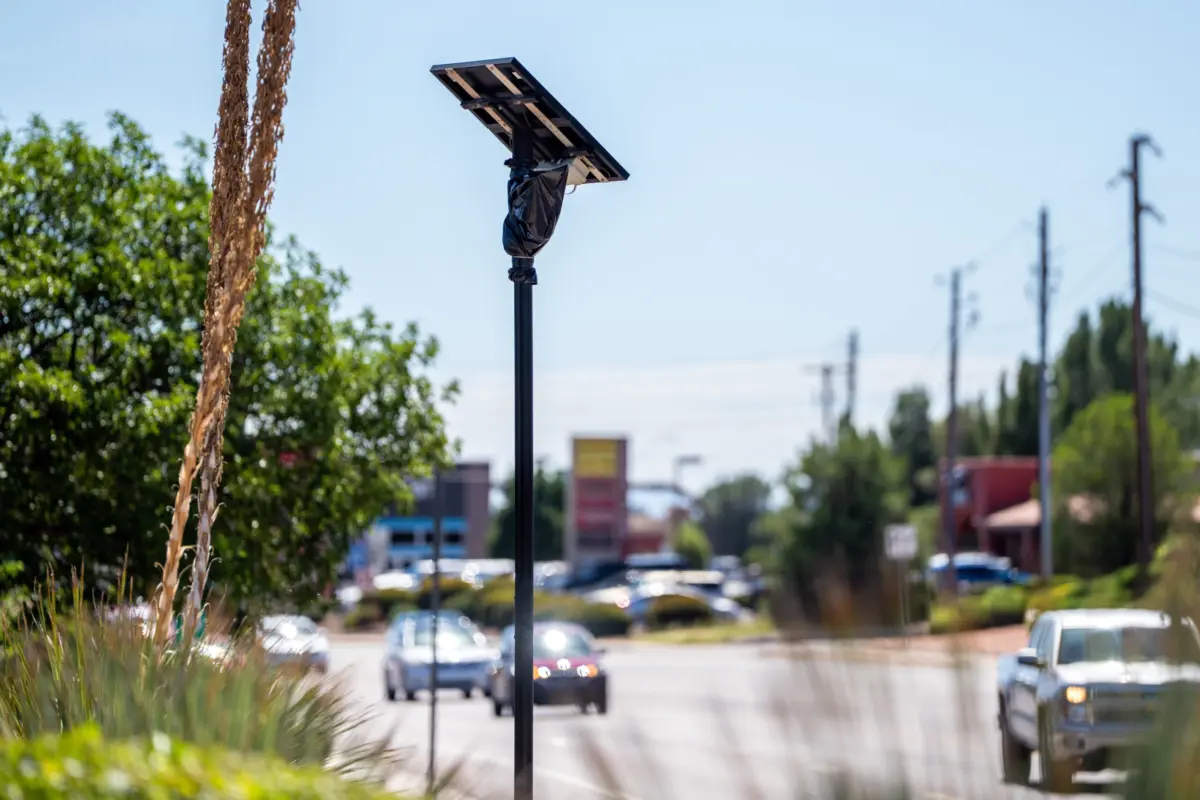
COTTONWOOD, Arizona — In a sudden and highly visible retreat from automated municipal surveillance, the City of Cottonwood and the Cottonwood Police Department (CPD) have suspended their network of Flock Safety automated license plate readers (ALPRs).
On Friday, Sept. 4, Cottonwood City Manager Mario Cifuentez II and Chief of Police Brian Freudenthal jointly announced the immediate deactivation of the camera network. Within hours of the announcement, municipal workers began covering the roadside cameras in heavy black plastic bags—a stark visual symbol of the escalating tension between modern policing technology and community expectations of privacy.
The suspension comes ahead of a highly anticipated Cottonwood City Council work session scheduled for 6 p.m. on Sept. 22 at the Riverfront Council Chambers. While statutory rules prevent the council from taking formal action during the work session, and residents will not be permitted to speak, public attendance is expected to be high as the community grapples with newly revealed data showing systemic compliance issues, regional data sharing, and a complete lack of searches related to the state grant that funded the program.
Chronology of a Surveillance Backlash
The path to the Sept. 4 suspension was paved by months of growing community resistance, spearheaded by local advocacy groups such as "Fight the Flock Cottonwood." The group has consistently argued that the ALPR system constitutes an invasive dragnet, tracking law-abiding citizens without sufficient oversight or clear evidence of efficacy.
[2025] Cottonwood PD secures $213,992.80 AZ DPS Grant for Human Trafficking prevention.
  │
[Jan 1 – Jul 24, 2026] CPD conducts 4,335 Flock searches; audits reveal low compliance rates.
  │
[Aug 19, 2026] Yavapai County Board of Supervisors rejects new ALPR contracts.
  │
[Sep 3, 2026] YCSO confirms they have no direct Flock contracts at Verde Villages Open House.
  │
[Sep 4, 2026] City of Cottonwood shuts down Flock network, covering cameras in black bags.
  │
[Sep 22, 2026] Cottonwood City Council schedules a public work session on the future of ALPRs.
The friction reached a critical juncture in late August and early September 2026, when public records requests yielded detailed audit logs of the police department’s Flock usage. The logs, obtained by activists and shared with local media, revealed that officers frequently bypassed internal protocols designed to justify and document vehicle searches.
Recognizing the depth of public dissatisfaction, city leadership decided that maintaining the system was doing more harm than good to community relations.
"Following discussions regarding the level of discord the license plate reader issue is generating within our community, it has been determined that it would be best to suspend the use of this technology at this time," the city’s Sept. 4 joint announcement read.
Chief Freudenthal acknowledged the necessity of public consent in local policing. "Just bring an open mind," Freudenthal said, addressing the upcoming work session. "We’re committed to community and public trust, and without it, our job is more difficult. So, if the public and the community is at a point where they’re done with Flock and they don’t think it’s the right tool for us, then we’ll listen."
Supporting Data: Inside the Cottonwood PD Audit Logs
An analysis of the Cottonwood Police Department’s Flock Safety audit logs from January 1 to July 24, 2026, paints a complex picture of how ALPR technology is deployed in the field. During this nearly seven-month period, CPD officers ran a total of 4,335 searches.
While approximately 70% of these queries were conducted within Cottonwood’s localized camera network, 1,288 searches extended into outside networks. Notably, 452 of these outward queries were "broad-net" searches that simultaneously queried roughly 6,000 other law enforcement networks across the country.
Total CPD Flock Searches (Jan 1 – Jul 24, 2026): 4,335
├── Localized Cottonwood Searches: ~3,047 (70%)
└── Outward Regional/National Searches: 1,288 (30%)
      └── Broad-Net Queries (6,000+ networks): 452
The Compliance Gap
To prevent abuse, Flock Safety systems require officers to enter a specific police case number and a brief written narrative justifying the search before querying the database. However, the audit logs reveal a significant gap between official policy and field practice:
- Case Number Compliance: Of the 4,335 searches, 3,220 (74.3%) included an entry in the case number field. However, 147 of these entries were placeholders such as "NONE" or "TEST" rather than active, valid case numbers.
- Narrative Explanations: Written explanations detailing the reason for the search were included in only 1,572 searches (36.3%).
- The "All Fields Filled" Rate: Only 1,094 searches contained both a valid case number and a written narrative, representing a complete compliance rate of just 25.2%.
- Undocumented Searches: Conversely, 637 searches (14.7%) featured neither a case number nor a narrative explanation. Beyond selecting a broad, pre-populated "crime" category, officers left no paper trail to explain why they were tracking specific vehicles.
| Search Metric | Number of Searches | Percentage of Total |
|---|---|---|
| Total Searches | 4,335 | 100% |
| Case Number Entered (Any) | 3,220 | 74.3% |
| Placeholder Case Numbers (e.g., "TEST") | 147 | 3.4% |
| Written Narrative Included | 1,572 | 36.3% |
| Fully Compliant (Case # & Narrative) | 1,094 | 25.2% |
| Non-Compliant (No Case # or Narrative) | 637 | 14.7% |
Search Categories and the Grant Discrepancy
The audit logs also categorized the types of offenses driving police inquiries. Minor offenses and administrative traffic issues far outnumbered investigations into violent or severe crimes:
CPD Flock Search Categories (Jan 1 – Jul 24, 2026)

Traffic Infractions       ██████████████████████████████ 826
Hit-and-Run / Accidents   █████████████ 363
Domestic Assault/Battery  █████████████ 358
Welfare Checks            ██████████ 274
Weapons Offenses          ██████████ 274
Drugs / Narcotics         ██████████ 260
Larceny / Theft           ████████ 221
Stolen Vehicles           ████████ 216
Non-Domestic Assault      ████████ 215
Burglary / Breaking & Ent ██████ 168
Missing / Runaways        ██████ 158
Warrants / Fugitives      █████ 127
DUI                       ████ 109
Sex Offenses              ████ 99
Threats / Harassment      ████ 92
Disorderly Conduct        ████ 91
Reckless Driving          ███ 74
Stolen Property           ███ 72
Trespass                  ██ 62
Vandalism                 ██ 56
Robbery                   ██ 49
Kidnapping / Abduction    █ 44
Other Categories          █████ 127
Human Trafficking         0
This breakdown has fueled local controversy due to the program’s funding source. In 2025, the Cottonwood Police Department secured a $213,992.80 grant from the Arizona Department of Public Safety (DPS) to purchase and maintain the Flock system.
The grant application explicitly stated that the funds would be used to "enhance law enforcement services and programs that reduce human trafficking within the state." Yet, throughout the entire seven-month audit period, not a single search out of the 4,335 conducted cited human trafficking as the justification.
Regional Collaboration and Outside Agency Queries
The audit logs also highlighted how Cottonwood officers utilized Flock technology to search networks belonging to neighboring jurisdictions, revealing a highly interconnected regional surveillance web.
Yavapai County Sheriff’s Office (YCSO)
CPD accessed YCSO’s network data in 61 searches. These queries were led by 32 domestic assault or battery investigations, including a Feb. 24 search for a white Chevrolet sedan fleeing a domestic violence incident. The remaining searches included 18 welfare checks (featuring three consecutive lookups on Feb. 23 for an unknown license plate), six searches for property destruction, four for sex offenses, and one for a missing person.
While YCSO does not hold direct financial contracts with Flock Safety, the agency operates under a Memorandum of Understanding (MOU) approved by the Yavapai County Board of Supervisors on Nov. 2, 2022. This agreement allows sheriff’s deputies to query outside agencies’ Flock databases without Yavapai County taxpayers directly funding the camera hardware.
Sedona Police Department
Cottonwood officers queried Sedona’s Flock network 28 times. This included 20 searches for robbery assistance and eight for larceny or theft. The robbery-related queries occurred during a highly concentrated block of searches on April 14, when officers ran multiple lookups for a black Mercedes-Benz sedan. Notably, these searches were conducted without attaching a local case number to the queries.
Camp Verde Marshal’s Office
CPD ran 26 searches within the Camp Verde Marshal’s Office network, consisting of 20 traffic infractions and six stolen vehicle inquiries. The vehicle theft queries included an April 12 search tracking a stolen motorcycle with an unknown license plate.
Official Responses and Justifications
As community opposition mounted, regional law enforcement and elected officials defended the utility of the technology while acknowledging the validity of the public’s concerns regarding privacy and oversight.
Chief Freudenthal on Context and Critical Incidents
Addressing the low rate of fully documented searches in the audit logs, Chief Freudenthal argued that raw spreadsheets fail to capture the high-stress, fast-moving reality of active police work.
To illustrate his point, Freudenthal referenced a previously reported incident from April 1, where CPD ran 46 consecutive domestic assault searches in the Coconino County Sheriff’s Office Flock network between 10:48 a.m. and 11:15 a.m. with no case numbers attached to the individual queries.
"The spreadsheet doesn’t give you the context," Freudenthal explained. "The context behind that was a female in a parking lot that screamed, called the police as she was getting forced into that vehicle. The officers desperately were trying to find that vehicle as fast as they could."
According to the chief, while CPD’s internal log showed an active case number was indeed assigned to the overall incident response, the 46 rapid, real-time queries sent to outside networks—including Coconino County—failed to carry the case number through the system due to the urgency of the active kidnapping investigation.
Yavapai County Board of Supervisors’ Cautious Approach
The debate in Cottonwood reflects a broader skepticism toward automated surveillance technology across Yavapai County. At a county open house in the Verde Villages on Sept. 3, Yavapai County Sheriff’s Office Commander Brent Kimbriel clarified the agency’s operational stance: "We do not have any Flock contracts."
Yavapai County Board of Supervisors Decision (Aug 19, 2026):
├── Denied: Three Ekin Patrol mobile ALPRs
└── Denied: $13,847 contract with LeadsOnline LLC for NightHawk services
Reasoning: Need for a comprehensive understanding of underlying privacy policies.
At the same open house, Yavapai County Board of Supervisors Vice Chairwoman Nikki Check (D-District 3) discussed the board’s recent unanimous decision on August 19 to reject several automated license plate reader proposals, including a $13,847 contract with LeadsOnline LLC for NightHawk Subscription Services and the acquisition of three Ekin Patrol mobile ALPRs.
"We had some ALPR and some other software contracts come to the Board of Supervisors, and we did deny those," Check said. "Not out of principle or understanding that there’s use for them, but just that we really needed to understand the policies that were working behind those contracts."
Implications for Privacy, Policy, and Modern Policing
The suspension of Cottonwood’s Flock camera network highlights a growing nationwide debate over the rapid deployment of automated surveillance tools by local police departments.
Proponents of ALPR systems argue that the technology acts as a force multiplier for understaffed departments. By instantly scanning thousands of license plates and comparing them against state and federal databases, the cameras can rapidly alert officers to stolen vehicles, missing Amber Alert subjects, and suspects with active warrants.
However, privacy advocates argue that without strict, independent oversight, these systems inevitably lead to "mission creep." The Cottonwood audit logs provide empirical support for this concern: despite securing federal/state funds under the banner of combating high-level crimes like human trafficking, the technology was overwhelmingly used to police minor traffic infractions and local municipal offenses.
Furthermore, the low rate of complete data entry—where only a quarter of all searches contained both a case number and a written justification—points to a systemic lack of internal accountability. When officers can query regional databases containing millions of vehicle location data points without entering a valid case number, the risk of personal or unauthorized use increases.
The upcoming Cottonwood City Council work session on September 22 will serve as a crucial forum for evaluating these issues. Although public comment is legally barred during this specific session, the meeting will force city leaders to address a fundamental question: Can the efficiency gains of automated surveillance ever justify the erosion of public trust? For now, the black plastic bags covering Cottonwood’s roadside cameras remain a clear reminder of a community that demanded its privacy back.
