

Published: September 20, 2026
From the Yoga Journal Archives: Originally featured in the January-February 2002 issue.
Main Facts: Deconstructing the Ashtanga Vinyasa
For practitioners of Ashtanga Yoga, few movements are as iconic—or as intimidating—as the seated pick-up and jump-back into Chaturanga Dandasana (Four-Limbed Staff Pose). Rooted in the lineage of Sri K. Pattabhi Jois, this dynamic transition requires a seamless blend of core compression, upper-body strength, precise anatomical alignment, and psychological fortitude.
Often mistaken as the sole definition of a vinyasa, the pick-up and jump-back is actually just one specialized transition within a broader system defined by breath and movement. However, because it is repeated multiple times throughout an Ashtanga practice, mastering it offers profound benefits: it builds dense upper-body and core strength, boosts cardiovascular endurance, enhances spatial awareness, and fosters deep mental resilience.
Despite its outward appearance of effortless grace, the movement presents a steep learning curve. Practitioners frequently encounter physical impasses, wrist discomfort, and mental resistance. Overcoming these barriers requires dismantling the movement into fundamental, accessible components: Dandasana (Staff Pose), Tolasana (Scales Pose), Bhujapidasana (Shoulder-Pressing Pose), Lolasana (Pendant Pose), and Chaturanga Dandasana.
Chronology: The Eight-Year Journey to Fluidity
The path to executing a fluid jump-back is rarely linear. For many students, the progression unfolds over years of dedicated, incremental practice.
Phase 1: Avoidance and Ego
When first introduced to the Ashtanga series, practitioners often assume their general flexibility and strength will suffice. Confronted with the reality of picking oneself up from a seated position and launching backward, the immediate reaction is frequently self-doubt: "I will never be able to do this," or "This is not a movement for my body type." Many resort to avoidance, skipping the pick-up entirely and flowing through the rest of the sequence while letting negative thought patterns dictate their practice.
Phase 2: Observation and Visualization
Progress begins the moment a practitioner stops making excuses and starts observing mechanics. By studying experienced yogis who execute the movement with ease, students learn to break the transition down into chronological sections:
- Pressing the palms firmly into the floor.
- Drawing the hips upward to create vertical space.
- Engaging the core, rounding the back, and drawing the feet tightly between the arms.
- Leaning forward and floating backward into Chaturanga Dandasana.
During this phase, visualization serves as a vital bridge. By picturing the sequence clearly in the mind’s eye—often over months or years of practice—the practitioner trains the neuromuscular pathways to execute the physical components. For some, like veteran teachers who document their personal journeys, true mastery can take up to eight years of consistent, patient application.
Supporting Data & Anatomy: Mechanics of the Transition
Success in the pick-up and jump-back relies on a strict understanding of biomechanics, weight distribution, and leverage. The body acts as a closed kinetic chain, where alignment in the hands and shoulders dictates safety and efficiency.
The Shoulder Mantra
Proper upper-body mechanics prevent injuries to the rotator cuffs, wrists, and lower back. Three primary actions form the foundational "shoulder mantra":
- Draw shoulder blades deep into the body: Keep them flat against the upper back.
- Slide shoulders down toward the ground: Keep them actively moving away from the ears.
- Broaden across the upper back and collarbones: Avoid collapsing the chest or hunching forward.
Foundational Asanas as Building Blocks
To safely achieve suspension and transit, practitioners must master foundational postures that condition specific muscle groups:
- Dandasana (Staff Pose): Teaches the baseline elongation of the spine and placement of the shoulder girdle. Pressing the palms down while lifting the sternum creates a cylindrical column of energy from the perineum to the crown of the head.
- Tolasana (Scales Pose): Develops the core and arm strength required to act as a fulcrum. Practitioners cross their ankles, place their hands slightly forward, and lift their entire lower body off the floor, keeping the wrist creases parallel to the front edge of the mat.
- Bhujapidasana (Shoulder-Pressing Pose): Cultivates deep hip opening and arm compression. By locking the knees high onto the upper arms and swinging the feet through the "window" of the arms, the practitioner learns compact control.
- Lolasana (Pendant Pose): Combines the suspension of Tolasana with the compactness of Bhujapidasana, teaching the body how to dangle midair like a swing supported by the poles of the arms.
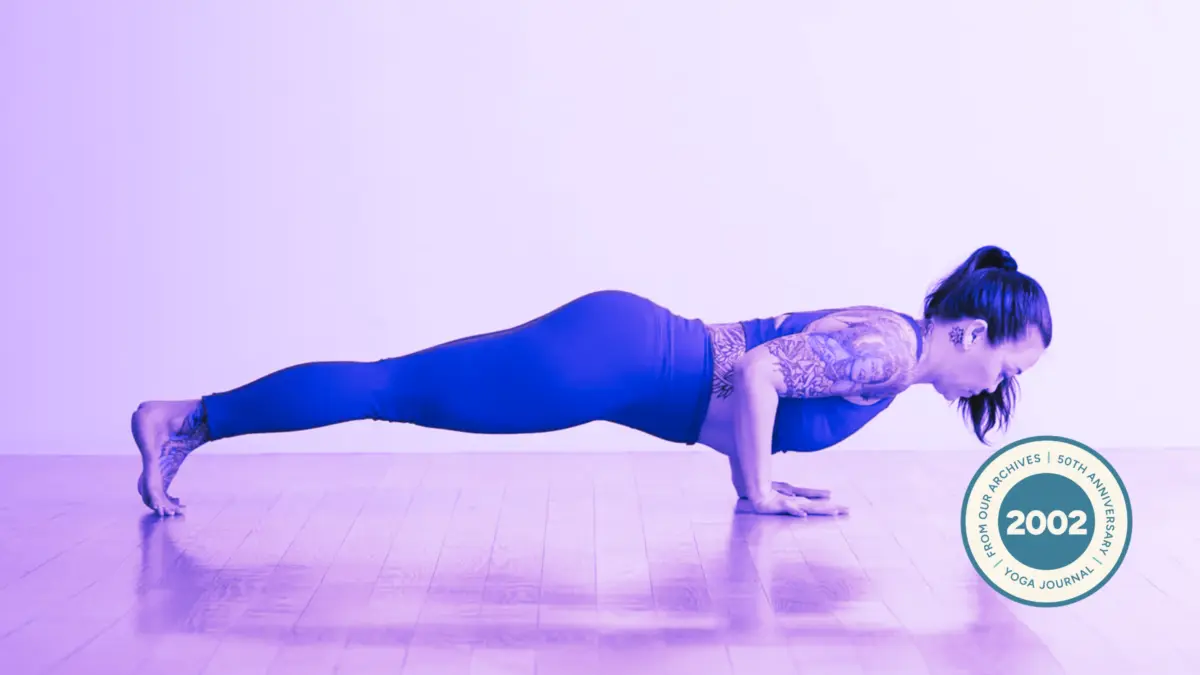
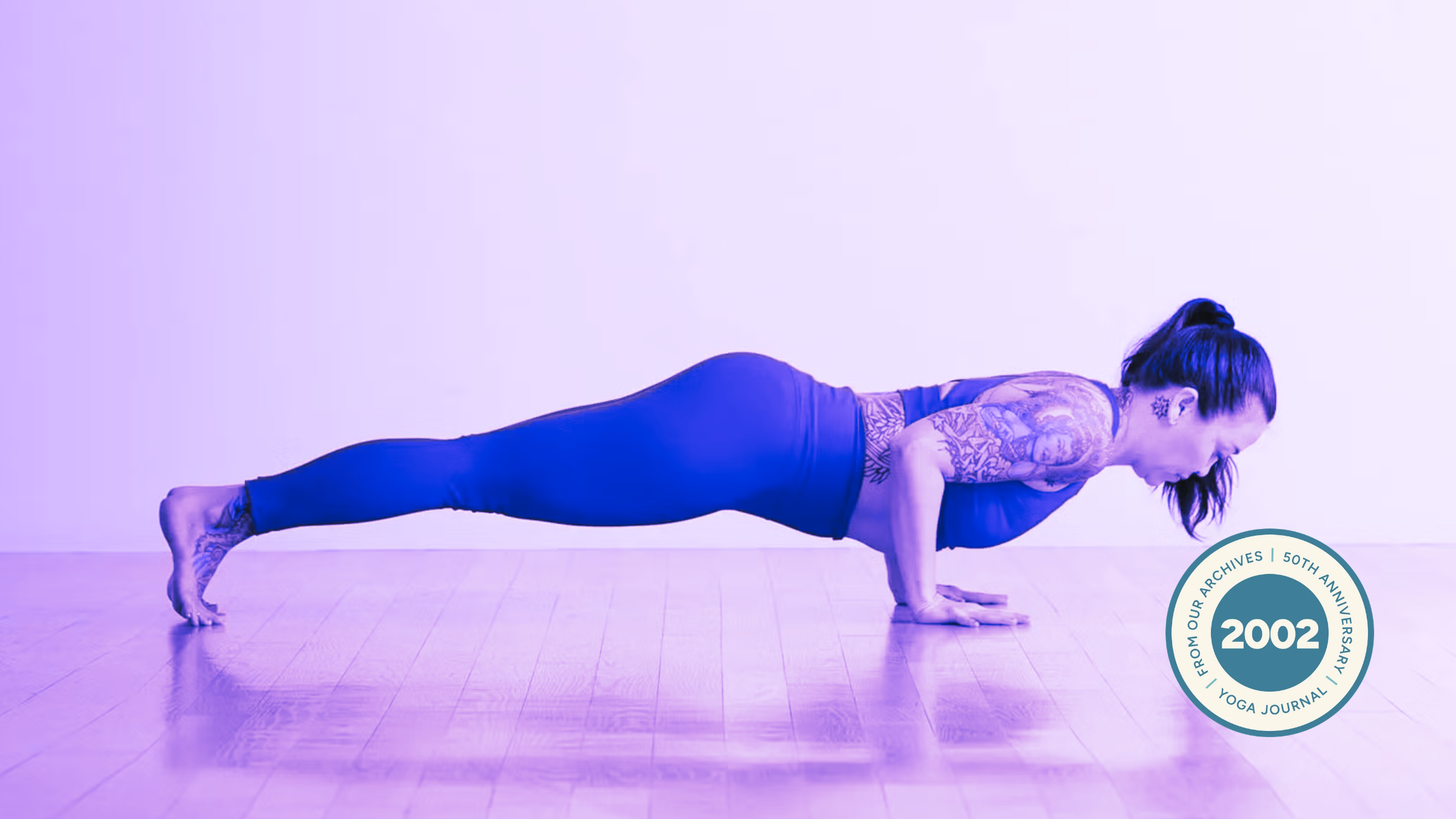
- Chaturanga Dandasana: The landing zone. Elbows must track directly over the wrists, and the body must lower into a right-angle position. Crucial Rule: Never jump directly from a high pick-up into a straight-arm Plank Pose, as the straight arms lack the natural shock-absorption of bent elbows, placing undue stress on the lower back.
Official Perspectives: The Philosophy of Tapas and Effort
In the framework of traditional Hatha yoga, physical postures are vehicles for mental inquiry. The struggle inherent in learning the jump-back provides a direct lesson in tapas—purification through heat and disciplined effort.
Balanced Effort vs. Extremes
Experienced instructors note two contrasting student archetypes when introducing the jump-back:
- The Overwhelmed: Students who feel instantly defeated, blaming external factors such as short arms, age, heavy hips, or stiff joints.
- The Over-Aggressive: Students who push their bodies past safe thresholds out of sheer determination, frequently resulting in wrist strains or shoulder impingements.
Neither extreme yields success. True progress requires a balanced effort that pairs physical determination with intelligent self-observation and compassion.
The Psychological Leap of Faith
Physical strength alone is insufficient if fear holds the body back. When suspended midair, practitioners often unconsciously brake their momentum because they fear the unknown trajectory toward Chaturanga. Overcoming this requires a mental shift: a "leap of faith" where the mind signals the body to glide forward, fully trusting that the conditioned arms will catch the landing.
Implications: Beyond the Mat
While the pick-up and jump-back is a celebrated milestone in Ashtanga practice, its true value extends far beyond physical acrobatics.
- Transforming Self-Esteem: Students who struggle with feelings of inadequacy often experience profound psychological shifts as they witness their bodies achieve what once seemed impossible.
- Cultivating Playfulness: Years of rigid technical discipline can make yoga feel overly serious. The dynamic, aerial nature of the jump-back infuses the practice with a youthful, playful quality.
- A Metaphor for Life: As Sri K. Pattabhi Jois famously stated, "Yoga is 99 percent practice and 1 percent theory." The journey toward mastering the jump-back teaches practitioners to let go of anxious attachments to end results.
By approaching the transition with patience, respect for bodily limitations, and an unwavering commitment to daily breath awareness, practitioners transform a simple physical movement into a moving meditation—a metaphor for navigating life’s transitions with grace, curiosity, and poise.
