

Main Facts
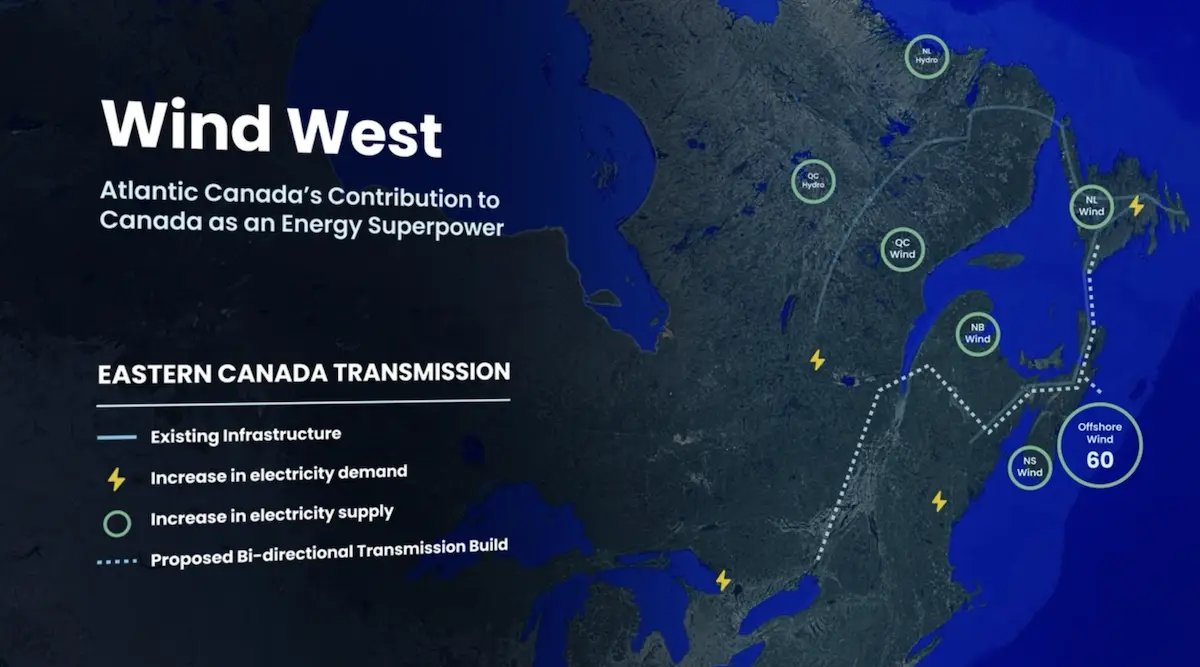
The Canadian province of Nova Scotia is advancing ambitious plans to develop one of North America’s largest offshore wind initiatives, titled "Wind West." Designed to tap into some of the most potent and reliable wind regimes on the continent, the project aims to generate massive quantities of renewable energy that vastly exceed local consumption requirements. Phase I alone targets a 5-gigawatt (GW) capacity, projected to yield approximately 24 terawatt-hours (TWh) of electricity annually—roughly double Nova Scotia’s current peak electricity demand.
Beyond provincial self-sufficiency, Wind West is positioned as a foundational pillar for regional energy collaboration. Through the broader framework of the Eastern Energy Partnership—a multi-province initiative linking Quebec, New Brunswick, Newfoundland and Labrador, Nova Scotia, and Prince Edward Island—the project seeks to forge robust cross-border transmission networks. These networks are expected to create direct economic and clean-power spillover effects for energy-hungry Northeastern states in the U.S., such as Massachusetts, which are actively seeking reliable alternatives to fossil fuels amid shifting federal energy policies.
Chronology of Events
- February 2025: Massachusetts Governor Maura Healey and Nova Scotia Premier Tim Houston sign a landmark Memorandum of Understanding (MOU) in Boston, establishing a formal partnership to collaborate on North Atlantic offshore wind development and regional grid integration.
- Late Spring 2025: The U.S. federal administration steps up pressure against domestic offshore wind development, initiating lease buyouts and directing defense reviews that stall multiple Atlantic and Pacific coast projects.
- June 2026: The 1.25-gigawatt Champlain Hudson Power Express transmission line officially commences commercial operations, successfully delivering hydropower from Quebec to supply up to 20% of New York City’s electricity demand.
- September 2026: The Government of Nova Scotia showcases Wind West as a premier investment opportunity at the inaugural Canada Investment Summit in Toronto, detailing its long-term potential to host up to 62 GW of offshore capacity.
- September 2026: Amid ongoing regulatory friction, the U.S. Department of Energy (DOE) restructures its programs, consolidating wind and solar offices into the "Integrated Energy Systems Office" (IESO) and adopting the terminology "aeromechanical energy systems" to describe wind turbine technology.
- Autumn 2026: Coalitions of state attorneys general from the Atlantic Seaboard and California file formal lawsuits against the U.S. Department of the Interior, challenging the legality of federal lease-cancellation payouts made to offshore developers.
Supporting Data
Nova Scotia’s offshore environment presents exceptional technical characteristics for large-scale energy generation:
- Wind Speeds: Annual average offshore wind speeds across identified development zones routinely top 9 to 11 meters per second (m/s).
- Capacity Factors: Projected operational capacity factors for Wind West turbines are expected to reach up to 60%. For comparison, contemporary U.S. coal-fired plants and high-efficiency combined-cycle natural gas facilities achieve operational capacity factors ranging from the mid-30% to low-60% range depending on seasonal demand, while other fossil-fuel generation methods score significantly lower.
- Scale and Potential: The provincial government has identified zones capable of hosting an estimated 62 gigawatts of total offshore wind potential. This volume equates to roughly 25% of Canada’s total projected nationwide electricity requirements.
- Phase I Metrics: The initial 5 GW tranche will produce 24 terawatt-hours of clean electricity per year, effectively doubling Nova Scotia’s peak domestic load and leaving a substantial surplus for export via interstate and international transmission corridors.
Official Responses
The cross-border partnership has garnered strong backing from regional leaders looking to secure long-term industrial growth and decarbonization pathways.

Nova Scotia Premier Tim Houston:
Emphasizing the transformative economic scope of the initiative during the February announcement, Premier Houston noted: "I look forward to sharing this clean energy with Massachusetts, powering economic opportunities for the New England region, and creating thousands of jobs and billions in investment in Nova Scotia."
Provincial Energy Planners:
According to strategic documents released by the Government of Nova Scotia, the province’s renewable assets extend far beyond wind. The administration’s policy brief states:
"Offshore wind from Nova Scotia can provide enormous quantities of clean energy, at stable prices, while diversifying supply, and boosting reliability for customers. And, in addition to Nova Scotia’s offshore wind, the Atlantic Provinces have other enormous resources to offer—in new and expanded hydro, in new nuclear, in onshore wind, geothermal, tidal and others."
U.S. State Legal Authorities:
In response to federal actions aimed at curtailing domestic offshore wind leases, state attorneys general have mounted coordinated legal challenges. A multi-state coalition—including representatives from New York, Connecticut, Maine, Massachusetts, New Jersey, and Rhode Island—filed suit against the U.S. Department of the Interior over billion-dollar lease termination agreements with major developers. Simultaneously, California Attorney General Rob Bonta and the California Energy Commission challenged federal buyouts affecting West Coast offshore leasing areas, arguing that the cancellations bypass established administrative law and damage state climate mandates.

Implications
Geopolitical and Economic Dimensions
The development of Nova Scotia’s offshore wind capacity highlights a growing divergence in energy policy between federal stances in Washington and sub-national jurisdictions across both Canada and the United States. While U.S. federal friction has introduced regulatory uncertainty for domestic projects, coastal Northeastern states face acute structural deficits in localized clean generation. By building out surplus capacity that can be exported southward, Canada solidifies its role as a strategic energy partner for New England and New York.
The operational success of transmission corridors like the Champlain Hudson Power Express demonstrates that cross-border electricity flows are both technically viable and economically transformative. Integrating Nova Scotia’s 62 GW of potential wind resources into the broader Eastern Energy Partnership could establish a resilient, multi-province grid capable of stabilizing prices and enhancing supply reliability across international boundaries.
Technological and Regulatory Adaptations
The emergence of innovative regulatory terminology within U.S. federal agencies—such as the Department of Energy’s adoption of "aeromechanical energy systems"—illustrates the administrative maneuvers required to navigate politically charged energy landscapes. However, semantic adjustments cannot entirely bypass the capital constraints facing domestic infrastructure development. As state-level legal challenges work their way through the court system, the contrast between stalled U.S. offshore initiatives and aggressive Canadian planning underscores how regional actors are stepping in to maintain momentum in the global energy transition.
Ultimately, Wind West represents more than a provincial infrastructure program; it serves as a bellwether for North Atlantic energy security. By capitalizing on world-class natural wind assets, Nova Scotia is positioning itself not only to achieve complete internal decarbonization, but also to anchor a new era of clean-power trade spanning international borders.
