

The global automotive landscape is undergoing a tectonic shift, and nowhere is this more apparent than in China, the world’s largest car market. Driven by high domestic gas prices, a relentless flood of technologically advanced new energy vehicles (NEVs), and a dramatic contraction in internal combustion engine (ICE) sales, China’s electrified vehicle market reached a staggering 65% market share in August 2026.
This milestone is not merely a testament to the rising popularity of electric cars; it marks a structural turning point where the traditional gas-powered car is being rapidly pushed toward obsolescence. As local manufacturers scale production, expand exports, and innovate at a breakneck pace, legacy automakers from Europe, Japan, and the United States find themselves caught in a historic sales crisis.
Main Facts: August 2026 at a Glance
- Record EV Market Share: NEVs captured 65% of total auto sales in China during August 2026.
- The ICE Collapse: Overall vehicle sales plummeted 24% year-over-year (YoY) to approximately 1.5 million units, driven by a severe crash in gas-powered vehicle demand.
- Powertrain Breakdown: While plug-in hybrids (PHEVs) fell 30% and extended-range electric vehicles (EREVs) dropped 22%, battery electric vehicles (BEVs) were the sole major powertrain to register positive growth, rising 1% YoY and claiming a 45% market share.
- Shifting Balances: The ratio of BEVs to PHEVs shifted to 69% versus 31% in August, signaling a strong resurgence in pure electric demand ahead of expected incentive phase-outs for hybrids.
- Exploding Exports: Chinese automakers exported 888,000 units in August—a 78% YoY jump—with NEVs accounting for 58% of those shipments.
Chronology of the Shift: How August 2026 Unfolded
The trajectory of China’s automotive market in 2026 has been defined by rapid policy adjustments, aggressive price competition, and swift technological rollouts.
- Early 2026: The year began with a slight cooling period for pure electric vehicles following adjustments to government subsidies, which temporarily gave an advantage to plug-in hybrids (PHEVs).
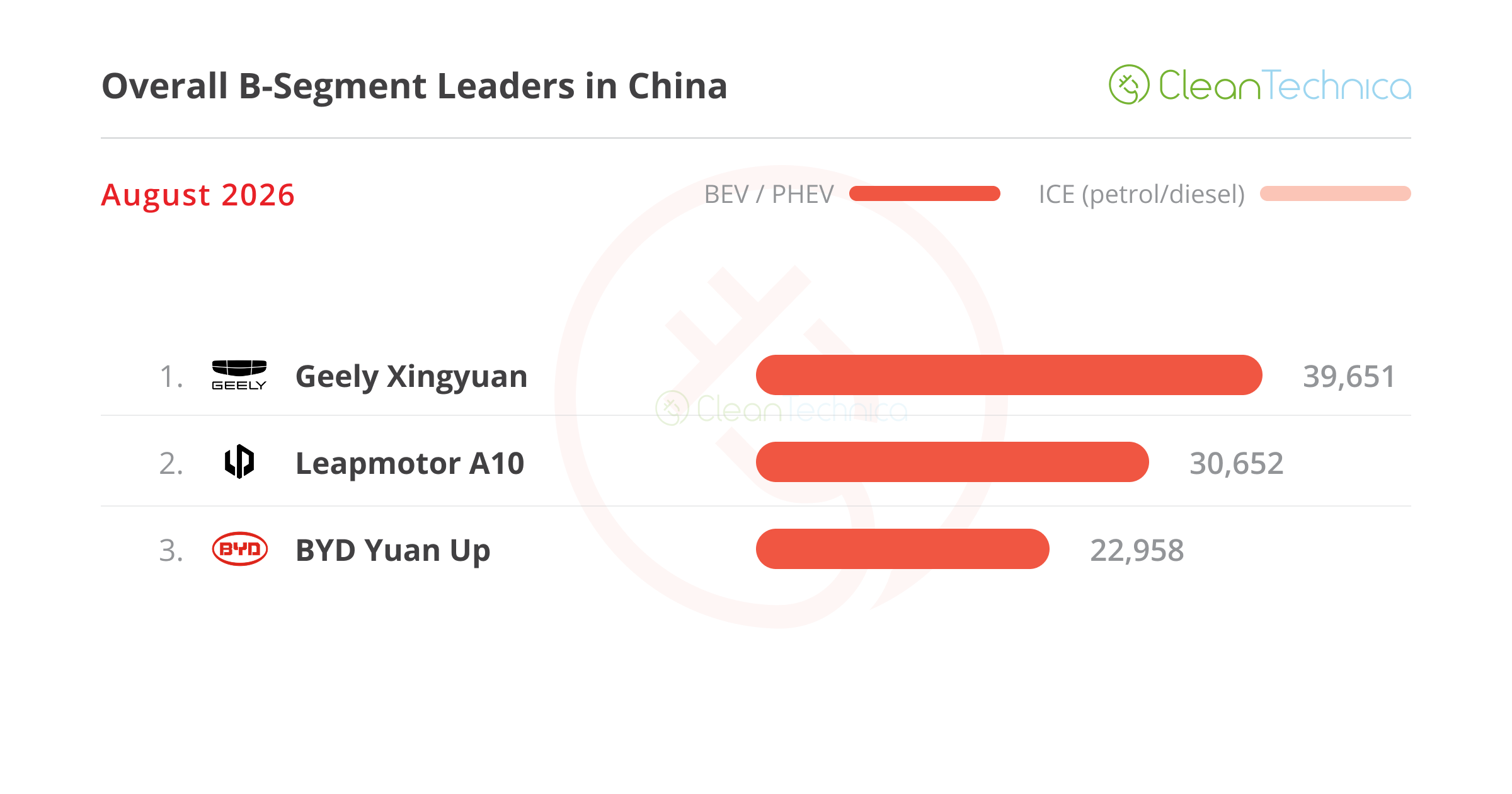
- Spring and Summer 2026: Domestic automakers responded by introducing a wave of affordable, high-value BEVs. Models designed to match the cost of entry-level gas cars—such as the Geely Xingyuan and Leapmotor’s new A-series—began capturing massive market share.
- August 2026: High fossil fuel prices and the arrival of highly anticipated next-generation vehicles (such as BYD’s Ultra series and Fang Cheng Bao’s BEV variants) triggered a collapse in traditional ICE sales. Overall market volume shrank to 1.5 million units, allowing NEVs to effortlessly capture a record-shattering 65% share. Concurrently, export hubs across China recorded nearly 900,000 international shipments, cementing the global reach of Chinese original equipment manufacturers (OEMs).
Supporting Data and Market Dynamics
To understand the sheer scale of China’s automotive transformation, one must examine the performance of individual segments, brands, and powertrain breakdowns.
Powertrain Realignment: The Return of the Pure EV
For much of early 2026, PHEVs enjoyed strong momentum due to shifting consumer incentives. However, August data signaled a sharp correction. Pure battery-electric vehicles surged back to command 69% of all plug-in sales, bringing the 2026 year-to-date average to 67%. With regulatory shifts slated to phase out tax exemptions for PHEVs and extended-range EVs by 2027, analysts expect pure electric dominance to widen further.
Top-Selling Models in Focus
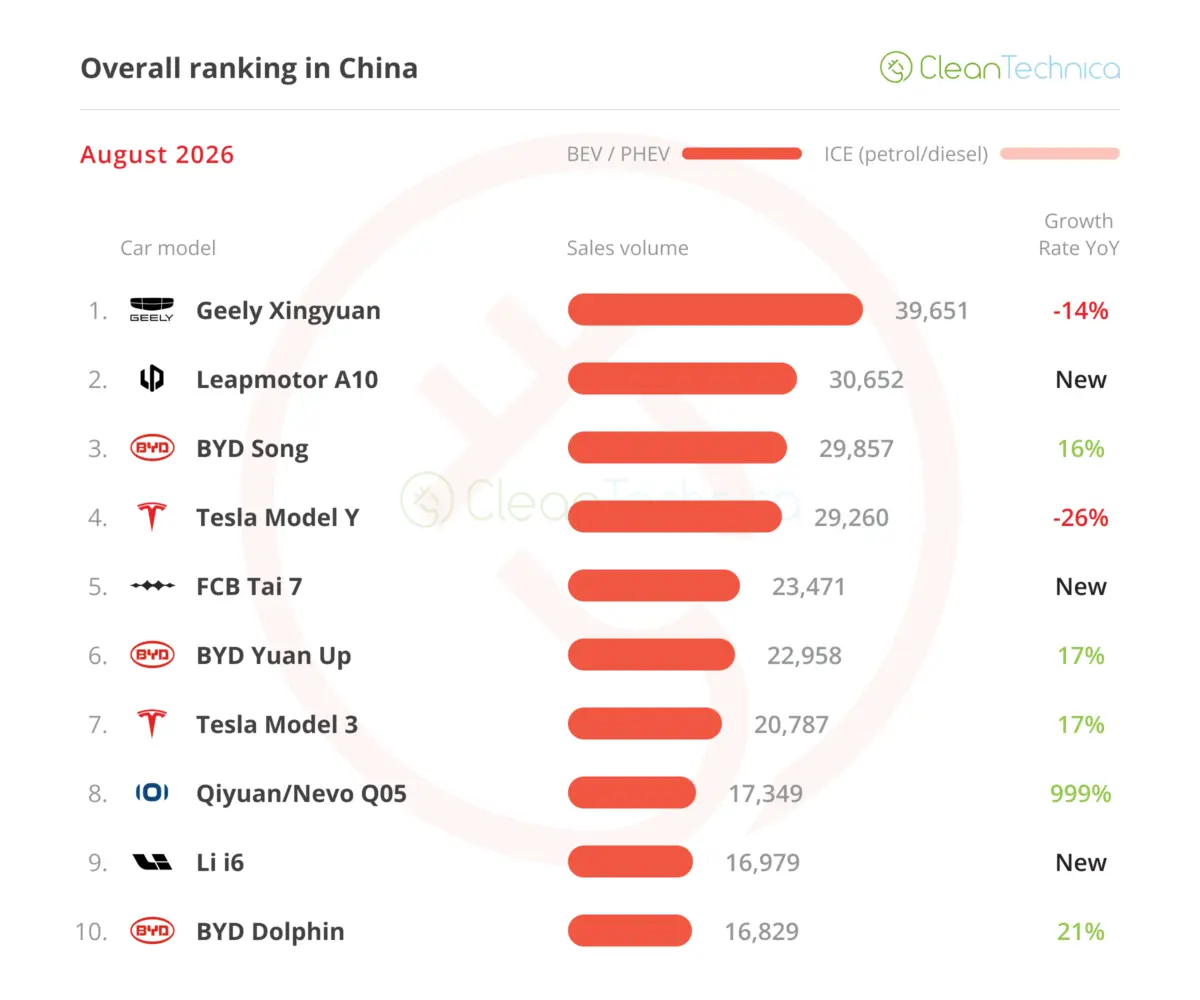
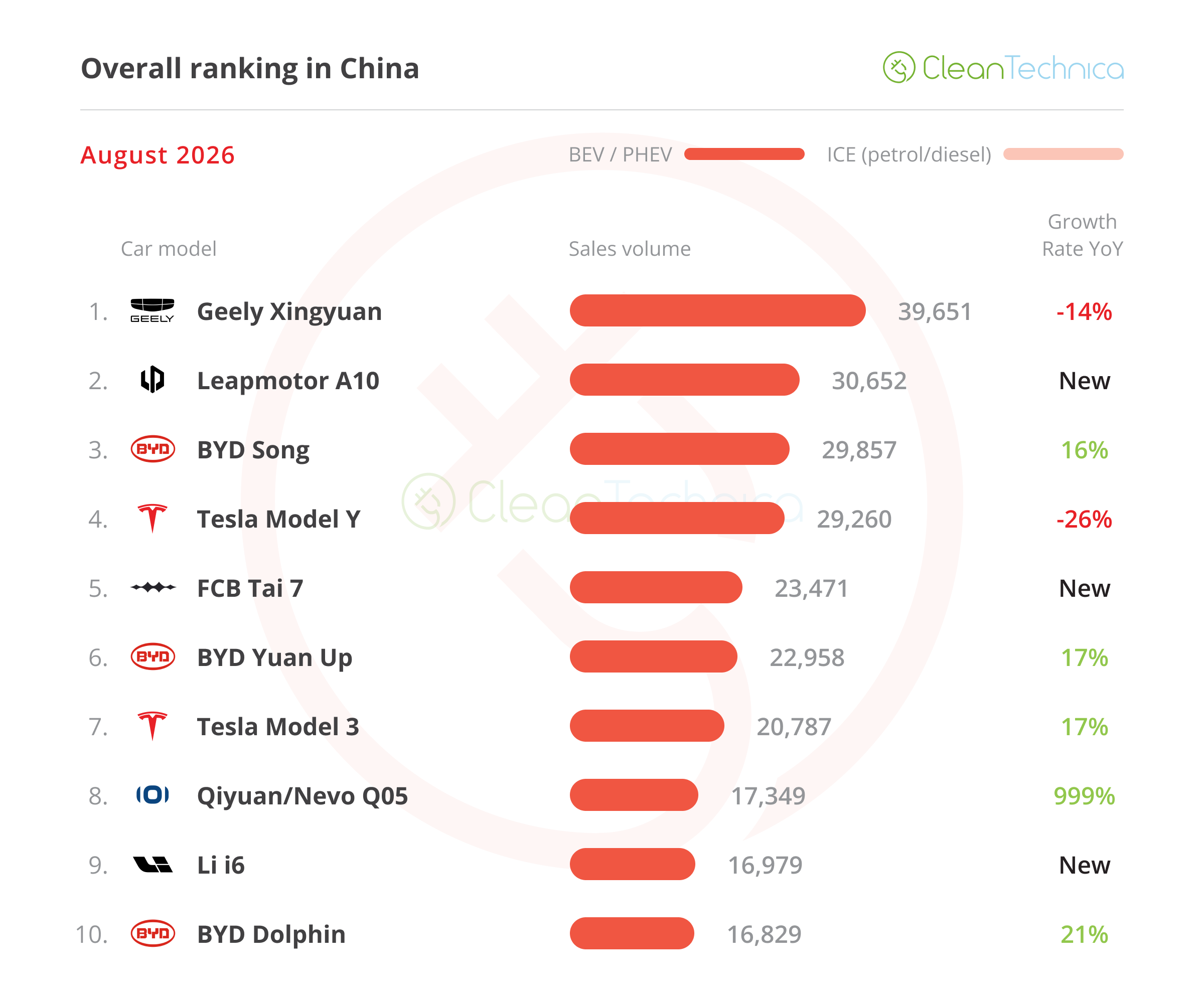
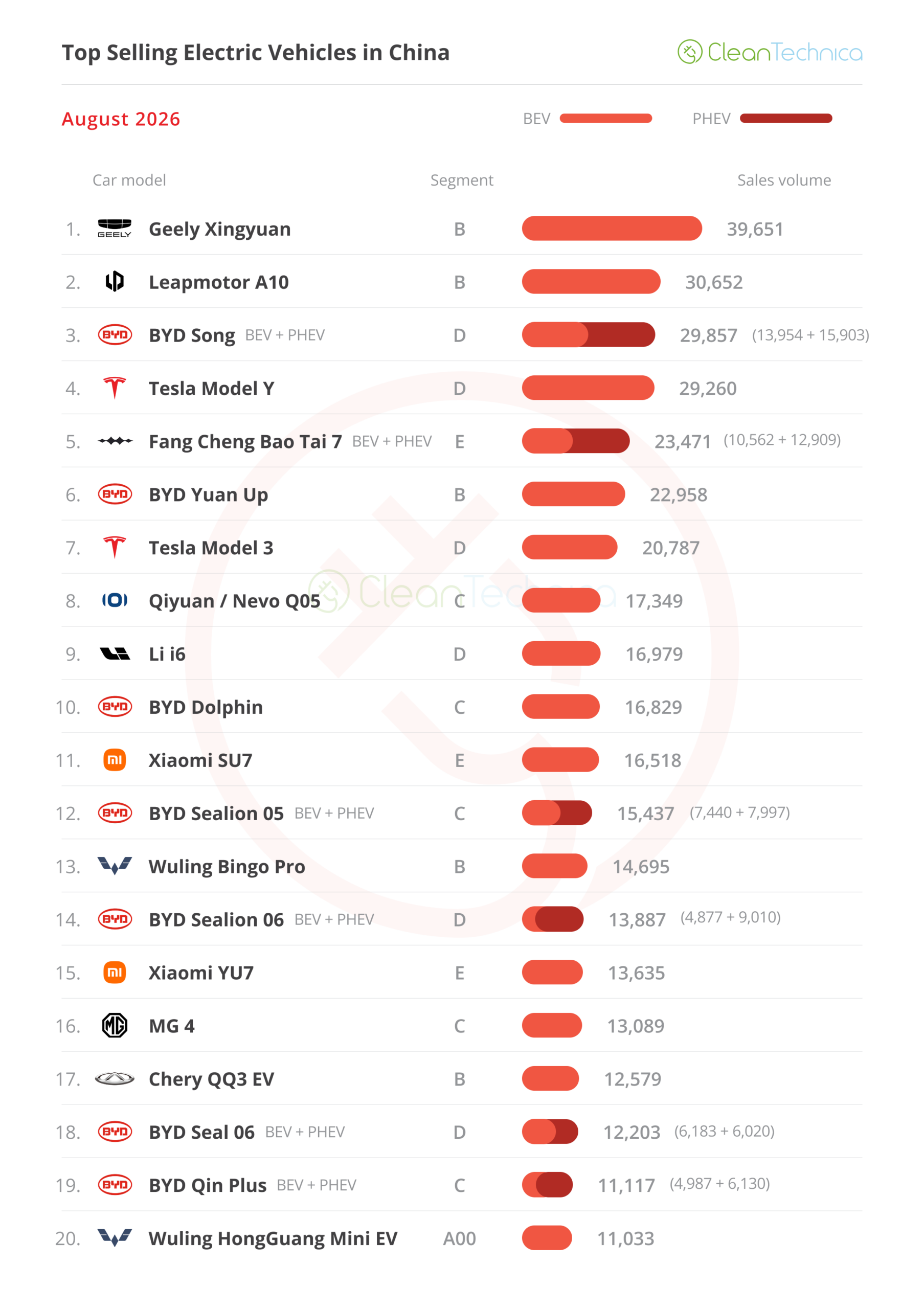
The top-selling vehicle rankings in August read almost exclusively as an all-electric honor roll:
- Geely Xingyuan (#1): Capturing 39,651 registrations, this compact hatchback continues to dominate by offering "BYD Dolphin features for BYD Seagull pricing" (roughly $10,000 USD). Despite fierce competition from new entrants, it remains the car to beat.
- Leapmotor A10 (#2): The Hangzhou-based startup’s new small crossover secured 30,652 registrations, riding a wave of production ramps and a competitive 66,000 yuan ($10,000) price tag.
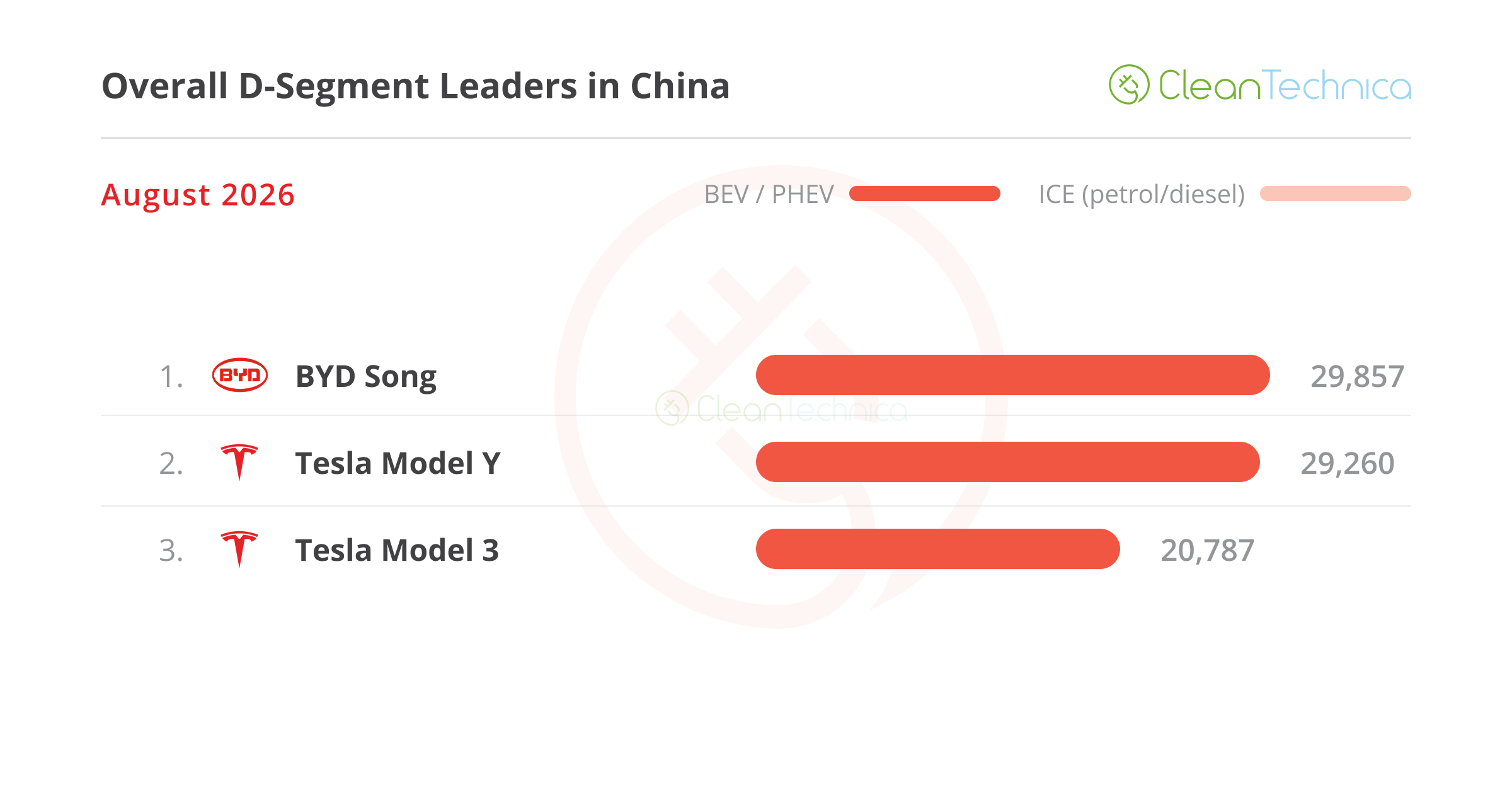
- BYD Song (#3): Combining BEV and PHEV variants, BYD’s midsize SUV achieved 29,857 registrations (up 16% YoY). The rollout of its new "Ultra" body style—featuring 800V architecture, lidar, and ultra-fast DC charging starting at just $22,000—positions it for sustained dominance.
- Tesla Model Y (#4): Delivering 29,260 units, the Model Y saw a 26% YoY drop. While the introduction of the long-wheelbase "L" variant has cushioned the blow, the aging six-year-old platform is facing intense pressure from hyper-advanced local competitors.
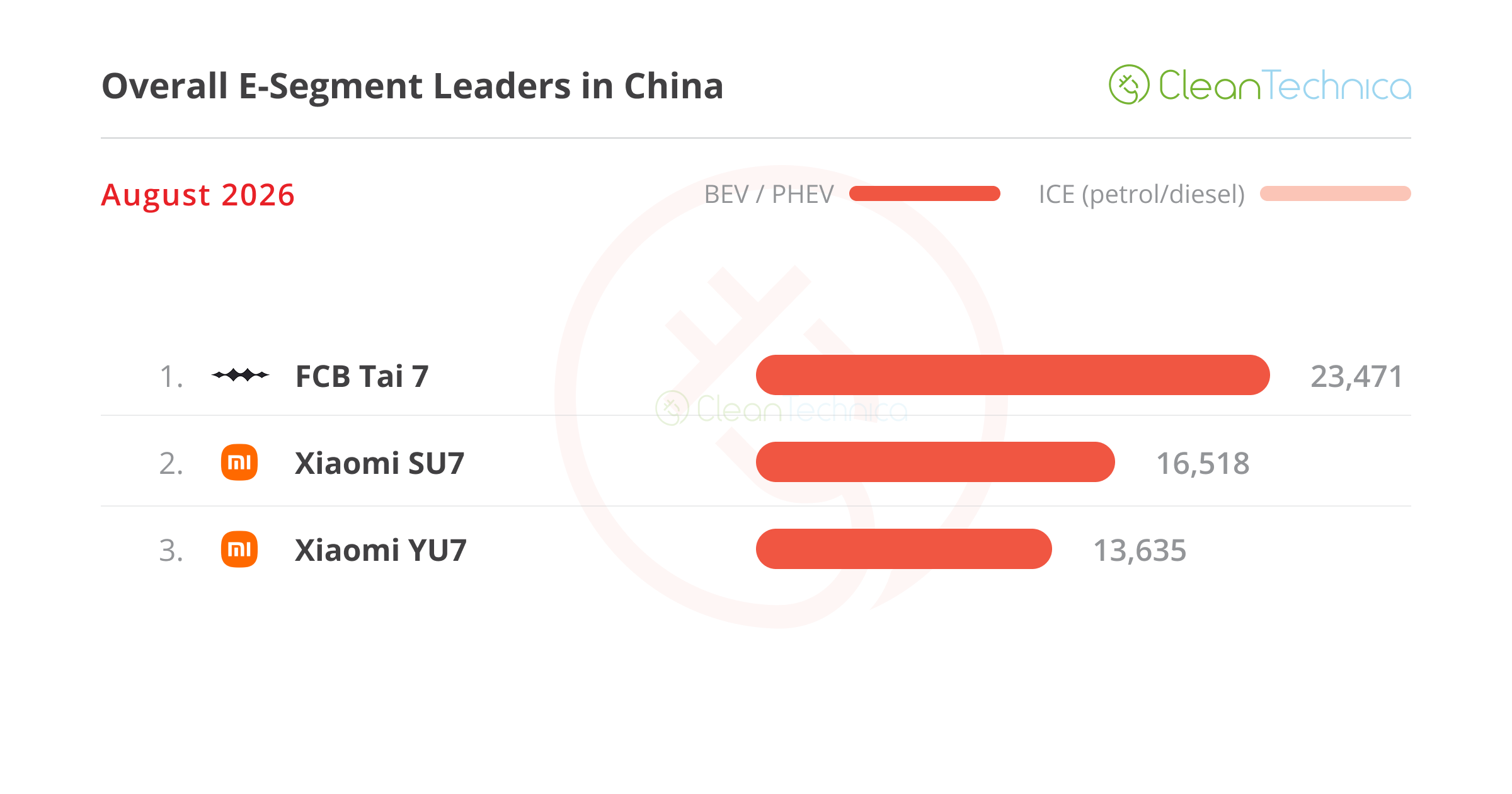
- Fang Cheng Bao Tai 7 (#5): BYD’s premium rugged SUV brand scored a stellar 23,471 registrations. Notably, its newly launched pure-electric variants outsold its PHEV counterparts in August, proving that heavy-duty, boxy EVs have captured consumer imagination.
The Manufacturer Landscape: Startups Surge, Legacy Giants Stumble
The overall brand and OEM leaderboards reflect a widening chasm between rising local challengers and struggling legacy giants.
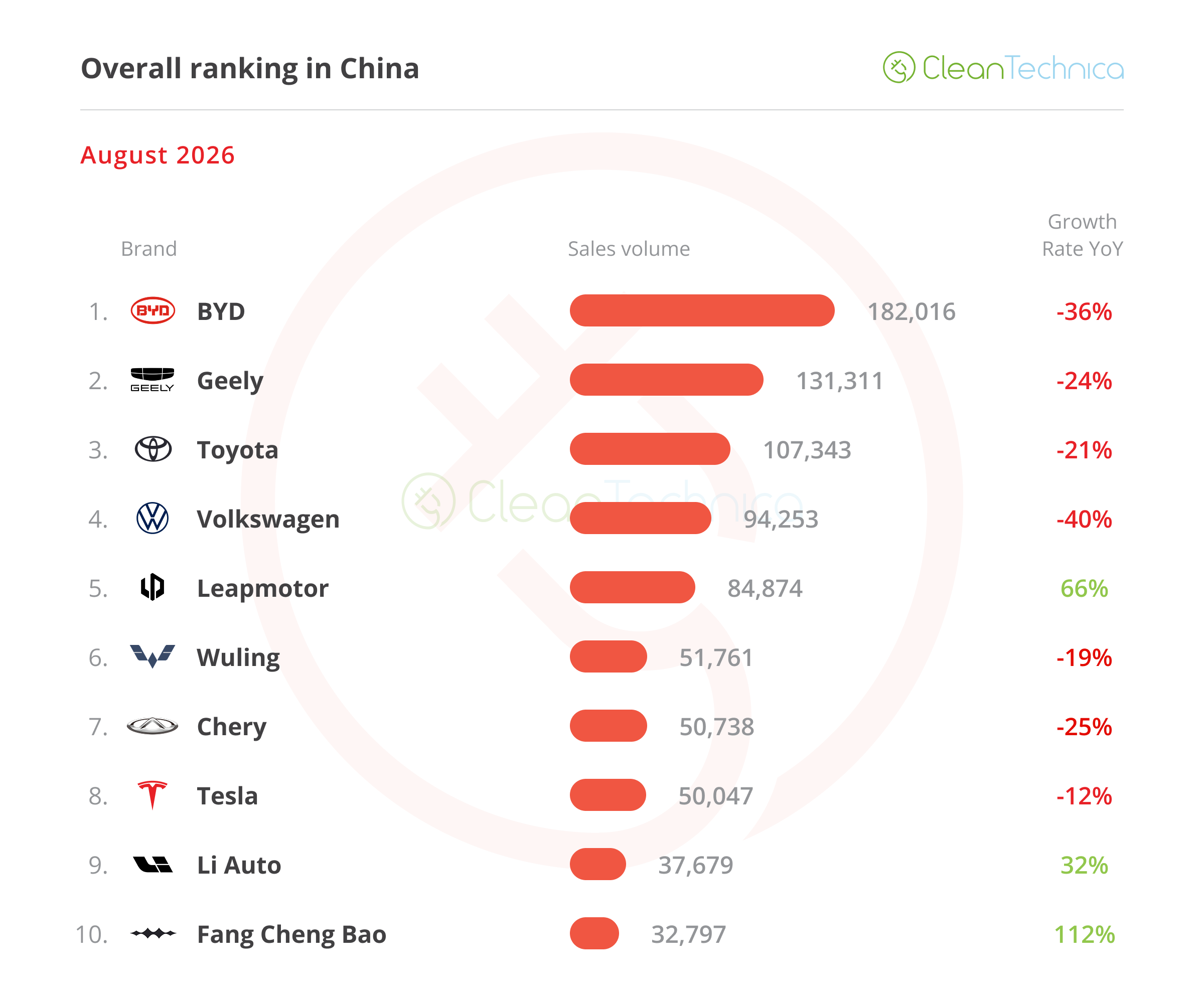
While Toyota managed to limit its sales drop to 21%, other legacy automakers faced catastrophic declines. Volkswagen suffered a staggering 40% crash in August, falling to fourth place in the brand rankings. Japanese automakers were hit even harder, with Honda and Nissan seeing sales plunge 50% and 55% YoY, respectively.
Conversely, domestic startups are thriving. Leapmotor posted an astonishing 66% YoY surge with 84,874 registrations, putting it within striking distance of overtaking Volkswagen. Meanwhile, luxury EV maker NIO jumped 104% YoY to 21,000 units, propelled by the massive success of its ES8 and ES9 flagships, which boast an average selling price of around $65,000 USD.

Official Responses and Industry Sentiment
Industry analysts and automotive executives have increasingly dropped traditional defenses, acknowledging that the transition away from internal combustion is no longer a slow-moving trend, but a rapid displacement.
Market observers note that investing heavily in internal combustion engine research and development (R&D) is now financially unviable. With China’s market tracking toward a greater than 60% NEV share for the full year of 2026—and potentially heading toward full electrification before 2030—automakers that fail to pivot risk complete irrelevance.
Furthermore, Chinese OEMs are looking far beyond domestic borders. By flooding international markets with competitively priced, highly electrified portfolios, local players are accelerating EV adoption across emerging markets in Southeast Asia, Latin America, the Middle East, and Europe. Localized success stories like Vietnam’s VinFast, Turkey’s Togg, and India’s Tata and Mahindra indicate that the global automotive ecosystem is recalibrating around electrification.
Strategic Implications
The August 2026 market data carries profound implications for the global automotive industry:

- The Death of ICE Investments: With China’s domestic market rapidly sidelining gas-powered vehicles, the window to recoup R&D investments in traditional combustion technology has slammed shut. Global legacy OEMs maintaining ICE-heavy lineups abroad face an unsustainable cost disadvantage.
- The Export Tsunami: As domestic growth matures, Chinese automakers are utilizing their manufacturing scale to export nearly a million vehicles a month. Given that over half of these exports are electrified, international markets are absorbing the shockwaves of China’s supply chain efficiency.
- The Rise of New Powerhouses: Startups like Leapmotor are proving that agile, focused product strategies can challenge entrenched automotive conglomerates. As these companies expand into multi-brand strategies and premium segments, the competitive pressure on both legacy foreign brands and domestic giants like BYD and Geely will only intensify.
As China hurtles toward a future where internal combustion engines are relegated to history books, the rest of the world’s automakers must run to catch up with a market that is moving at unprecedented speed.
