

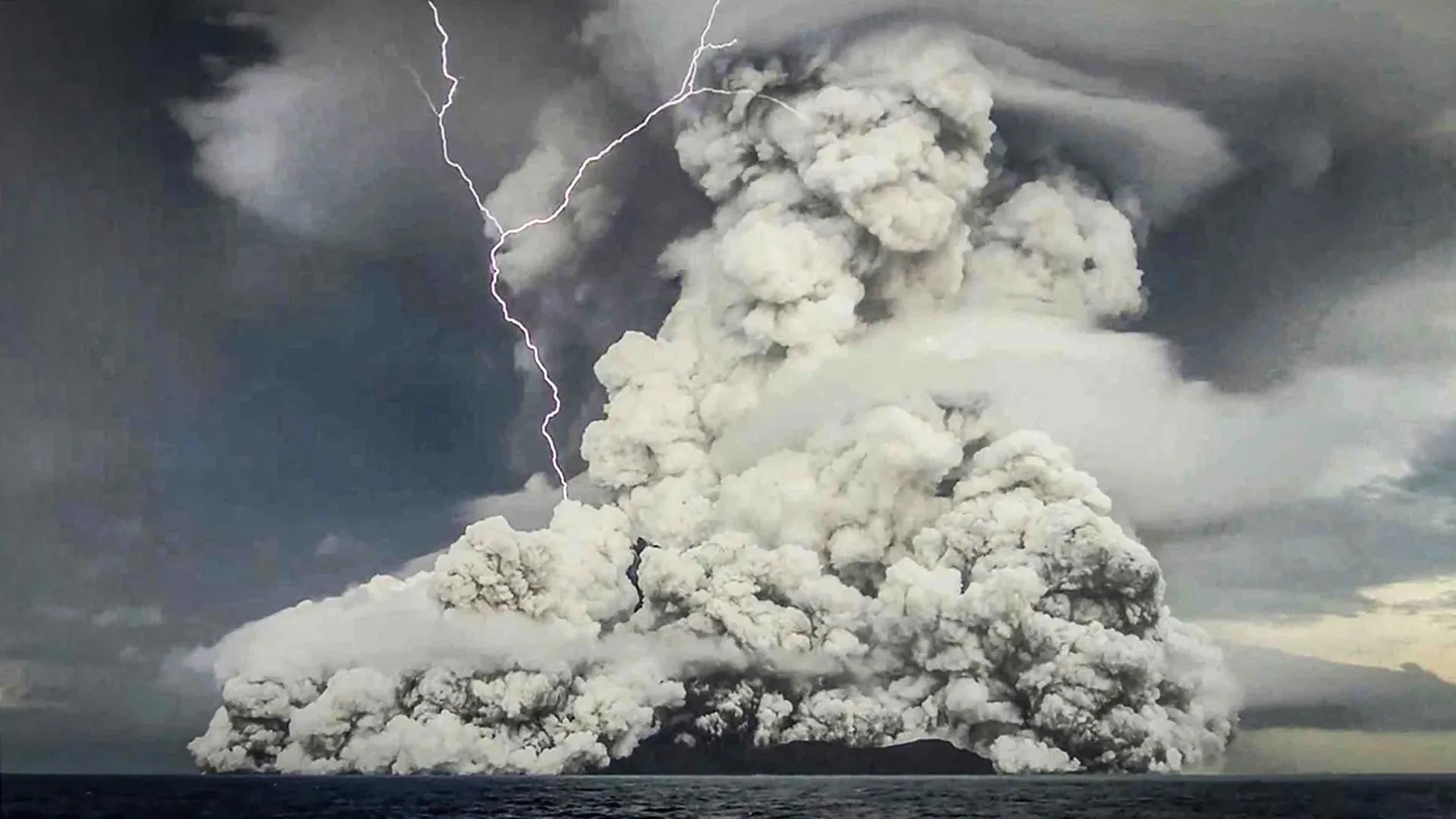
When the Hunga Tonga-Hunga Ha’apai underwater volcano erupted in the South Pacific in January 2022, it sent shockwaves around the globe, triggering tsunamis and blasting an unprecedented amount of water vapor directly into the stratosphere. Months later, as scientists analyzed the atmospheric fallout using advanced satellite technology, they uncovered a surprising silver lining. The colossal volcanic plume did not just inject massive amounts of greenhouse gases and debris into the upper atmosphere; it also catalyzed an unexpected chemical reaction that actively destroyed a portion of the methane pollution the volcano itself had generated.
The discovery, recently published in the journal Nature Communications, offers a rare glimpse into a powerful natural atmospheric cleaning mechanism. By illuminating how volcanic ash, sea salt, and sunlight can interact to break down methane—a greenhouse gas roughly 80 times more potent than carbon dioxide over a 20-year span—the findings could reshape global climate models. Furthermore, the revelation provides scientists with a potential blueprint for engineered atmospheric methane removal, offering a new frontier in the global fight against near-term climate warming.
Main Facts
The 2022 eruption of Hunga Tonga-Hunga Ha’apai stands as one of the most powerful volcanic events of the modern era. Driven by its submarine location, the cataclysmic explosion thrust massive quantities of ocean water and jagged volcanic ash high above the troposphere and deep into the stratosphere.
Within this soaring volcanic plume, researchers detected record-breaking concentrations of formaldehyde. Because formaldehyde is a fleeting chemical byproduct created exclusively during the atmospheric degradation of methane, its prolonged presence served as a smoking gun. Satellite tracking revealed that the cloud continuously destroyed methane for more than 10 weeks as it drifted across the globe toward South America.
Calculations indicate that the eruption initially belched roughly 300 gigagrams (Gg) of methane into the atmosphere—an amount roughly equivalent to the annual emissions of two million cows. However, the unique chemical reactions occurring within the plume simultaneously neutralized roughly 900 megagrams (Mg) of methane per day.
The underlying chemistry hinges on a complex, sunlight-driven reaction involving iron salt aerosols. When sunlight strikes a mixture of volcanic ash and sea salt (the latter carried aloft by the violent submarine explosion), it liberates reactive chlorine atoms. These chlorine atoms aggressively attack and dismantle surrounding methane molecules.
While a similar mechanism involving Saharan dust and sea salt over the Atlantic Ocean was discovered in 2023, observing this phenomenon operating at high altitudes in the stratosphere within a volcanic plume is entirely unprecedented.
Chronology of Discovery
The unravelling of this atmospheric mystery unfolded across multiple stages, bridging ground-breaking fieldwork, satellite observation, and international collaboration:
- January 2022: The Hunga Tonga-Hunga Ha’apai volcano violently erupts beneath the South Pacific, injecting millions of tons of water vapor, sulfur dioxide, ash, and gases into the stratosphere.
- Early 2022: The European Space Agency’s Sentinel-5P satellite, utilizing its TROPOMI (TROPOspheric Monitoring Instrument) payload, begins tracking the sprawling, high-altitude volcanic cloud as it circles the globe.
- Late 2022 to 2023: Researchers notice anomalous, extraordinarily high formaldehyde readings within the plume data. Because TROPOMI is designed primarily for lower-altitude air pollution monitoring, scientists must painstakingly recalibrate the instrument’s sensitivity, accounting for extreme altitude variations and sulfur dioxide interference.
- 2023: Independent research teams identify that Saharan dust mixing with sea salt can generate reactive chlorine under sunlight, laying the groundwork for understanding iron salt aerosol chemistry.
- Mid-to-Late 2024: Synthesizing satellite data and chemical models, the international research team—led by Dr. Maarten van Herpen and Professor Matthew Johnson—realizes that the exact same chlorine-driven chemistry has been operating on a massive scale within the Hunga Tonga stratospheric cloud.
- Publication: The findings are officially peer-reviewed and published in Nature Communications, accompanied by support from organizations like Spark Climate Solutions.
Supporting Data and Metrics
To grasp the significance of the Hunga Tonga event, researchers rely on a framework of precise atmospheric measurements and comparative metrics:
- Methane Potency: Methane is responsible for roughly one-third of current global warming. Over a 20-year timescale, it traps heat with an efficiency roughly 80 times greater than carbon dioxide.
- Atmospheric Lifespan: Unlike carbon dioxide, which can linger in the atmosphere for centuries, methane typically breaks down naturally within roughly a decade, making it a prime target for swift climate intervention.
- Eruption Emissions: The volcano released approximately 300 gigagrams (Gg) of methane—matching the yearly output of over two million cattle.
- Destruction Rate: The plume systematically eradicated roughly 900 megagrams (Mg) of methane per day.
- Tracking Duration: Satellites were able to continuously monitor the formaldehyde signature—and by extension, active methane destruction—for 10 days as the cloud traveled toward South America, with broader chemical effects persisting even longer.
Official Responses and Expert Insights
The international team behind the study emphasizes that these findings bridge a major gap in our understanding of atmospheric chemistry and earth systems science.
Dr. Maarten van Herpen of Acacia Impact Innovation BV, the study’s first author, expressed initial astonishment at the data:
"When we analyzed the satellite images, we were surprised to see a cloud with a record-high concentration of formaldehyde. We were able to track the cloud for 10 days, all the way to South America. Because formaldehyde only exists for a few hours, this showed that the cloud must have been destroying methane continuously for more than a week. It is known that volcanoes emit methane during eruptions, but until now it was not known that volcanic ash is also capable of partially cleaning up this pollution."
Professor Matthew Johnson of the University of Copenhagen highlighted the shock of discovering this mechanism in the stratosphere:
"What is new—and completely surprising—is that the same mechanism appears to occur in a volcanic plume high up in the stratosphere, where the physical conditions are entirely different. We now know that atmospheric dust—for example from a volcanic eruption—impacts the methane budget, meaning the budget of how much methane is added to the atmosphere and how much is removed. Because dust has not previously been taken into account, it is important that we correct the data on which these estimates are based."
Addressing the technical challenges of space-based observation, Dr. Isabelle De Smedt of the Royal Belgian Institute for Space Aeronomy noted:
"Retrieving formaldehyde from TROPOMI in a stratospheric volcanic plume is far outside the instrument’s standard operating conditions—we had to carefully correct the satellite’s sensitivity for the unusual altitude of the signal and account for interference from the high sulfur dioxide concentrations. Getting these corrections right was essential to confirm that what we were seeing was real."
Dr. Jos de Laat of the Royal Netherlands Meteorological Institute, the study’s senior author, pointed out the utility of this discovery for future atmospheric research:
"How do you prove that methane has been removed from the atmosphere? How do you know your method works? It’s very difficult. But here we address that problem by showing that methane breakdown can in fact be observed using satellites."
Global Implications
The implications of the Hunga Tonga discovery stretch across multiple scientific disciplines, touching upon climate modeling, global carbon-methane accounting, and geoengineering research.
1. Rewriting the Global Methane Budget
The global methane budget acts as a financial ledger for the planet, tallying the influx of methane from wetlands, agriculture, fossil fuel extraction, and geological sources against the natural processes that purge it from the air. Historically, atmospheric dust and volcanic ash have been largely overlooked in these calculations. By proving that mineral dust and sea salt aerosols can actively accelerate methane destruction, researchers will be forced to revise global climate models to incorporate these dynamic natural cleaning agents.
2. The "Emergency Brake" on Climate Change
Because methane breaks down within about 10 years, rapidly reducing atmospheric concentrations can yield noticeable climate benefits within a single decade. Scientists often refer to methane mitigation as an "emergency brake" capable of staving off near-term warming and reducing the risk of crossing catastrophic climate tipping points. However, researchers stress that this is not a substitute for cutting carbon dioxide emissions; long-term planetary stability still demands aggressive decarbonization.
3. A Blueprint for Engineered Methane Removal
Perhaps the most forward-looking implication is the potential to mimic nature. As scientists and climate tech companies explore atmospheric methane removal—deliberately accelerating the breakdown of greenhouse gases already present in the air—Hunga Tonga serves as a powerful proof of concept.
While any intentional manipulation of atmospheric chemistry requires rigorous safety and efficacy studies to avoid unintended ecological consequences, the study demonstrates a clear pathway forward. By proving that space-based instruments like Sentinel-5P’s TROPOMI can successfully monitor methane destruction via formaldehyde signatures, science now possesses the observational tool needed to verify whether artificial atmospheric cleanup methods are truly working.
