

By Global Science Correspondent
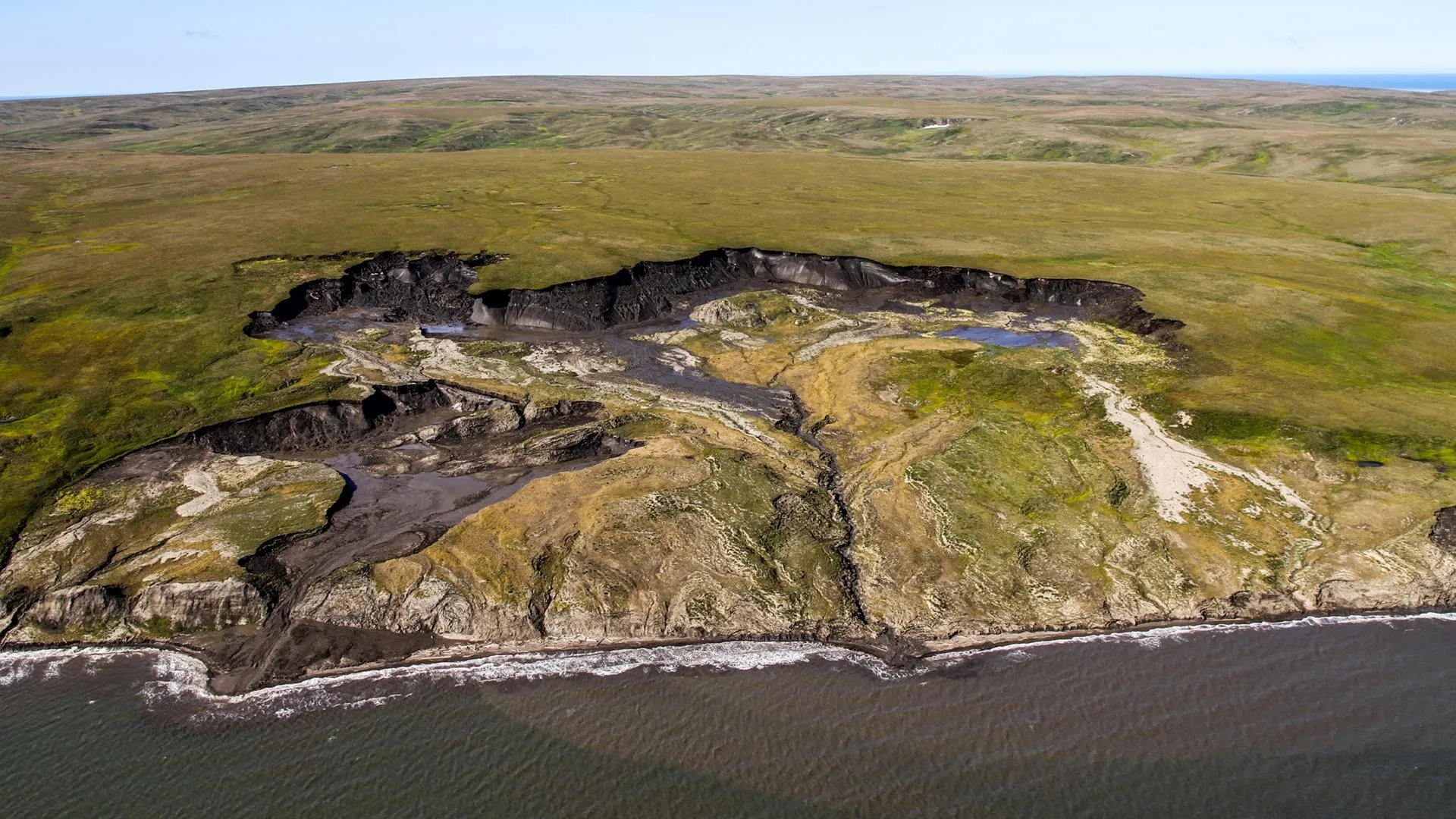
BERLIN/BREMEN — Deep within the frozen expanses of the Arctic, an immense ecological transformation is quietly unfolding. As global temperatures rise at an unprecedented pace, the region’s permafrost—ground that has remained frozen for millennia—is beginning to thaw. With this thaw comes the structural collapse of coastlines and the release of staggering quantities of organic carbon long locked away beneath the tundra.
For years, climatologists have wrestled with a critical, high-stakes question: When this ancient carbon is washed into the Arctic Ocean, what happens to it? Does it cycle back into the atmosphere as potent greenhouse gases, accelerating global warming, or does it become permanently sequestered in marine sediments?
A groundbreaking study published in the journal Nature Geoscience has finally begun to clear this scientific fog. Led by researchers from the Alfred Wegener Institute (AWI) and MARUM – Centre for Marine Environmental Sciences at the University of Bremen, the study reveals that the vast majority of terrestrial carbon washing off thawing permafrost coasts remains safely buried in the seabed rather than venting into the atmosphere. The secret to this unexpected preservation lies in the surprisingly picky appetites of seafloor microorganisms, which turn out to be ecological "gourmets."
Main Facts: Unlocking the Arctic’s Carbon Budget
The newly published research provides unprecedented clarity on the fate of organic carbon released by coastal erosion in the Arctic, focusing heavily on the rapidly changing permafrost shores of Qikiqtaruk (Herschel Island) in Arctic Canada.
At the heart of the issue is the sheer scale of the Arctic’s carbon reserves. Permafrost ecosystems across northern landmasses hold roughly 1,300 gigatonnes of organic carbon, much of it derived from preserved plant remains accumulated over thousands of years. An additional 400 gigatonnes are locked away within ocean sediments and major river deltas.
As the Arctic warms faster than any other region on Earth—a phenomenon known as Arctic amplification—these frozen foundations are destabilizing. Rivers and aggressive coastal erosion are currently flushing up to 0.02 gigatonnes of terrestrial organic carbon into the sea each year. According to climate models, this outflow is projected to surge by an astonishing 70 to 150 percent by the year 2100.
Until now, the critical unknown was the efficiency of the marine carbon pump: How much of that mobilized carbon is mineralized by bacteria and returned to the atmosphere as carbon dioxide or methane, and how much is safely locked away in the seabed?
The AWI and MARUM research team discovered that only about 10 percent of the organic carbon cascading from land into the coastal ocean is broken down by microorganisms and converted into gases that eventually make their way into the water column and the atmosphere. The remaining 90 percent settles on the seafloor, effectively exiting the active global carbon cycle for the foreseeable future.
Chronology of the Discovery: From Fieldwork to Breakthrough
The journey toward these findings represents a multi-year effort of rigorous Arctic fieldwork, laboratory analysis, and geochemical detective work.
Phase 1: Field Sampling off Herschel Island
To reconstruct how carbon moves through the coastal ecosystem, researchers traveled to Qikiqtaruk (Herschel Island) in the Canadian Yukon. Using specialized drilling equipment, the scientific team collected sediment cores from various locations directly off the island’s eroding coastlines. These sediment columns act as historical archives, preserving layers of organic and inorganic material deposited over roughly the last 50 years.
Phase 2: Pore Water and Isotopic Analysis
Back in the laboratories at the Alfred Wegener Institute and MARUM, the team subjected the sediment cores to exhaustive chemical interrogation. They extracted and analyzed pore water—the interstitial fluid trapped in the tiny spaces between sediment particles. By measuring the concentration of dissolved inorganic carbon in this pore water, the scientists could precisely quantify how much carbon dioxide local microorganisms had generated through respiration.
To determine the exact origin of this carbon, the team turned to isotope geochemistry.
Phase 3: Unmasking Microbial Diets with Isotopes
By examining carbon isotopes within the sediment and pore water, the researchers could trace the biochemical pathways of single-celled organisms living deep in the mud.
- The $^13$C Isotope: This carbon marker allowed scientists to differentiate whether the microbes were consuming carbon originating from terrestrial plants or marine sources like algae.
- The $^14$C Isotope: Radiocarbon dating enabled the team to distinguish between "young" carbon (derived from recent marine production) and "old" carbon (thousands of years old, released directly from ancient thawing permafrost).
Phase 4: Publication and Peer Review
Synthesizing these lines of evidence, the research team submitted their findings to Nature Geoscience. Following rigorous peer review, the study was published, instantly altering how geochemists view the vulnerability of land-derived carbon in polar marine environments.
Supporting Data and Geochemical Evidence
The core revelation of the study centers on the metabolic preferences of seafloor bacteria. Scientists initially assumed that when a massive wave of organic material from degraded permafrost washed into the ocean, local microorganisms would indiscriminately consume whatever nutrients were available.
Instead, the data revealed a stark selectivity.
"The sediment is home to ‘gourmet’ bacteria that apparently prefer fresh carbon stemming from, for example, more recent algal remains over the ‘old’ carbon from permafrost deposits," explains Prof. Gesine Mollenhauer, a geochemist at the AWI and co-spokesperson for the ‘The Ocean Floor – Earth’s Unexplored Interface’ Cluster of Excellence.
Because these microbial communities preferentially target fresh, highly reactive marine carbon—such as phytoplankton and algae sinking from the sunlit surface waters—the ancient, structurally complex organic matter from the permafrost is largely bypassed. Left unconsumed, this ancient terrestrial carbon binds with mineral particles, sinks rapidly through the water column, and becomes permanently buried in accumulating seabed sediments.
This preferential feeding behavior dramatically lowers the immediate risk of permafrost-derived carbon accelerating global warming through atmospheric outgassing, at least within the coastal deposition zones studied.
Official Responses and Expert Perspectives
The lead authors of the study emphasize both the reassuring nature of their findings and the critical need for continued caution and investigation.
Dr. Manuel Ruben, lead author of the study from the AWI Helmholtz Centre for Polar and Marine Research, highlights the immediate value of the research for climate science:
"Our study shows, more precisely than ever before, how much carbon is safely stored in the seabed—and just how much of the decomposed material actually originates from the old permafrost," Dr. Ruben notes. "This provides an important foundation for climate models that can predict the consequences of permafrost thawing for the global climate."
At the same time, Dr. Ruben points out the sheer magnitude of the changes underway along Arctic coastlines:
"Although the sea here carries away huge quantities of organic carbon from the coast, surprisingly little of it ends up in the ocean’s active carbon cycle. Microorganisms convert around ten percent of the organic carbon from the sediments into gases, which rise into the water and can then enter our atmosphere."
Prof. Gesine Mollenhauer underscores that while the current findings offer a vital piece of the puzzle, the scientific community must remain vigilant and expand its investigative scope:
"Carbon isotopes represent our atomic indicators that can identify the food source of the microorganisms. The $^13$C isotope, for example, tells us whether they have consumed carbon from land or from the sea. By way of the $^14$C isotope, we were able to determine whether the single-celled organisms preferred old organic carbon from permafrost or fresh organic carbon from algae remains. However, we do need further research here. This is because some of the organic carbon from the permafrost may already have been broken down before it reaches the seabed."
Broader Implications: Ecosystems and Climate Modeling
While the finding that much permafrost carbon remains safely buried in the seabed offers a minor reprieve for global climate projections, the relentless flow of land into the sea carries profound ecological consequences for the Arctic Ocean.
Altering Coastal Light and Marine Food Webs
The massive influx of sediment from eroding shorelines drastically alters the physical properties of coastal waters. Suspended mineral fragments cloud the water column, while dissolved organic carbon darkens it, severely restricting light penetration.
This reduction in light availability directly impacts primary producers—single-celled algae and phytoplankton that rely on sunlight to synthesize biomass and generate oxygen. Because these microscopic primary producers form the foundation of the entire Arctic marine food web, any disruption to their productivity ripples upward, affecting fish populations, marine mammals, and the subsistence livelihoods of indigenous coastal communities.
The Road Ahead: The 2027 ‘Arctic Pulse’ Campaign
To capture the full spectrum of these environmental shifts, polar researchers are already preparing for the massive international ‘Arctic Pulse’ campaign, scheduled for 2027.
This ambitious multi-platform initiative will deploy coordinated observations from the state-of-the-art German research icebreaker Polarstern, specialized AWI research aircraft, and ground-based stations across the Arctic. The overarching goal is to map how rapid, climate-driven changes on land are fundamentally restructuring Arctic marine ecosystems from the seafloor up.
Transforming Global Climate Models
Ultimately, the study by the Alfred Wegener Institute and MARUM provides an indispensable empirical constraint for global climate models. By quantifying the exact percentage of eroded carbon that escapes into the atmosphere versus that which is sequestered in the seabed, climate scientists can refine their predictions regarding the Arctic feedback loop.
As the planet continues to warm and permafrost landscapes experience unprecedented rates of decay, understanding the nuanced behavior of microscopic "gourmet" bacteria in the dark depths of the seafloor has become an essential tool in forecasting Earth’s climatic future.
