

The United States possesses a staggering, largely untapped natural resource: an estimated 1,170 terawatt-hours per year of zero-emission electricity hidden within the ocean waves crashing along the nation’s contiguous coasts, Alaska, Hawaii, and Puerto Rico. This immense potential represents a cornerstone for reliable, round-the-clock baseload renewable energy. Yet, as the domestic energy landscape undergoes significant policy shifts under the Trump administration’s "American Energy Dominance" plan, the path for renewable technologies has been fraught with uncertainty.
While solar and offshore wind projects have faced stringent regulatory roadblocks and skeptical federal oversight, a surprising exception has emerged. Marine energy—specifically wave and tidal power, categorized broadly under the umbrella of hydropower—has not only survived the political chopping block, but is actively accelerating. Driven by key federal approvals, strategic international partnerships, and open-source technological innovations, the US wave energy sector is entering a pivotal new era of commercial readiness.
Main Facts: The Scope and Status of US Wave Energy
Marine energy harnesses the kinetic and potential energy of ocean waves, tides, and ocean currents to generate clean electricity. Unlike wind and solar, which are intermittent and depend on weather patterns or daylight, marine energy offers predictable, continuous generation cycles that can deliver power 24/7.
Despite this immense promise, the sector has historically lagged behind wind and solar due to formidable engineering challenges, high deployment costs, and complex regulatory hurdles. However, recent developments demonstrate a renewed federal and institutional commitment to overcoming these barriers:
- Massive Resource Potential: The US coastal and territorial waters hold an estimated 1,170 terawatt-hours of wave energy potential annually.
- PacWave South Opens: Following more than a decade of planning, permitting, and construction, the PacWave South wave energy test facility off the coast of Oregon is officially open for business.
- Pre-Permitted Advantage: PacWave South bypasses lengthy regulatory delays by utilizing a pre-permitted site with an established Bureau of Ocean Energy Management (BOEM) lease, slashing initial testing costs and timelines for developers.
- Open-Access Innovation: In Hawaii, the National Laboratory of the Rockers (NLR) and the University of Hawaii are leveraging the "SURF-WEC" project to provide open-source data, designs, and remote-control frameworks to the wider marine energy industry.
Chronology: A Timeline of Resilience and Progress
The journey of American marine energy from a niche concept to a federally supported commercial frontier spans several decades, characterized by key milestones of perseverance:
- Early 2000s: The US Navy and Marine Corps pioneer early grid-connected wave energy testing at Kaneohe Bay in O‘ahu, Hawaii, establishing foundational operational data for marine devices.
- 2021: The Department of the Interior’s Bureau of Ocean Energy Management issues an official lease agreement to Oregon State University for the PacWave South project, laying the regulatory groundwork for an open-water test bed.
- Early to Mid-2025: The political landscape shifts sharply with the implementation of the Trump administration’s "American Energy Dominance" plan. While solar and offshore wind face severe political headwinds, non-wind renewables like biomass, hydropower, and geothermal secure a place in the policy framework.
- July 2025: The Trump administration signals unexpected support for marine energy by expanding a longstanding Department of Energy (DOE) energy collaboration with Norway to encompass marine technologies.
- Late 2025: The Bonneville Power Administration signs a formal agreement to integrate power generated from wave devices at PacWave South into the regional grid, proving the commercial viability of the site despite federal policy shifts.
- September 2026: The Department of Energy’s Office of Critical Minerals and Energy Innovation (OCMEI) officially announces that PacWave South is open for testing, marking a monumental milestone for the industry as developers begin deploying inaugural devices. Simultaneously, the NLR highlights five successful months of data collection from the SURF-WEC project in Hawaii.
Supporting Data: Infrastructure and Technological Breakthroughs
The revitalization of US wave energy is built upon a robust foundation of testing infrastructure and collaborative research networks designed to lower the cost of entry for private developers.
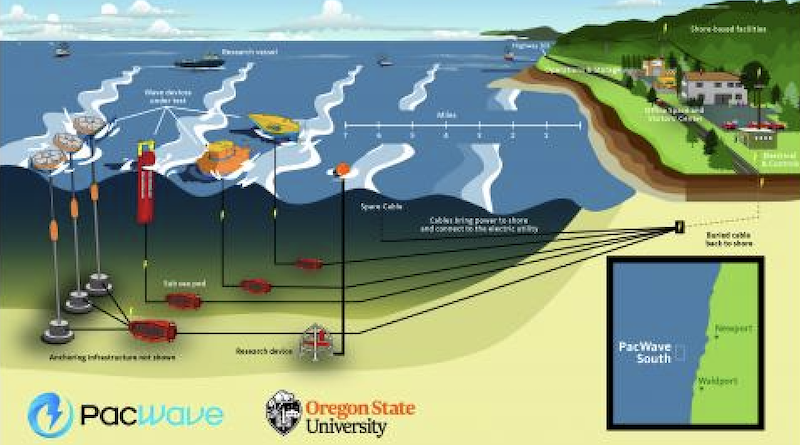
The PacWave South Facility
Located seven miles off the coast of Oregon, PacWave South is a state-of-the-art, grid-connected, open-water test facility. Funded in part by the Department of Energy and operated by Oregon State University, the facility is engineered to accommodate up to 20 distinct wave energy converters spread across four individual test berths.
A primary economic hurdle for wave energy developers has been the prohibitive cost of designing custom mooring and anchoring systems. To address this, PacWave researchers are developing generic, modular mooring solutions. By allowing diverse wave energy devices to hook into a standardized underwater infrastructure, the facility aims to drastically drive down capital expenditures for commercial scale-up.
SURF-WEC and Open-Source Collaboration
While large-scale grid testing advances in Oregon, smaller-scale, agile experimentation is taking place in Hawaii. Over the past five months, researchers from the National Laboratory of the Rockers (NLR) and the University of Hawaii at Manoa have been gathering real-world operational data from the "SURF-WEC" wave energy converter.
Roughly the size of a large-screen television, the SURF-WEC device oscillates dynamically with passing waves, driving a sealed hydraulic system to generate electricity once internal pressure thresholds are met. Crucially, SURF-WEC is equipped with an adaptive control system and an open-source monitoring platform called MODAQ 2.0. This system allows researchers to remotely switch between passive and active operational modes, optimizing energy capture efficiency while sharing live performance data transparently with global marine energy stakeholders.
Official Responses: Perspectives from Government and Industry
Despite political polarization surrounding energy policy, federal leadership has increasingly recognized marine energy as a vital component of a diversified grid.
Nichole Fitzgerald, head of the Department of Energy’s Hydropower and Hydrokinetic Office, emphasized the long-term strategic value of the new infrastructure during the PacWave South opening announcement:

"The PacWave South facility will help reduce testing barriers for wave energy developers and spur innovation to America’s benefit for years to come."
Echoing these sentiments, the Department of Energy’s Office of Critical Minerals and Energy Innovation highlighted the immediate practical benefits of the site’s regulatory status:
"Thanks to its pre-permitted status, PacWave South allows wave energy developers to test devices without regulatory delays that can add to testing budgets and timelines."
Industry analysts note that while the current market maturity of marine energy lags decades behind mature sectors like onshore wind and utility-scale solar, the establishment of risk-reduction facilities provides the exact scaffolding needed to bridge the "valley of death" between prototype design and commercial deployment.
Implications: What the Future Holds for American Wave Energy
The survival and maturation of wave energy initiatives under the current political climate carry profound implications for the future of American clean technology and grid resilience.
- Diversification of Baseload Power: As grid demands soar due to data center expansion, artificial intelligence, and vehicle electrification, reliance solely on intermittent wind and solar presents reliability challenges. Wave energy provides predictable, high-density baseload power that complements existing renewable portfolios, particularly in coastal population centers.
- A Blueprint for Streamlined Permitting: The pre-permitted framework established at PacWave South serves as a valuable case study for future renewable energy infrastructure. By addressing environmental monitoring and regulatory compliance proactively, federal agencies can drastically accelerate deployment timelines without sacrificing environmental stewardship.
- Global Competitiveness: By fostering open-source data sharing—exemplified by initiatives like MODAQ 2.0 and the TEAMER network—the United States is positioning itself as a collaborative global hub for marine hydrokinetic engineering.
While widespread commercialization of wave energy may still take years to fully materialize, the foundational architecture is now firmly in place. By navigating complex political shifts and overcoming formidable engineering barriers, American wave energy has proven resilient—ready to ride the tide toward a diversified, zero-emission energy future.
