

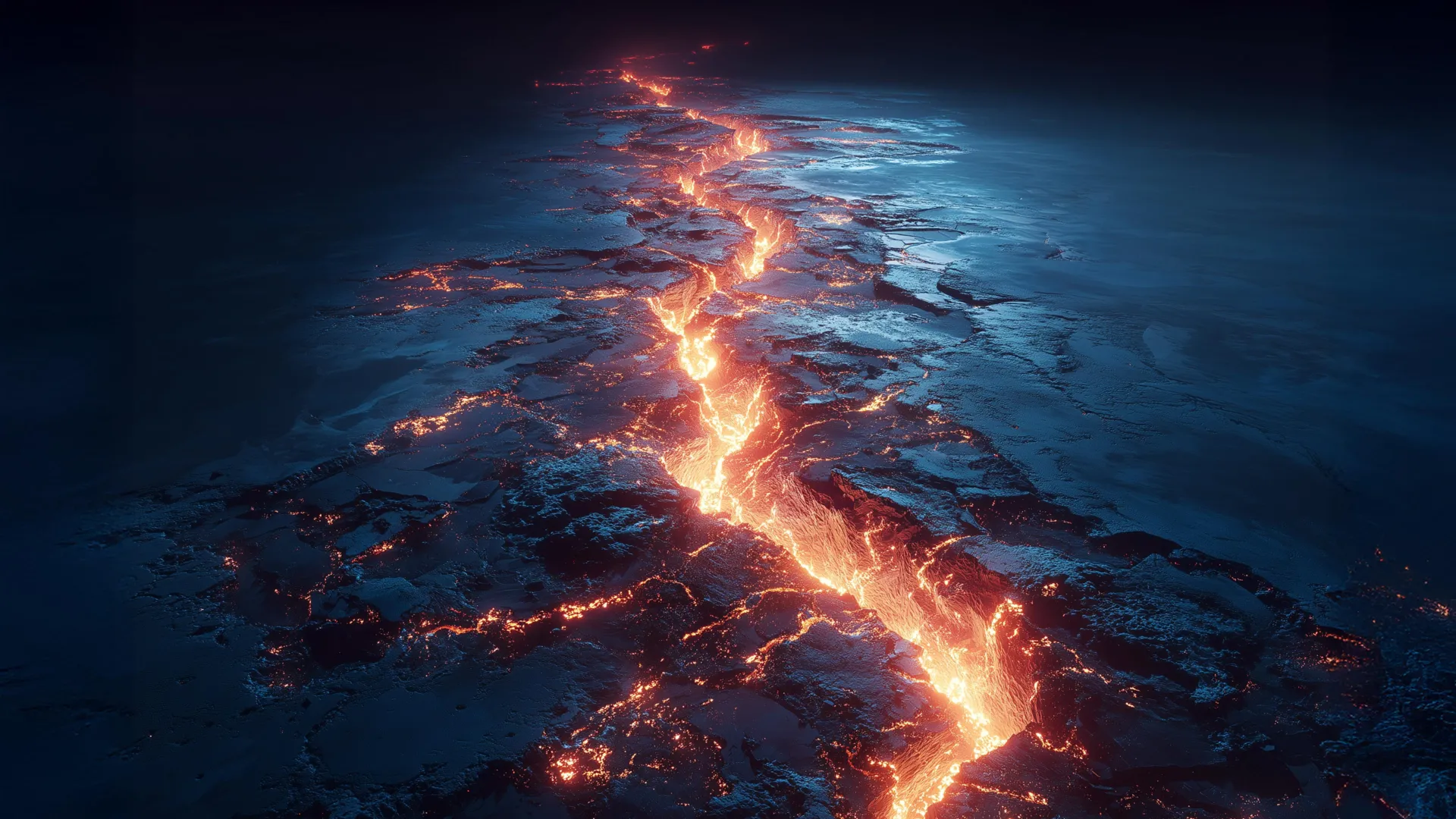
TOKYO — For decades, geologists viewed the formation of Earth’s massive oceanic plateaus as relatively straightforward processes of construction: colossal volumes of molten rock simply surged upward, breaching the seafloor and pouring out across the crust to form thick, towering mountains of basalt. But a groundbreaking new study reveals that history’s most ferocious volcanic outbursts did not merely sit atop the ocean floor—they fundamentally restructured, fractured, and chemically re-engineered the deep tectonic plate lying beneath them.
A multi-institutional team of Japanese researchers has utilized seismic waves to peer deep into the hidden interior beneath the Ontong Java Plateau (OJP) in the western Pacific Ocean. Their findings demonstrate that when an unprecedented volume of magma forced its way toward the surface roughly 120 million years ago, it did not just pass through the existing oceanic plate; it tore through it, weaving complex subterranean networks of vertical pathways and altering the chemical makeup of the surrounding rock on a planetary scale.
The research, led by Lecturer Azusa Shito of the Okayama University of Science—in collaboration with Associate Professor Akira Ishikawa of the Institute of Science Tokyo and Professor Masako Yoshikawa of Hiroshima University—was recently published in the scientific journal Geophysical Research Letters.
Main Facts: Unlocking the Subterranean Architecture of the Ontong Java Plateau
The Ontong Java Plateau stands as the undisputed titan of oceanic plateaus. Sprawling across an area of the western Pacific roughly the size of Alaska, this gargantuan undersea highland was forged during a cataclysmic chapter of submarine volcanism 110 to 120 million years ago. Geologists widely consider this event to be the largest single outpouring of magma in Earth’s recorded history.
However, despite its immense topographic footprint, the internal architecture of the tectonic plate lying directly beneath the OJP had remained largely mysterious. Traditional geophysical models assumed that the oceanic plate beneath such features would retain a relatively simple, uniform layer-cake structure, typical of normal seafloor created at mid-ocean ridges.
The new study shatters that assumption. By analyzing specialized high-frequency seismic waves known as Po and So waves, the research team discovered that the plate beneath the OJP is a complex, composite interior. It features a chaotic web of horizontal laminations intersected by massive swarms of vertical magma conduits, known scientifically as dikes.
Furthermore, the seismic data revealed unusually sluggish wave speeds traveling through the plate. This anomaly indicates that the magma rising from the Earth’s deep interior did not just carve physical channels through the rock; it interacted with the surrounding mantle, chemically transforming it through a process known as "refertilization."
Chronology: A Timeline of Cataclysm and Discovery
To understand the magnitude of the recent findings, geoscientists look back across a timeline spanning over a hundred million years of Earth’s history, alongside the recent technological milestones that made this discovery possible.
- 110–120 Million Years Ago (The Cataclysm): A colossal thermochemical plume—a column of abnormally hot, chemically distinct material originating deep within the Earth’s mantle—ascends toward the surface. It breaches the lithosphere of the ancestral Pacific plate, triggering the largest volcanic event in planetary history. Torrents of basaltic lava flood the seafloor, while extensive underground networks of magma carve through the existing plate, chemically altering its mineral composition.
- The Intervening Eras: The Ontong Java Plateau cools and drifts on its tectonic plate, masking its complex internal plumbing beneath thousands of meters of water and overlying sedimentary layers. For generations, scientists debate the surface-level impacts of the OJP event, linking its massive release of greenhouse gases and thermal energy to ancient oceanic anoxia and mass extinction events.
- Recent Decades (Seismic Network Deployment): Oceanographers and seismologists deploy arrays of ocean-bottom seismometers (OBS) around the OJP, complemented by seismic monitoring stations on isolated Pacific islands. These instruments begin capturing continuous, high-frequency seismic data reverberating through the region.
- Present Day (The Breakthrough): Utilizing advanced seismic waveform modeling, Dr. Azusa Shito, Dr. Akira Ishikawa, Dr. Masako Yoshikawa, and their colleagues process anomalies in Po and So wave propagation. They successfully map the hidden vertical dike swarms and low-velocity chemical alterations beneath the plateau, publishing their paradigm-shifting results in Geophysical Research Letters.
Supporting Data: How Seismic Waves Decode the Earth’s Interior
Probing thousands of meters of water and kilometers of solid rock to image structures hidden deep beneath the ocean floor requires specialized geophysical tools. Because direct drilling into the deep mantle remains technologically impossible, researchers relied on the behavior of natural seismic waves to reconstruct the hidden plumbing of the OJP.
Specifically, the research team focused on Po and So waves—high-frequency seismic signals that propagate horizontally through oceanic lithosphere rather than diving deep into the fluid outer core or bouncing solely through the lower mantle. Under normal geological conditions, Po and So waves are generated when primary (P) and secondary (S) waves scatter repeatedly through the finely layered horizontal structures of a standard oceanic plate. This continuous scattering allows the energy to travel efficiently over distances spanning several thousand kilometers.
However, the waves recorded by ocean-bottom seismometers surrounding the OJP displayed bizarre and unexpected behavior:
- Efficient Po Waves: Po waves managed to propagate through the region relatively unimpeded.
- Dampened So Waves: Simultaneously, So waves weakened and attenuated dramatically.
By running rigorous seismic waveform models, the team realized that this specific combination of wave behavior could only be produced by a very specific type of internal structure: horizontal stratification coupled with dense, vertical interruptions. These vertical interruptions are dike swarms—ancient pathways where molten magma forced its way upward through tectonic fractures and subsequently solidified. The horizontal layers allowed certain waves to pass, while the vertical dikes fractured and disrupted the continuity of others.
Compounding this structural anomaly was the discovery that both Po and So waves traveled at significantly slower speeds beneath the OJP than they do beneath normal, young or aged oceanic plates. Seismic wave velocities are highly sensitive to temperature, rigidity, fracturing, and chemical composition. Because elevated temperatures alone could not account for the extreme drop in wave speed, the researchers deduced that a profound compositional change had taken place within the plate’s rock matrix.
Official Responses and Expert Insights
The implications of the study extend far beyond regional geology, offering new frameworks for understanding how deep mantle plumes interact with Earth’s rigid outer shell.
In discussions surrounding the publication, the research collaborative emphasized the unprecedented nature of the physical transformation captured by their models.
"An oceanic plate is not merely a passive platform that allows magma to transit to the surface; it is an active participant that gets structurally dismantled and chemically rewritten during extreme volcanic events," the research team noted in summary of their work.
The study highlights the critical role of thermochemical plumes—mantle plumes that differ chemically from the surrounding mantle because they may contain recycled materials from ancient oceanic crust that were subducted millions of years prior. When these plumes ascend, the sheer volume and chemical reactivity of the generated melt radically alter the host rock through a process known as refertilization.
To understand refertilization, geologists look at the composition of the upper mantle, which is predominantly made of a rock called peridotite. When partial melting occurs—such as when a mantle plume depressurizes and melts—certain elements and minerals are stripped away, leaving the remaining peridotite depleted. However, when subsequent waves of magma percolate through these depleted zones, they reintroduce those lost chemical components. This secondary infusion fundamentally alters the mineralogy, density, and physical properties of the mantle rock, explaining the sluggish seismic velocities observed beneath the Ontong Java Plateau.
Broader Implications: Rewriting the Textbooks on Mantle Dynamics and Plate Tectonics
The revelation that super-volcanic events can chemically and structurally refashion an entire oceanic plate forces a significant recalibration of how geophysicists model the Earth’s interior.
1. Reassessing Large Igneous Provinces (LIPs)
The Ontong Java Plateau is classified as a Large Igneous Province (LIP). Earth has experienced multiple LIP events throughout its deep geological history, including the Siberian Traps and the Deccan Traps. If the mechanisms uncovered beneath the OJP are universal, it suggests that every major volcanic plateau on Earth is underpinned by a deeply altered, structurally compromised tectonic root. This internal fracturing and refertilization may influence how plates age, subduct, or break apart millions of years after their formation.
2. Environmental and Extinction Linkages
The OJP formation 120 million years ago coincided with significant global climate shifts, oceanic anoxia (widespread oxygen depletion in the oceans), and minor extinction events. Understanding the plumbing system that fed this monster volcanic event provides climatologists and paleontologists with better constraints on the sheer volume of greenhouse gases, sulfur, and thermal energy injected into the Earth-ocean-atmosphere system. When magma interacts so violently and extensively with pre-existing plate materials, the volatile release profiles can be far more complex than simple surface lava flows suggest.
3. Advancing Seismic Imaging Techniques
Methodologically, the success of utilizing Po and So wave attenuation to map vertical dikes opens new doors for geophysical exploration. Scientists can now apply these advanced waveform modeling techniques to other remote, underexplored underwater plateaus—such as the Kerguelen Plateau or the Manihiki Plateau—to search for similar hidden volcanic root systems.
Looking Forward
As researchers continue to unpack the data gathered from the western Pacific, the Ontong Java Plateau stands no longer just as a monument of ancient surface lava flows, but as a window into the violent, transformative underworld of our planet. The study by Shito, Ishikawa, Yoshikawa, and their colleagues proves that when the Earth’s deepest fires break through the crust, they leave an indelible, structurally complex signature written deep within the architecture of the stone itself.
