

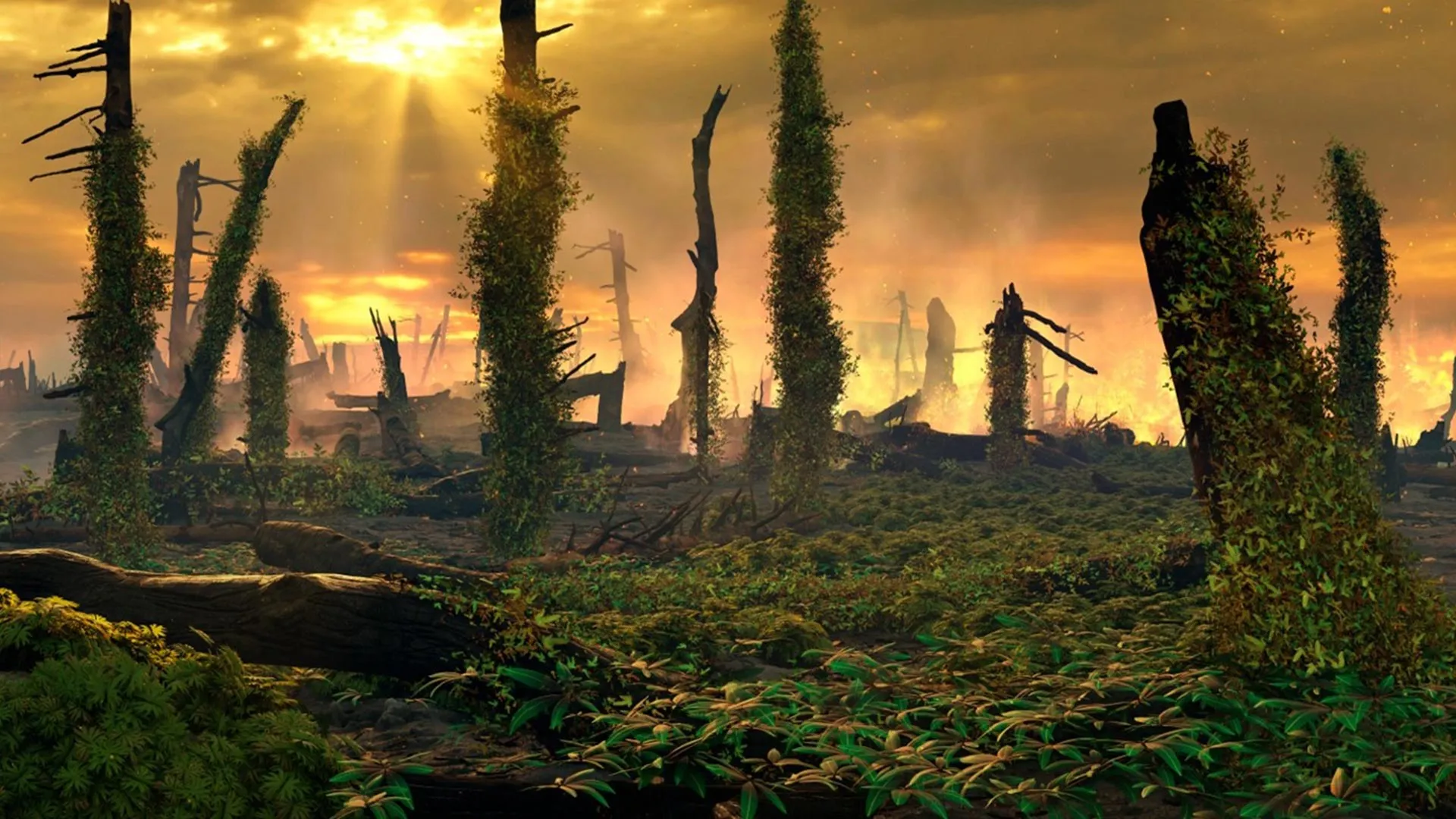
LONDON & UTRECHT — Roughly 201 million years ago, Earth stood on the precipice of one of its most catastrophic evolutionary bottlenecks. The end-Triassic mass extinction wiped out a vast swath of marine and terrestrial species, fundamentally reshaping the trajectory of life on our planet. While scientists have long known that massive volcanic eruptions tied to the fragmentation of the supercontinent Pangea triggered this global crisis, a new study reveals a terrifying, self-sustaining feedback loop that exacerbated the disaster: a relentless cycle of wildfires fueled by opportunistic disaster flora.
Published on July 21, 2026, in the prestigious journal Nature Geoscience, groundbreaking research led by an international team of geologists at Utrecht University offers unprecedented insight into this prehistoric inferno. By examining deep geological cores across Northwest Europe and employing a novel analytical technique, the research team has mapped out a "hellish world" where ancient ferns did not merely survive the apocalypse—they helped fuel it.
Main Facts: Unraveling a Prehistoric Inferno
The end-Triassic extinction event was initially kicked off by the Central Atlantic Magmatic Province (CAMP), a colossal system of volcanic activity that belched staggering quantities of carbon dioxide into the atmosphere over a geologically brief period. This massive injection of greenhouse gases drove global temperatures up by an estimated 5 to 10 degrees Celsius, completely destabilizing ancient ecosystems.
As the planet rapidly heated, complex forest ecosystems dominated by towering trees collapsed under the physiological stress of heat and shifting precipitation patterns. Into this ecological vacuum stepped ferns. These resilient, opportunistic plants rapidly colonized the wounded landscapes, spreading across broad swaths of what is now Northwest Europe and giving rise to expansive, savannah-like environments.
However, the new Utrecht University-led study demonstrates that these newly established fern-dominated landscapes were intensely vulnerable to ignition. Rather than acting as passive victims of climate change, the ferns themselves provided the continuous, highly combustible fuel that drove wave after wave of massive wildfires.
The primary takeaways of the new research include:
- The Feedback Loop: Deforestation and climate warming cleared the way for ferns; these ferns then acted as dry fuel, driving recurrent wildfires that hindered tree recovery and perpetuated the barren, fire-prone landscape.
- Innovative Methodology: Researchers utilized the newly minted "Palynomorph Darkness Index" (PDI)—a low-cost technique measuring the RGB color spectrum of fossilized pollen and spores—to accurately track ancient fire activity across four independent geological basins.
- Extended Duration: The ferocious fire interval and associated fern spike lasted anywhere from 40,000 to as long as 300,000 years.
Chronology of a Crisis: From Pangea’s Breakup to the "Dark Zone"
To understand how this prehistoric landscape devolved into a recurring inferno, scientists have had to reconstruct a timeline spanning hundreds of thousands of years, tracking the shifting environmental phases preserved in stone.
Phase 1: The Volcanic Trigger (approx. 201 Million Years Ago)
The timeline begins with the initial rifting of Pangea. As the supercontinent began to tear apart, colossal fissure eruptions associated with CAMP released gigatons of CO2 into the atmosphere. The ensuing greenhouse effect spiked global temperatures, destabilizing regional climates and triggering a wave of primary extinctions among long-established flora and fauna.
Phase 2: Forest Collapse and the Fern Spike
As temperatures soared and soils eroded, complex canopy forests—unable to adapt quickly enough to the sudden heat and environmental stress—collapsed. This ecological vacuum was swiftly dominated by ferns. Because many fern species possess deep, protected root systems beneath the soil surface, they could endure the initial trauma of environmental collapse and outpace other plants in recolonizing the devastated terrain. This transition marked the beginning of the "fern spike."
Phase 3: The Incubation of the "Dark Zone"
During the main extinction interval, sedimentary layers across Northwest Europe began recording an anomalous geological signature. Utilizing four distinct drill cores—including a newly recovered, 640-meter-long core from the United Kingdom—the research team analyzed 15,000 individual pollen and spore fossils.
Ordinarily, organic microfossils darken over time as they are buried deeper underground, subjected to increasing geothermal heat and pressure. However, the researchers discovered a striking anomaly: the oldest, deepest fossils remained lightly colored, while fossils originating specifically from the extinction interval were darkened to an extreme degree. Once the extinction interval ended, the microfossils abruptly returned to their normal pale yellow hue.
Because this dramatic darkening occurred simultaneously across four different geological basins with distinct burial histories, burial depth could not be the cause. Instead, the researchers realized they had uncovered a widespread signal of extreme, prolonged heating from surface wildfires—a geological "Dark Zone."
Supporting Data: Overcoming Limitations in Deep-Time Research
Reconstructing ancient wildfire regimes is notoriously difficult. Historically, scientists have relied on two primary proxies: fossil charcoal fragments and polycyclic aromatic hydrocarbons (PAHs)—organic compounds produced specifically by the incomplete combustion of organic matter that settle into sedimentary layers.
While valuable, both traditional methods carry significant limitations. Large chunks of charcoal can easily fracture into myriad smaller pieces during fossilization or extraction, artificially inflating estimates of past fire magnitude. Meanwhile, PAHs are volatile and mobile; they can travel great distances on atmospheric currents before being deposited, meaning a PAH signature in a lakebed core might originate from a fire hundreds or thousands of miles away. Furthermore, not all PAH molecules survive the millions of years it takes for sediments to lithify into rock.
To bypass these hurdles, Dr. Bas van de Schootbrugge and his colleagues engineered a clever, cost-effective alternative: the Palynomorph Darkness Index.
+-----------------------------------------------------------------+
|               PALYNOMORPH DARKNESS INDEX (PDI)                  |
+-----------------------------------------------------------------+
|  1. Capture microfossil images via light microscope & camera    |
|  2. Convert RGB color spectrum into average gray scale values   |
|  3. Quantify carbonization intensity caused by surface heat     |
|  4. Cross-reference with charcoal and PAH abundance markers     |
+-----------------------------------------------------------------+
By quantifying the exact shade of fossil pollen and spores using digital imaging and gray-scale conversion, the team could precisely measure the degree of thermal alteration caused by proximity to surface fires. When the team cross-referenced their 15,000 PDI measurements with historical charcoal accumulation rates and PAH levels, the data aligned perfectly. The mysterious "Dark Zone" in fossil coloring overlapped precisely with the peak fern abundance and the highest concentrations of combustion markers.
Official Responses and Expert Insights
The study’s findings have sent ripples through the paleontology and paleoclimatology communities, offering a sophisticated look at how minor ecological shifts can cascade into planetary-scale catastrophes.
Dr. Bas van de Schootbrugge, a senior author of the paper from Utrecht University, emphasizes the unique biological resilience of ferns and their dual role as both victims and perpetrators of the crisis.
"Ferns are truly remarkable plants that have withstood many crises throughout Earth history, and some species can adapt to some of the most extreme environments," Van de Schootbrugge notes. "They can be considered to be true disaster species."
Rather than fading away as the climate warmed, these resilient plants exploited the devastation. However, this evolutionary triumph came with a catastrophic ecological catch.
"When the ferns dry out, the thick mats act as the ideal fuel to trigger massive wildfires," Van de Schootbrugge explains. Once established, these fast-spreading pioneer plants formed extensive fern savannahs. Because of their dense growth habits, certain species functioned effectively as ecological "fire ladders," helping surface flames sweep rapidly across landscapes while actively choking out any lingering attempts by competing flora to re-establish themselves.
"Ferns responded to and delivered the fuel that fanned the flames, triggering repeated massive wildfires," Van de Schootbrugge adds, summarizing the epoch. "A truly hellish world."
Implications: Lessons from Deep Time for a Modern Planet
While the end-Triassic extinction occurred 201 million years ago, the mechanics of the disaster hold profound, sobering implications for the modern Earth system.
The prehistoric event demonstrates how multiple environmental stressors can lock into a destructive, self-amplifying feedback loop. In the case of the Triassic-Jurassic transition, the sequence unfolded as follows:
- Initial Forcing: Massive volcanic carbon emissions drove rapid greenhouse warming.
- Habitat Destruction: Extreme heat and disrupted weather patterns caused widespread deforestation.
- Opportunistic Takeover: Resilient pioneer species (ferns) rapidly invaded the cleared landscapes.
- Amplification: The new vegetation dried out seasonally, providing continuous fuel for recurrent, hyper-intense wildfires that prevented long-term ecological recovery.
This ancient chain reaction underscores a vital lesson regarding modern global change. As contemporary ecosystems face mounting pressures from human-driven climate change, widespread deforestation, and habitat fragmentation, the risk of unleashing opportunistic, fire-prone vegetative regimes grows significantly.
"The lesson we can learn from this, is that the combination of climate change, deforestation, and the spread of opportunistic species can provide all the ingredients for a perfect storm," Van de Schootbrugge concludes.
As modern scientists continue to refine techniques like the Palynomorph Darkness Index, deep-time archives are increasingly proving that Earth’s history is not just a sequence of isolated catastrophes, but an interconnected tapestry of cause, effect, and feedback—reminding humanity of the delicate, sometimes explosive balances that govern life on our changing planet.
