

The American West has long been romanticized through a traditional lens. For generations, the visual vocabulary of the region was defined by the dust-choked realism of Frederic Remington, the dramatic vistas of Albert Bierstadt, and the rugged, unvarnished cowboy ethos immortalized by Western pulp illustration. These works captured a rapidly disappearing frontier, freezing it in amber for eastern audiences and generations to come.
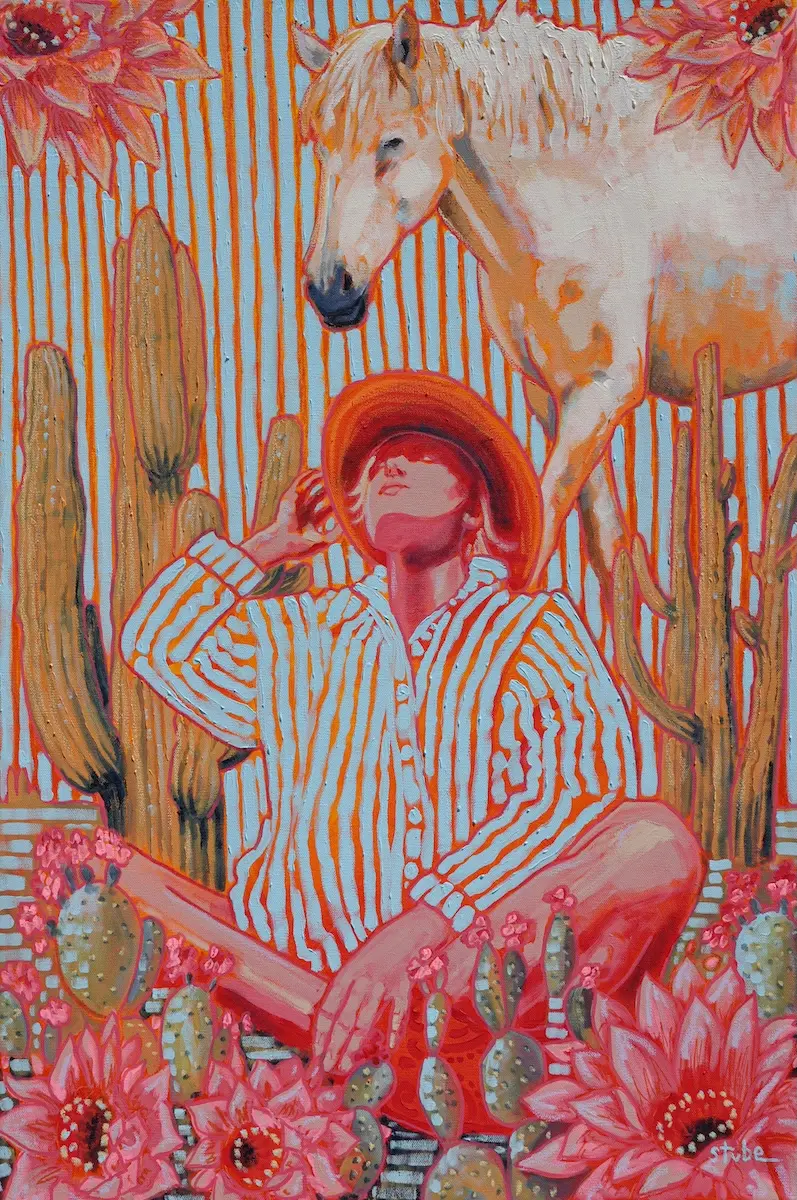
Enter Maren Stubenvoll. At just 28 years old, this Montana-based painter is gleefully shattering those sepia-toned traditions, replacing them with a vibrant, acid-bright, and psychologically complex universe. Stubenvoll’s work places cowgirls and Rocky Mountain fauna against sweeping, surrealist landscapes that distort perspective and scale. Her canvases—rendered in rich layers of acrylic and oil pastel—are at once deeply rooted in the geography of the American West and entirely untethered from reality.
Featured in the prestigious "21 Under 31 | Young Artists to Watch, 2026" roundup from the August/September issue of Southwest Art, Stubenvoll represents a new vanguard. She is part of a generation of young creators who respect the history of the Western genre while aggressively pushing its boundaries into uncharted, imaginative territory.
Her journey from a curious, art-obsessed child in the Pacific Northwest and the Mountain West to a rising star represented by Bozeman’s LeeAnn Ramsy Art Gallery is a testament to perseverance, digital-age resourcefulness, and a profound, living connection to the landscape she calls home.
Chronology: The Evolution of an Unconventional Artist
To understand Maren Stubenvoll’s idiosyncratic visual style is to understand an artistic path that largely bypassed the traditional ivory towers of fine art academia in favor of an independent, self-directed apprenticeship with the world.
Early Beginnings and the Self-Taught Foundation
Art was never just a passing interest for Stubenvoll; it was her native language from her earliest days. Growing up, art was consistently her favorite subject in school. While many children drift away from creative pursuits as academic pressures mount, Stubenvoll leaned in. However, her foundational education was not forged in the rigid ateliers of classical academies.
Instead, she became a lifelong, mostly self-taught practitioner. She spent her formative years engaging in relentless observation and hands-on practice. When gaps in her technical knowledge arose, she didn’t wait for a professor to hand down wisdom—she turned to the democratization of knowledge found on the internet. "A good dose of YouTube" became part of her curriculum, proving that the modern master need not rely solely on institutional gatekeepers.
The Brief Academic Detour
Stubenvoll did not entirely eschew formal education. She enrolled for a single year at an art school in Oregon, dipping her toes into the institutional art world. Yet, she quickly realized that the structured, often dogmatic environment of a multi-year degree program was not the vehicle she needed to build her unique voice. Rather than conforming to contemporary academic trends—which often lean away from representational and narrative painting—she left the program to forge her own path. She returned to the rugged independence of the Mountain West, trusting her own instincts, her sketchbook, and the vast landscapes outside her window to guide her brush.
Finding Her Footing in Bozeman
Relocating to Montana provided Stubenvoll with the geographical and cultural anchor her work needed. Bozeman, a burgeoning hub for contemporary Western art, offered a supportive community of galleries, collectors, and fellow creatives. It was here that her career began to gain serious traction.
Through hard work, distinctive branding, and a fearless approach to mixing mediums—primarily balancing the flat, opaque vibrancy of acrylics with the buttery, expressive marks of oil pastels—she began building a dedicated following. Today, her work is officially represented by the LeeAnn Ramsy Art Gallery in Bozeman, marking her transition from a promising local talent to an artist with a national profile. Her price range—spanning from $250 for smaller studies up to $10,000 for major statement pieces—reflects a healthy, growing demand among savvy contemporary art collectors.
Supporting Data and Artistic Profile
To appreciate the physical and conceptual makeup of Stubenvoll’s practice, one must look closely at her materials, inspirations, and the philosophical framework that drives her daily studio routine.
Style, Technique, and Inspirations
Stubenvoll’s signature aesthetic is an unexpected, highly effective mashup of three distinct art movements: impressionism, surrealism, and decorative pattern work.
Her subjects are typically singular—often a solitary cowgirl, a horse, or native wildlife—isolated against vast, dreamlike backdrops. To create these worlds, she deliberately skews perspectives and plays with scale. A cowgirl might loom large over a stylized mountain range, or an animal might be rendered in colors that defy nature, transforming a routine pastoral scene into an otherworldly psychodrama.
- Medium: Acrylic and oil pastel on canvas. This combination allows Stubenvoll to lay down fast-drying, flat, vibrant fields of color with acrylics, and then return with oil pastels to add rich, tactile textures, expressive lines, and luminous highlights.
- Dimensions: Her works vary, but pieces like her striking 36" x 24" canvas I Can and I Must Still Grow demonstrate her mastery of vertical compositions that draw the viewer’s eye upward, mirroring the verticality of the Rocky Mountains.
- Pricing Structure: Works are accessible across a broad collector spectrum, priced between $250 and $10,000, accommodating both first-time buyers and seasoned collectors looking to invest in museum-quality regional art.
The Studio Environment and Sonic Influence
Every artist relies on external triggers to enter a state of flow, and for Stubenvoll, that trigger is auditory. She notes that she will "forever be entranced by anything Bon Iver creates."

The connection between Justin Vernon’s indie-folk experimentalism and Stubenvoll’s paintings is remarkably clear: both artists take traditional, localized idioms (Americana/folk music and Western art, respectively) and fracture them through layers of modern abstraction, texture, and emotional depth. Just as Bon Iver layers falsetto vocals with distorted horns and ambient field recordings, Stubenvoll layers figurative Western archetypes with surreal color palettes and intricate pattern work. The poetry in the lyrics mirrors the poetic isolation of her singular subjects.
Influences and Coveted Collections
Great artists are always avid consumers of art. When asked about her favorite work by another contemporary artist, Stubenvoll points to a piece hanging in her own home, purchased from a local market in Bozeman. Created by artist Shan Graf, the painting depicts a young girl in a bright orange sweater staring into a mirror that sits just off the canvas, captured in the act of cutting her own white hair short. The psychological intensity and narrative mystery of Graf’s work resonate strongly with Stubenvoll’s own exploration of identity and interiority within her subjects.
Official Responses and Creative Philosophy
Stubenvoll’s artistic ethos is shaped by a rare blend of humility, relentless drive, and a profound integration of her creative output with her physical life outside the studio.
Overcoming Perfectionism: The "Bad Art" Rule
For emerging artists, the pressure to produce a masterpiece with every stroke can be paralyzing. Stubenvoll has developed a pragmatic, psychologically sound antidote to this creative block. When asked about the best art advice she has ever received, she points to the liberating truth that the best way to make great art is to make a lot of bad art first.
"Let go of the brakes, get out of your head and simply create constantly, and the good and even great art will emerge," Stubenvoll advises.
This philosophy explains her prolific output and the fearless experimentation seen in her canvases. By giving herself permission to fail on the canvas, she eliminates the fear that stifles innovation, allowing surrealist impulses and bold color choices to flow naturally.
The Inseparable Bond Between Art and Adventure
For many artists, the studio is an airtight sanctuary away from the world. For Stubenvoll, the studio and the wilderness are part of a continuous loop. Her passions for trail running, mountain biking, and photographing the Montana landscape are not mere hobbies pursued in her spare time; they are vital components of her creative R&D.
"My passion for my art and for adventuring in the landscape around me truly feels inseparable—two different creative expressions drawn from the same well of inspiration," she explains. The physical exertion of tearing through a mountain trail, the shifting light on an alpine ridge, and the visceral feel of the earth underfoot directly inform the mood, energy, and chromatic intensity of her paintings.
Implications: Securing a Legacy in the New West
As the contemporary art market increasingly values authenticity, regional specificity, and genre-defying hybridity, artists like Maren Stubenvoll are carving out a formidable space for themselves. What does her rise mean for the broader ecosystem of Western art, and what are her long-term aspirations?
Shifting the Demographics of the Western Canon
Historically, the Western art market has skewed older—both in terms of its creators and its primary collectors. By recognizing talents like Stubenvoll in their "21 Under 31" feature, publications like Southwest Art are signaling a generational shift. Younger buyers are looking for art that speaks to their contemporary sensibilities while honoring their geographic heritage. Stubenvoll’s work bridges the gap between traditional Western nostalgia and modern surrealism, making it appealing to millennials and Gen Z collectors who want to see their complex, multifaceted relationship with the outdoors reflected on their walls.
The Ultimate Artistic Goal: The Family Heirloom
While commercial success and gallery representation are vital milestones, Stubenvoll’s ultimate ambitions transcend monetary valuation or art-world accolades. When asked about her long-term goals, her focus shifts to intimacy and longevity.
"My goal for my art is to continue to create original work that people adore and put into their homes to become family heirlooms," she says. "When I’m long gone, I hope that someone’s great-great-granddaughter sees one of my pieces and feels the same joy I felt when I created it decades before."
In an era defined by fast-paced digital consumption, ephemeral social media content, and hyper-trendy art movements that flare up and burn out overnight, Stubenvoll’s ambition is refreshingly classic. She is crafting physical objects of enduring beauty—objects designed to weather the decades, hang in family living rooms across generations, and tell a vibrant, surreal story about what it means to live, breathe, and create in the American West today.
For more information on Maren Stubenvoll’s available works, print releases, and upcoming gallery showings, visit her official website at stubecreative.com or contact the LeeAnn Ramsy Art Gallery in Bozeman, Montana.
