

Published: August 27, 2026
From the Yoga Journal Archives: Originally published in the May–June 2002 issue.
Main Facts
In the modern yoga studio, the physical practice often serves as a mirror—not just of our physical alignment, but of our mental habits. When practitioners observe others in a shared class, a cascade of psychological reactions can occur. Inspiration, mentorship, and shared energy are common positive outcomes. However, practitioners frequently fall into the subtle trap of comparison. Noticing that one peer is stronger, another balances with effortless grace, and a third possesses seemingly impossible flexibility is a natural human tendency. Unfortunately, these observations routinely birth self-doubt, unwarranted pride, fierce competitiveness, and envy.
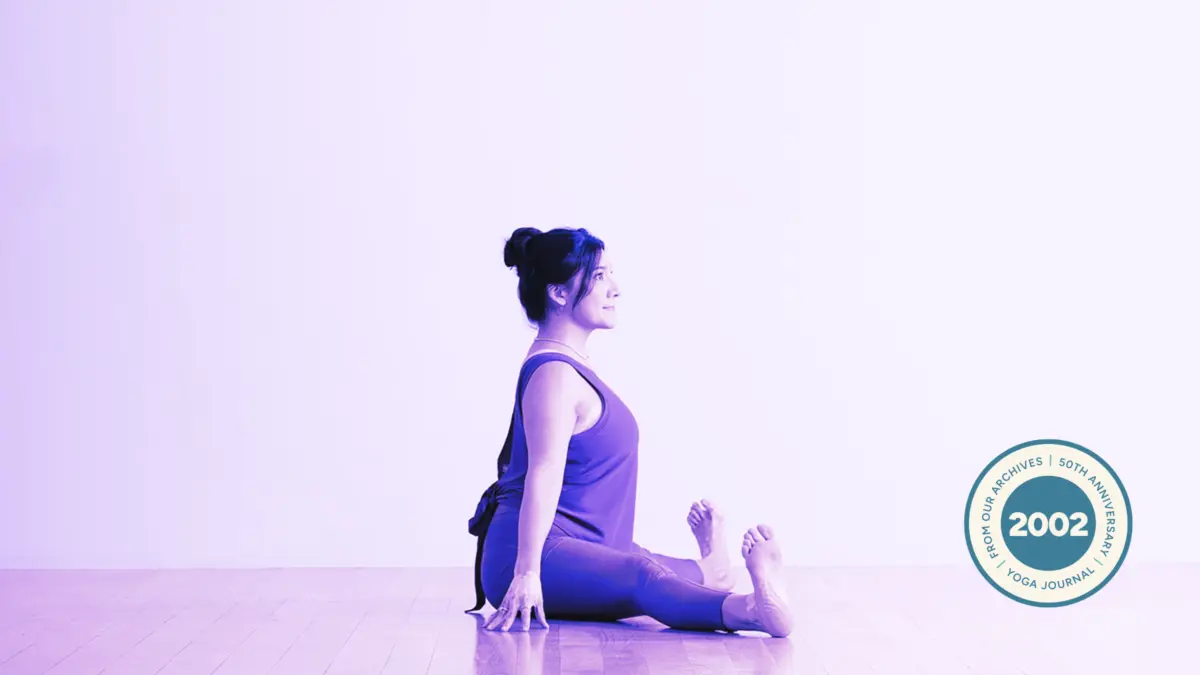
This internal dialogue often intensifies during specific postures, most notably Upavistha Konasana (Wide-Angled Seated Forward Bend). Unlike prone or supine poses that require an internal focus, or standing balances that demand rigorous gaze discipline (drishti), Upavistha Konasana positions the practitioner upright with an unobstructed view of the room. Sitting in a wide-legged V-shape naturally exposes practitioners to the varying levels of flexibility within a group, making it a fertile ground for judgment, frustration, and a compromised sense of self-worth.
To counter these psychological hurdles, ancient yogic philosophy offers the principle of samtosha—the second niyama (ethical observance) outlined in Patanjali’s Yoga Sutras, translating directly to "contentment." Cultivating samtosha requires a fundamental shift in perspective: recognizing that every student arrives on the mat with a unique blueprint of gifts and challenges. Coupled with the modern wisdom of Buddhist teacher Pema Chödrön, who famously urges students to "start where you are," the practice of Upavistha Konasana transforms from a performance-based test of flexibility into an exercise in radical self-acceptance, surrender, and emotional release.
Chronology
The wisdom surrounding Upavistha Konasana and the psychological pitfalls of the yoga mat has evolved over decades of pedagogical refinement.
- Pre-2002 (Foundational Era): Traditional hatha yoga lineages utilized wide-legged seated postures primarily for opening the pelvic basin, stimulating the reproductive organs, and preparing the subtle body for meditation. However, instruction often focused strictly on physical alignment, occasionally leading practitioners to push past their anatomical limits in pursuit of a "perfect" flat-to-the-floor forward fold.
- May–June 2002 (Archival Publication): Yoga Journal published a definitive guide on Upavistha Konasana, bridging the gap between biomechanical instruction and psychological mindfulness. This piece formally highlighted how architectural poses like the wide-angled seated forward bend trigger social comparison and introduced the integration of samtosha as a direct antidote to mat-side judgment.
- Present Day (2026 and Beyond): Contemporary yoga pedagogy heavily emphasizes trauma-informed teaching, functional movement over aesthetic perfection, and prop-supported restorative variations. The insights from the 2002 archives remain remarkably prescient, serving as a foundational reminder in teacher trainings worldwide that the internal landscape of a pose supersedes its external geometry.
Supporting Data & Anatomical Insights
Understanding the mechanics and energetic anatomy of Upavistha Konasana illuminates why it evokes such profound physical and emotional responses.
The Energetic Blueprint: The Second Chakra
Upavistha Konasana directly targets the anatomical and energetic region of the second chakra, known in Sanskrit as Svadhisthana (meaning "own base center"). Located in the sacrum, hips, reproductive organs, and groins, this energy center is governed by the element of water.
- The Water Element: Water teaches humanity to "go with the flow," emphasizing adaptability, fluidity, and emotional receptivity.
- Surrender Over Resistance: When practicing Upavistha Konasana, the body mirrors the qualities of water. Instead of aggressively fighting tight hamstrings or a resisting mind, practitioners are encouraged to soften into the present moment, trusting natural physiological unfoldment with each exhalation.
Anatomical Breakdown and Phased Progression
Because the posture engages the deep adductors, hamstrings, and lower back, a structured approach is vital to prevent injury and foster safety.
- The Inverted Introduction (Legs Up the Wall):
- Method: Sitting with one shoulder against a wall, a practitioner rolls onto their back and swings their legs up the vertical surface, opening into a V-shape.
- Benefits: Gravity assists the stretch while the back muscles remain entirely protected and relaxed on the floor. It allows safe access to hamstring and groin opening without the downward load of the spine.
- Seated Alignment in the Center of the Room:
- Method: Sitting on the edge of a folded blanket to elevate the pelvis, the practitioner establishes the natural inward curve (lordosis) of the lumbar spine. Legs extend in a wide V-shape with kneecaps and toes pointing strictly toward the ceiling.
- Biomechanics: Lengthening through the inner groins, inner knees, and inner ankles creates structural integrity. Engaging the back of the heels stretches the Achilles tendons while keeping the spine light and upright.
- The Hinged Forward Fold:
- Method: Only after mastering the upright seat, practitioners hinge forward from the hip creases rather than rounding the thoracic or lumbar spine.
- Safety Indicator: If the lower back rounds backward during the descent, the body is signaling that the forward bend is premature.
Official Perspectives & Pedagogical Responses
Senior yoga instructors, somatic therapists, and mindfulness experts consistently advocate for a paradigm shift in how wide-angled postures are taught and received in group settings.
- On Eliminating Comparison: Master instructors note that the moment a student’s eyes wander across a classroom to measure their flexibility against a neighbor, they abandon their internal dialogue. Pediatric and adult somatic educators recommend closing the eyes during the initial stages of Upavistha Konasana. By shutting out visual stimuli, practitioners instantly redirect their awareness inward, tuning into the rhythm of the breath and the subtle release of tension in the jaw, shoulders, and lower back.
- On Prop Utilization as Inclusion: Modern alignment philosophy firmly rejects the notion that props are "cheats." Using blankets to elevate the pelvis, rolled washcloths behind the knees to soften joint pressure, or chairs and bolsters for restorative variations ensures that practitioners of all body types and flexibility levels can access the pose. Official teaching standards emphasize that modifying a posture to honor skeletal variation is the truest expression of yoga.
Implications
The lessons learned on the mat during Upavistha Konasana extend far beyond the rubber, cork, or jute boundaries of a yoga space. The psychological habits formed when confronting a deep physical opening—impatience, harsh self-criticism, competitive drive, and insecurity—frequently mirror how individuals navigate professional, social, and personal challenges in their daily lives.
Cultivating Everyday Santōsha
By practicing radical contentment on the mat, individuals rewire their brains to better handle external pressures off the mat. When a practitioner learns to breathe through the intense sensations of tight inner thighs without judgment, they build emotional resilience. They begin to realize that personal timing does not need to align with societal benchmarks.
Redefining Success in Movement
Ultimately, integrating mindfulness with biomechanics redefines what it means to "succeed" in a physical discipline. Success is no longer measured by how flat one’s chest is to the floor in a forward bend, but by the quality of awareness brought to the present moment. By dropping internal resistance, embracing the fluid qualities of the Svadisthana chakra, and anchoring oneself in the quiet grace of samtosha, the practice of Upavistha Konasana becomes less about stretching the body and much more about opening the heart.
