

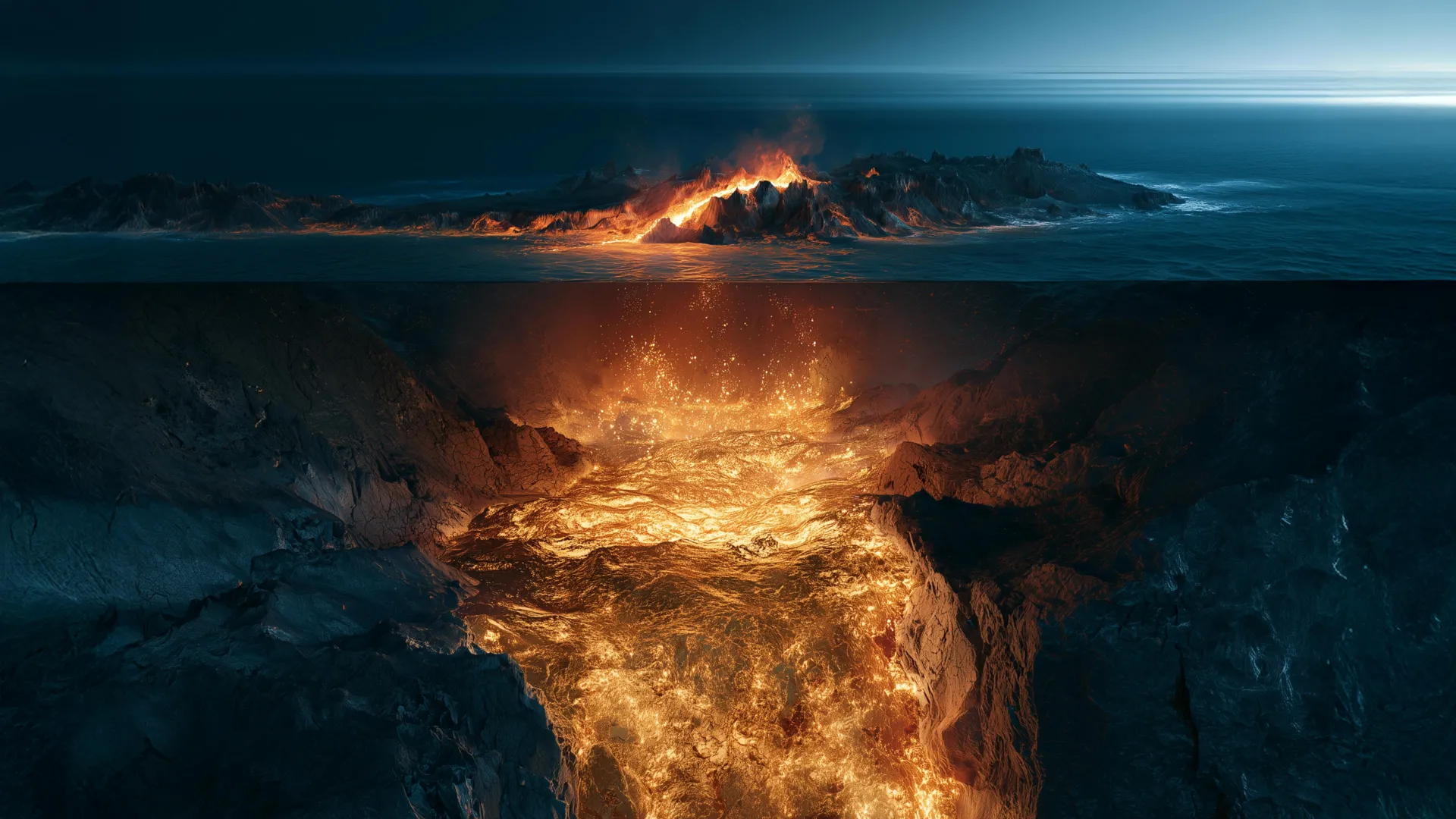
Main Facts: Unlocking the Subterranean Alchemist
Deep beneath the churning, cobalt-blue surface of the South Pacific, a massive geological laboratory is operating in absolute darkness. For decades, geoscientists have marveled at an enduring geological puzzle: why are island arcs—dramatic, crescent-shaped chains of submarine and subaerial volcanoes that form above oceanic subduction zones—so remarkably enriched in precious metals, particularly gold?
A groundbreaking study led by Dr. Christian Timm, a distinguished marine geologist at the GEOMAR Helmholtz Centre for Ocean Research Kiel, has finally begun to demystify this phenomenon. Published after years of meticulous fieldwork and laboratory analysis, the research reveals that the Earth’s mantle acts as a sophisticated, multi-stage "gold kitchen." Far below the ocean floor, water-assisted, high-degree melting processes progressively concentrate gold, setting the chemical stage long before any magma ever breaches the Earth’s crust to form a volcano.
The study centers on the analysis of 66 pristine volcanic glass samples dredged from the seafloor along the Kermadec island arc and the adjacent Havre Trough, located north of New Zealand. By capturing the chemical snapshot of ancient magmas frozen in time by rapid cooling, Dr. Timm and his international team demonstrated that gold enrichment in these zones is not a fluke of a single volcanic eruption. Instead, it is the cumulative result of a complex, repeated geological cycle where water acts as a thermal enabler, driving intense melting that breaks down sulfide minerals and unlocks trapped precious metals.
While these rocks are nowhere near rich enough to be scooped up for commercial mining—containing concentrations millions of times too dilute for industrial extraction—they represent the vital first chapter in the life cycle of gold. By understanding how the mantle pre-conditions these magmas, scientists gain a powerful new lens through which to view the genesis of valuable hydrothermal ore deposits across the globe.
Chronology: From Seafloor Dredges to the "Life Cycle of Gold"
To comprehend how this subterranean alchemical system works, it is necessary to retrace the chronological steps that led Dr. Timm’s team to their conclusions.
Step 1: The Gathering of Seafloor Archives
The investigation began with high-precision oceanic exploration. Marine geologists deployed specialized dredging equipment along the Kermadec island arc and the Havre Trough. These regions represent active subduction zones where the Pacific Plate dives beneath the Indo-Australian Plate, creating intense tectonic, thermal, and volcanic activity.
Step 2: Capturing the Moment of Quenching
As molten rock erupts or intrudes beneath the ocean, the freezing seawater causes it to quench—cool down almost instantaneously. This rapid thermal shock prevents the formation of large mineral crystals, trapping the chemical composition of the liquid magma inside a sheath of volcanic glass. Among these samples, the researchers prioritized "primitive glasses." These rare specimens preserve the pristine chemistry of the magma before fractional crystallization could alter its signature, offering an unfiltered window into the deep mantle.
Step 3: High-Precision Trace Element Detection
Back in the laboratory, scientists subjected the volcanic glasses to rigorous analytical chemistry. Because gold exists in mantle-derived rocks at extraordinarily minute concentrations—measured in parts per billion or nanograms per gram—detecting it requires ultra-sensitive equipment. The team measured gold alongside other chalcophile ("sulfur-loving") elements, including silver, copper, selenium, and platinum. Because these elements behave predictably relative to one another during melting events, their ratios act as chemical fingerprinting tools.
Step 4: Connecting the Mantle to the Surface
By correlating the chemical ratios found in the primitive glasses with thermal and hydrological models of subduction zones, the researchers mapped out the journey of gold. They realized that the journey does not start with the fluids squeezed out of the subducting slab, as many had long assumed. Rather, those fluids prime the mantle pump, triggering repeated episodes of melting that strip sulfur-bound gold away from mantle rocks and funnel it upward into the rising volcanic plumbing systems.
Supporting Data: What the Numbers Tell Us
The empirical evidence gathered from the Kermadec and Havre Trough samples provides robust statistical backing for the multi-stage melting hypothesis.
Unusually High Gold Concentrations
When the research team analyzed the primitive volcanic glasses, the baseline findings immediately stood out. The gold concentrations in these samples were often several times higher than those observed in comparable magmas originating from mid-ocean ridges—the sprawling underwater mountain ranges where tectonic plates pull apart rather than collide.
Specifically, the samples revealed original gold concentrations of up to six nanograms per gram (ng/g) of rock. While six billionths of a gram per gram of rock sounds infinitesimal, in geochemical terms, it is remarkably elevated for a mantle-derived magma.
Distinct Elemental Ratios
The quantitative data gathered for chalcophile elements painted an even clearer picture:
- Gold-to-Copper Ratios: The samples exhibited gold-to-copper ratios significantly higher than those measured in standard fertile mantle rocks and primitive mid-ocean ridge basalts.
- Silver-to-Copper Ratios: Conversely, the silver-to-copper ratios retained signatures closely resembling those of the ambient mantle, indicating that silver and copper behaved differently under the specific high-temperature melting regimes observed.
- Temperature Thresholds: The chemical signatures confirmed that mantle melting occurred at relatively high temperatures—specifically above the sulfide liquidus. This thermal threshold is critical because it represents the point at which sulfide minerals begin to break down completely.
The Math of Multi-Stage Melting
To achieve these specific chemical markers, a single melting event is mathematically insufficient. The data forced the researchers to conclude that the mantle source beneath the Kermadec arc had experienced a complex history: it was first depleted by an initial melting event, and then subjected to subsequent, high-degree melting phases. Each successive cycle further concentrated the remaining gold, stripping it from the refractory mantle matrix and loading it into the ascending melt.
Official Responses and Expert Insights
The study has generated significant discussion within the marine geology and petrology communities, reshaping how scientists view the deep-earth origins of ore-forming systems.
Dr. Christian Timm, lead author of the study and marine geologist at GEOMAR, emphasized that the research corrects long-held assumptions about the direct role of subduction-zone water:
"We initially assumed that water released from the subduction zone directly controlled gold enrichment," Timm explained. "However, our data show that water mainly facilitates mantle melting. The key factor for high gold concentrations is the high—and in part repeated—degree of melting."
Elaborating on the mechanical behavior of precious metals within the Earth’s interior, Timm highlighted the pivotal role of sulfide minerals:
"Gold in the mantle is commonly bound in sulfide minerals. At high degrees of melting, these minerals break down, releasing their gold completely into the melt. This means gold can remain trapped during limited melting. Once melting becomes intense enough to destroy the sulfide minerals, however, the stored gold is released and enters the rising magma."
Summarizing the broader implications of the findings for planetary chemistry and economic geology, Timm framed the discovery as a fundamental shift in perspective:
"Our results demonstrate that gold enrichment is not the result of a single melting event, but of multiple stages. Only repeated melting allows gold to become strongly concentrated in the magma… We are effectively looking at the first step in the life cycle of gold. It begins with the transfer of gold from the mantle into a melt that eventually forms volcanoes. The alchemy starts long before the metal reaches the surface."
Other geological experts not directly involved in the GEOMAR study have noted that the research bridges a critical gap between mantle dynamics and shallow crustal mineral deposit formation, providing a quantitative framework that can be tested in other subduction systems around the globe, such as the western Pacific rim and the Caribbean.
Implications: Tracing the Life Cycle of Gold
The revelation that Earth’s mantle operates as a multi-stage "gold kitchen" carries profound implications for multiple fields of earth science, from theoretical geodynamics to applied economic geology.
Rethinking Hydrothermal Ore Systems
Along submarine island arcs, hydrothermal vent systems—often referred to colloquially as "black smokers"—circulate superheated, mineral-rich fluids through the oceanic crust. These systems frequently deposit massive sulfide ores on the seafloor that contain unusually high concentrations of gold and other precious metals.
Until now, the exact source of this excess gold remained a subject of intense debate. Did the metal come entirely from shallow magmatic degassing chambers directly beneath the volcanoes, or was its journey initiated much deeper down? Dr. Timm’s research strongly suggests that the mantle’s pre-enrichment phase provides a running start. By establishing elevated baseline gold concentrations in the primary magmas, the mantle sets the stage for hydrothermal systems to scavenge, transport, and redeposit the metal in concentrated, near-surface pockets.
Mineral Exploration and Global Metallogeny
While the volcanic glass samples studied by GEOMAR are far too low in grade for commercial extraction, understanding the chemical markers of pre-enriched mantle sources gives mineral exploration companies a new conceptual tool. By analyzing volcanic rock chemistry in various tectonic settings, geologists may eventually be able to identify which submarine arcs possess the deep mantle plumbing systems most favorable for generating giant, economically viable gold deposits—both on the modern seafloor and in ancient mountain belts exposed on land.
A New Chapter in Earth History
Ultimately, this research refines our understanding of how chemical differentiation operates within our planet. The crust and mantle are not static layers; they are locked in a continuous, dynamic dialogue mediated by plate tectonics. Water carried downward by descending oceanic plates acts as the ultimate catalyst, driving convective melting that systematically purifies and concentrates rare elements.
As scientists continue to decode the chemical messages preserved in underwater volcanic glass, the mystique surrounding Earth’s subterranean gold factory is steadily giving way to hard, quantitative science. The alchemy of the Earth, it turns out, is governed by precise thermodynamic rules operating hundreds of kilometers beneath our feet—proving that the story of gold begins long before any prospector ever pans a river or any miner swings a pick.
