

LOS ANGELES — For nearly 170 years, a profound and eerie silence has blanketed the southern segments of California’s most formidable fault lines. Since the magnitude 7.9 Fort Tejon earthquake violently tore through the region in 1857, the relentless, grinding movement of massive tectonic plates has continued unabated deep beneath the earth’s surface. While the surface remains tranquil, pressure has silently accumulated for generations, building a colossal subterranean tension.
Now, a groundbreaking international study has revealed a stark and sobering reality: tectonic stress along Southern California’s premier fault systems has reached—and in some areas decisively surpassed—any levels recorded over the past 1,000 years.
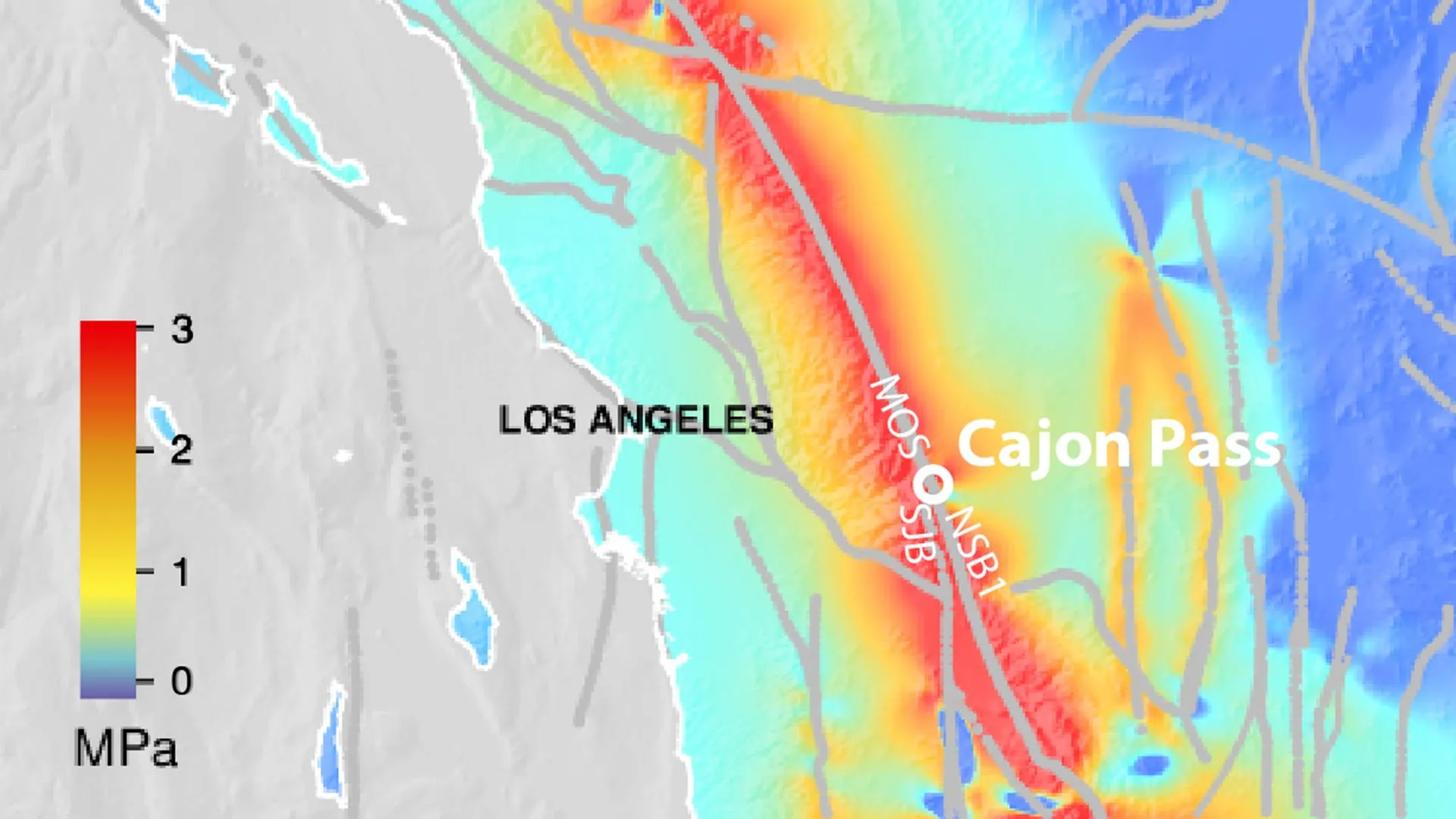
Published in the Journal of Geophysical Research: Solid Earth, the research focuses on the intersection of the San Andreas and San Jacinto fault systems northeast of Los Angeles. Spearheaded by Dr. Liliane Burkhard of the Division of Space Research and Planetary Sciences (WP) at the Physics Institute of the University of Bern, the study introduces a revolutionary geological concept known as the "earthquake gate." According to the findings, the region is not only under historic levels of strain, but the specific distribution of that stress has created a dangerous configuration capable of triggering catastrophic, multi-fault ruptures with devastating consequences for the greater metropolitan area.
Main Facts: The Anatomy of a Millennial High-Pressure Zone
Earthquakes are the planet’s violent mechanism for releasing accumulated crustal stress. When massive tectonic plates—in this case, the Pacific and North American plates—grind past one another, they frequently become frictionally locked. Instead of sliding smoothly, the rocks deform, storing elastic energy over decades, centuries, or even millennia until the friction threshold is breached and a sudden rupture occurs.
In Southern California, the tectonic burden is largely shared by two titan fault systems: the San Andreas Fault and the San Jacinto Fault. As they approach one another northeast of Los Angeles, they converge at the Cajon Pass—a topographically and geologically complex corridor.
Using an advanced, physics-based four-dimensional earthquake cycle model, Dr. Burkhard’s team simulated a millennium of fault behavior. By synthesizing geological evidence with historical data, the researchers calculated current stress levels across the region. The numbers are unprecedented:
- San Jacinto-Bernardino Section: Current stress has been estimated at an alarming 3.6 MPa (Megapascals), clearing past any value generated during the entire 1,000-year simulation.
- Mojave South Section of the San Andreas Fault: Current stress stands at 2.8 MPa, representing exceptionally high strain compared to long-term historical averages.
Crucially, the study highlights that the danger does not stem solely from the sheer volume of pressure on a single fault. Rather, it is the relative parity of stress between the two neighboring fault systems that raises the greatest alarm. When both systems are critically and similarly overloaded, the likelihood increases exponentially that a rupture will not stay contained to one fault, but will instead "jump the gate" at Cajon Pass to propagate simultaneously across both systems.
Chronology: A 1,000-Year Window into California’s Seismic Past
To construct a reliable baseline for modern stress levels, the research team—which included scientists from the University of Hawaiʻi at Mānoa, the U.S. Geological Survey Earthquake Science Center in Pasadena, and the Scripps Institution of Oceanography at UC San Diego—had to look far beyond modern instrumentation.
The timeline of discovery and the historical seismic milestones framing the research include:
- The Pre-Instrumental Era (The Past Millennium): Utilizing paleoseismic data, the team reconstructed 1,000 years of historical earthquake activity. This data was harvested through meticulous geological techniques, including radiocarbon dating of displaced sediment layers, tree-ring records analyzing stress-induced arboreal damage, and historical indigenous and colonial accounts of ground ruptures.
- January 9, 1812 (The Wrightwood Earthquake): A powerful historical earthquake that served as a vital geological precedent. Unlike later events, the 1812 earthquake successfully crossed the Cajon Pass junction, propagating through both the San Andreas and San Jacinto fault systems as a massive, unified dual-fault event.
- January 9, 1857 (The Fort Tejon Earthquake): Striking with an estimated magnitude of 7.9, this monumental rupture tore through central and southern segments of the San Andreas Fault. Notably, this historical earthquake stopped at Cajon Pass, failing to jump to the San Jacinto Fault. The 1857 event marked the beginning of the exceptionally long quiet period that persists today.
- The Modern Era (Post-1857 to Present): For nearly 170 years, the absence of a major rupture along these specific segments has allowed continuous tectonic loading. The current study integrates this prolonged quiescence into a 4D physics model to map how stress distributes, accumulates during quiet intervals, and relaxes in the deeper crust over centuries.
Supporting Data: Decoding the "Earthquake Gate"
The mechanics of how earthquakes propagate through complex geological junctions have long puzzled seismologists. Past events demonstrated wildly unpredictable behaviors: some ruptures halted abruptly at structural barriers, while others tore effortlessly through multiple faults.
The introduction of the "earthquake gate" concept provides a vital framework for understanding these dynamics. Dr. Burkhard’s model demonstrates that the Cajon Pass does not act as a static barrier or a passive channel; rather, it is a dynamic valve whose permeability to seismic rupture is entirely dictated by prevailing stress conditions.
[ Tectonic Plate Motion ]
         │
         ▼
   (Continuous Loading Over Centuries)
         │
         ├───────────────────────────────┐
         ▼                               ▼
[ San Andreas Fault ]         [ San Jacinto Fault ]
   (Mojave South: 2.8 MPa)       (Bernardino: 3.6 MPa)
         │                               │
         └───────────────┬───────────────┘
                         ▼
              THE CAJON PASS GATE
        (Stress Levels Closely Aligned)
                         │
                         ▼
        [ POTENTIAL DUAL-FAULT RUPTURE ]
When stress levels diverge significantly between two intersecting faults, a rupture traveling along one path typically loses energy and terminates at the junction—mirroring the behavior of the 1857 Fort Tejon event. However, when stress builds to elevated and comparable levels on both sides—as the model shows is happening today—the mechanical resistance at the junction drops dramatically.
"So not only is it concerning that the stresses are reaching historic highs," Dr. Burkhard noted, "but also that the relative stress conditions between the two fault systems are approaching the range we associate with major ruptures crossing both faults simultaneously—and that is a scenario with much larger consequences for the region."
Official Responses and Scientific Consensus
The findings have reverberated through the global geophysics community, prompting cautious evaluation from academic institutions, federal agencies, and disaster management organizations. While the study offers unprecedented resolution into subterranean mechanics, lead researchers and external experts have been careful to contextualize what the data does—and does not—mean.
"The study is not a prediction of when an earthquake will occur," Dr. Burkhard emphasized. Seismology has not yet evolved to the point of forecasting the exact day, month, or year of a future seismic event. Instead, the model acts as a rigorous diagnostic tool. "What we can say is that the system is critically stressed and that physics-based models like ours give a clearer picture of the range of scenarios we should be prepared for."
Representatives from the U.S. Geological Survey (USGS) Earthquake Science Center have lauded the four-dimensional modeling approach for bridging the gap between paleoseismology and modern stress physics. By simulating the complex viscoelastic relaxation of the Earth’s lower crust over centuries, the study offers a blueprint that can be adapted to other complex, multi-fault tectonic junctions across the globe—from New Zealand to Turkey and Japan.
Emergency management officials in Southern California have received the findings as an urgent call to action. Rather than inciting panic, agencies view the research as vital ammunition for long-term urban planning, structural retrofitting, and public education campaigns.
Implications: Preparing for the Multi-Fault Scenario
The physical and societal implications of a simultaneous, multi-fault rupture originating at the Cajon Pass cannot be overstated.
If a future seismic event successfully breaches the earthquake gate, it would not affect an isolated, rural stretch of land. The Cajon Pass and its immediate surrounding regions serve as the vital aorta of Southern California’s economic and logistical infrastructure. The corridor carries major interstate transportation routes (including Interstate 15), critical high-voltage electrical transmission lines, massive petroleum and natural gas pipelines, and transcontinental freight rail lines connecting the Ports of Los Angeles and Long Beach to the rest of the nation.
Furthermore, a dual-fault rupture would simultaneously shake some of the most densely populated and rapidly growing areas in the United States, stretching in a broad arc from the greater Los Angeles basin through San Bernardino, Riverside, and out into the Coachella Valley. The compounding effects of simultaneous shaking across interconnected fault segments would amplify structural damage, disrupt lifeline infrastructure for weeks or months, and severely challenge emergency response capabilities.
Ultimately, the University of Bern-led study transforms abstract geological fears into quantifiable parameters. By revealing that Southern California’s fault systems have entered an uncharted realm of tectonic pressure, the research strips away uncertainty regarding the potential magnitude of future threats. The message to urban planners, engineers, and residents is clear: while nature dictates the accumulation of stress, human resilience will depend entirely on how effectively society prepares for the worst-case scenarios brought to light by advanced science.
