

Main Facts
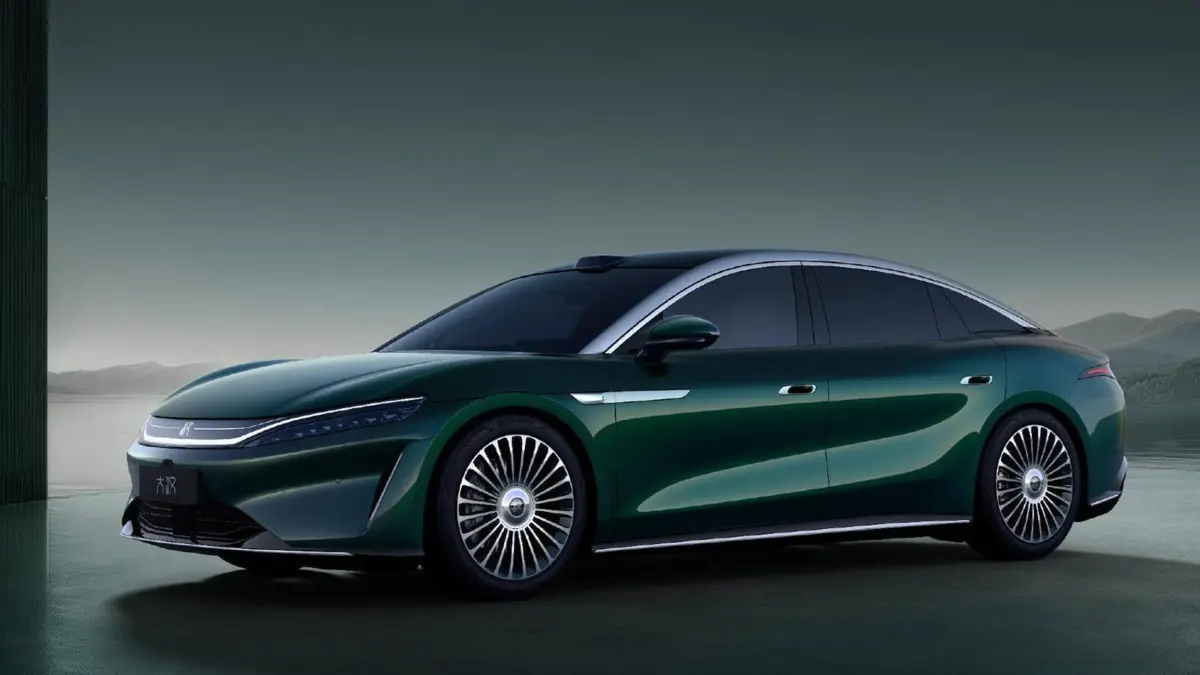
Last week, Chinese automotive giant BYD officially launched its new global flagship-level sedan, the Da Han. Representing a massive evolutionary leap not just for the Han nameplate but for the entire BYD brand, the Da Han enters the market with a direct mandate: to challenge, and in many key metrics surpass, the most prestigious legacy luxury sedans built by long-established Western automakers.
Priced during its pre-sale window between 249,900 RMB (~$37,181 USD) and 299,900 RMB (~$44,620 USD), the Da Han offers specifications, luxury appointments, and technological integrations that frequently rival—and occasionally exceed—vehicles costing up to ten times as much. Built on cutting-edge 1000V architecture and utilizing a second-generation Blade Battery, the large sedan blends staggering performance, supercar-beating aerodynamics, extreme ultra-fast charging capabilities, and class-leading spaciousness.

Crucially, the Da Han is designed to prove a point about modern engineering: that an electric vehicle can lead its class not through compromises made in the name of efficiency, but precisely because it is electric and efficient.
Chronology: From Market Challenger to Domestic Dominance
The trajectory of the BYD Han is a microcosm of the rapid ascension of Chinese electric vehicles.

The Early Competitor (2020–2024)
When the original Han debuted several years ago, it marked a historic turning point. It was among the first competitive, electrified offerings from a domestic Chinese manufacturer targeting the lucrative 200,000+ RMB (~$29k+) price segment—a territory historically dominated by joint-venture (JV) internal combustion engine (ICE) vehicles. While imperfect, the original Han successfully disrupted Western brand loyalty and quickly became the premier vehicle of choice for high-end commercial car services and "black car" fleets across China.
The Transition Phase and Fleet Separation
As BYD prepared for its next-generation architecture, older iterations of the Han family saw price reductions to clear inventory, with the current Han EV dropping to 179,800–187,800 RMB, and the Han L positioned between 219,800 and 279,800 RMB. Recognizing the need to separate utilitarian fleet demands from ultra-luxury private ownership, BYD launched the Linghui sub-brand in May, introducing models like the E9 to serve commercial car services using rugged, lower-output front-wheel-drive configurations. Meanwhile, the consumer-facing flagship line was freed to reach unprecedented heights.

The Launch of the Da Han (Present Day)
Unveiled last week, the Da Han takes the foundational prestige of the Han lineage and elevates it to a global tier. Dubbed the "Shenzhen Maybach" by enthusiasts on Chinese social media, the Da Han establishes an entirely new benchmark for what a flagship Chinese sedan can achieve, aiming squarely at the crown traditionally worn by the Mercedes-Benz S-Class.
Supporting Data & Engineering Specifications
The raw numbers behind the Da Han underline its status as a technological tour de force.

Powertrain and Performance
- Rear-Wheel Drive (RWD) Models: Equipped with a single motor producing 370 kW (496 horsepower).
- All-Wheel Drive (AWD) Models: Adds a 200 kW front motor for a combined output of 570 kW (764 horsepower).
- Acceleration: The AWD variant rockets from 0 to 100 km/h in an astonishing 3.3 seconds, and handles the 100 to 150 km/h passing sprint in just 3.2 seconds.
- Top Speed: Electronically capped at 270 km/h.
Dimensions and Agility
At 5,256 mm long, 1,999 mm wide, and 1,510 mm high, riding on a 3,130 mm wheelbase, the Da Han is a massive vehicle. It is longer than a standard-wheelbase Mercedes S-Class (5,179 mm) and a remarkable 78 mm wider. Thanks to standard rear-wheel steering, however, its turning radius is a remarkably tight 4.95 meters—matching that of BYD’s subcompact Seagull hatchback.
Suspension and Aerodynamics
The vehicle utilizes DiSus-A dual-chamber air suspension that reads the road ahead in real-time, offering 100 mm of height adjustment to grant the low-slung sedan SUV-like ground clearance when necessary while actively varying stiffness between supple comfort and sporty rigidity. Aerodynamically, the Da Han achieves a drag coefficient of just 0.197, placing it immediately behind the YangWang U7 at the pinnacle of production vehicle efficiency.
Battery, Range, and Flash Charging
- Battery Capacity: A massive 102.326 kWh second-generation Blade Battery integrated into a 1000V electrical architecture.
- Range (CLTC): The RWD model delivers an astonishing 1,008 km of range, while the AWD variant achieves 880 km.
- Charging Speeds: Utilizing BYD’s flash-charging ecosystem, the battery can replenish from 10% to 70% in just 5 minutes, and 10% to 97% in 9 minutes. Buyers receive 18 months of complimentary flash charging.
Interior Luxury and Technology
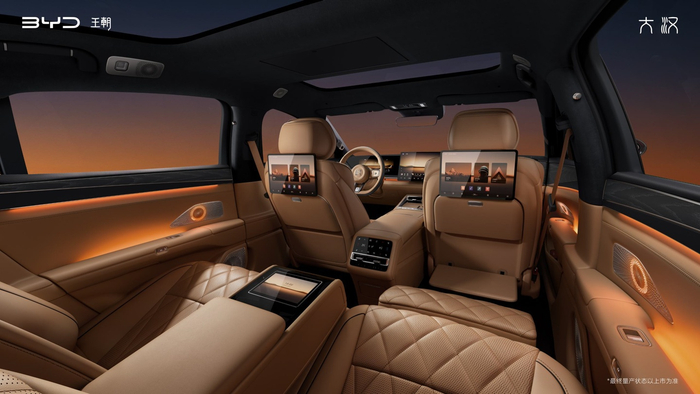
Inside, the cabin features a multi-screen layout including a Head-Up Display (HUD), driver instrument cluster, central infotainment touchscreen, and a dedicated passenger screen. Rear passengers are treated to a ceiling-folding center screen, seatback-mounted displays, and control screens integrated into the armrests. Comfort features include Nappa leather seats with heating, ventilation, massagers, and extending leg rests, hand-polished real white ash wood grain, electronic smart-dimming PDLC privacy glass, and a 31-speaker Devialet sound system with Dolby Cube Atmos 2.0.
Official Responses and Comparative Benchmarks
During the official launch presentation, BYD executives did not shy away from comparing the Da Han directly to elite Western benchmarks, specifically targeting the Mercedes-AMG S 63 E PERFORMANCE and the Mercedes-AMG EQS 53 4MATIC+.

Challenging Mercedes-Benz
When stacked against the Mercedes-AMG S 63 E PERFORMANCE—which commands a staggering starting price of 2,674,800 RMB ($397,626 USD) in China—the Da Han matches its acceleration time, boasts a shorter braking distance, achieves a higher top speed, and features a dramatically tighter turning radius (compared to the AMG’s lumbering 12.4-meter circle). Furthermore, the Da Han integrates advanced intelligent driving features and luxury amenities that outpace the German flagship at roughly one-tenth of the cost.
Against the all-electric Mercedes EQS 53 (priced at 1.566 million RMB / $232,990 USD), the AWD Da Han is not only vastly more affordable at 299,900 RMB ($44,620 USD), but it also surpasses the German EV in range (880 km CLTC vs. 601 km for the EQS) and acceleration speed, all while avoiding the polarizing "jellybean" exterior styling that has struggled to capture consumer enthusiasm.

Pacing Against Tesla
When compared to the Tesla Model 3 Long-Range—the closest available option in Tesla’s sedan lineup given the discontinuation of the Model S in many markets—the Da Han proves superior in both physical scale and energy efficiency. A comparably equipped Model 3 Long-Range AWD in China exceeds 347,500 RMB ($51,702 USD) and offers significantly less interior volume, a smaller battery (84.85 kWh vs 102.3 kWh), and a vastly shorter driving range under identical CLTC metrics. Moreover, BYD’s charging speeds outpace Tesla’s current offerings by a factor of ten when utilizing flash-charging infrastructure.
Implications for the Global Automotive Landscape
The arrival of the Da Han carries profound implications for the global luxury automotive sector.

The Shift from "Good Value" to "Undisputed Excellence"
Historically, domestic Chinese automotive brands competed primarily on price, offering reasonable utility for consumers who could not afford premium imports. The Da Han shatters this paradigm. BYD has crafted a vehicle that does not merely undercut Western luxury brands financially; it outperforms them technologically, aerodynamically, and spatially. By claiming leadership across 44 distinct metrics, BYD is signaling that Chinese engineering has matured to a level where its flagship products are world-class, regardless of price point.
Infrastructure Synergy in China
BYD’s launch of the Da Han coincides with a massive expansion of domestic charging networks. With plans to operate over 20,000 dedicated flash-charging stations by the end of the year—complemented by a national trajectory of 28 million charging points—range anxiety and refueling friction are effectively neutralized for Chinese consumers. This infrastructure advantage makes owning a vehicle like the Da Han significantly more convenient than operating a traditional gasoline-powered luxury car.

Global Market Friction
While the Da Han is poised to dominate the domestic market and redefine consumer expectations in regions where free trade prevails, its path to global ubiquity will face geopolitical hurdles. Protectionist policies, regulatory barriers, and political resistance to advanced Chinese EV technology in Western markets may delay its arrival abroad. However, for markets with open trade policies, the Da Han represents an irresistible alternative to traditional executive sedans.
Ultimately, the Da Han represents a philosophical turning point for the automotive industry. It proves that electric flagships no longer need to make concessions for efficiency. Instead, through relentless innovation in battery chemistry, aerodynamic design, and digital integration, the Da Han stands tall as a better, faster, more luxurious, and inherently more efficient machine than the century-old legacy it seeks to dethrone.
