

Main Facts: Remembering Rachel Pollack’s Vision of the Tarot
Few figures in the modern history of cartomancy have left as profound, intellectually rigorous, and creatively expansive a footprint as Rachel Pollack. Authored originally as an essay for World Tarot Day on May 25, 2015, Pollack’s reflections on the nature of the cards offer a rare window into the mind of one of the 20th and 21st centuries’ foremost esoteric writers.
At the core of Pollack’s philosophy is a deceptively simple yet radical premise: "Story. It’s all story." While many practitioners approach the Tarot through the lens of strict divination, predictive fortune-telling, or rigid esoteric dogmas, Pollack viewed the 78 cards of the deck primarily as a dynamic machinery for narrative creation. Referencing the famed Italian author Italo Calvino’s observation that "the tarot is a machine for constructing stories"—alongside the Hasidic teaching that "God made humans because God loves stories"—Pollack positioned the art of Tarot not as a static blueprint of a predetermined future, but as an interactive canvas where human imagination, archetype, and lived experience intersect.
Through her foundational books, such as 78 Degrees of Wisdom, her fictional works, and her continuous engagement with the global tarot community, Pollack argued that truth itself is not a passive rock waiting to be discovered, but an active, collaborative narrative brought into being through engagement. Her intellectual framework bridges psychology, quantum philosophy, mystical traditions like the Kabbalah, and creative storytelling, forever changing how generations perceive the mysterious archetypes of the Rider-Waite-Smith deck and beyond.
Chronology: A Lifelong Journey Through Narrative and Esotericism
To understand Rachel Pollack’s revolutionary approach to the Tarot, one must trace the timeline of her encounters with the cards, literature, and the metaphysical world—a journey that spanned over five decades.
- Early Spring 1970: Rachel Pollack’s lifelong relationship with the Tarot begins. Introduced to the deck by a friend who used Eden Gray’s guidebook, Pollack is immediately captivated not by the prospect of future predictions, but by the visual poetry of the cards. Each card strikes her as a "frozen moment in a story," with the evocative Six of Swords leaving a lasting impression from that very first reading.
- The 1970s–1980s (Emergence of a Master Writer): Immersing herself deeply in esoteric studies, mythology, and literature, Pollack begins formulating a fresh, psychological, and narrative-driven approach to cartomancy. Her scholarly pursuits culminate in groundbreaking literary output that challenges traditional, fatalistic views of divination.
- 1980 (Publication of a Masterpiece): Pollack publishes 78 Degrees of Wisdom: A Book of Tarot, which is widely heralded by modern practitioners and critics alike as the "Bible of Tarot." By blending Jungian psychology, mythology, and deep esoteric history, she reframes the cards as mirrors of human spiritual evolution.
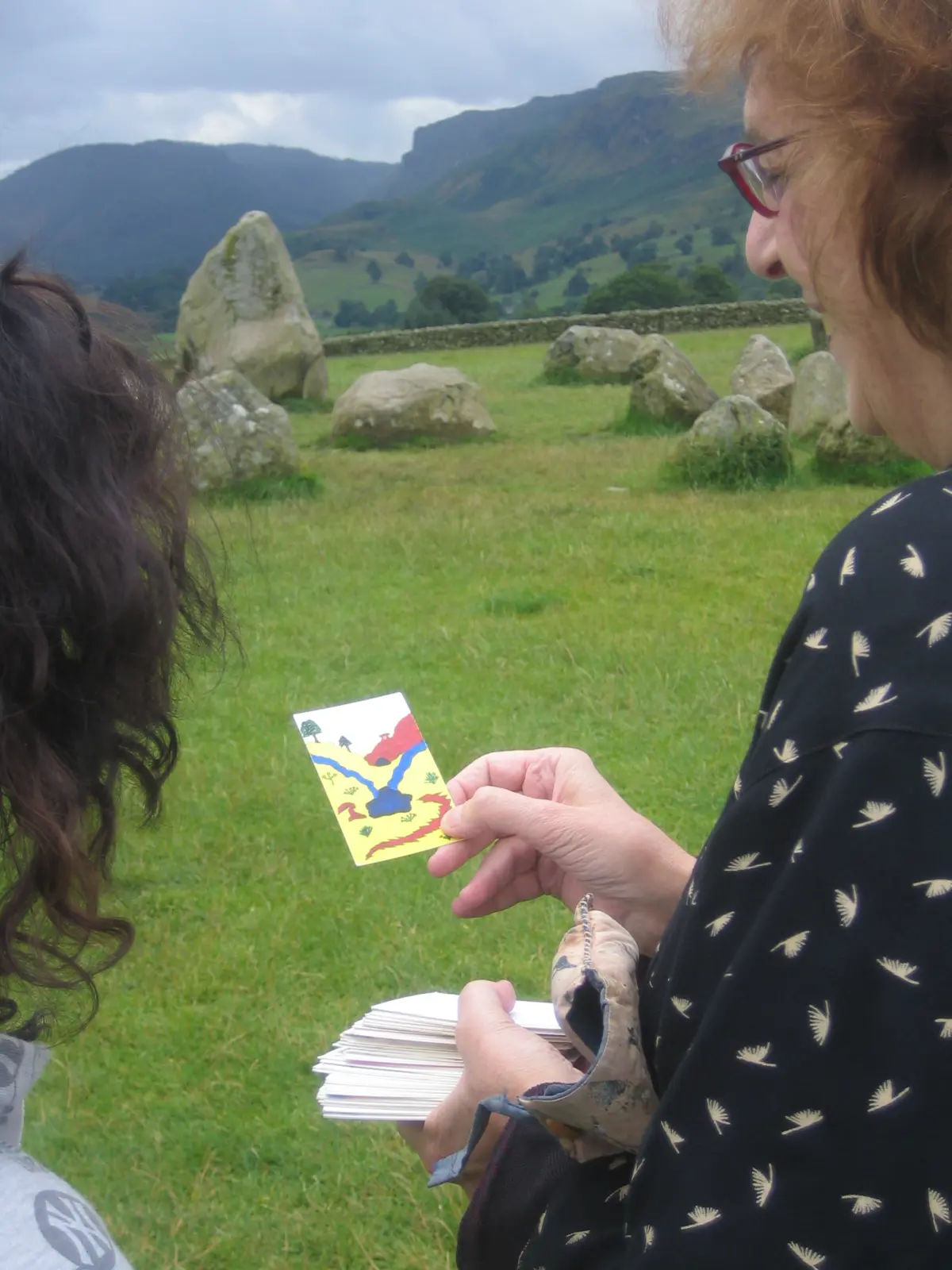
- July 2009 (The Tarosophy Tarot Conference): Pollack travels to the historic Lake District in the United Kingdom, visiting the ancient Castlerigg Stone Circle. During this gathering—documented by the Tarosophy Tarot Conference—she shares her profound insights with international peers, cementing her status as a beloved global ambassador of the craft.
- May 25, 2015 (World Tarot Day Essay): Writing for World Tarot Day, Pollack pens her definitive philosophical meditation on mortality, truth, and narrative. In it, she contemplates her ideal epitaphs—ranging from African pygmy songs to Egyptian funerary texts—before landing on her ultimate philosophical anchor: "Story. It’s all story" and "The world is not what we think it is."
- April 2023 (Legacy and Archival Reflection): The Tarot Association publishes retrospectives and rare photographs of Pollack from her time at Castlerigg, celebrating her enduring influence on contemporary esoteric thought following her passing.
Supporting Data: The Architecture of Tarot as a Narrative Machine
To fully appreciate Pollack’s perspective, one must examine the structural elements that define her philosophy of reading and interpreting the cards:
1. The Tripartite Dynamic of a Reading
Pollack famously observed that every authentic Tarot reading involves three distinct "people" (or presences) interacting in real-time:
- The Subject: The querent, bringing their lived reality, questions, and psychological framework.
- The Reader: The facilitator, acting as a translator, bridge-builder, and active listener.
- The Cards Themselves: The visual agents, carrying centuries of archetypal weight, artistic symbolism, and narrative momentum.
Together, these three forces allow a living story to emerge organically, tailored precisely to the psychological and situational needs of the moment.
2. The Illusion of Fixed Truth vs. Co-Created Reality
Pollack challenged the binary debate of whether Tarot is "real" or "fake." Drawing a parallel to modern physics, she recounted a conversation with a physicist friend regarding subatomic particles. When asked if complex particles might not actually exist until scientists predict and look for them, the physicist confirmed it was entirely possible.
Similarly, Pollack argued that:
- Truth does not simply lie passively like a rock; humanity engages with it and brings it into being.
- Complex systems—whether the Kabbalistic Tree of Life, quantum physics, or future divination—operate as interlocking sets of human stories.
- While routine readings offer broad thematic resonance, pivotal moments in human life often trigger an uncanny mathematical and psychological synchronicity, where the deck produces the exact, necessary card to unlock a vital life decision.
Official Responses and Reflections from the Global Esoteric Community
The publication of Pollack’s writings and historical archives has drawn widespread acclaim, tributes, and academic commentary from leaders within the global spiritual, literary, and tarot communities.
Marcus Katz, co-founder of the Tarot Association, noted during memorial retrospectives:

"Rachel Pollack did not just teach us how to read the cards; she taught us how to read the world. She brought a rare combination of literary brilliance, uncompromising intellect, and deep spiritual warmth to a field that is all too often crowded with dogmatism. Her insistence that the Tarot is fundamentally about storytelling liberated generations of readers to trust their own intuition and creative agency."
Fellow esoteric authors and psychologists have frequently cited 78 Degrees of Wisdom as the singular text that transitioned modern Tarot from a parlor trick of fortune-tellers into a legitimate tool for shadow work, self-actualization, and therapeutic reflection.
In her 2015 World Tarot Day essay, Pollack herself reflected on the profound paradox of how the cards operate:
"If you’re a reader, people will often ask, ‘How does the Tarot work?’ As if we could answer that! I just say that nobody knows, but it does. Sometimes the story the cards tell is meaningful but not precise to that person. At other times, however, the deck finds the one exact card to answer someone’s question… And this brings me to something else I’ve learned through the Tarot, and another line that might serve as an epitaph—The world is not what we think it is."
Implications: The Enduring Cultural and Spiritual Legacy of Rachel Pollack
The implications of Rachel Pollack’s philosophical framework extend far beyond the niche world of cartomancy. By stripping away superstitious fatalism and replacing it with an empowering narrative model, Pollack reshaped how contemporary spiritual seekers engage with uncertainty.
Reimagining Divination in the 21st Century
In an era dominated by rapid technological advancement, algorithmic predictability, and existential anxiety, Pollack’s philosophy offers a counter-narrative. She reminds humanity that uncertainty is not something to be feared or exhaustively controlled, but a creative space to be inhabited. When a querent draws a difficult card—such as the Tower or the Three of Swords—a fatalistic reader sees doom; a Pollack-inspired reader sees a dramatic turning point in an unfolding, dynamic narrative where the protagonist retains agency.
Bridging Art, Psychology, and Mysticism
Pollack’s legacy ensures that Tarot is viewed not as an isolated occult oddity, but as an intersecting crossroads of world literature, art history, Jungian depth psychology, and mystical philosophy. Her books continue to serve as essential reading for writers, therapists, artists, and spiritual seekers who recognize that human beings are fundamentally storytelling creatures.
Ultimately, whether carved on an imaginary tombstone or lived out daily by thousands of practitioners worldwide, Rachel Pollack’s ultimate maxim remains her greatest gift to us: The world is not what we think it is—it is story, and it is all story.
