

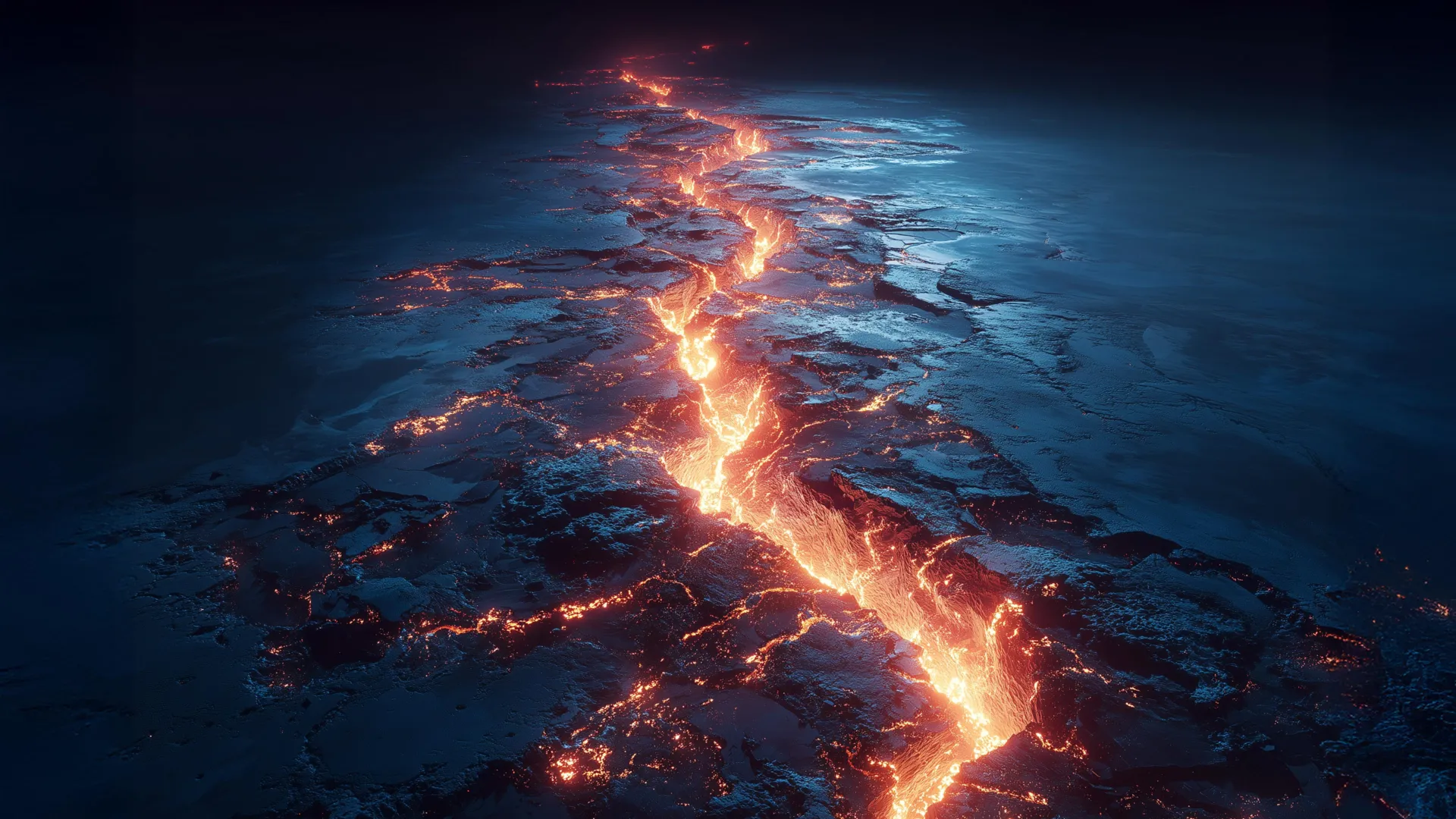
TOKYO & OKAYAMA — In the annals of Earth’s geological history, few events rival the colossal fury that birthed the Ontong Java Plateau roughly 120 million years ago. Stretching across the western Pacific Ocean, this monolithic underwater expanse represents the largest known oceanic plateau on the planet—a testament to an epoch of extraordinary submarine volcanism that likely altered global climate, suffocated ancient oceans, and catalyzed mass extinctions.
Yet, for decades, geoscientists focused primarily on the surface spectacle: the staggering volumes of basaltic lava that cascaded across the seafloor, building a plateau so immense it dwarfs many terrestrial mountain ranges.
Now, a groundbreaking study led by a collaborative team of Japanese researchers reveals that the cataclysm left an even more profound, hidden legacy. The torrential upwelling of magma did not merely pool on the ocean floor; it fundamentally tore, reshaped, and chemically re-engineered the very tectonic plate beneath it. Published in the journal Geophysical Research Letters, the study unveils a complex, scarred interior hidden deep beneath the Pacific seafloor—offering an unprecedented look at how super-volcanoes transform Earth’s interior architecture.
Main Facts: Unveiling a Composite Interior
The research was spearheaded by Lecturer Azusa Shito of the Okayama University of Science, working in close partnership with Associate Professor Akira Ishikawa of the Institute of Science Tokyo and Professor Masako Yoshikawa of Hiroshima University. By deploying sophisticated seismic wave analysis, the team dismantled long-held assumptions regarding the uniformity of oceanic plates.
Typical oceanic plates possess a relatively straightforward, layered structure. However, the seismic profile beneath the Ontong Java Plateau (OJP) tells a radically different story. The researchers discovered that the plate’s interior is a complex, composite matrix composed of horizontal layering densely cross-hatched by vast swarms of vertical magma pathways, known to geologists as dikes.
Dikes form when pressurized molten rock forces its way through fractures in solid rock, subsequently cooling and solidifying into vertical sheets. When multiplied across a regional scale into "dike swarms," these structures preserve an enduring archive of intense, historical tectonic plumbing.
Furthermore, the team detected anomalously low seismic wave velocities coursing through the plate. This critical metric indicates that the magma rising from the Earth’s deep mantle did more than simply carve physical conduits through the crust; it fundamentally interacted with and altered the chemical composition of the surrounding mantle rock.
Chronology: The Evolution of a Super-Plateau
To understand the magnitude of this discovery, scientists must look back more than a hundred million years to the Cretaceous period, a time when Earth’s internal engine operated with blistering intensity.
110–120 Million Years Ago: The Cataclysmic Outpouring
During the Aptian-Albian ages of the Cretaceous, the Ontong Java Plateau erupted onto the floor of the proto-Pacific Ocean. It remains the largest volcanic outpouring in Earth’s recorded history. The sheer volume of magma expelled during this event was so staggering that it disrupted the global biosphere. Paleoclimatologists and geologists have long theorized that the massive release of greenhouse gases, volcanic aerosols, and thermal energy severely altered ocean chemistry, triggered widespread marine anoxia (oxygen depletion), and contributed to global extinction pulses.
The Deep-Mantle Catalyst
Recent geochemical and geophysical modeling suggests this monstrous event was driven by a thermochemical plume—an extraordinarily hot column of upwelling material originating deep within Earth’s lower mantle. Unlike standard mantle plumes, thermochemical plumes carry distinct chemical signatures, often containing recycled fragments of ancient oceanic crust subducted millions of years prior. As this buoyant, superheated mass rose toward the surface, it generated prodigious amounts of melt. However, the precise mechanical and chemical interaction between this colossal plume and the pre-existing oceanic plate above it remained a persistent black box in geoscience—until now.
Modern-Day Discovery: Decoding the Seafloor
Fast forward to the modern era. Utilizing high-frequency seismic signals recorded by ocean-bottom seismometers and island-based instruments, the team of Shito, Ishikawa, and Yoshikawa successfully peered hundreds of kilometers beneath the Pacific seafloor, unlocking the structural timeline preserved within the lithosphere.
Supporting Data: The Language of Seismic Waves
The foundation of the Japanese team’s discovery lies in the behavior of high-frequency seismic signals known as Po and So waves.
Unlike standard body waves that sweep indiscriminately through the deep Earth, Po and So waves are specialized seismic waves that propagate horizontally through oceanic plates rather than escaping into the surrounding mantle. Because their velocity, attenuation, and scattering characteristics are exquisitely sensitive to the physical state of the rocks they traverse, they act as natural computed tomography (CT) scans for the deep seafloor.
Under normal tectonic conditions, Po and So waves are generated by the repeated scattering of primary (P) and secondary (S) waves bouncing through the finely layered strata of a standard oceanic plate. This continuous internal reflection allows the signals to travel over distances of several thousand kilometers without losing coherence.
The Anomaly Beneath Ontong Java
When the research team analyzed the seismic data gathered around the OJP, they encountered a striking anomaly:
- Po waves propagated through the region with high efficiency, maintaining their strength over long distances.
- So waves, conversely, suffered dramatic attenuation, weakening and dissipating far more rapidly than expected.
By running complex seismic waveform models to simulate various subsurface geometries, the researchers realized that this acoustic dichotomy could only be explained by a dual-nature interior. The horizontal layering (lamination) of the plate allowed Po waves to travel efficiently, while the dense network of vertical dike swarms scattered and disrupted the So waves.
Moreover, both Po and So waves registered significantly slower velocities beneath the plateau compared to standard oceanic crust. Seismic waves decelerate when passing through rocks that are elevated in temperature, structurally fractured, less rigid, or chemically distinct from normal mantle peridotite. Standard structural fracturing alone, the team concluded, could not account for the drastic drop in velocity. The chemistry of the plate itself had been fundamentally altered.
Official Responses and Expert Insights
The study, published in Geophysical Research Letters, has drawn significant attention within the international geodynamics community for its innovative integration of seismic data and petrological chemistry.
While the primary researchers have laid out a compelling framework, the broader implications of their findings highlight a shift in how geologists view mantle-crust interactions.
"We are no longer just looking at volcanic plateaus as piles of lava stacked upon an unchanging floor," notes the theoretical framework established by the research team. "The sheer volume and thermal energy of a super-plume act as a chemical and structural blender, completely reworking the lithosphere it breaches."
The study emphasizes a complex geochemical process known as refertilization. The Earth’s upper mantle is predominantly composed of a rock called peridotite. When mantle rock undergoes partial melting—such as during the generation of a mantle plume—certain mineral components are stripped away, leaving behind a "depleted" peridotite residue.
However, as subsequent waves of magma rise through the newly formed dike swarms, they traverse this depleted matrix. Through high-temperature reactions, the newly introduced magma returns vital chemical elements back into the depleted peridotite, effectively "refertilizing" the rock. This chemical recharge alters the mineralogy, density, and elasticity of the mantle rock, providing a neat explanation for the sluggish seismic velocities recorded by the team.
Implications: Rewriting the Textbooks of Plate Tectonics
The revelations surrounding the Ontong Java Plateau extend far beyond regional Pacific geology. They challenge and expand our fundamental understanding of how large igneous provinces (LIPs) interact with Earth’s tectonic plates.
1. A New Paradigm for Mantle-Crust Dynamics
For decades, tectonic models often treated the lithospheric plate and the ascending mantle plume as distinct entities—the plume rises, punches through the plate, and erupts on top. The OJP study demonstrates that this relationship is far more interactive and destructive. Plumes can extensively inject themselves into the plate, plumbing it with thousands of vertical pathways and chemically regenerating its mineral makeup.
2. Refining Geophysical Imaging
The successful use of Po and So wave modeling to map internal dike swarms provides a powerful new tool for geophysicists. Researchers can now apply similar analytical techniques to other massive oceanic plateaus around the globe—such as the Kerguelen Plateau in the Indian Ocean or the Hikurangi Plateau off the coast of New Zealand—to determine if deep-plate refertilization is a universal hallmark of super-volcanism.
3. Deep-Earth Recycling
By confirming that ascending magma chemically alters the mantle lithosphere, the study sheds light on the long-term chemical evolution of Earth’s interior. It highlights the continuous, dynamic exchange of elements between the deep mantle and the crust, proving that Earth’s tectonic engine is constantly recycling, refining, and rebuilding its own foundation.
As scientists continue to decode the seismic whispers trapped beneath the world’s oceans, the legacy of the Ontong Java Plateau stands redefined: not merely as a monument of surface destruction, but as a deep-earth crucible that permanently transformed the fabric of our planet.
