

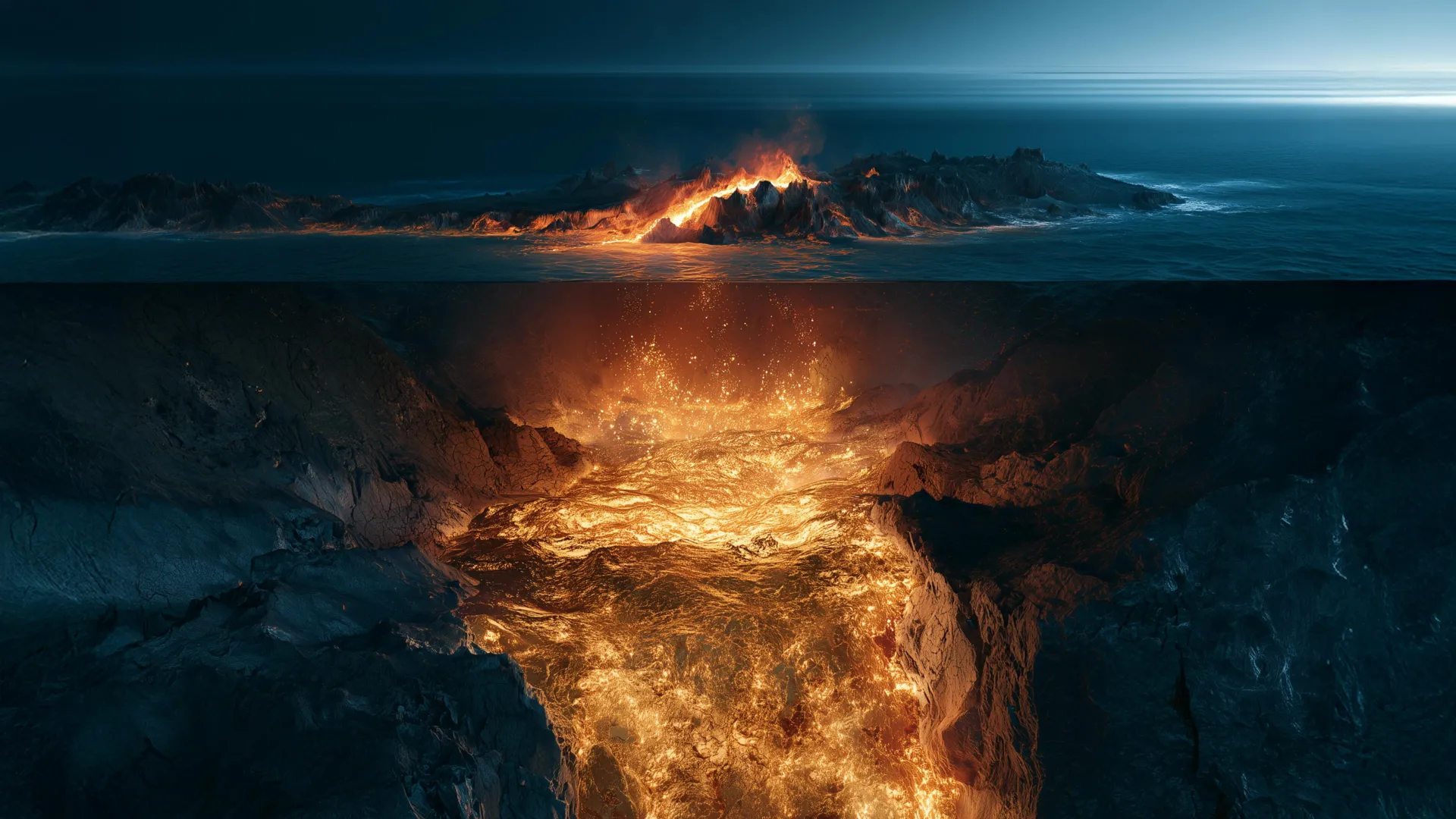
Deep beneath the rolling waves of the world’s oceans, hidden in the fiery crucibles of volcanic chains known as island arcs, Earth operates a geological refinery that has long baffled scientists. For decades, geologists have noted an intriguing anomaly: volcanic rocks found along subduction zones—where one tectonic plate dives beneath another—are frequently and inexplicably enriched with gold. While these deep-sea rocks do not contain enough of the precious metal to trigger a modern-day oceanic gold rush, understanding their high concentrations has remained a holy grail for economic geologists and petrologists alike.
Now, a groundbreaking study led by marine geologist Dr. Christian Timm of the GEOMAR Helmholtz Centre for Ocean Research Kiel has pulled back the curtain on this subterranean alchemy. The research reveals that Earth’s mantle acts as a sophisticated, multi-stage melting machine. Powered by water and driven by intense heat, this dynamic system progressively concentrates gold long before the magma ever ascends to form underwater volcanoes.
The findings not only rewrite our understanding of noble metal behavior beneath the ocean floor, but they also offer crucial insights into the formation of hydrothermal mineral deposits that pepper the planet’s dynamic tectonic plate boundaries.
Main Facts: Unlocking Earth’s Sub-Seafloor Gold Kitchen
At the core of the new research is a fundamental geological mystery: why are subduction-zone magmas so disproportionately rich in gold compared to those found at mid-ocean ridges? To solve this, Dr. Timm and his international team turned their attention to the Kermadec island arc and the adjacent Havre Trough, located north of New Zealand.
The team analyzed 66 volcanic glass samples dredged from the seafloor. Volcanic glass is formed when underwater lava encounters near-freezing ocean depths and cools almost instantaneously. This flash-cooling process acts as a geological time capsule, locking in the chemical composition of the molten rock at the exact moment of eruption. By examining these pristine chemical signatures, researchers can read the history of conditions deep beneath the seafloor.
The analysis yielded remarkable results. The primitive glasses—samples that preserve the original chemistry of the magma before fractional crystallization alters it—exhibited gold concentrations several times higher than comparable magmas from mid-ocean ridges.
Crucially, the study established that this enrichment is not a one-off stroke of geological luck. Instead, it is the product of high-degree, multi-stage melting of a mantle source that has been depleted by previous melting events and subjected to subsequent reheating.
While the rocks feature gold concentrations as high as six nanograms per gram—an exceptionally high figure for mantle-derived magma—the concentrations fall far short of what is required for commercial mining. Economic ore deposits demand concentrations several orders of magnitude higher, meaning these submarine zones represent the starting point, or the "first step in the life cycle," of gold rather than a finished product ready for extraction.
Chronology: From Seafloor Sampling to Sub-Mantle Breakthrough
To trace the complex journey of gold from the deep mantle to the volcanic arc, the research unfolded across several distinct analytical and conceptual phases.
Phase 1: Exploration and Sampling
The foundation of the study was laid by gathering pristine geological material. Researchers collected 66 volcanic glass samples from the seafloor along the Kermadec island arc and the Havre Trough. These regions represent a classic subduction setting where the Pacific Plate dives beneath the Indo-Australian Plate, generating intense seismic and volcanic activity.
Phase 2: Chemical Fingerprinting
Back in the laboratory, the team subjected the volcanic glass to rigorous geochemical analysis. They measured trace amounts of gold alongside a suite of chalcophile ("sulfur-loving") elements, including silver, copper, selenium, and platinum. Because these elements behave in predictable, chemically analogous ways during melting processes, their ratios serve as geochemical fingerprints, revealing the temperature, pressure, and volatile conditions inside the mantle at the time of melting.
Phase 3: Decoupling Water from Direct Enrichment
Initially, the scientific consensus pointed a finger squarely at the subducting plate. As oceanic slabs sink into the mantle, they release massive volumes of water and other volatiles stored in hydrated minerals. It was long assumed that this slab-derived water directly scavenged gold from the mantle and dragged it upward into the rising magma. However, as the chemical data was processed, this simple narrative began to unravel. The data showed that while water was undeniably present, its primary role was catalytic rather than direct.
Phase 4: Recognizing Multi-Stage Melting
The final breakthrough came when the team modeled the behavior of sulfide minerals within the mantle. The chemical signatures—specifically the relationship between gold, copper, and silver ratios—revealed that the source mantle had undergone more than one round of melting. This realization shifted the paradigm: gold enrichment is the cumulative result of repeated, intense thermal events that systematically strip and concentrate noble metals over geological timescales.
Supporting Data: What the Numbers Tell Us
The empirical data gathered by Dr. Timm’s team provides a robust mathematical and chemical backing for their multi-stage melting hypothesis.
When comparing the Kermadec samples to primitive mid-ocean ridge basalts (MORB) and fertile mantle estimates, several stark contrasts emerged:
- Elevated Gold Baselines: Primitive glasses from the Kermadec arc displayed gold concentrations reaching up to 6 nanograms per gram. For mantle-derived magmas, this is an exceptionally high threshold.
- Distinct Metal Ratios: The samples revealed gold-to-copper ratios significantly higher than those typically found in standard mid-ocean ridge environments or fertile, un-melted mantle source rocks.
- Silver-to-Copper Parity: Despite the high gold anomalies, the samples retained silver-to-copper ratios closely resembling those of the ambient mantle. This chemical stability indicated that melting occurred at relatively high temperatures—specifically above the sulfide liquidus—where sulfide minerals can break down completely.
These numbers demonstrate that standard models of single-stage mantle melting cannot account for the sheer volume of gold mobilized in island arcs. The math demands a system where mantle rock is depleted of its initial melt, only to be refueled, hydrated, and melted a second or third time under high-temperature conditions.
Official Responses and Expert Insights
Dr. Christian Timm, leading the research from the GEOMAR Helmholtz Centre for Ocean Research Kiel, emphasizes that the study fundamentally alters how geologists view the genesis of precious metals in tectonic collision zones.
"Our research shows that hydrous mantle melting beneath island arcs is a key driver of gold enrichment," Dr. Timm explains. "In these settings, the mantle behaves like a multi-stage melting system that progressively concentrates gold."
Addressing the initial hypothesis regarding water released from descending tectonic plates, Dr. Timm notes a vital nuance in how the geochemical data reconfigured their understanding:
"We initially assumed that water released from the subduction zone directly controlled gold enrichment. However, our data show that water mainly facilitates mantle melting. The key factor for high gold concentrations is the high—and in part repeated—degree of melting."
Explaining the microscopic mechanisms that allow gold to escape the mantle matrix, Dr. Timm points to the destruction of sulfide minerals:
"Gold in the mantle is commonly bound in sulfide minerals. At high degrees of melting, these minerals break down, releasing their gold completely into the melt."
This mechanical breakdown marks the transition from trapped metal to mobile magma. As Dr. Timm summarizes, the study captures the earliest chapters of a protracted geological biography:
"Our results demonstrate that gold enrichment is not the result of a single melting event, but of multiple stages. Only repeated melting allows gold to become strongly concentrated in the magma… We are effectively looking at the first step in the life cycle of gold. It begins with the transfer of gold from the mantle into a melt that eventually forms volcanoes. The alchemy starts long before the metal reaches the surface."
Implications: From Deep Mantle Dynamics to Hydrothermal Wealth
The implications of this study ripple across multiple branches of earth sciences, bridging the gap between deep-mantle petrology and shallow-crust economic geology.
1. Re-evaluating Submarine Hydrothermal Systems
Along submarine island arcs and back-arc basins, hydrothermal vent systems—often colloquially known as "black smokers"—circulate superheated, mineral-rich water through fractured volcanic rock. Many of these modern seafloor hydrothermal systems are known to contain anomalously high concentrations of gold, copper, and zinc.
While these near-surface hydrothermal systems are responsible for precipitating the actual ore bodies, scientists have long debated the ultimate provenance of the metals. Dr. Timm’s findings suggest that the mantle beneath subduction zones may establish the baseline chemical conditions long before hydrothermal fluids begin their work. The repeated, water-assisted melting mechanism identified in this study provides a plausible upstream source for the heavy metal loads observed in oceanic hydrothermal fields.
2. Refining Exploration Models for Economic Deposits
While the volcanic glass samples analyzed in this study are far too lean in gold to warrant commercial extraction, understanding the "starting conditions" of metal enrichment is invaluable for mining exploration. Economic geologists look for the convergence of multiple geological factors—deep mantle priming, efficient magma ascent, crustal trapping mechanisms, and hydrothermal focusing. By clarifying the initial step in this long chain of events, the GEOMAR-led research helps exploration companies build more accurate predictive models for finding metal-rich deposits, both on modern seafloors and in ancient, uplifted mountain belts on land (such as greenstone belts or porphyry copper-gold deposits).
3. A New Perspective on Subduction Zone Volcanism
Beyond economic considerations, the study provides a deeper look into the thermodynamic and chemical engine of subduction zones. Subduction zones are Earth’s primary recycling plants, driving surface materials down into the mantle and returning them via volcanic eruptions. Understanding how trace elements like gold, platinum, and copper partition during mantle melting gives geologists a sharper lens through which to view the evolution of the Earth’s crust and mantle over billions of years of plate tectonic history.
Conclusion
Earth’s hidden gold kitchen is neither mythical nor magical; it is a rigorous, thermodynamic consequence of plate tectonics, water chemistry, and repeated thermal recycling. By decoding the chemical messages preserved in underwater volcanic glass, scientists have demystified how precious metals are coaxed out of the deep mantle. As researchers continue to trace the complete life cycle of gold—from mantle sulfide breakdown to seafloor hydrothermal precipitation—humanity gains a clearer picture of the complex planetary machinery that builds our world.
