

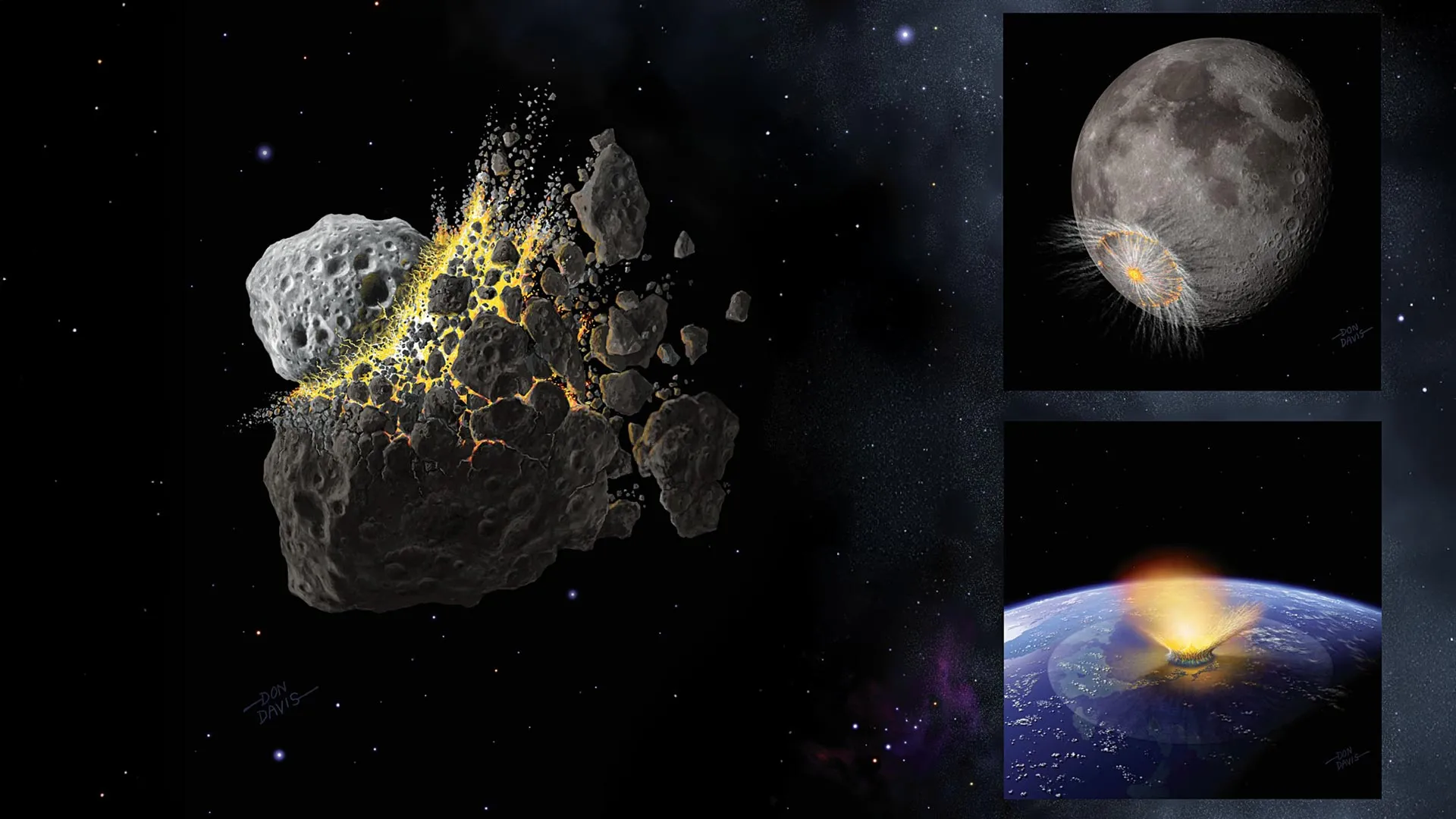
BOULDER, Colorado — Nearly 800 million years ago, deep within the silent abyss of the main asteroid belt situated between Mars and Jupiter, two massive celestial bodies collided in a catastrophe of unimaginable scale. The violent impact pulverized a primitive parent asteroid, initiating a cosmic chain reaction that would pelt the inner solar system with a relentless, multi-million-year storm of space debris.
According to a comprehensive study led by researchers at the Southwest Research Institute (SwRI), this ancient cataclysm sent vast clouds of fragmented rock hurtling toward Earth, the Moon, and Mars. Far from being a mere astronomical footnote, the ensuing bombardment may have fundamentally altered planetary geology, catalyzed seismic and volcanic upheavals, and perhaps even injected a volatile catalyst into Earth’s climate system and early biosphere.
While the modern scientific community has long understood that impact events can reshape worlds—most notably through the 6.1-mile-wide Chicxulub asteroid strike 66 million years ago that spelled doom for the non-avian dinosaurs—this newly modeled event points to a far more sustained planetary siege. By combining advanced dynamical modeling with lunar geology, scientists are beginning to reconstruct a hidden chapter of solar system history that connects the physics of the asteroid belt to the evolution of life on Earth.
Main Facts: The Eulalia Breakup and the Inner Solar System Barrage
At the heart of the SwRI-led discovery is the breakup of the parent body responsible for the Eulalia asteroid family. Primitive carbonaceous chondrite-like objects—asteroids rich in carbon, organic compounds, and water-bearing minerals—dominated this ancient collision.
When the parent body shattered, its physical location within the main belt proved to be the ultimate catalyst for disaster. The object sat precariously on the edge of the J3:1 mean motion resonance with Jupiter, a gravitational sweet spot defined by a ratio where an orbiting body completes three revolutions around the Sun for every one completed by the gas giant.
- The Trigger: A catastrophic collision in the main asteroid belt roughly 800 million years ago.
- The Culprit: The parent body of the Eulalia asteroid family, positioned on the brink of Jupiter’s J3:1 gravitational resonance.
- The Mechanism: Immediate gravitational scattering hurled roughly half of the resulting debris into Earth-crossing orbits, while thermal forces slowly fed more fragments into the resonance over the next 100 to 150 million years.
- The Planetary Toll: Due to its larger cross-section and stronger gravity, Earth absorbed approximately twenty large impacts for every single hit sustained by the Moon.
- The Timing: The peak of the impact wave coincides with a mysterious, prolonged period of global cooling and significant evolutionary shifts in Earth’s biosphere.
Chronology of a Cosmic Catastrophe: From Belt to Biosphere
Reconstructing events that occurred hundreds of millions of years ago requires an intricate stitching together of orbital mechanics, chronological dating, and geological forensics.
Phase One: The Impact (T = 0, ~800 Million Years Ago)
Two primitive, carbon-rich asteroids collide at staggering velocities in the main belt. The impact completely disintegrates the parent body of the Eulalia family, generating a vast cloud of shrapnel ranging from dust-sized particles to mountain-sized boulders.
Phase Two: The Immediate Escape (~800 to 795 Million Years Ago)
Because the fragmentation occurred right at the edge of the J3:1 resonance, roughly 50% of the newly liberated debris was captured almost instantaneously by Jupiter’s gravitational pull. The gas giant acted as a cosmic slingshot, distorting the fragments’ circular paths into highly eccentric, elongated orbits that routinely crossed the orbital trajectories of the inner rocky planets.
Phase Three: The Yarkovsky Drift (~795 to 650 Million Years Ago)
The celestial bombardment did not arrive as a single, brief shooting-star show. Instead, it unfolded as a grueling siege. Over the next 100 to 150 million years, an additional 25% of the remaining Eulalia fragments steadily migrated into the J3:1 resonance.
This slow migration was driven by the Yarkovsky effect—a subtle, thermal phenomenon where an asteroid absorbs sunlight and reradiates it as infrared energy. Because the heat escapes unevenly as the asteroid rotates, it creates a minute, continuous thruster-like force that alters the object’s orbital path over millions of years. This thermal drift continually fed fresh supplies of impactors into Earth-crossing trajectories.
Phase Four: Planetary Consequences (~800 to 650 Million Years Ago)
As the debris swept through the inner solar system, it battered all terrestrial worlds. While the Moon recorded these strikes in its static crust, Earth and Mars absorbed the brunt of the kinetic energy, triggering localized environmental stress, massive seismic shaking, and, in the case of Mars, concurrent surges in volcanic activity.
Supporting Data: Reading the Lunar and Terrestrial Archives
Proving that an asteroid shower occurred 800 million years ago is a formidable scientific challenge. On Earth, plate tectonics, persistent water erosion, volcanism, and weathering act as an aggressive geological eraser. Continents drift, ocean floors are subducted into the mantle, and surface landscapes are continually churned, leaving fewer than 200 confirmed impact structures on the entire planet—most of them geologically young.
To circumvent this missing terrestrial data, planetary scientists turned to Earth’s silent neighbor: the Moon.
The Moon as a Planetary Archive
Lacking an atmosphere, plate tectonics, or liquid surface water, the lunar surface is remarkably static. Craters formed billions of years ago remain sharply etched into its crust. By analyzing the estimated ages of major lunar impact basins and examining impact glass samples brought back by NASA’s Apollo missions, researchers established that the Moon experienced a sharp, unexplained surge in large impacts around 800 million years ago.
Impact glass forms when a high-velocity meteor strike generates extreme heat, flash-melting surrounding rock. As the molten material cools rapidly into glass, it locks in radiometric clocks and chemical fingerprints. By dating these glass beads, scientists can pinpoint when ancient impacts occurred.
Scaling Up to Earth
Once the lunar impact rate was quantified, researchers applied gravitational scaling laws to calculate Earth’s exposure. Because Earth possesses a significantly larger surface area and a much stronger gravitational pull than the Moon, it acts as a cosmic magnet for stray debris.
Calculations indicate that for every single large asteroid or comet that successfully struck the Moon, approximately twenty objects of comparable or greater size slammed into Earth. This means an intense lunar impact epoch translates to a staggering, apocalyptic bombardment on Earth, with hundreds of city-killer or continent-altering asteroids striking the planet over a span of roughly 150 million years.
Official Responses and Expert Perspectives
The study, which bridges the gap between celestial mechanics and terrestrial paleontology, has drawn significant attention from the planetary science community.
Dr. William Bottke, an executive director in SwRI’s Solar System Science and Exploration Division in Boulder, Colorado, and lead author of the research paper, emphasized the profound implications of connecting asteroid belt dynamics to the history of life.
"The role impacts have played in shaping the origin and evolution of life in our solar system is poorly understood," said Bottke, who also directs the Center for Lunar Origin and Evolution (CLOE) within NASA’s Solar System Exploration Research Virtual Institute.
"The heavily cratered surface of the Moon serves as a reminder of the large impacts in Earth’s past, but so far, only the Chicxulub impact event 66 million years ago has been strongly linked to a specific effect on life, namely the mass extinction of the dinosaurs."
Bottke pointed out that studying asteroid showers offers a unique window into epochs of planetary history that would otherwise remain opaque.
"These rare events, triggered by large, well-positioned collisions in the main asteroid belt, bombard all inner solar system worlds," Bottke explained. "So, evidence preserved on the Moon’s static surface can be used to infer what happened on Earth and Mars in ancient times."
Discussing the methodology behind identifying the Eulalia family as the source, Bottke noted the collaborative effort of his research team:
"Our cosmic forensics team used collisional and dynamical models to link these to the formation of the Eulalia asteroid family, when a primitive carbonaceous chondrite-like object collided with another object. The location of the parent asteroid was key—it broke up on the brink of the gravitational 3:1 mean motion resonance with Jupiter."
Implications: Climate, Biosphere, and Planetary Evolution
The alignment of this prolonged asteroid barrage with critical milestones in Earth’s history opens the door to fascinating new hypotheses regarding planetary evolution.
1. Environmental and Climatic Pressures
The peak of the Eulalia-driven impact storm roughly coincides with a geological era known for widespread global cooling, including severe glacial episodes often referred to by paleoclimatologists as "Snowball Earth" events. While the SwRI study does not definitively prove that the asteroid barrage caused these climatic shifts, the chronological overlap is too striking to ignore.
Frequent, massive impacts would have lofted billions of tons of pulverized rock, dust, and sulfur aerosols into the stratosphere, periodically dimming the Sun and triggering drastic cooling phases. Furthermore, carbonaceous chondrites—the very type of asteroids that made up the Eulalia family—carry abundant volatile compounds, water, and organic molecules, potentially altering atmospheric chemistry upon impact.
2. Biological Adaptation and Evolution
Evolutionary biologists have long debated the drivers behind major transitions in Earth’s biosphere. The Cryogenian period, spanning from roughly 720 to 635 million years ago, immediately followed this impact window and preceded the sudden diversification of complex multicellular life during the Ediacaran and Cambrian periods.
While catastrophic impacts are traditionally viewed strictly through the lens of destruction, persistent environmental stress can also act as an evolutionary pressure cooker, accelerating adaptation, driving speciation, and clearing ecological niches.
3. Seismic and Volcanic Shaking on Mars
The consequences of the Eulalia breakup were not restricted to Earth and the Moon. Mars, sitting on the outer edge of the inner solar system highway, would have experienced a heavy share of the debris.
According to the researchers, the impacts on the Red Planet would have triggered immense episodes of seismic shaking capable of fracturing planetary crusts on a global scale. Intriguingly, the timing of these impacts correlates with a documented surge in ancient Martian volcanic activity, suggesting that heavy bombardment may have penetrated the Martian lithosphere, prompting mantle plumes and widespread volcanism.
Looking Ahead: The Future of Impact Forensics
As planetary science advances, researchers plan to test these models further by targeting upcoming sample-return missions and high-resolution lunar mapping initiatives. By analyzing pristine samples from unvisited lunar craters and refining dynamical models of the main asteroid belt, scientists hope to piece together a definitive timeline of the solar system’s most violent eras.
For now, the research serves as a humbling reminder of our cosmic interconnectedness. The quiet, distant realm of the main asteroid belt—often perceived as a static field of floating space rocks—is capable of sudden, violent upheavals that send ripples across millions of miles of vacuum, ultimately writing and rewriting the evolutionary stories of worlds like Earth, the Moon, and Mars.
