

By Global Science Correspondent
Published in association with scientific reporting standards
Main Facts
For centuries, subterranean aquatic chambers have acted as nature’s quietest archives, swallowing up the remains of prehistoric beasts, modern livestock, and native fauna alike. Yet, despite holding extraordinary records of Earth’s distant past, these submerged graveyards have long frustrated paleontologists and archaeologists.
Until now, scientists lacked a reliable, standardized framework to determine how the bones of extinct megafauna and other animals accumulated, survived, and transformed within these complex aquatic ecosystems.
A landmark study led by researchers at Griffith University has fundamentally changed this dynamic. Published in the peer-reviewed journal PLOS One under the title "Neotaphonomic characteristics of vertebrate site formation in underwater caves," the research provides the scientific community with a robust, multi-layered diagnostic framework. By systematically decoding the physical, chemical, and biological "fingerprints" left on skeletal remains in underwater environments, researchers can now accurately reconstruct the history of these bone deposits.
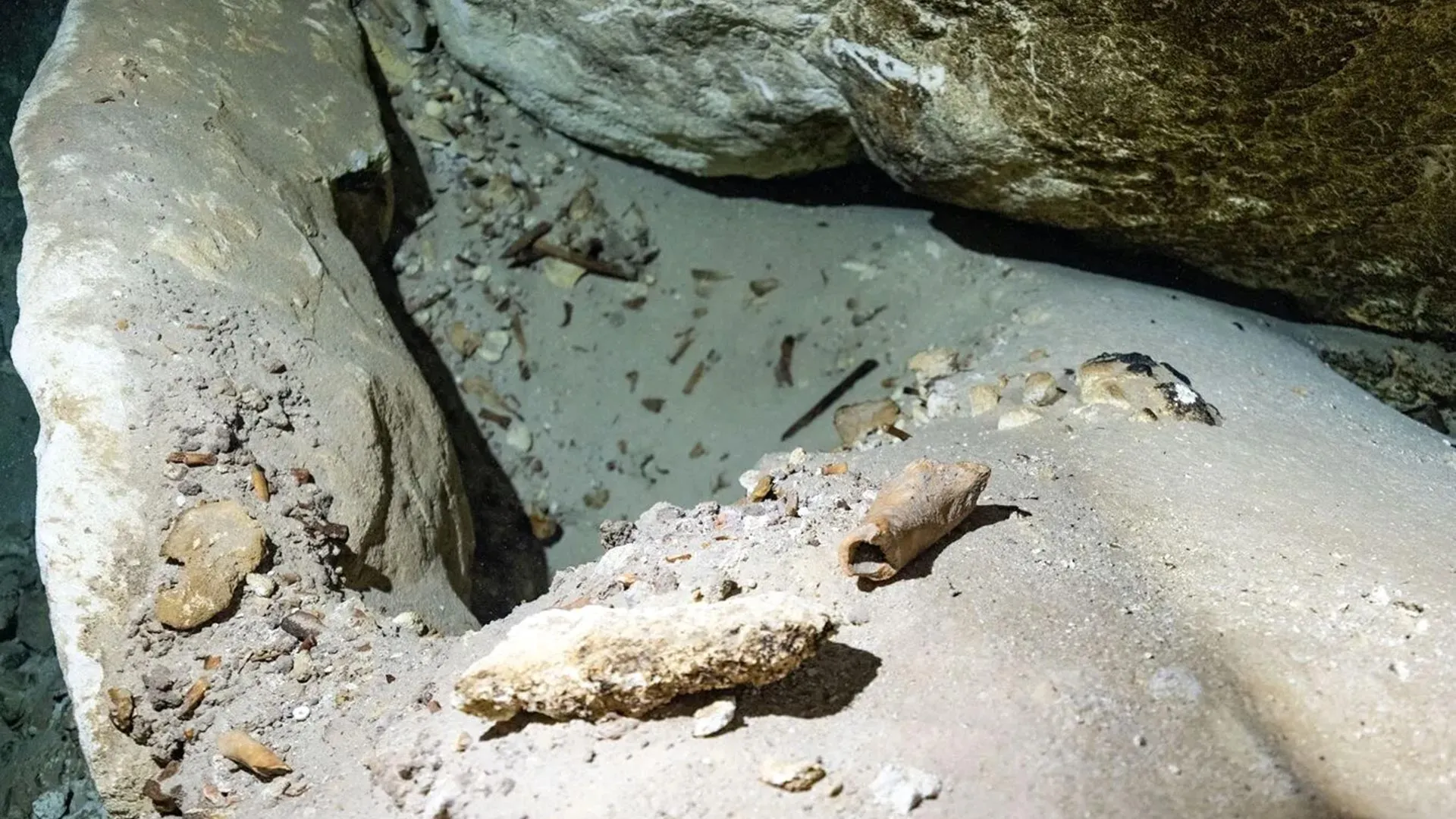
The study, spearheaded by Meg Walker—a PhD candidate at the Australian Research Centre for Human Evolution (ARCHE)—focuses on animal bones recovered from two distinct underwater cave systems in South Australia: Green Waterhole and Gouldens Sinkhole. Collaborating closely with elite cave divers from the Cave Divers Association of Australia, the research team analyzed a diverse assemblage of vertebrate remains. These ranged from native marsupials like kangaroos, possums, quolls, and swamp rats to introduced species including cows, sheep, pigs, rabbits, and dingoes.
The findings reveal that underwater caves are far from chaotic; rather, they are highly specialized preservation chambers. While dry caves suffer from surface weathering, root etching, and terrestrial bacterial consumption, submerged caves preserve bone integrity in remarkably specific ways. The degree and type of modification depend heavily on environmental gradients, particularly light penetration and biological activity within the water column.
This new interpretive model bridges a critical gap in paleontology, giving scientists a powerful new lens through which to analyze not only modern faunal remains, but also the ancient, fragile fossils of long-extinct megafauna.
Chronology
To understand how bones behave inside underwater environments over extended periods, the research team adopted a neotaphonomic approach—studying contemporary and historical remains to model ancient processes.
The 1840s Baseline: Historical Accumulation
The timeline of the South Australian cave specimens is tied directly to the colonial history of the region. Following the arrival of European settlers and the founding of Mount Gambier in the 1840s, the local ecosystem shifted dramatically. Livestock, domestic pests, and introduced predators joined the native fauna.
Over the decades, animals fell, wandered, or were washed into the gaping vertical shafts of local sinkholes and limestone caves. Some of the bones recovered by the dive teams date back to this early settlement period, providing a known chronology spanning roughly 180 years. This precise temporal window allowed researchers to track how skeletons accumulated, settled, and underwent modification over decades and centuries.
The Dive Operations and Specimen Recovery
The fieldwork required specialized expertise. Navigating narrow, lightless, and structurally complex underwater tunnels is hazardous, requiring advanced technical cave-diving training. Working alongside the Cave Divers Association of Australia, Walker and her colleagues descended into Green Waterhole and Gouldens Sinkhole.
Divers mapped the spatial distribution of the bones resting on the cave floors, carefully logging their positions relative to cave walls, underwater currents, and sediment layers. Selected specimens were then painstakingly recovered without disturbing the delicate underwater stratigraphic context.
Multi-Scale Laboratory Analysis
Once brought to the surface, the bones underwent a rigorous, multi-tiered analytical sequence in the laboratory. The researchers examined the specimens across multiple scales, moving from macro-level structural assessments to micro-level elemental and molecular testing:
- Macro-analysis: Visualizing spatial distributions, surface fracturing, abrasion patterns, and macro-borings.
- Micro-analysis: Utilizing high-powered microscopy to inspect bone surfaces for microscopic microbial alterations, mineral crusts, and plant colonization.
- Chemical and Molecular testing: Analyzing elemental compositions and extracting proteins trapped within ancient cellular structures to determine how aquatic chemistry alters bone chemistry over time.
Supporting Data
The comparative data generated by the Griffith University study highlights stark differences between how bones degrade in dry terrestrial caves versus submerged aquatic systems.
The Aquatic Signature
When bone is submerged in water, its degradation pathway shifts entirely away from subaerial weathering. The research demonstrated that underwater caves can preserve skeletal remains with astonishing fidelity. In many instances, the bones retained their original structural integrity and displayed finely detailed surface morphology.
However, this preservation is far from uniform; it is dictated by micro-habitats within the cave system:
- The Photic Zone (Lit Areas): Near brightly lit cave entrances, sunlight penetrates the water, enabling various species of algae and aquatic plants to thrive. These organisms actively colonize the surfaces of submerged bones. As they grow and interact with the bone matrix, they leave behind distinctive biological signatures—etched patterns and organic residues that tell researchers the bone sat in a well-lit, shallow part of the cave.
- The Aphotic Zone (Total Darkness): Deep within the "midnight regions" of the caves, where sunlight never penetrates, plant life is entirely absent. Free from photosynthetic organisms and many light-dependent biological agents, bones deposited in these pitch-black depths often remain in pristine condition, showing minimal surface degradation over a century or more.
The Terrestrial Contrast
In stark contrast, bones recovered from dry, terrestrial caves exhibited an entirely different suite of taphonomic markers. Lacking the protective, stable chemistry of stagnant or slowly moving subterranean water, dry cave bones showed no aquatic signatures. Instead, they bore the unmistakable scars of a terrestrial struggle:
- Bacterial Consumption: Land-based bacteria actively consumed and degraded parts of the organic bone matrix.
- Root Etching: Plant roots, seeking moisture and nutrients, crept down into the caves and carved long, meandering grooves across the surfaces of the bones.
- Subaerial Weathering: Exposure to fluctuating humidity and seasonal temperature changes caused cracking, flaking, and structural delamination.
Official Responses and Expert Insights
The study has drawn widespread praise from the international paleontological and archaeological communities, who have long sought a reliable framework to decode underwater fossil deposits.
"By analyzing animal bones from two underwater cave systems in South Australia, we have revealed how different cave environments leave distinct preservation ‘fingerprints’ on skeletal remains," said Meg Walker, lead author and PhD candidate at ARCHE.
Walker emphasized the meticulous nature of the research, noting how combining historical timelines with high-resolution laboratory techniques allowed the team to reverse-engineer the taphonomic process.
"Backed by radiocarbon-dated bones, we tracked how skeletons accumulated and were modified over decades and centuries in underwater caves, then compared them to those buried in dry caves," Walker explained. "Using a range of methods, from the macro to the micro, we looked at features associated with wet and dry caves—things like spatial distributions of the bones and their surfaces, down to elemental compositions and proteins trapped in ancient cells."
Professor Julien Louys, Director of the Australian Research Centre for Human Evolution (ARCHE) and Walker’s PhD supervisor, highlighted the broader significance of the methodology.
"This study has delivered the first framework for interpreting how megafauna fossils formed, survived, and changed in underwater caves," Professor Louys stated. "It will provide archaeologists and paleontologists worldwide with a powerful new tool for reconstructing past environments and histories in these challenging conditions."
Implications
The publication of this research in PLOS One marks a turning point for several scientific disciplines, opening up new avenues for discovery across the globe.
Unlocking Megafauna Mysteries
Australia and other parts of the world boast rich repositories of extinct megafauna—giant wombats (Diprotodon), marsupial lions (Thylacoleo), and giant short-faced kangaroos (Procoptodon)—whose remains frequently turn up in sinkholes and flooded cave systems. Historically, scientists struggled to determine whether these creatures fell into the caves naturally, were dragged in by predators, or were washed in by ancient flash floods.
By applying the new taphonomic framework, researchers can now read the physical and chemical markers on ancient megafauna bones with unprecedented accuracy. This will allow scientists to reconstruct the exact pathways by which these prehistoric creatures entered the caves, providing clearer pictures of past ecosystems, predator-prey dynamics, and mass-mortality events.
Reconstructing Past Environments (Paleoclimatology)
Because bones act as chemical sponges, absorbing elements and organic molecules from their surrounding environments, the preservation "fingerprints" identified in this study offer a window into paleoclimatology. By analyzing the micro-chemical changes and protein survivability in submerged bones, scientists can infer ancient water chemistry, temperature fluctuations, and hydrological shifts over tens of thousands of years.
A Global Standard for Subterranean Research
Underwater caves are notoriously difficult and dangerous environments to study. Until now, interpretations of bone assemblages recovered from these sites were often speculative, hindered by a lack of comparative baselines.
This study establishes a rigorous scientific benchmark. Archaeologists and paleontologists working in flooded cave systems from the cenotes of Mexico to the submerged karst systems of Europe and the Mediterranean now have a standardized diagnostic guide. They can evaluate their own finds against the South Australian baseline, ensuring greater consistency and accuracy in global prehistoric research.
As researchers continue to deploy these new methods, the dark, silent depths of the Earth’s underwater caves are finally beginning to surrender the deep historical secrets they have guarded for millennia.
