

Published August 12, 2026
In the vast and intricate landscape of Hatha Yoga, practitioners frequently find themselves traversing a physical and mental labyrinth. With every new posture, the practitioner steps away from the comfort of known mechanics and enters a world of nebulous sensations, shifting balances, and geometric demands. Among all standing postures, however, few present as formidable a structural challenge as Pyramid Pose, or Parsvottanasana.
According to archival insights originally published in Yoga Journal’s May–June 1989 issue, achieving and maintaining proper pelvic alignment in Pyramid Pose remains one of the most elusive milestones in a yogi’s repertoire. Far from a simple forward bend, Parsvottanasana serves as a masterclass in spatial awareness, demanding an intricate understanding of how the pelvis moves in relation to the femur bones, the spine, and the earth.
Main Facts: The Anatomy of the Pelvic Gateway
The foundational thesis of classical alignment theory posits that the body itself is a map, and the pelvis is the gateway through which structural integrity is maintained. While practitioners easily establish a sense of alignment in foundational postures like Mountain Pose (Tadasana)—where the pelvis lifts gracefully off the thighs and the inner legs lengthen firmly from the groins to the floor—transitioning into asymmetrical or forward-bending postures often causes this internal compass to fail.
When transitioning blindly into forward folds, practitioners frequently commit structural errors:
- The Arching Back: The lumbar spine pulls away from the legs instead of lengthening.
- Abdominal Bloating: The abdomen pushes forward uncomfortably, creating a heavy, downward pressure on the thighs.
- Pelvic Asymmetry: In poses like Pyramid, one side of the pelvis naturally rotates forward and down while the opposite side tilts up and back, creating an unlevel foundation.
By shifting focus away from merely "reaching the floor" and toward lifting the pelvis up and away from the thighbones, practitioners can unlock space within the hip sockets. This single biomechanical adjustment transforms forward bends from forced, strain-heavy stretches into natural, passive extensions of the spine.
Chronology: Tracing the Evolution of Movement from Mountain to Pyramid
To understand the mechanics of Pyramid Pose, instructors advise tracing pelvic movement chronologically through increasingly complex postures. This progressive mastery builds the neural pathways and muscle memory required for safe execution.
Phase 1: The Baseline (Tadasana to Uttanasana)
The journey begins in Mountain Pose. When transitioning into Standing Forward Bend (Uttanasana), placing hands directly on the front hip bones reveals the correct directional cue: instead of pressing the abdomen downward, the practitioner must visualize lifting the pelvis up and away from the fingers. This immediately activates the legs, creates space in the hip joints, and allows the torso to fold organically.
Phase 2: Seated Explorations
The principle of pelvic lift is reinforced in seated postures such as Seated Forward Bend (Paschimottanasana) and Open Angle Pose (Upavista Konasana). By pressing the sitting bones back into the floor while lengthening the torso forward, the abdomen pacifies, spinal strain is eliminated, and the hamstring stretch deepens safely.
Phase 3: Transitioning to Open-Hip Standing Poses
Before tackling the closed-hip geometry of Pyramid Pose, the pelvic lift must be mastered in open-hip standing variations:
- Triangle Pose (Utthita Trikonasana): Lifting the pelvis away from the front thigh prevents the weight of the torso from crushing the front leg, thereby averting hyperextension of the knee.
- Side Angle Pose (Utthita Parsvakonasana): Creating space in the hip socket relieves painful groin compression on the bent leg.
- Half Moon Pose (Ardha Chandrasana) & Warrior III (Virabhadrasana III): Lifting the pelvis back and off the standing leg as the spine reaches forward dramatically improves balance and stability.
Supporting Data: Step-by-Step Variations for Pyramid Pose
Because Parsvottanasana requires squaring the hips while folding forward over a straight front leg, it presents unique challenges for beginners and those with tight hamstrings or lower back issues. Practitioners can utilize a systematic progression of structural supports to master the pose safely.
1. The Wall Preparation (For Beginners and Tight Hamstrings)
- Setup: Stand in Mountain Pose facing a wall, approximately 18 inches away. Step the left foot back one full stride, aligning the arch of the left foot with the heel of the right.
- Execution: Inhale to raise the arms overhead, expanding the upper chest. Exhale, lift the pelvis off the thighs, hinge from the hip joints, and place the hands evenly on the wall.
- Alignment: Keep the torso parallel to the floor, draw the pelvis back away from the shoulders, and broaden the back ribcage. Hold for 30 seconds before switching sides.
2. The Strap Support (For Lower Back Relief)
- Setup: Create a large loop using a 6-to-7-foot strap or rope (or hook it over a set of doorknobs). Step inside the loop with your back to a wall or door edge, holding the strap.
- Execution: Step the right leg forward so the strap presses firmly across the hip crease, supporting the pelvis. Raise the arms on an inhalation, lengthen the torso forward on an exhalation, and rest the hands on a chair or blocks.
- Benefit: Allow the torso to hang passively from the strap to release lower back tension. Once lengthened, press the right foot down and lift the pelvis away from the strap to deepen the hip socket extension.
3. The Hands-On Pelvic Leveling Variation
- Setup: Stand in Mountain, spring feet 3 to 3.5 feet apart. Turn the left foot in 30 degrees and the right foot out 90 degrees. Turn the torso to face the right leg.
- Execution: Place fingers on the front corners of the pelvic rim. Notice how the right pelvis drops forward and down while the left tilts up.
- Correction: As you fold forward, actively guide the right side of the pelvis up, back, and away from your right hand, while driving the left side forward into your left hand. Place hands on the floor or blocks once squared.
4. Advanced Variations: Interlocked Fingers and Namaste Arms
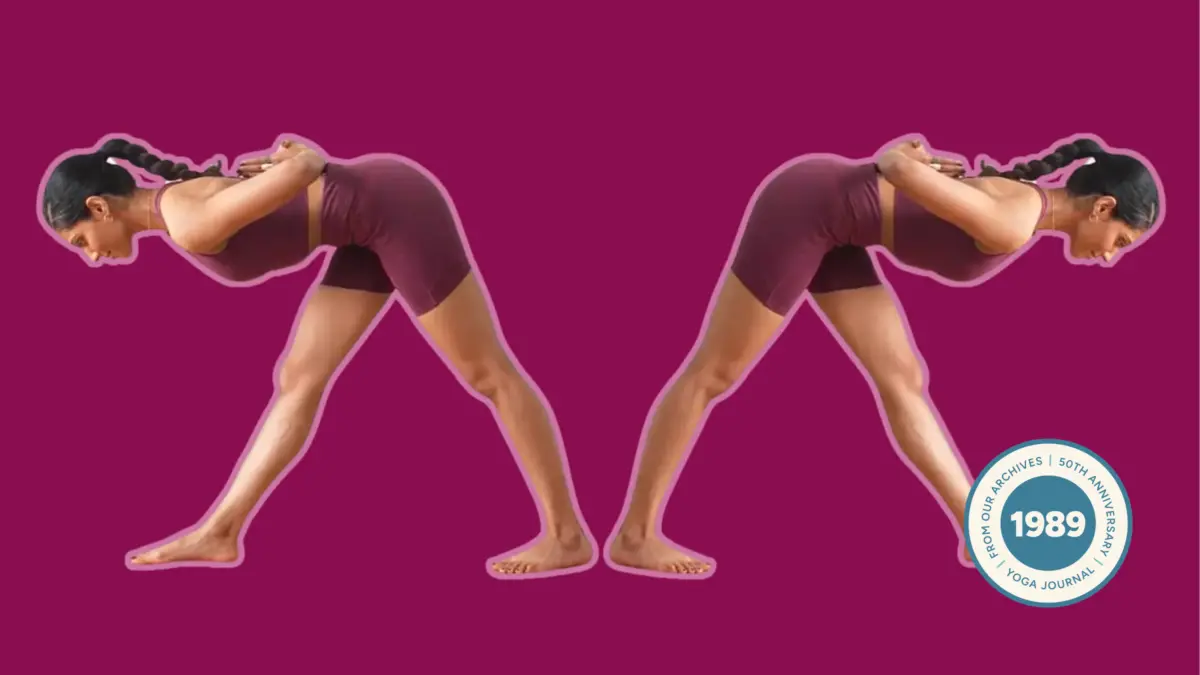
- For the Intermediate Practitioner: Start with feet 3.5 feet apart, turn the torso toward the front leg, and interlock the fingers behind the back. Draw shoulder blades down, open the chest, and fold forward with a flat back, ultimately bringing the head toward the shin.
- For the Advanced Practitioner: Begin in Mountain with hands in Namaste behind the back (or clasping elbows). Spring the feet apart, square the hips, and extend the torso forward while maintaining palm contact. Raise the elbows toward the ceiling to draw the head to the shin, surrendering the weight of the brain and torso into stillness.
Official Perspectives: The Philosophy of Instruction
In the realm of somatic education and advanced yoga practice, external cues are never absolute destinations; they are merely navigational tools. Drawing from Charles V. W. Brooks’ seminal work on Sensory Awareness, archival philosophy warns against treating yoga as a rigid performance checklist:
"Very many of us have been taught how to stretch—as though there could be a method for this simplest and most spontaneous of all expressive movements. We must start in an entirely different way. We must first come to enough inner quiet so that we can feel what may really be needed at this moment. Then stretching will become discovery and not performance, a meditation instead of an exercise."
When a practitioner successfully integrates a new alignment cue, the mind experiences a brief window of heightened clarity. However, as muscles quickly adapt to repetitive patterns, that initial spark of neurological freshness fades. True progress occurs when practitioners use these moments of heightened alertness to cultivate internal creativity rather than rote muscle memory.
Implications: The Inherent Logic of Bodily Discovery
The ultimate implication of disciplined, mindful alignment practice extends far beyond physical flexibility. When a student works with a single anatomical image—such as lifting the pelvis away from the thigh—across a continuum of poses, a profound shift occurs in breath, spinal extension, and mental focus.
Over time, this methodical exploration reveals an orderly, secret network within the body. The discoveries made on the mat do not manifest randomly; rather, they unfold according to an astonishing inner logic. This inherent bodily intelligence suggests a higher, intuitive framework locked within every practitioner—one that teaches the individual, day by day, precisely what they need to know next on their inward journey.
