

Introduction and Main Facts
The debate over how autonomous vehicles should perceive the world has defined the modern automotive technology landscape for over a decade. At the heart of this discussion lies a fundamental philosophical divide: Is human-level biological vision sufficient for full autonomy, or does achieving true, uncompromised safety require a redundant suite of active and passive sensors?
This debate was thrust back into the spotlight during a comprehensive 49-minute presentation by Waymo Co-CEO Dmitri Dolgov at a recent Y Combinator event. While the early portions of Dolgov’s talk addressed the grueling realities of scaling autonomous software—famously noting that "the demo is only 1% of the work"—his remarks regarding sensor architecture deliver a clear and deliberate challenge to industry rivals, most notably Tesla.
Dolgov explicitly defended Waymo’s reliance on a multi-modal sensor suite comprising cameras, radar, and lidar. In doing so, he drew a sharp line in the sand, arguing that vision-only systems will ultimately hit a safety ceiling that prevents them from achieving robust, "strongly superhuman" performance.
Chronology of the Sensor Debate
To understand the weight of Dolgov’s recent statements, it is necessary to look back at how the autonomous vehicle (AV) industry has evolved:
- The Early 2010s (The Birth of Multi-Modal AVs): Pioneering projects—including Google’s self-driving car project (which later became Waymo)—embraced expensive mechanical lidar units alongside cameras and radar to build high-definition 3D maps and detect obstacles.
- The Mid-2010s to Late 2010s (Cost and Scalability Concerns): As companies attempted to commercialize autonomous driving, the high cost of custom lidar systems became a primary bottleneck. Competitors split paths: some doubled down on refining sensor fusion, while others sought cheaper alternatives.
- The Rise of the Vision-Only Philosophy: Tesla, under the leadership of Elon Musk, pivoted aggressively away from radar and lidar. Musk argued that because humans navigate complex driving environments using only biological eyes (passive optical sensors) and a neural network, computers should be able to do the same using cameras alone. Tesla eventually stripped radar from its production vehicles and never integrated lidar, relying entirely on camera suites and neural networks for its Full Self-Driving (FSD) software.
- The Present Day (The Divergence Reaches a Head): Waymo’s commercial robotaxi operations continue to expand safely across major metropolitan areas using a robust sensor mix, while Tesla continues to push its vision-based FSD suite toward unsupervised autonomy. Dolgov’s recent Y Combinator presentation marks a renewed, public defense of multi-sensor redundancy, reigniting the public and technical debate.
Supporting Data and Technical Analysis
During his presentation at the 16-minute mark, Dolgov dissected the engineering rationale behind Waymo’s hardware choices. He acknowledged the core philosophical argument of vision-only advocates—that humans drive using only eyes, proving that biological vision is theoretically sufficient for driving. However, he introduced a crucial caveat regarding the target level of performance.
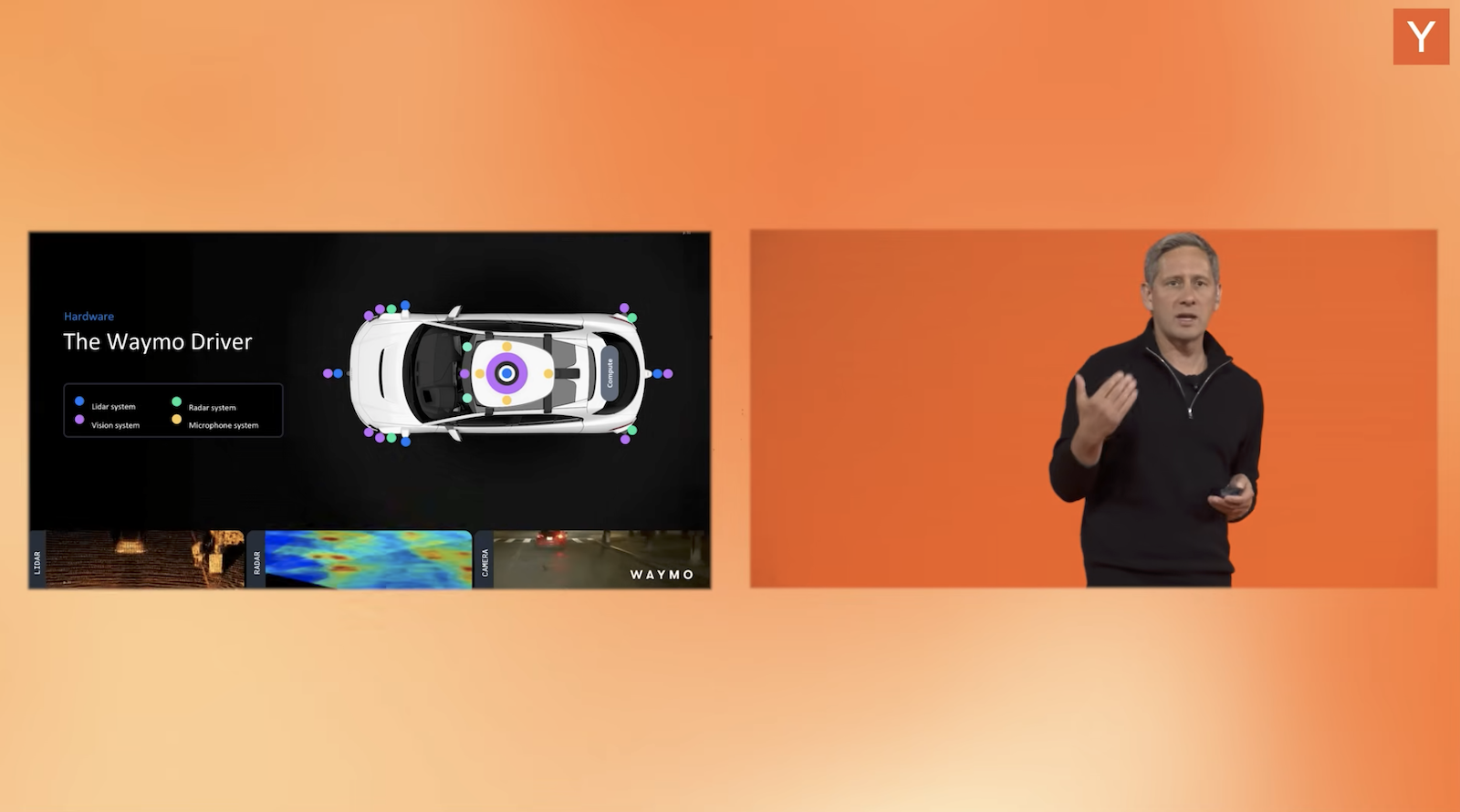
"If the goal were just to approximately match human performance, or to build an assist product, that’s a very reasonable way to go. However, if you are targeting full autonomy, and you’re targeting superhuman — strongly superhuman performance — you find that weak sensing just leads to a safety curve that flattens out way too early."
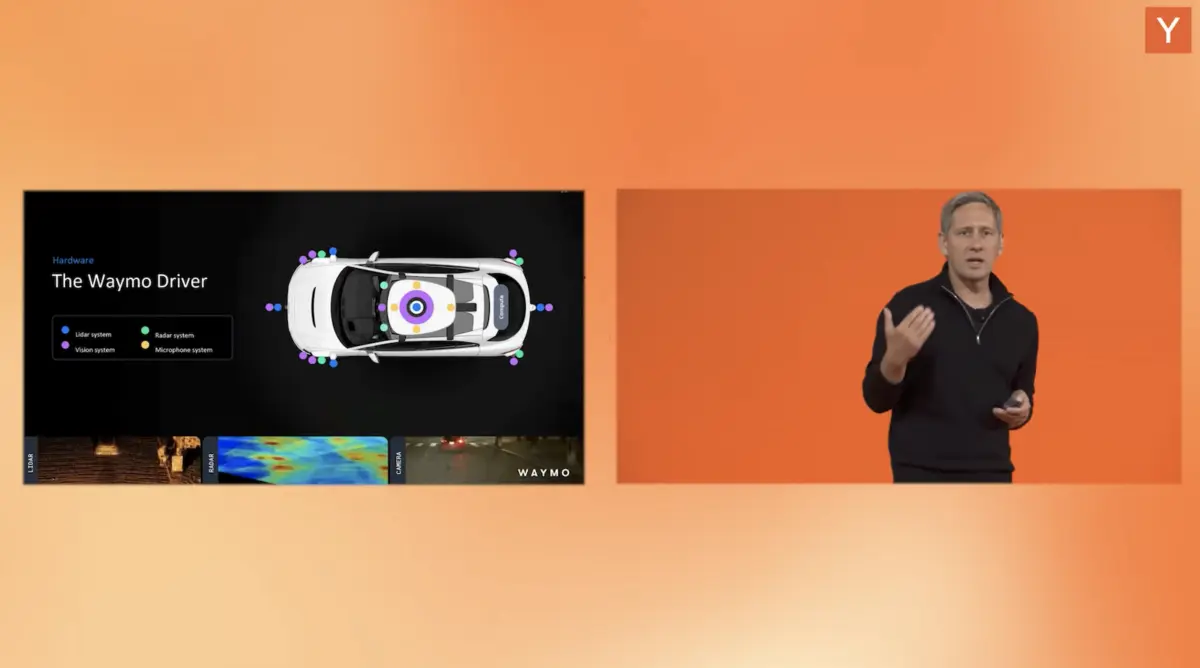
To achieve that "strongly superhuman" safety threshold, Dolgov explained how Waymo’s three primary sensor modalities complement one another to eliminate blind spots and environmental vulnerabilities:
1. Cameras (Passive Optical)
- Strengths: Provide high spatial resolution and rich color data, making them essential for reading road signs, traffic lights, and lane markings.
- Limitations: Being passive sensors, their performance degrades significantly in low-light conditions, pitch darkness, or when compromised by glare (such as driving directly into a blinding sunset) or severe weather.
2. Lidar (Active Light Detection and Ranging)
- Strengths: Emits laser pulses to measure the precise 3D structure of the environment surrounding the vehicle. It provides exact distance and geometry measurements independent of ambient lighting conditions.
- Limitations: Historically expensive, though manufacturing costs have dropped significantly over the years.
3. Radar (Active Radio Detection and Ranging)
- Strengths: Uses radio waves that excel at punching through adverse environmental conditions like heavy fog, torrential rain, and snow. Furthermore, radar can directly measure velocity vectors using the Doppler effect.
- Limitations: Offers lower resolution compared to cameras and lidar, meaning it cannot easily classify fine-grained objects on its own.
By combining these technologies, Waymo ensures that if one sensor modality is degraded—for instance, if a camera is blinded by glare—active sensors like lidar and radar maintain spatial awareness. Dolgov emphasized that active sensors "see just as well in pitch darkness," providing a layer of physical redundancy that passive optical systems inherently lack.
Industry and Official Responses
Dolgov’s remarks have reignited polarising reactions across the tech and automotive sectors.
- The Waymo Perspective: Waymo’s official engineering stance remains steadfast: safety-critical commercial robotaxi deployments carrying paying passengers without a safety driver require deterministic redundancy. Relying solely on software algorithms to interpret optical data without independent depth and velocity verification via lidar and radar introduces edge-case risks that Waymo’s leadership considers unacceptable.
- The Tesla Perspective: While Tesla representatives did not issue a real-time rebuttal to Dolgov’s specific presentation, the company’s public doctrine—championed frequently by Elon Musk—has long maintained that lidar is a "crutch" and a "fool’s errand" that distracts from solving the fundamental AI problem. Tesla argues that solving computer vision via end-to-end neural networks trained on massive vehicle fleets is the only scalable path to global autonomy, because human roads are explicitly designed for biological vision.
- The Broader AV Community: Independent autonomy researchers remain divided. Many safety advocates align with Dolgov, arguing that commercializing driverless transit demands defense-in-depth engineering. Conversely, cost-conscious automakers looking to scale consumer passenger vehicles lean toward vision-centric or reduced-sensor configurations to keep consumer price points viable.
Implications for the Future of Autonomous Mobility
The ongoing divergence between Waymo’s multi-sensor fusion and Tesla’s vision-only approach carries massive implications for the future of transportation, consumer trust, and regulatory approval.

1. Regulatory Scrutiny and Safety Validation
Regulators examining autonomous vehicle deployment look closely at sensor redundancy. Waymo’s ability to secure commercial permits in dense, complex urban environments (such as San Francisco, Phoenix, Los Angeles, and Austin) has been heavily bolstered by its comprehensive safety case, which explicitly relies on multi-modal sensing to handle unpredictable edge cases. If regulatory bodies adopt stricter safety baselines, vision-only systems may face higher hurdles to proving equivalent risk mitigation.
2. Cost vs. Capability Trade-Offs
The economic implications of this debate are profound. Multi-sensor suites equipped with automotive-grade lidar and radar are undeniably more expensive to manufacture and maintain than camera-only configurations. Tesla’s strategy aims for mass-market affordability, enabling a software update to turn consumer cars into autonomous assets. Waymo’s current hardware payload is tailored for fleet operations where safety and operational uptime outweigh initial vehicle acquisition costs. However, as solid-state lidar prices continue to fall, the cost gap between these two philosophies is narrowing.
3. The Public Perception Battle
Dolgov’s comments essentially challenge the narrative built around consumer "Full Self-Driving" packages. By publicly stating that weak sensing architectures lead to a safety curve that "flattens out way too early," Waymo is preparing consumers and enterprise partners to evaluate autonomous systems not by their marketing titles, but by their underlying physical capabilities. As both companies scale toward their respective visions of the future, the streets will ultimately serve as the final judge of whether biology-inspired vision or multi-modal redundancy holds the definitive key to safe, universal autonomy.
