

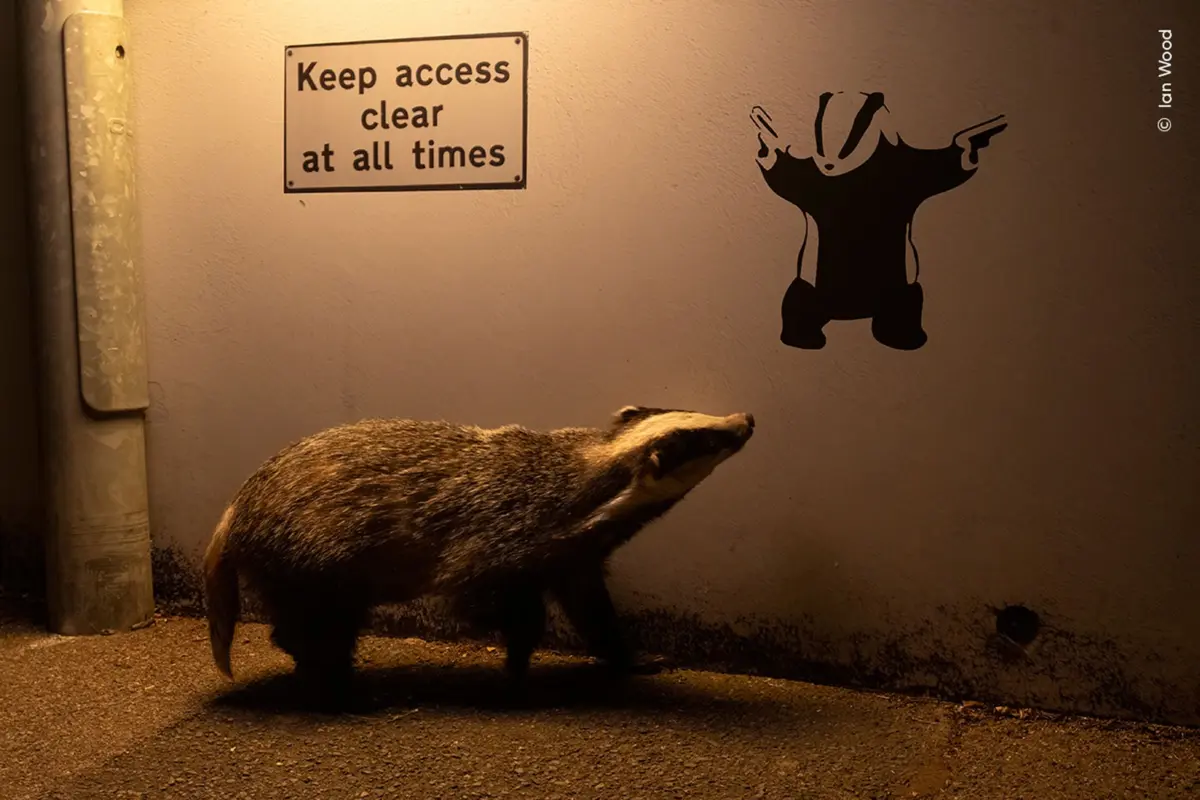
LONDON — In a milestone year that saw a record-shattering global engagement, the prestigious Wildlife Photographer of the Year (WPOTY) competition has crowned its latest People’s Choice winner. British photographer Ian Wood has captured the imagination of over 76,000 nature enthusiasts worldwide with his evocative, lamplit image titled ‘No Access’. The winning photograph features an ambling Eurasian badger glancing inquisitively upward at a piece of striking graffiti in the coastal town of St Leonards-on-Sea, East Sussex.
The announcement, made by the Natural History Museum in London, marks the tenth anniversary of the People’s Choice Award. While the photograph has been celebrated for its artistic merit and its humorous juxtaposition of urban grit and rural wildlife, it also serves as a poignant Trojan horse—carrying a heavy conservation message regarding the controversial badger cull currently sweeping parts of the English countryside.
Alongside Wood’s triumph, four other highly commended finalists captured global attention, showcasing the breathtaking diversity, raw power, and ethereal beauty of the natural world. Together, these five images represent the pinnacle of modern wildlife photography, hand-picked from nearly 60,000 submissions entered into the landmark 60th edition of the competition.
Main Facts: The Triumph of ‘No Access’
The winning photograph, ‘No Access’, is a masterclass in patience, timing, and environmental storytelling. Shot on a quiet, dimly lit pavement in St Leonards-on-Sea, the image portrays a lone Eurasian badger (Meles meles) illuminated solely by the warm, amber glow of an overhead streetlamp. As the mammal ambles along the concrete path, it pauses to cast a curious glance upward toward a familiar piece of local graffiti.
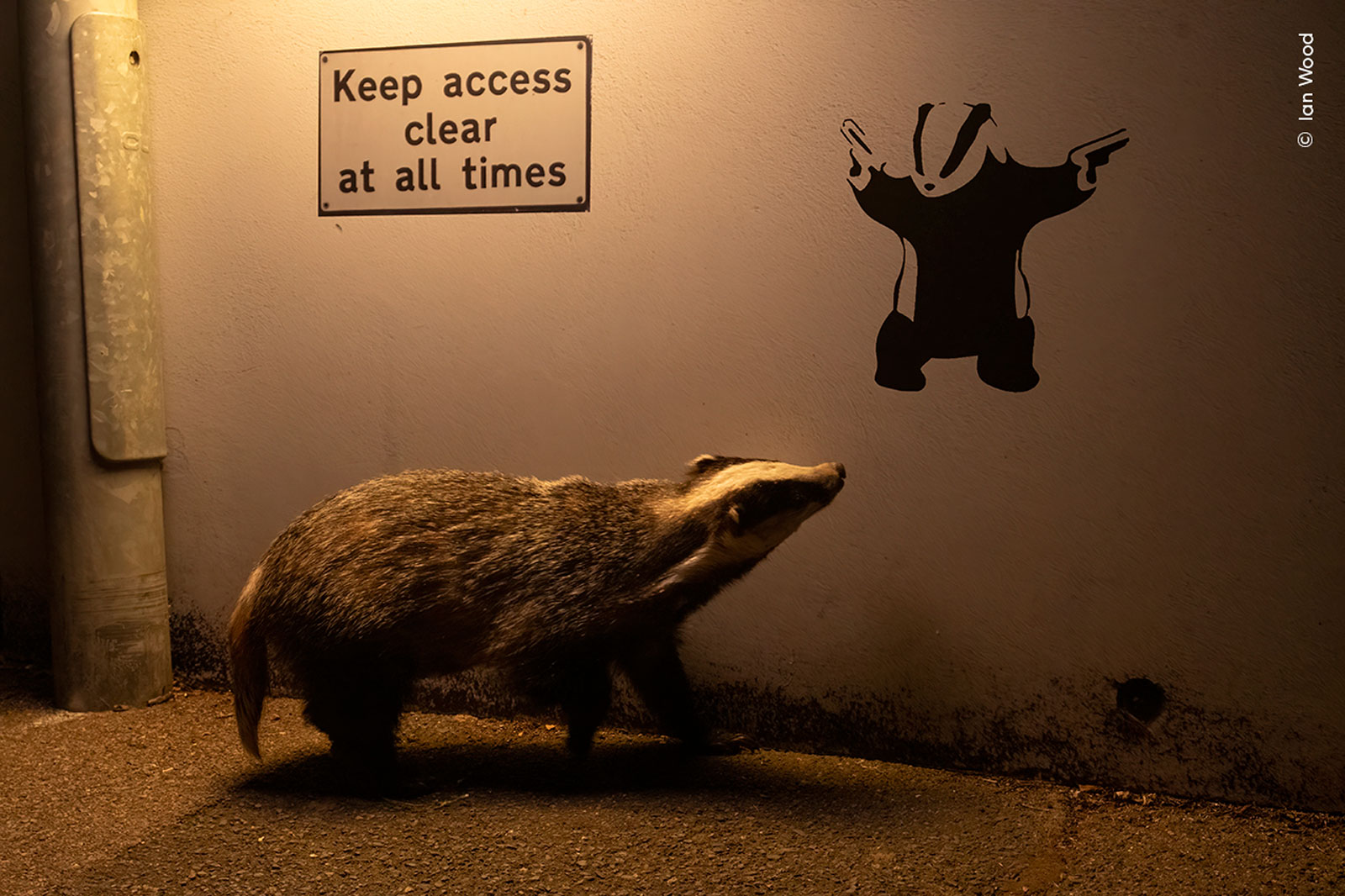
The triumph is significant on several fronts:
- Global Engagement: More than 76,000 nature and photography fans cast their votes online and at the Natural History Museum, marking a record-breaking turnout for the People’s Choice Award.
- Elite Selection: ‘No Access’ emerged as the favorite out of a fiercely competitive shortlist of 25 images, which had been curated by an international panel of experts from a pool of roughly 60,000 global entries submitted to the 60th Wildlife Photographer of the Year competition.
- Exhibition Status: The winning photograph, alongside the four highly commended finalist images, will remain on prominent display—both online and via interactive voting screens—at the flagship Wildlife Photographer of the Year exhibition at the Natural History Museum in London until June 29, 2025.
Dr. Douglas Gurr, Director of the Natural History Museum, praised the winning frame for its layered narrative. "Ian’s flawlessly timed image offers a unique glimpse of nature’s interaction with the human world, underscoring the importance of understanding urban wildlife," Dr. Gurr remarked. "His exceptional photograph serves as a powerful reminder that local nature and wildlife, often just outside our homes, can inspire and captivate us."
Chronology: From Suburban Scraps to Global Acclaim
The journey to ‘No Access’ spans months of careful observation, local adaptation, and photographic perseverance.
The Urban Foraging Shift
The story behind the image begins in the urban neighborhoods of St Leonards-on-Sea. Residents in the area had long practiced the habit of leaving food scraps on pavements and doorsteps to feed local urban foxes. Over time, however, this accessible bounty caught the attention of unexpected neighbors: Eurasian badgers descending from a nearby woodland sett to forage in the concrete labyrinth of the town.

Ian Wood, attuned to the shifting behavioral patterns of local wildlife, noticed badgers regularly navigating the urban landscape under the cover of darkness. He observed one particular badger frequently walking along a pavement bordered by a weathered brick wall adorned with graffiti. Recognizing the potential for a compelling compositional statement—the intersection of wild biology and anthropogenic art—Wood resolved to capture the scene.
The Stakeout
Photographing nocturnal urban wildlife requires meticulous planning to avoid disturbing the animals while securing optimal lighting. Wood set up a discreet, small photographic hide on the edge of the road, positioning his camera to frame the graffiti and the pavement below.
Operating late at night with minimal gear, he relied entirely on the ambient wash of a municipal lamppost to illuminate the scene. Success hinged on a fleeting window of opportunity: the badger needed to walk through the narrow pool of lamplight and pause just long enough to look upward, creating a moment of eye contact between viewer and subject. That precise fraction of a second resulted in the award-winning frame.
The Vote and the Reveal
Once shortlisted by the Natural History Museum’s judging panel, ‘No Access’ entered the public arena for the People’s Choice vote. As the weeks progressed, the image struck a chord with voters navigating the modern realities of human-dominated landscapes. When the final tallies were counted in early 2025, Wood’s badger was crowned the winner of the tenth People’s Choice Award, launching the photographer—and his conservation agenda—onto the global stage.
Supporting Data: The 2024–2025 Finalists
While Ian Wood claimed the ultimate crown, the 2024 People’s Choice shortlist featured extraordinary works that pushed the boundaries of technical skill and artistic vision. Four images received "Highly Commended" status, capturing the imaginations of voters across continents:
1. ‘Earth and Sky’ by Francisco Negroni (Chile)
- The Subject: A breathtaking nocturnal capture of a double lenticular cloud formation hovering over the Villarrica volcano in Chile.
- The Drama: The clouds are dramatically illuminated from below by the fiery, molten glow of active lava emission, fusing geological fury with atmospheric serenity.
2. ‘Edge of Night’ by Jess Findlay (Canada/Global)
- The Subject: An atmospheric action shot of a ghostly barn owl (Tyto alba) bursting through the rotting hayloft window of a derelict, forgotten barn.
- The Drama: Captured at the twilight threshold, the image highlights the ethereal beauty and silent predatory prowess of an iconic farmland bird navigating human ruins.
3. ‘Whiteout’ by Michel d’Oultremont (Belgium)
- The Subject: A stoat (Mustela erminea) sitting upright in a pristine, snow-blanketed landscape in Belgium, surveying its freezing domain.
- The Drama: Exhibiting masterclass camouflage, the stark white winter coat of the stoat blends almost seamlessly into the drifting snow, testing the limits of minimalist nature photography.
4. ‘Spiked’ by David Northall (United Kingdom)
- The Subject: A gripping wildlife encounter featuring a battle-hardened honey badger (Mellivora capensis).
- The Drama: The image shows a bloodied yet intensely determined honey badger returning to finish off a Cape porcupine, which had attempted a lethal, quill-heavy defense earlier in the skirmish. It underscores the brutal, unyielding survival instincts found in the animal kingdom.
Official Responses and Conservation Warnings
Despite the lighthearted internet adoration and "badger love" that flooded social media following his nomination, Ian Wood has used his platform to sound a sobering alarm. Behind the charm of an urban badger navigating English streets lies a grim ecological crisis.
"The outpouring of badger love since my photo was nominated for the People’s Choice Award has been beautifully overwhelming," Wood stated. "Finding out that it has won is truly humbling. However, there is a darker side to this image."
Living in rural Dorset, Wood is deeply immersed in private rewilding efforts aimed at restoring native habitats for a wide array of British wildlife. However, he warns that these local conservation victories are being heavily undermined by government-backed policies.
"I live in rural Dorset where I’m on a re-wilding mission to enhance habitats for a huge array of wildlife. The badger cull — which is still ongoing — has decimated their numbers and I fear that unless the cull is stopped, we’ll only see badgers in urban settings in several parts of England. My hope is for this image to raise awareness of the damaging effect of the badger cull and help push for change."
— Ian Wood, Wildlife Photographer
Dr. Douglas Gurr echoed the sentiments of artists using the competition as a vehicle for environmental advocacy. Through initiatives like the Wildlife Photographer of the Year, the Natural History Museum continues its mission to spotlight impactful stories from the natural world, transforming casual observers into active advocates for the planet.
Implications: Urban Adaptation Versus Rural Eradication
Wood’s victory with ‘No Access’ forces a critical examination of how wildlife management policies in the United Kingdom are reshaping animal distributions.
For decades, the official UK badger cull—implemented primarily as a measure to curb bovine tuberculosis (bTB) in cattle—has divided scientists, farmers, and conservationists. Critics of the cull argue that the mass eradication of badgers is scientifically unjustified, inhumane, and environmentally destructive, leading to localized population crashes across rural shires.

The unintended sociological and ecological consequence of these rural culls, as hinted at in Wood’s photograph, is the gradual displacement of badgers toward human settlements. Pushed out of traditional territories or seeking sanctuary from rural persecution, resilient mammals are increasingly adapting to suburban and urban environments. Here, they encounter new hazards: fast-moving traffic, litter, restricted green spaces, and—paradoxically—well-meaning citizens leaving out food scraps.
‘No Access’ captures this dystopian biological reality in a single frame. The badger is simultaneously displaced and enduring, trapped between the concrete walls of human infrastructure and the invisible, systemic threats posed by human agricultural policy.
Looking Forward
As the Natural History Museum launches its search for the next generation of visual storytellers—with entries for the 61st Wildlife Photographer of the Year competition currently being reviewed by an international panel of experts—photographs like Wood’s set a high bar. Winning images must do more than simply look aesthetically pleasing; they must provoke thought, spark debate, and challenge society to reconsider its relationship with the non-human world.
The winners of the 61st competition will be officially announced at an annual awards ceremony hosted at the Natural History Museum in London in October 2025. In the meantime, ‘No Access’ remains on view in London, serving as a quiet, glowing sentinel reminding every visitor that the wild animals living on the margins of our towns are fighting for their right to exist—both on the pavement and in the fields.
