

Main Facts
On June 16, the Western world lost one of its most towering spiritual and academic figures. Robert "Bob" Thurman, widely regarded as the preeminent American Buddhist scholar, translator, teacher, and activist of our time, passed away peacefully at his home in Woodstock, New York, at the age of 84.
Thurman’s life was defined by a rare synthesis of rigorous academic scholarship, profound spiritual practice, and tireless social activism. As the co-founder of Tibet House US alongside his wife, Nena, and figures like Richard Gere and Philip Glass, Thurman served as a crucial cultural bridge between the ancient wisdom of Tibet and the modern Western consciousness. He was a close friend and confidant of His Holiness the Dalai Lama, an impassioned advocate for Tibetan self-determination, and the Jey Tsong Khapa Professor of Indo-Tibetan Buddhist Studies at Columbia University—the first endowed chair of its kind in the United States.
On August 3, family, friends, students, and global Buddhist leaders gathered at the Menla Retreat and Spa in Phoenicia, New York—a holistic wellness center established by Bob and Nena Thurman—to mourn his passing and celebrate his monumental legacy. Coincidentally, the date of the memorial service fell on what would have been Thurman’s birthday.
The gathering was more than a conventional memorial; it was a deeply sacred event rooted in Tibetan Buddhist tradition. The service commenced with the traditional 49-day puja (prayer ritual), performed by monks from the prestigious Sera Jey Monastery in India. In Tibetan Buddhist cosmology, the 49-day period marks the time a consciousness spends in the bardo—the intermediate state between death and rebirth—culminating in a special ritual designed to guide the deceased toward liberation, enlightenment, or an auspicious rebirth.
For those who knew him, Thurman was larger than life. Armed with a brilliant intellect, an infectious sense of humor, and a heart defined by radical altruism, he spent decades translating complex philosophical texts, reforming the academic study of religion, and dedicating his formidable energy to the service of the dharma and the Tibetan people.
Chronology
To understand the breadth of Robert Thurman’s impact, one must trace a life journey that spanned continents, academic institutions, and spiritual traditions.
- August 3, 1941: Robert Thurman is born in New York City. Raised in a culturally rich environment, he initially pursued a conventional path, attending Phillips Exeter Academy and later Harvard University.
- The Turning Point (1961–1964): A profound personal tragedy—the loss of his left eye in a freak accident—shattered Thurman’s worldview and catalyzed a deep existential search. He left Harvard and traveled extensively across Europe, the Middle East, and Asia.
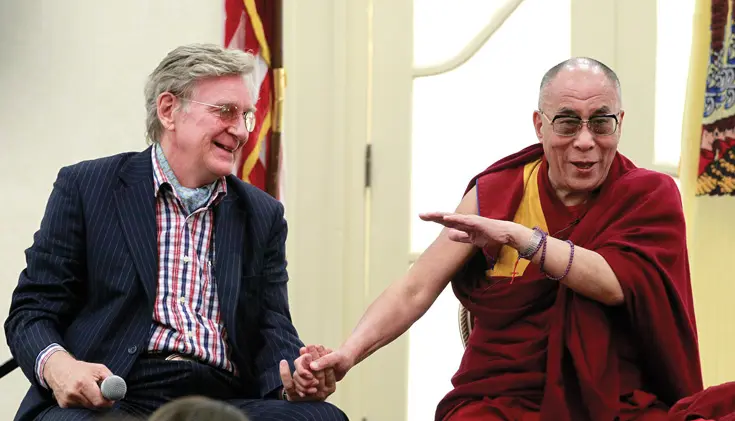
- Encounters with the Dalai Lama (1965): While living in India as a wandering seeker, Thurman encountered Tibetan refugees and their spiritual leader, the 14th Dalai Lama. This meeting permanently altered the trajectory of his life. Thurman became the first Westerner to be ordained as a Tibetan Buddhist monk by the Dalai Lama, studying intensively under him and other great masters.
- Return to Academia (Late 1960s–1970s): Realizing that his calling lay in bridging East and West, Thurman returned to secular life and completed his BA (1969), AM (1972), and PhD (1976) at Harvard University, studying under the legendary Buddhologist Daniel H.H. Ingalls.
- Building Institutions (1980s–1990s): After teaching at Amherst College for fifteen years, Thurman moved to Columbia University in 1988. In 1987, alongside the Dalai Lama and a group of concerned artists and intellectuals, he co-founded Tibet House US in New York City to preserve and promote Tibetan culture.
- Public Intellectual and Author (2000s–2010s): Thurman authored numerous groundbreaking books, including The Central Philosophy of Tibet, Wisdom and Compassion: The Sacred Art of Tibet, and Inner Revolution: Life, Liberty, and the Pursuit of Real Happiness. He became a fixture in the American cultural landscape, famously named one of Time magazine’s 25 most influential Americans in 1997.
- The Final Years: Continuing his scholarship, teaching, and philanthropic efforts well into his twilight years, Thurman collaborated with digital and media platforms—including Lion’s Roar—to produce global initiatives like the Dalai Lama Global Vision Summits.
- June 16, 2024: Robert Thurman passes away at his home in Woodstock, New York, at age 84.
- August 3, 2024: The traditional 49-day Sera Jey Monastery memorial service and celebration of life are held at Menla Retreat and Spa in Phoenicia, New York.
Supporting Data and Scholarly Impact
Robert Thurman’s professional metrics and institutional footprint underscore his monumental influence on modern religious studies.
As an academic, Thurman transformed how Indo-Tibetan Buddhism was studied in Western universities. Historically, Western academia approached Buddhism through a detached, purely philological lens—often treating living traditions as historical artifacts rather than valid philosophical systems. Thurman shattered this paradigm by integrating rigorous critical scholarship with a deep, experiential appreciation for the practice.
At Columbia University, where he taught for nearly three decades until his retirement as professor emeritus, Thurman mentored dozens of doctoral students who now populate religion departments across North America and Europe. His translation work was similarly prolific. He brought monumental texts—most notably the Vimalakirti Nirdesa Sutra—into vibrant, contemporary English, ensuring that ancient philosophical concepts were rendered accessible and relevant to modern readers.
Beyond academia, his economic and cultural footprint through Tibet House US has raised millions of dollars to support Tibetan diaspora communities, refugee schools, and cultural preservation projects in India and the West. The Menla Retreat and Spa in the Catskill Mountains, established by Bob and Nena Thurman, stands as a physical manifestation of his vision: an intersection where ancient contemplative wisdom meets modern holistic wellness, environmental stewardship, and community healing.
Official Responses and Tributes
The global outpouring following Thurman’s passing reflected his unique position as a cultural and spiritual ambassador.
Representatives from the Central Tibetan Administration (CTA) in Dharamsala, India, released statements expressing deep sorrow and profound gratitude for Thurman’s decades of unwavering solidarity with the Tibetan cause. During the darkest periods of geopolitical erasure for Tibet, Thurman was a tireless voice in Western political and media circles, framing the Tibetan struggle not merely as a geopolitical conflict, but as a defense of a universal human treasure-house of peace and inner science.
Colleagues, students, and spiritual leaders who spoke at the August 3 memorial painted a vivid picture of a man whose public achievements were mirrored by his private warmth. Speakers noted his pioneering academic career, his brilliant translations, and his passionate advocacy for Tibetan freedom. Yet, recurring themes in the tributes were his roles as a devoted husband to Nena, a loving father—including to his notable children, such as actress Uma Thurman—and a grandfather who cherished his family above all worldly accolades.
In reflections shared by editors and collaborators at Lion’s Roar, who worked closely with Thurman and his son Ganden on initiatives like the Dalai Lama Global Vision Summits, a common realization emerged: beneath his dazzling intellect and theatrical flair lay a singular, unshakeable motivation. Whether he was debating a philosopher, negotiating a summit, or comforting a friend, Bob Thurman was driven entirely by the desire to create the maximum amount of benefit for others.
Implications: The Legacy of a Modern Bodhisattva
The passing of Robert Thurman marks the closing of a foundational chapter in the transmission of Buddhism to the West. As the generation of pioneering Western teachers who studied directly under the great displaced Tibetan masters of the mid-20th century begins to pass, the community is left to contemplate what comes next.
Thurman’s life offers a working definition of what it means to be a modern bodhisattva—a term in Mahayana Buddhism describing an enlightened being dedicated not to personal escape from suffering, but to the liberation of all sentient beings. In an era often fractured by polarization, cynicism, and institutional distrust, Thurman’s life demonstrated that intellectual brilliance and spiritual devotion are not mutually exclusive; nor are deep contemplative practice and fierce social activism.
His legacy challenges future generations of scholars and spiritual seekers to step outside the ivory tower. Thurman showed that the insights of the dharma must be put to work in the messy arenas of politics, culture, and family life to alleviate real-world suffering.
As the 49-day bardo prayers concluded on August 3, those gathered at Menla did not merely mourn an ending. They celebrated a trajectory that had altered the spiritual DNA of America. Robert Thurman’s scholarship will be studied in university libraries for generations; his institutional contributions will protect Tibetan culture for years to come; and the countless lives he touched with his humor, wisdom, and boundless heart will continue to ripple outward. Bob Thurman succeeded in his grand ambition: he created immense benefit. And in doing so, he left the world immeasurably brighter than he found it.
