

By Melvin McLeod
Published in partnership with Lion’s Roar
Main Facts: Celebrating the Life of an American Bodhisattva
On a sunlit Monday in August, family, friends, international scholars, and spiritual leaders gathered in the tranquil Catskill Mountains of New York to mourn the passing and celebrate the extraordinary life of Robert Thurman. Widely regarded as the preeminent American Buddhist figure of our era, Thurman passed away peacefully on June 16 at his home in Woodstock, New York, at the age of 84.
A titan of modern academia, a prolific translator of esoteric Tibetan texts, a tireless advocate for Tibetan liberation, and a close, trusted confidant of His Holiness the Dalai Lama, Thurman left behind a towering legacy. Yet, to those who knew him best, his defining characteristic was not his intellect—brilliant though it was—but his vast capacity for compassion. He was, in the truest sense of the Mahayana Buddhist tradition, a bodhisattva: an enlightened being dedicated entirely to the alleviation of suffering and the cultivation of universal good.
The memorial service, held on August 3 at the Menla Retreat and Spa in Phoenicia, New York—a premier holistic wellness center founded by Thurman and his wife, Nena—marked the culmination of the traditional 49-day Tibetan mourning and transition period. Coincidentally, the date also would have been Thurman’s birthday, turning a day of poignant remembrance into a profound celebration of a life extraordinarily well-lived.
Chronology: From the Bardo to Legacy—A Life in Full
To understand the scope of Robert Thurman’s impact, it is helpful to trace the timeline of his final farewell and the remarkable milestones that preceded it.
The 49-Day Journey and the Final Puja
In Tibetan Buddhism, the bardo is the intermediate state between death and rebirth, believed to last for 49 days. During this window, the consciousness of the deceased navigates a series of psychological and spiritual transitions before taking a new form. To honor this sacred window, monks from the renowned Sera Jey Monastery in India traveled to Menla to perform traditional death-transition rites.
The 49-day cycle concluded on August 3 with a specialized puja (ritual offering) designed to assist Thurman’s consciousness in achieving ultimate liberation—or, at the very least, a fortunate and auspicious rebirth. This ancient ritual provided a deeply spiritual framework for a man who spent his life bridging the ancient wisdom of the Himalayas with the hyper-modern sensibilities of the West.
A Life of Intellect and Devotion
Thurman’s journey into Buddhism was as unconventional as it was transformative. Born in New York City in 1941, his early life took a dramatic turn during his college years at Harvard University, where an accident cost him his left eye. This profound physical trauma served as a catalyst for a spiritual awakening, sending him on a global quest for meaning that eventually led him to India.
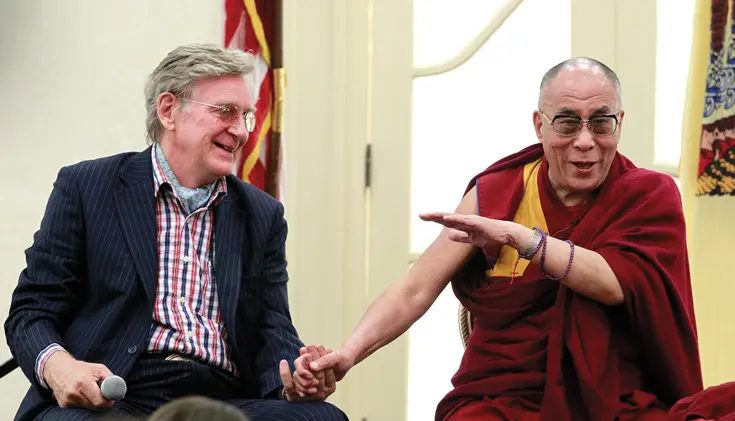
There, he encountered Tibetan refugees and studied under the guidance of the Dalai Lama, eventually becoming the first Westerner to be ordained as a Tibetan Buddhist monk by the Dalai Lama himself. Though he later returned to lay life to pursue an academic career, his bond with the Tibetan spiritual leader and the Tibetan people remained unbreakable for the rest of his days.
As a scholar, Thurman revolutionized the study of religion in the West. He served as the Jey Tsong Khapa Professor of Indo-Tibetan Buddhist Studies at Columbia University—the first endowed chair of Buddhist Studies in the United States. Through his rigorous academic work, his accessible and lively books, and his luminous translations of complex philosophical texts, he opened the floodgates of Buddhist wisdom for generations of modern practitioners and scholars alike.
Supporting Data: Pillars of Thurman’s Life’s Work
Robert Thurman’s CV reads like a blueprint for cultural and spiritual diplomacy. His contributions span multiple domains, each leaving an indelible mark on modern society.
Academic and Literary Contributions
- Columbia University: As a foundational professor, Thurman mentored hundreds of graduate students, integrating rigorous textual scholarship with a living, breathing appreciation for Buddhist practice.
- Translation Work: He brought monumental texts out of classical Tibetan and Sanskrit, making works like the Vimalakirti Nirdesa Sutra accessible and inspiring to English-language readers.
- Accessible Scholarship: Through popular books such as Inner Revolution, Why the Dalai Lama Matters, and Wisdom Is a Must, Thurman demystified Buddhism, arguing that its psychological and philosophical frameworks are urgently needed to heal modern social and environmental ills.
Institutional Foundations
- Tibet House US: Co-founded in New York City in 1987 at the request of the Dalai Lama, Tibet House serves as a cultural sanctuary dedicated to preserving, protecting, and sharing the endangered civilization and art of Tibet.
- Menla Retreat and Spa: Established alongside his wife, Nena, Menla in Phoenicia, New York, stands as a premier destination for Tibetan medicine, holistic healing, yoga, and contemplative retreat, embodying Thurman’s vision of integrating spiritual awakening with physical well-being.
Official Responses and Personal Tributes
The memorial service at Menla drew an array of luminaries, family members, colleagues, and spiritual leaders who offered moving testimonies to Thurman’s multifaceted character.
Speakers reflected on his pioneering academic career, his tireless political advocacy for a free Tibet, and his electrifying public lectures, which frequently blended high academic philosophy with Borscht Belt humor and radical optimism. Yet, amidst the accolades celebrating his global impact, the most resonant tributes focused on his domestic life. Colleagues and admirers noted that for all his grand causes and international prestige, Bob Thurman remained first and foremost a devoted husband to Nena, a loving father to his children—including award-winning actress Uma Thurman and producer Ganden Thurman—and a doting grandfather.
Writing on behalf of Lion’s Roar and reflecting on years of close collaboration—particularly in producing the annual Dalai Lama Global Vision Summits alongside Ganden Thurman, Kira, and the team at Tibet House—reminiscences centered on a single, driving force.
"What I learned during our lively discussions and negotiations was that Bob was ultimately motivated by only one thing: how to create the most possible benefit," recalled those who worked closely with him. "I think that’s the definition of a bodhisattva: someone who, amid all the challenges and eccentricities of this human life, is concerned with one thing—creating benefit."
Implications: The Enduring Legacy of an American Trailblazer
The passing of Robert Thurman closes a monumental chapter in the history of Western Buddhism. As the generation of Western pioneers who first brought Asian contemplative traditions to North America passes on, questions naturally arise about the future preservation and adaptation of these lineages.
Thurman’s life offers a compelling roadmap for that future. He demonstrated that deep scholarly rigor does not have to be divorced from passionate social activism, nor does spiritual practice require withdrawal from the messy, complex arenas of modern politics and media. By founding institutions like Tibet House and Menla, he ensured that his work would outlive him, providing physical and cultural anchors for future generations.
Furthermore, Thurman’s unwavering championing of the Tibetan cause helped keep international attention focused on the plight of Tibet under Chinese rule, establishing a precedent for engaged Buddhism that merges spiritual awakening with human rights advocacy.
As the smoke from the 49-day puja cleared at Menla and friends prepared to return to their respective corners of the globe, the prevailing emotion was not despair, but profound gratitude. Robert Thurman proved that a single human life, fueled by an expansive mind and an unshakeable commitment to the welfare of others, can alter the cultural landscape of an entire nation. In a world frequently divided by cynicism and conflict, the legacy of this great American bodhisattva—one defined entirely by the relentless pursuit of universal benefit—remains a beacon of enduring hope.
