

Main Facts
Ontario is facing a monumental electricity demand surge that is reshaping its long-term energy planning. According to the Independent Electricity System Operator (IESO), provincial electricity demand reached 145.6 terawatt-hours (TWh) in 2025, marking a 4.4% increase in just a single year. Looking further ahead, the IESO’s reference case projects demand to skyrocket to 250 TWh by 2050. However, the broader forecast range spans from 207 TWh to 297 TWh, presenting a massive 90 TWh spread that makes precise, rigid long-term infrastructure planning exceptionally hazardous.
The immediate challenge for Ontario is not a lack of massive peak capacity, but an impending annual energy shortfall. Following current projects already underway, the province faces an annual energy deficit exceeding 8 TWh by 2032, which will widen to more than 12 TWh by 2035. Meanwhile, the incremental summer capacity gap does not materialize until 2035, and it starts modestly at approximately 950 MW.
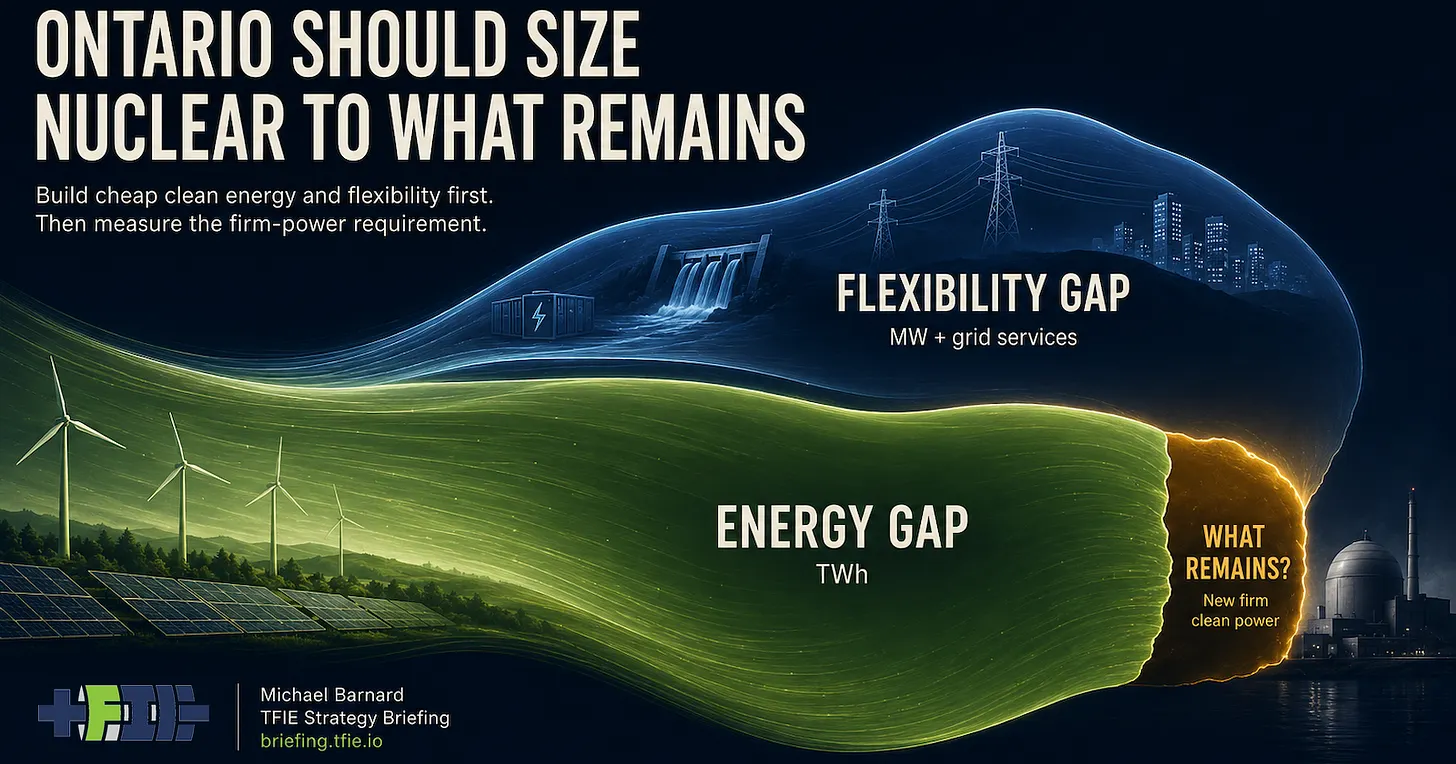
To bridge these gaps without locking into prematurely bloated or excessively costly megaprojects, energy analysts argue that Ontario must prioritize fast-to-deploy clean energy assets, battery storage, and grid flexibility first. Only after maximizing these resources should the province size new nuclear generation to fit whatever durable, un-met energy gap remains. This strategy seeks to avoid dogmatic debates over whether Ontario should be exclusively a "nuclear province" or a "renewables province," focusing instead on a pragmatic, mixed-resource framework that addresses both annual volume shortages and hourly grid-balancing requirements.
Chronology
- 2020: Transmission-connected gas and oil generation in Ontario accounted for just 9.7 TWh, representing about 7% of total transmission-connected generation. At this stage, the grid relied heavily on its existing nuclear fleet, which was beginning to enter scheduled refurbishment phases.
- 2020–2025: Ontario experienced a prolonged hiatus from major new-build renewable energy procurements, leading to a political and development pipeline drought as renewables were frequently weaponized as political wedge issues.
- 2025: Provincial electricity demand hit 145.6 TWh—a 4.4% leap year-over-year. Simultaneously, reliance on transmission-connected gas and oil generation tripled compared to 2020, jumping to 31.4 TWh and making up 19.3% of transmission-connected generation as nuclear output dipped due to ongoing outages and refurbishments.
- Recent Years (Refurbishments): Major nuclear refurbishments achieved notable operational successes. The Darlington refurbishment program finished ahead of schedule and under budget, while Bruce Unit 3 returned to service seven months early and below initial cost estimates.
- Present Day (2026): Ontario has resumed competitive renewable and storage procurements. The first Long-Term 2 (LT2) energy window successfully contracted 1,115 MW of wind and solar projects at prices 21% lower than previous comparable large-scale procurements. An LT2 capacity window simultaneously added 640 MW of batteries, pushing contracted storage past 3.5 GW by 2030 at costs dropping significantly below prior rounds.
Supporting Data
The unfolding energy dynamics in Ontario are defined by stark metrics regarding demand growth, procurement pricing trends, and shifting generation portfolios:
- 90 TWh Spread: The wide variance in the IESO’s 2050 demand projections—ranging from a low of 207 TWh to a high of 297 TWh—highlights the danger of committing prematurely to massive, capital-intensive infrastructure buildouts.
- Annual Deficits: Ontario faces a shortfall of over 8 TWh of annual energy by 2032, expanding past 12 TWh by 2035. The summer capacity gap, by contrast, starts small at roughly 950 MW in 2035.
- Renewable Cost Reductions: The initial tranche of LT2 renewable projects contracted 1,115 MW of clean energy (expected to yield ~2.37 TWh annually) at prices 21% below previous large-scale procurements.
- Storage Price Trajectory: The latest LT2 capacity window added 640 MW of batteries—bringing total contracted storage above 3.5 GW by 2030—at prices 36% cheaper than the expedited first long-term battery procurement and 16% cheaper than the subsequent regular procurement.
- Fossil Fuel Surge: Transmission-connected gas and oil generation spiked from 9.7 TWh (7% share) in 2020 to 31.4 TWh (19.3% share) in 2025, heavily driven by rising demand and temporary nuclear refurbishment outages.
- Nuclear Scale: While Darlington and Bruce refurbishments have progressed smoothly, proposed future nuclear additions—such as the GE Hitachi BWRX-300 Small Modular Reactors (SMRs) at Darlington and pre-development work at Bruce C and Wesleyville (which could theoretically hold up to 10 GW)—represent massive financial and technical commitments without established first-of-a-kind cost certainty in Ontario.
Official Responses and Stakeholder Perspectives
Energy planners, independent market analysts, and political observers have engaged in fierce debates over the correct sequencing of Ontario’s grid transformation.

The Independent Electricity System Operator (IESO) emphasizes the necessity of keeping all long-term options open, pointing to the vastly divergent 2050 demand scenarios as justification for maintaining flexibility. IESO data underscores that while wind and solar can rapidly inject bulk clean energy into the grid, and batteries can shift load profiles, the province still requires firm capacity to handle deep winter peaks and unexpected demand spikes.
Market analysts and energy policy groups, such as those contributing to the TFIE Strategy Briefing, argue that policymakers must avoid repeating past political mistakes. Critics have pointed out that the provincial Conservative government spent years suppressing renewable energy development for political posturing, inadvertently starving the province of a robust development pipeline that is now desperately needed.
However, experts caution against swinging to the opposite extreme—namely, locking the province into an unproven, wall-to-wall nuclear megaproject strategy before knowing where actual demand will land. Proponents of a phased approach stress that existing nuclear assets (such as the Darlington and Bruce refurbishments) should be fully valued and extended, while unproven technologies like the GE Hitachi BWRX-300 SMRs must be treated as first-of-a-kind projects whose real-world construction schedules and budgets must be rigorously demonstrated rather than blindly assumed.
Implications
The strategic decisions made in Ontario today will dictate the economic competitiveness, environmental footprint, and reliability of the province’s electrical grid for the next half-century.
1. Breaking the False Dichotomy
The notion that Ontario must choose between being a "nuclear province" or a "renewables province" is increasingly viewed as an outdated false dichotomy. A modern decarbonized grid requires an integrated mosaic of resources: wind and solar for low-cost bulk energy generation; batteries, hydro, and demand response for short-term flexibility; transmission interties for regional balancing; and dependable nuclear power for baseload stability.

2. Displacing Natural Gas Flexibility
A primary hidden cost of Ontario’s recent energy shortfall has been the tripling of gas-fired generation. Gas is currently doing the heavy lifting of load following, frequency response, and reserves. To push gas back to the economic margins, Ontario must procure resources that can mimic these exact grid-balancing services hour by hour. Expanding utility-scale storage, leveraging smart demand response, and optimizing regional transmission interties are critical steps in this direction.
3. De-risking Nuclear Investments
While nuclear power remains a vital cornerstone of Ontario’s low-carbon identity, the economic risks of new builds cannot be brushed aside. Refurbishing existing, operational CANDU reactors at sites with established supply chains and trained workforces is a low-risk, high-return venture. Conversely, building out unproven SMR designs like the BWRX-300, or committing billions upfront to massive greenfield sites like Wesleyville and Bruce C before demand certainty arrives, exposes ratepayers to severe financial overruns.
4. A Sequenced Roadmap for Success
Ultimately, the path forward relies on intelligent sequencing:
- Build the fast stuff first: Rapidly scale up wind, solar, and battery storage through regular, competitive procurements that reveal true market pricing.
- Maximize existing assets: Continue successful nuclear refurbishments and maintain high capacity factors across the current fleet.
- Learn by doing: Evaluate the performance and true costs of the SMRs currently under construction before greenlighting expansive new nuclear fleets.
- Defer irreversible decisions: Keep larger nuclear options in pre-development pipelines, allowing the province to size future megaprojects accurately to whatever durable energy gap remains as the 2030s unfold.
