

Introduction and Main Facts
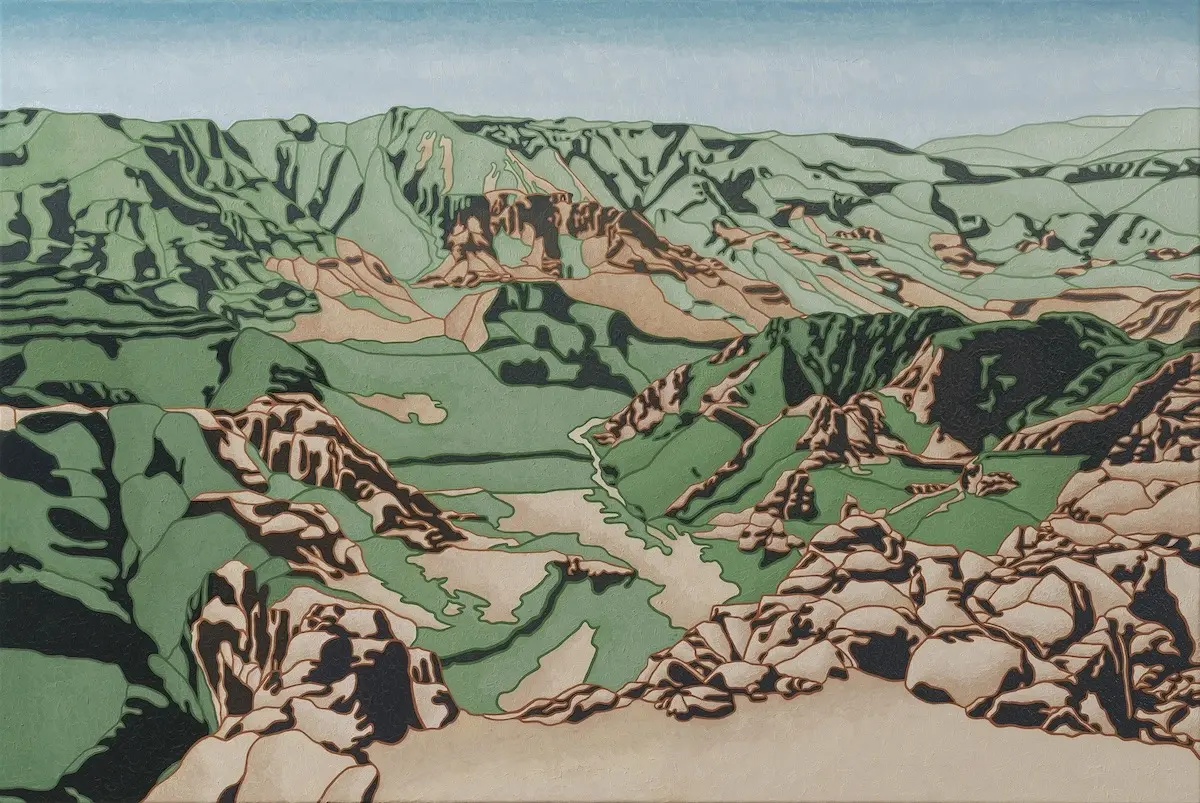
In the contemporary landscape of American fine art, few painters interrogate the topography of the American West with the precise, analytical gaze of Arizona-based artist Carson Bilger. Bridging the gap between objective cartography and subjective psychological space, Bilger employs a specialized technique known as planar analysis to distill sprawling, complex vistas into harmonious compositions of three-dimensional forms rendered as flat planes.
His striking canvases—such as the 32-by-48-inch Ease the Mind and the expansive 36-by-72-inch It Would Never End—do not merely copy what the eye sees; rather, they reconstruct a scene the way a faded memory settles into the human consciousness. Through a sophisticated mastery of structure, light, shadow, and a distinctively graphic aesthetic rooted in his academic background, Bilger creates landscapes that invite prolonged contemplation. His work posits a fascinating philosophical premise: that nature is never experienced the same way twice, and that diametrically opposed visual elements can coexist in a single frame.
Represented by Western Gallery, Bilger’s work has garnered critical acclaim, most recently featured in the October/November 2026 issue of Southwest Art magazine. His unique fusion of illustration principles, rigorous preparatory methodologies, and painterly abstraction has established him as a distinctive voice in modern Western landscape art.
Chronology of Artistic Evolution
To understand Carson Bilger’s current output, one must trace the chronological development of his artistic identity, which has continually evolved from graphic roots toward a more sophisticated synthesis of perception and memory.
The Foundational Years and Academic Training
Bilger’s journey into the fine arts began with rigorous academic training, culminating in a master’s degree in illustration. This educational background profoundly influenced his eventual transition into landscape painting. While many landscape artists rely strictly on intuitive impressionism, Bilger’s training instilled a strong graphic aesthetic. He learned to view images as constructed narratives where lines guide the viewer’s eye and color dictates emotional resonance. This structural discipline would later become the bedrock of his planar analysis approach.
Developing the Planar Method
Over years of outdoor excursion and studio experimentation, Bilger’s process underwent a refining transformation. He sought a way to translate the overwhelming visual data of sprawling wilderness into something manageable yet emotionally resonant. This led him to adopt planar analysis. By breaking a scene down into geometric planes, he found a method that felt both naturally intuitive when drawing and logically sound when attempting to flatten a three-dimensional expanse onto a two-dimensional canvas.
Scaling Up and Refining the Medium
As Bilger’s artistic ambitions expanded, so did the physical dimensions of his work. This scaling up required a technical pivot in his preparatory phase. Originally relying on watercolor for his small-scale compositional studies, Bilger transitioned to acrylic paints. Acrylics offered him a truer, more immediate sense of color relationships, allowing him to successfully translate small compositional studies into large-scale masterworks like It Would Never End.
Supporting Data and Creative Methodology
Carson Bilger’s creative process is a meticulous exercise in documentation, reduction, and execution. Far from relying solely on fleeting plein-air impressions, his work is deeply anchored in the tangible reality of actual places and experiences.

Field Documentation and Photography
Every painting begins in the real world. Bilger travels extensively, documenting landscapes through photography and field observations. This foundational step ensures that despite the abstracted, geometric nature of his finished pieces, they remain fundamentally grounded in physical geography.
Sketching and Value Structures
Once back in the studio, Bilger moves from documentary photography to compositional distillation:
- Selection: He sifts through his reference material to select compelling compositions that offer strong structural potential.
- Pen and Paper: He executes initial sketches using a standard ballpoint pen, focusing heavily on working out value structures in his sketchbook.
- Small-Scale Studies: Before touching a large canvas, Bilger produces preparatory studies—historically in watercolor, but increasingly in acrylic—to test color palettes and atmospheric tones.
Anatomy of a Bilger Composition
According to the artist, the execution of a painting follows a strict hierarchical consideration of space:
- Spatial Hierarchy: The foremost concern is how individual sections of the landscape recede into the distance and define the horizon line.
- Light and Color Balance: Next comes the management of light. Bilger is consistently drawn to the dramatic contrast between shadows and the inherent colors of the landscape, as well as how atmospheric distance naturally washes out environmental tones.
- Contained Abstraction: Up close, Bilger’s canvases reveal a deeply "painterly" quality. Through deliberate blending, textural brushstrokes, and thick layers of paint, he builds what he calls "contained abstraction" within each individual shape. Viewers who examine his work closely discover a series of tiny, singular abstract compositions operating independently while contributing to the cohesive whole.
Official Perspectives and Philosophy
Bilger’s artistic vision is driven by a deep curiosity regarding human perception, memory, and the subjective nature of experience. He is fascinated by how two people can stand in the exact same location yet experience an entirely different reality depending on the time of day, their specific vantage point, and their broader psychological context.
"Over the years, my process developed so that the paintings became increasingly more accurate representations of the visions in my mind," Bilger notes, highlighting the internal validation that guides his stylistic choices.
Furthermore, his work serves as an exploration of paradox.
"It speaks to an idea that I have been contemplating," Bilger explains, "which is that things that are diametrically opposed can coexist."
This philosophical stance manifests visually in his art through the friction between rigid, graphic geometry and fluid, painterly textures; between the vast, unyielding scale of the American wilderness and the intimate, memory-like softness of his color palettes.

By employing multiple visual entry points—utilizing lines that weave shapes together like a narrative—Bilger deliberately attempts to capture and hold the viewer’s attention for extended periods, encouraging them to look past the surface and engage with the underlying mechanics of how we perceive our world.
Implications for the Art World
Carson Bilger’s innovative approach to landscape painting carries significant implications for how contemporary artists and collectors view the genre of Western art.
Redefining the Western Landscape
For generations, Western landscape painting has often drifted toward either hyper-realistic documentation or loose impressionistic romanticism. Bilger carves out a vital middle ground. By merging the structural clarity of illustration and planar geometry with the emotional weight of psychological memory, he proves that the Western landscape is not a static postcard subject, but a dynamic psychological space. His work suggests that landscape art can be simultaneously conceptual and representational.
Engaging the Modern Viewer
In an era dominated by rapid digital consumption and fleeting attention spans, Bilger’s multi-layered compositions—imbued with contained abstractions and rich textural brushwork—offer an antidote. By rewarding prolonged, close-up viewing, his paintings challenge gallery-goers and collectors to slow down, examine the micro-compositions within the macro-landscape, and reconsider their own relationships with the environment.
Market Presence and Future Outlook
With strong representation through Western Gallery and critical recognition in premier publications like Southwest Art, Bilger is positioned as a bellwether for a new generation of artists redefining regional art. His ability to scale up his vision without losing the intimate, memory-driven quality of his work signals a lasting career that will continue to influence collectors, students of art, and fellow painters alike.
Contact and Representation Information
For inquiries, available works, or further information regarding Carson Bilger’s art, collectors and enthusiasts can utilize the following official channels:
- Official Website: carsonbilger.com
- Gallery Representation: Western Gallery
(Note: This profile builds upon reporting originally featured in the October/November 2026 issue of Southwest Art magazine. To explore more stories profiling top-tier contemporary artists in their entirety, consider subscribing to the print or digital editions via Artists Network.)
