

By Willard Shoko
Independent Starlink Researcher and Network Consultant
Introduction: The New Frontier in Zimbabwean Connectivity
The evolution of telecommunications in Zimbabwe is entering a transformative chapter. From the historic establishment of the Mazowe Earth Station in 1985 to the rapid deployment of modern Low Earth Orbit (LEO) satellite constellations, the nation’s digital infrastructure is undergoing a radical paradigm shift. Today, independent networking architectures are conceptualizing a comprehensive, twelve-month strategic roadmap focused on the rollout of domestic gateway teleports, high-frequency Q/V band licensing, and a centralized Point of Presence (PoP) in Harare.
By integrating cutting-edge satellite technology with Zimbabwe’s expanding terrestrial fiber backbones, this roadmap aims to resolve historical bandwidth bottlenecks, reduce latency, and future-proof the nation’s digital economy.
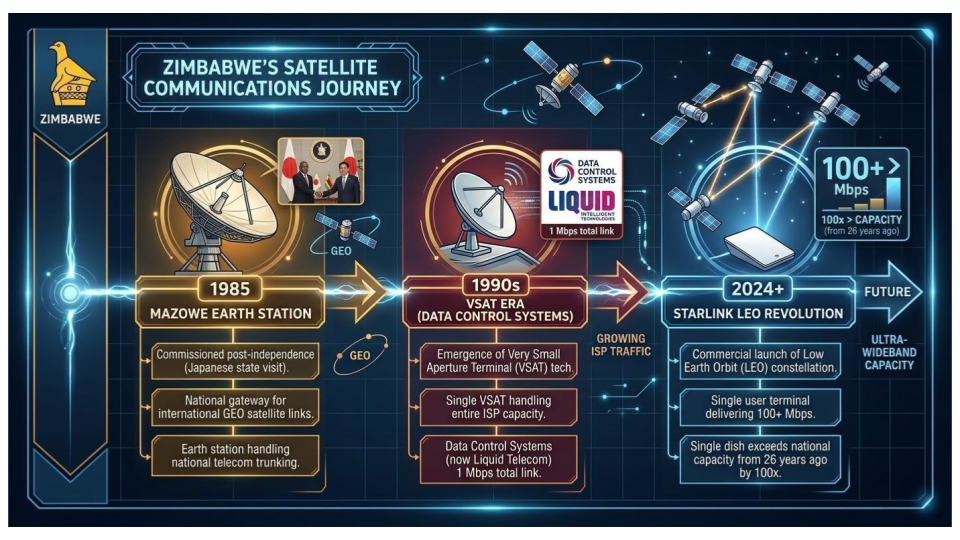
Chronology of Satellite Communications in Zimbabwe
To understand the magnitude of the current LEO satellite revolution, one must trace the trajectory of Zimbabwe’s telecommunications milestones over the past four decades.
1. The GEO Era and the Mazowe Earth Station (1985)
Zimbabwe’s formal entry into satellite communications began following an official state visit to Japan in the mid-1980s. This diplomatic and technological exchange led directly to the construction of the country’s primary satellite hub at Mazowe in 1985. For decades, the Mazowe Earth Station stood as the nation’s solitary gateway to international telecommunications networks, relying entirely on Geostationary Earth Orbit (GEO) links. While revolutionary for its time, GEO technology was constrained by high latency—due to the extreme altitude of the satellites—and limited aggregate bandwidth.
2. The VSAT Milestone and Early Commercial Expansion
As enterprise and consumer demands for data grew, Very Small Aperture Terminal (VSAT) technology emerged as the next operational milestone. Early commercial implementations in Zimbabwe relied on a single VSAT terminal to handle the entire international bandwidth load for Data Control Systems—the corporate entity that eventually evolved into Liquid Intelligent Technologies. In those foundational days, this single terminal delivered a modest 1 Mbps aggregate trunk connection to service the nation’s burgeoning data needs.

3. The LEO Constellation Shift (2024–Present)
The contemporary landscape bears little resemblance to the early satellite era. Individual domestic and enterprise users in modern Zimbabwe routinely consume far more bandwidth than the total national capacity available during the late 1990s.
The official commercial introduction of LEO satellite services in Zimbabwe on September 6, 2024, marked a decisive turning point. To put this technological leap into perspective, a single modern enterprise dish or user terminal today delivers throughput exceeding Zimbabwe’s entire national bandwidth capacity from 1999 by a staggering factor of 100.
Historical Performance Metrics and Latency Trends
Following its market entry in late 2024, Starlink experienced rapid adoption across both urban and remote sectors. Initial performance benchmarks reflected a pristine regional network load characterized by high speeds and reliable connectivity. However, by September 2026, substantial regional subscriber adoption created predictable network congestion, resulting in bandwidth throttling during peak usage hours and mixed latency performance across various regions.

Technical analyses indicate that deploying local ground station teleports and a dedicated domestic Point of Presence (PoP) in Harare will permanently resolve these bandwidth bottlenecks. Such infrastructure will stabilize throughput speeds and consistently maintain sub-20 ms domestic latencies, ensuring that the local network can comfortably absorb surging data demands.
Technical Architecture and Spectrum Allocation
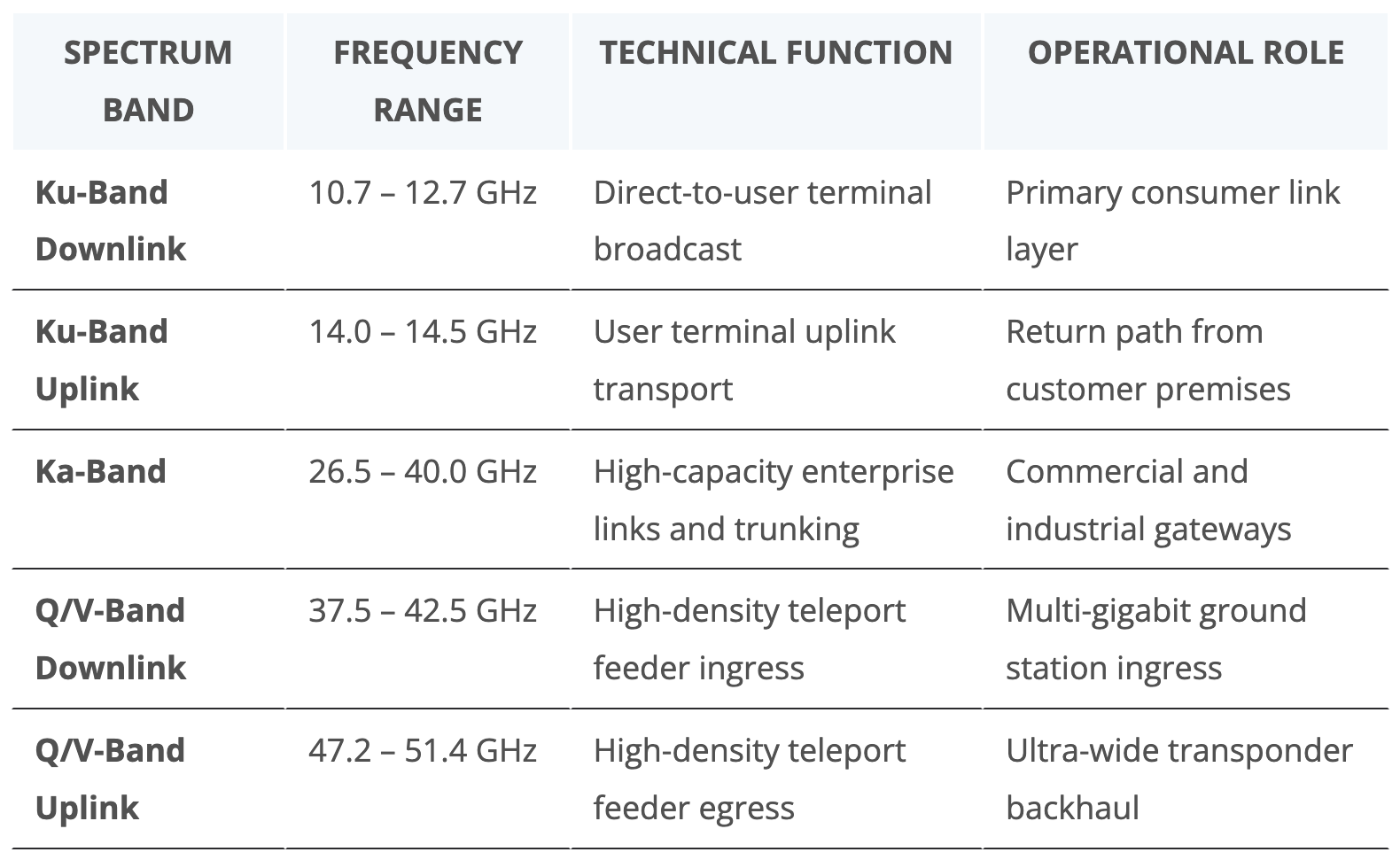
Establishing high-capacity feeder links between rapidly moving LEO constellations and fixed terrestrial networks requires sophisticated spectrum management. Beyond standard Ku and Ka bands, the implementation of high-frequency feeder allocations in the Q/V band is critical for next-generation satellite architectures.
Q/V Band Engineering Advantages
- Massive Spectrum Availability: The Q/V bands offer significantly wider contiguous blocks of spectrum compared to congested Ku and Ka bands, allowing for multi-gigabit per second data flows per gateway.
- High-Density Data Transmission: Essential for supporting dense urban clusters and enterprise hubs without saturating lower frequency bands.
- Advanced Frequency Reuse: Mitigates interference across vast geographical expanses, optimizing overall satellite network efficiency.
Spectrum Band Allocation Framework
Managing these high frequencies requires strict regulatory coordination with national authorities—such as the Postal and Telecommunications Regulatory Authority of Zimbabwe (POTRAZ)—to prevent interference with existing terrestrial and satellite services while clearing the path for commercial ground station deployment.
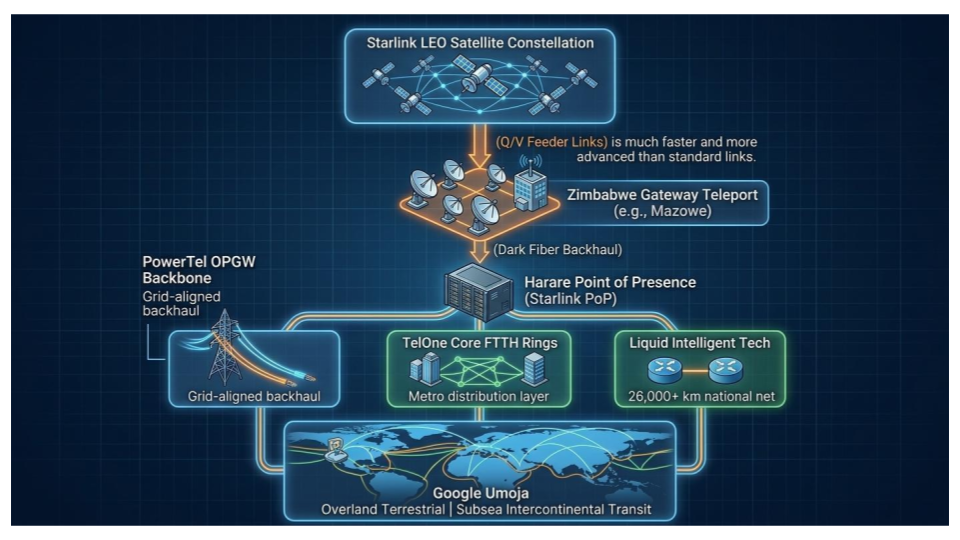
National Fibre Infrastructure Synergy Matrix
A successful LEO ground station strategy does not operate in a vacuum; it requires deep integration with existing and ongoing terrestrial fiber builds. Connecting local Starlink teleports to a central Harare PoP directly leverages Zimbabwe’s robust and expanding fiber optic backbone:
- Liquid Intelligent Technologies Fibre Backbone: Operating over 26,000 kilometers of fiber infrastructure within Zimbabwe, Liquid provides the core long-haul terrestrial routing layer. Connecting Starlink’s Harare PoP directly into Liquid’s regional cross-border network ensures highly resilient transit across the entirety of Southern Africa.
- PowerTel and Paratus Zimbabwe Partnership: Powertel and Paratus Zimbabwe formed an equal-investment Public-Private Partnership (PPP) to construct a high-capacity DWDM fiber backhaul network across the country. Beginning with an active 800 Gbps link between Plumtree and Bulawayo, this agreement leverages Powertel’s powerline-based national fiber infrastructure and Paratus’s continental network to deliver up to 10 Tbps in cross-border bandwidth linking Zimbabwe, Botswana, and Zambia.
- TelOne Expansions: TelOne continues to drive backbone capacity expansions along crucial cross-border transit links—including Kazungula (connecting to Zambia and Botswana) and Beitbridge (connecting to South Africa)—to meet surging regional demand for 100G+ wavelengths.
- Dark Fibre Africa (DFA) Zimbabwe: DFA constructed a 1,500-kilometer open-access optical fiber backbone running along national railway servitudes from Beitbridge through Bulawayo, Harare, and Mutare. Built via an $18 million partnership with BCS Group and Dandemutande, the network utilizes Dense Wavelength Division Multiplexing (DWDM) technology to deliver multi-gigabit transit capacity, offering local ISPs and mobile operators redundant, high-speed wholesale backhaul.
- Google Umoja Cable System: Providing an overland terrestrial path from East Africa down through Southern Africa and across to global subsea landings, linking the local Starlink PoP to the Umoja network establishes direct, low-latency access to intercontinental cloud links.
Capacity Resolution Mechanisms for Harare
To eliminate peak-hour throttling and maintain superior Quality of Service (QoS), the proposed architecture relies on several capacity resolution mechanisms tailored for the Harare hub:
- Local Traffic Offloading: Routing domestic traffic locally via the Harare PoP rather than bouncing signals through international ground stations.
- Dynamic Load Balancing: Distributing peak-hour data loads evenly across multiple terrestrial fiber providers (Liquid, PowerTel, DFA, TelOne).
- Caching and Content Delivery Networks (CDNs): Implementing localized caching nodes to serve frequently accessed web content instantly without taxing upstream satellite links.
Global Benchmarks: Insights from Brazil and the USA
Zimbabwe is not charting this course alone. Brazil and the United States serve as primary operational benchmarks for successfully deploying LEO satellite ground infrastructure across expansive and diverse geographic landscapes.
In both nations, the integration of multiple regional gateway teleports with open-access terrestrial backbones eliminated regional latency spikes and enabled rural, suburban, and enterprise sectors to harness multi-gigabit satellite broadband seamlessly. Adopting these proven global frameworks ensures that Zimbabwe’s infrastructural rollout aligns with international carrier-grade standards.
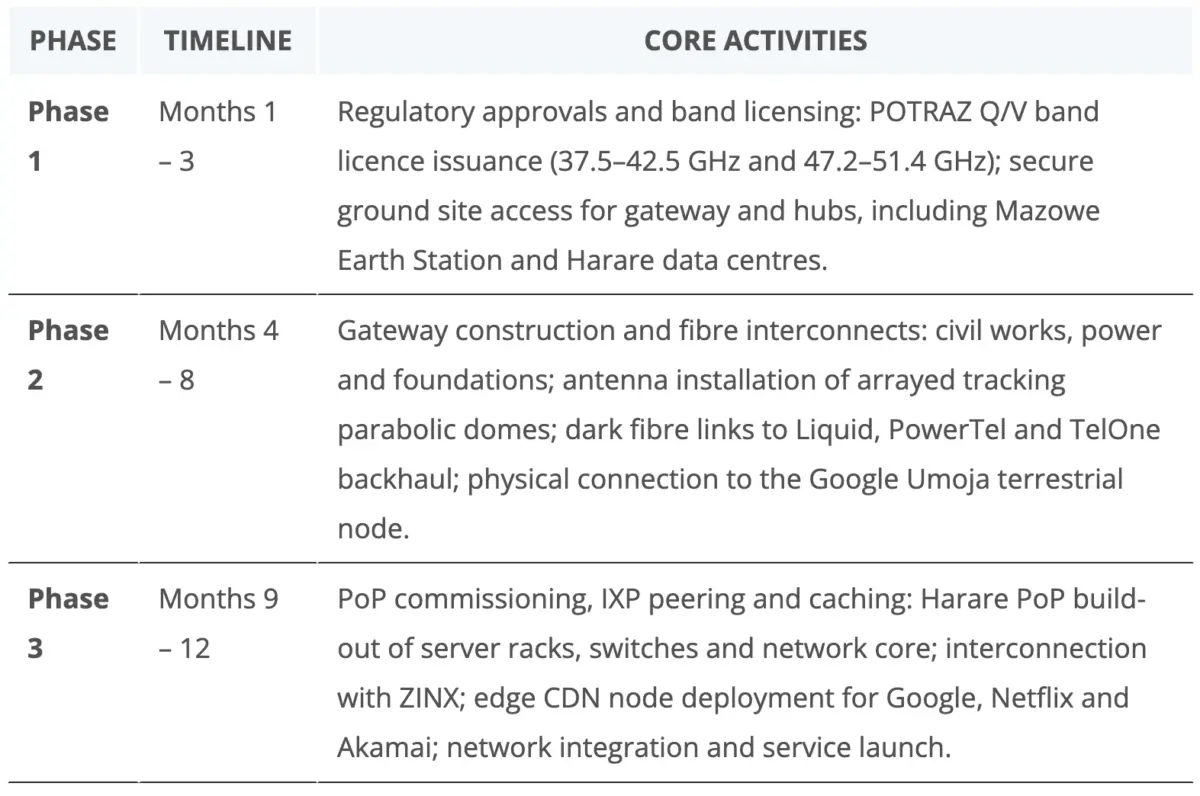
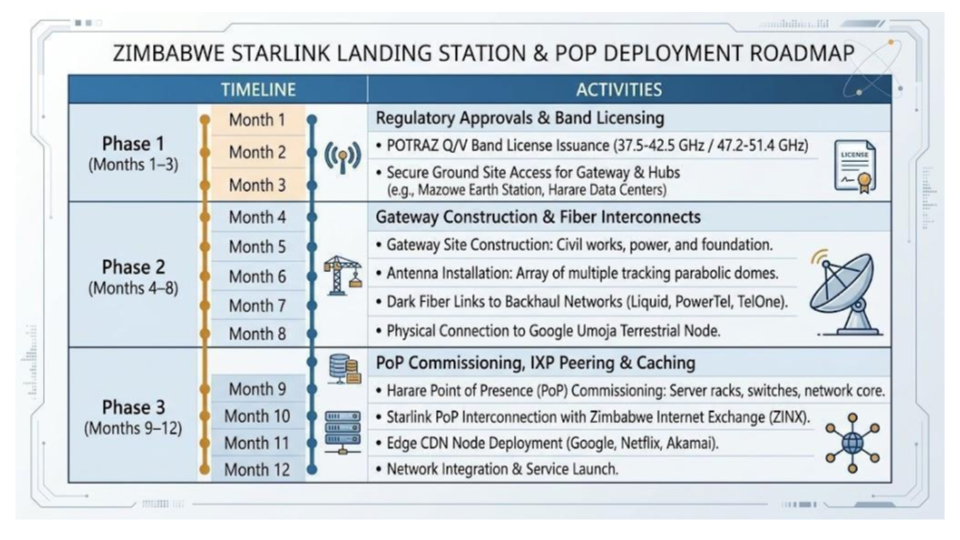
Strategic Implementation Roadmap
The proposed deployment is structured as a rigorous, twelve-month execution plan divided into three distinct phases:
- Phase 1: Regulatory Clearance & Spectrum Acquisition (Months 1–4)
- Securing necessary operating licenses and Q/V band spectrum allocations through regulatory bodies.
- Finalizing site acquisition agreements for domestic gateway teleports.
- Phase 2: Physical Infrastructure & Gateway Construction (Months 5–8)
- Constructing physical landing stations, antenna arrays, and power redundancy systems.
- Establishing physical fiber interconnects with primary backbone providers (Liquid, DFA, PowerTel, TelOne).
- Phase 3: PoP Commissioning, Integration, and Service Launch (Months 9–12)
- Deploying and testing the central Harare Point of Presence.
- Executing end-to-end network stress tests, latency optimizations, and officially transitioning commercial traffic to the domestic gateway architecture.
Implications for Zimbabwe’s Digital Future
The successful execution of this twelve-month roadmap carries profound implications for Zimbabwe’s socio-economic development. By establishing domestic gateway teleports and a centralized Harare PoP, the nation will transition from a secondary consumer of constrained satellite bandwidth to a primary, high-capacity digital hub in Southern Africa.
For educational institutions, healthcare providers, financial enterprises, and rural communities, this infrastructural leap promises uncompromising internet speeds, ultra-low latencies, and total network resilience—ultimately cementing Zimbabwe’s position at the forefront of the African digital revolution.
About the Author
Willard Shoko is an Independent Starlink Researcher and Network Consultant with over two decades of hands-on expertise in networking infrastructure and internet connectivity. Passionate about next-generation satellite technology, Willard is a key community contributor on X and Reddit, best known for his work mapping unofficial Starlink Ground Stations and Points of Presence (PoPs). His technical insights have earned recognition and reposts directly from Elon Musk and Starlink. Today, he leverages his deep network architecture expertise to design and deploy tailored internet-based solutions across the educational and private sectors. (Independent consultant; not affiliated with Starlink.)
