

By In5D Editorial Staff
Metaphysical Research & Consciousness Studies
Main Facts: The Phenomenon of the "Impossible Familiarity"
Every night, as humanity slips past the conscious threshold of wakefulness into the mysterious theatre of sleep, millions of individuals experience landscapes that defy the physical laws of our waking reality. Among these nocturnal phenomena, a particularly confounding genre of dream has captured the attention of dream researchers, metaphysical thinkers, and everyday sleepers alike: the dream that feels less like a product of imagination and more like a recovered memory.
For years, dreamers have reported visiting sprawling metropolitan centers they have never seen in this lifetime, traversing architectural wonders that do not exist on any map, and operating futuristic technologies with an intuitive mastery that feels native rather than learned.
Perhaps most striking is the emotional core of these experiences: an overwhelming, bone-deep sense of familiarity. Sleepers frequently wake up with the distinct conviction that they have "returned home," even though they are gazing upon architecture, physics, and environments entirely alien to our current epoch of human civilization.
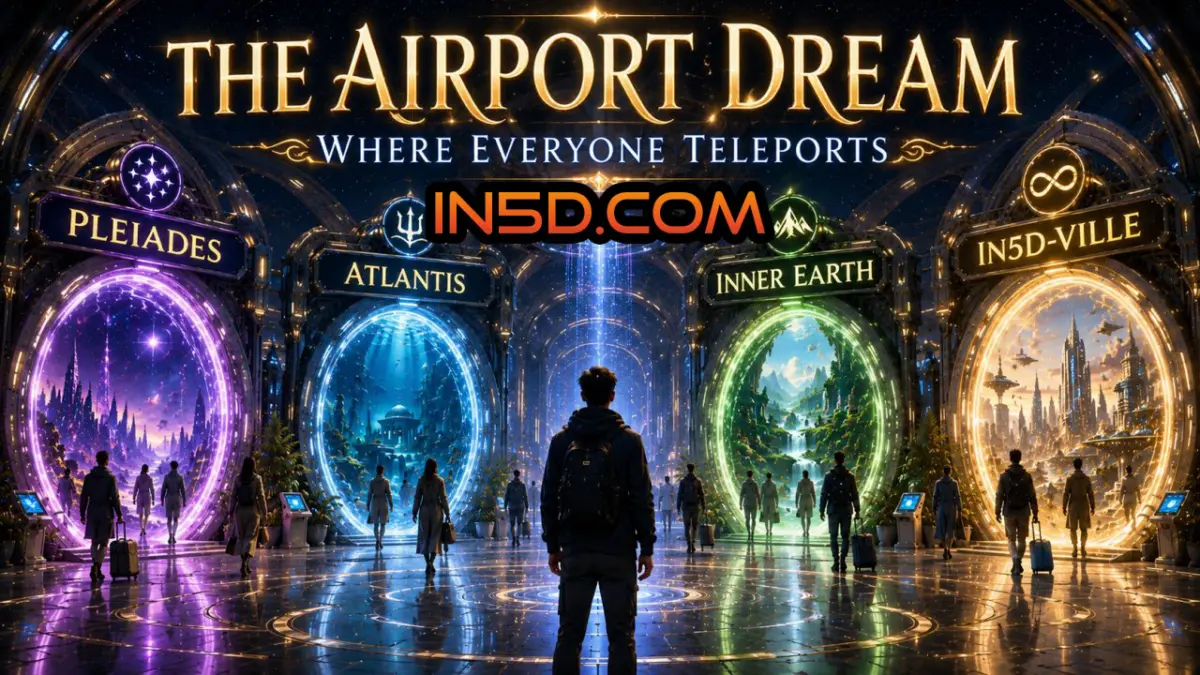
Consider the account of Gregg Prescott, M.S., founder of the consciousness exploration platform In5D. On January 2, 2014, Prescott experienced a nocturnal vision that epitomizes this anomaly. Finding himself in an expansive, terminal-like structure, he observed an environment devoid of the traditional markers of air travel—no airplanes, no asphalt runways, no boarding gates, and no TSA checkpoints.
Yet, the space possessed an undeniable purpose. Everyone present moved with absolute certainty of destination. Instead of boarding commercial aircraft, travelers simply and seamlessly teleported from one sector to another.
What made the encounter profound was not the revolutionary physics of instantaneous transit, but the psychological response to it: total normalcy. There was no panic, no existential shock, and no cognitive dissonance. To Prescott and the other figures in the dream, teleportation was as routine as stepping onto a moving walkway. Furthermore, the experience was saturated with a euphoric anticipation—a subconscious awareness that he was about to depart for a destination unimaginably distant from Earth, yet accessible in a fraction of a second.
This raises a fundamental question that bridges neuroscience, psychology, and metaphysics: What are these hyper-real dreamscapes, and why do they evoke such an undeniable sense of recognition?
Chronology: A History of Human Inquiry Into Altered Dream States
To understand why a teleportation terminal in a dream can feel like a forgotten homecoming, it is helpful to trace humanity’s evolving relationship with the dream state across centuries and disciplines.
Ancient and Esoteric Interpretations (Pre-20th Century)
For ancient civilizations, dreams were rarely dismissed as mere neurological static.
- The Ancient Egyptians and Greeks viewed the dream state as a genuine dimension of travel. Temples of Sleep (such as the Asklepiaeum in Greece) were constructed specifically for "incubated dreams," where seekers would travel to receive divine healing, prophecies, and cosmological insights. In these traditions, visiting otherworldly architecture or interacting with advanced modalities of travel was interpreted as the soul wandering through alternate planes of existence.
- Eastern esoteric traditions, including Tibetan Dream Yoga (Yogasanas), posited that the dream state is an alternate level of consciousness just as "real" as the waking world. Masters of these arts trained to maintain lucid awareness within dreamscapes, treating the environment not as a passive projection of the brain, but as a fluid, malleable dimension where consciousness could traverse vast spatial and dimensional distances.
The Rise of Modern Psychology (Late 19th to 20th Century)
With the advent of psychoanalysis through figures like Sigmund Freud and Carl Jung, the Western world began to categorize dreams through a symbolic lens.
- Freud famously framed dreams as the "royal road to the unconscious," focusing primarily on repressed wishes, infantile desires, and day residues masked by psychological defense mechanisms.
- Carl Jung, however, expanded this framework exponentially with the introduction of the Collective Unconscious and Archetypes. Jung suggested that certain dreams tap into a shared psychological reservoir inherited by all human beings. This could theoretically explain why disparate individuals across the globe report strikingly similar architectural motifs, futuristic cities, or transcendent modes of travel—they are navigating psychic structures native to the human psyche as a whole.
The Quantum and Metaphysical Shift (21st Century)
In contemporary consciousness research, the boundary between neuroscience and metaphysics has begun to blur. With the rise of quantum mechanics and holographic universe theories, researchers are increasingly open to the possibility that consciousness is not merely a byproduct of gray matter, but a fundamental property of the cosmos.
Dreams like Prescott’s airport vision—occurring in 2014 and analyzed over subsequent decades—sit at the cutting edge of this modern dialogue, forcing us to reconsider whether the sleeping mind is passively hallucinating or actively tuning into alternate frequencies of reality.
Supporting Data: Mapping the Architecture of the Subconscious
While subjective experiences of teleportation and otherworldly travel cannot easily be measured in a conventional laboratory, extensive qualitative data collected by dream researchers, psychological databases, and digital tracking platforms reveal undeniable behavioral patterns.
Common Motifs in "High-Fidelity" Dreams
Data gathered from long-term dream journals indicate that a significant percentage of the population experiences what can be termed "high-fidelity dreams"—dreams characterized by:
- Hyper-Real Sensory Input: Textures, temperatures, and emotional resonances that match or exceed waking life.
- Technological Intuition: The seamless operation of devices, portals, or vehicles (such as teleportation hubs or anti-gravity craft) that the dreamer has no waking reference for, yet instinctively understands.
- The "Deja-Vu of the Soul": The distinct psychological conviction that a location visited in the dream was known prior to the dream itself.
The Problem of Human Memory Retention
According to sleep science, humans typically forget roughly 95% to 99% of their dreams within minutes of waking up. The rapid decay of REM-wave memory structures means that even the most profound, life-altering dream insights dissolve into the ether of daily distractions before morning coffee.
For decades, dream researchers noted a critical methodological flaw in how humans study their own inner worlds: isolated data points.

- A person might remember a vivid dream about flying in 2018.
- They might recall a dream about stepping through a portal in 2021.
- They might dream of an unfamiliar technological hub in 2024.
Viewed in isolation, each dream is written off as a bizarre, isolated neurological anomaly—a weird firing of synapses after eating too late at night. However, when these events are cataloged, aggregated, and analyzed over a span of years, patterns begin to emerge that completely alter the interpretation of the data.
Official Responses and Theoretical Frameworks: How Science and Philosophy View the Phenomenon
How do mainstream academics, psychologists, and esoteric philosophers explain these recurring, highly complex dream motifs? Several prevailing hypotheses attempt to decode the mystery.
1. The Neuroscientific Perspective: Pattern Synthesis and Simulation
Neuroscientists generally argue that dreams are the brain’s way of consolidating memory, processing emotional residue, and running neurological simulations.
- The Activation-Synthesis Theory: Originally proposed by J. Allan Hobson and Robert McCarley, this theory suggests that the pons (a structure in the brainstem) sends random electrical impulses during REM sleep. The forebrain then attempts to weave these random signals into a coherent story, resulting in bizarre juxtapositions like flying, teleporting, or navigating impossible airports.
- The Simulation Theory: Proponents argue that the brain uses dream states as an evolutionary "virtual reality" sandbox, testing how the psyche reacts to novel stressors, spatial navigation, and unprecedented scenarios.
2. The Psychological Perspective: Symbolic Processing of Life Transitions
From a depth psychology standpoint, recurring motifs of travel, portals, and transit hubs are rarely about literal teleportation. Instead, they serve as profound metaphors for personal transformation.
- Transit Hubs (Airports/Terminals): Symbolize transitional phases in waking life—moving from one career, relationship, or psychological maturity level to another.
- Teleportation: Represents rapid, radical shifts in perspective or consciousness where the ego bypasses the slow, linear steps of personal growth and instantaneously "arrives" at a new state of being.
3. The Metaphysical and Multidimensional Perspective: Non-Local Consciousness
Esoteric researchers and consciousness pioneers offer a more radical interpretation: consciousness is non-local, meaning it is not strictly confined to the physical brain.
- In this view, during sleep, the physical body rests while the subtle energy body (or consciousness itself) detaches and explores alternate realities, parallel timelines, or higher-density dimensions.
- The "airport" Prescott described may not be a random firing of neurons, but a literal energetic transit station utilized by non-physical consciousness to navigate the multi-dimensional cosmos.
Implications: Connecting the Dots Across Time and Space
The true danger in evaluating profound dream experiences is treating them as isolated ephemera. As Prescott notes after nearly twenty years of tracking and writing about dream phenomena, the greatest mistake sleepers make is not forgetting their dreams, but forgetting the patterns.
The Shift Toward Automated Pattern Recognition
To combat the natural human tendency to let deep insights slip away, modern technological tools are beginning to bridge the gap between subjective inner experiences and objective data analysis.
Rather than relying on generic dream dictionaries—which attempt to apply blanket definitions (e.g., "dreaming of a snake means X") to deeply personal symbols—contemporary consciousness tools focus on longitudinal pattern recognition.
For instance, digital tracking initiatives like the In5D Infinite application are designed to act as an external memory bank for the subconscious. By securely logging dreams over months and years, users can uncover correlations that would otherwise remain invisible to the conscious mind.
Imagine discovering through longitudinal data analysis that:
- Every dream involving portals or instantaneous travel occurred within a 30-day window of a major life transition (such as a career change, relocation, or spiritual awakening).
- Specific architectural motifs appear exclusively during periods of deep emotional healing.
- Recurring symbols map directly onto cyclical patterns of personal growth.
This shifts the study of dreams from passive guesswork to active self-discovery. It is not about telling a user what to believe; it is about connecting the dots across time and space.
Toward a New Understanding of Reality
As humanity continues to navigate an era of rapid technological, psychological, and spiritual evolution, our relationship with the dream state is undergoing a renaissance. Whether these familiar, futuristic dreamscapes are symbolic projections of the psyche, visits to alternate realities, or glimpses into a multi-dimensional home we left behind, they serve a vital function.
They remind us that human experience is far vaster, more mysterious, and more deeply interconnected than our waking consensus reality suggests.
The next time you wake up with the lingering, haunting sensation that you have just returned from a place you’ve never visited—whether it is a silent teleportation terminal or a city of light—do not let it fade into the morning fog. Record it. Watch the patterns unfold.
For within the architecture of your dreams may lie the map of who you truly are, and where your consciousness is ultimately bound.
Infinite Love and Light,
The In5D Editorial Team
