

By CleanTechnica Analysis Desk
Special Report / Opinion & Strategic Review
Main Facts
The Canadian Urban Transit Research and Innovation Consortium (CUTRIC) sits at the very center of Canada’s multi-billion-dollar green transit transition. However, a deep structural conflict has brought the organization’s dual role into sharp focus. CUTRIC simultaneously acts as a technology commercialization advocate, an industry lobbyist, a project coordinator, and an arbiter of scientific, data-driven planning advice.
Critics and strategic analysts argue that this dual mandate creates an irreconcilable conflict of interest. While CUTRIC has played an instrumental role in advancing battery-electric bus (BEB) interoperability and assembling massive public funding packages, its institutional framework lacks the fundamental mechanism required of a true scientific advisory body: the capability to objectively abandon a favored technology when empirical data proves it obsolete.
For years, CUTRIC has heavily championed hydrogen fuel-cell buses, consistently labeling them as "essential" for difficult transit operating environments—such as hilly terrains, extreme winter climates, and long daily route blocks. Yet, a comprehensive new assessment from the TFIE Strategy Briefing questions whether this position is backed by rigorous, balanced comparative analysis. By failing to systematically evaluate modern, mature direct-electric alternatives—such as advanced managed depot charging, opportunity charging, and rapidly scaling in-motion charging infrastructures—CUTRIC risks misguiding municipal and federal investments worth hundreds of millions of public dollars.
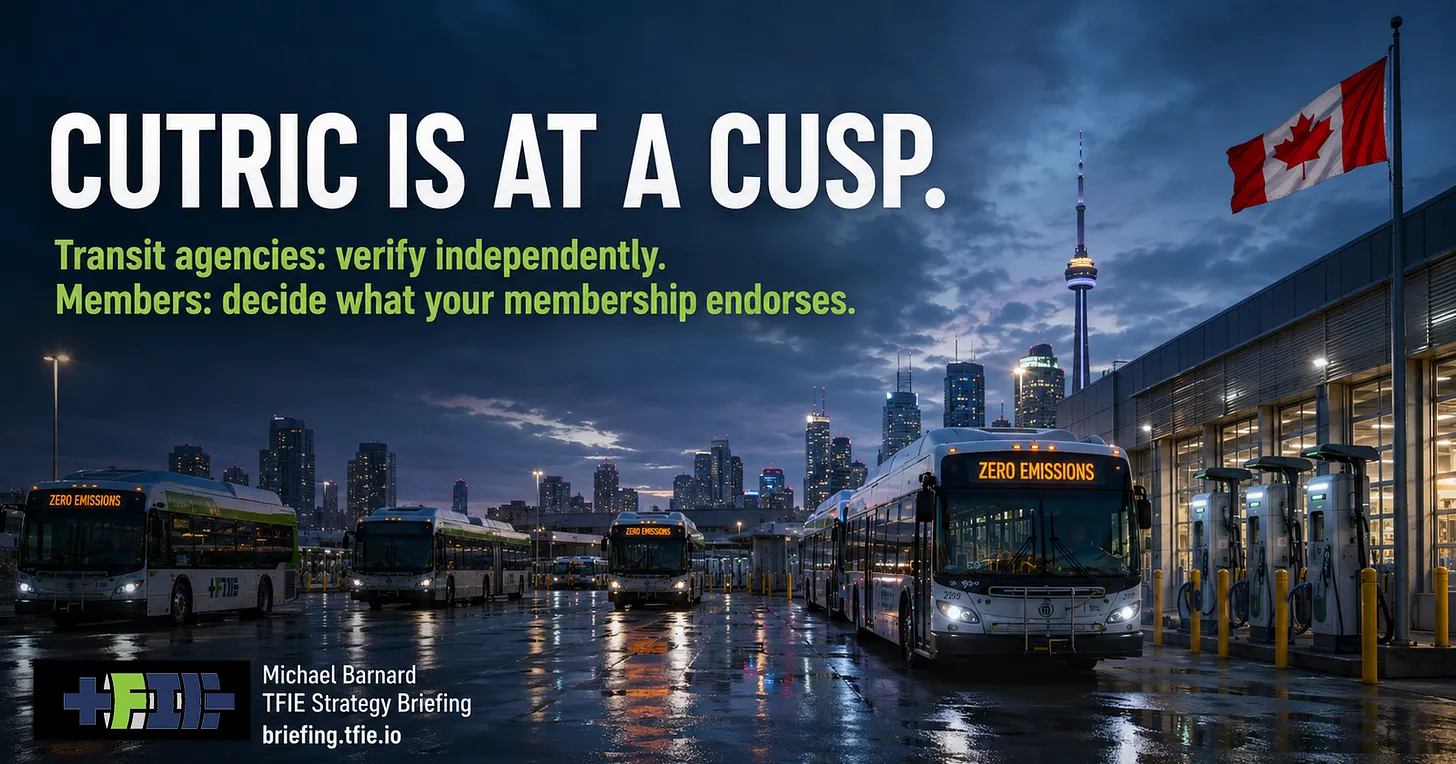
Consequently, transit agencies across Canada and beyond are being urged to fundamentally re-evaluate how they consume CUTRIC’s data. Rather than treating the organization as an independent, infallible authority that settles complex technology questions, transit operators must independently verify service assumptions, winter performance metrics, lifecycle economics, and grid requirements.
Chronology: The Rise of CUTRIC and the Evolution of the ZEB Debate
To understand the current institutional tension, it is necessary to trace how CUTRIC expanded its influence across Canada’s public transit landscape over the past decade.
- 2014–2016 (Founding and Early Mandate): CUTRIC was established with the explicit goal of driving innovation, research, and commercialization in Canada’s low-carbon transit sector. Early on, the organization focused heavily on bringing together disparate stakeholders—including bus manufacturers, component suppliers, and municipal transit agencies—to tackle pressing collective-action problems.
- 2017–2020 (The Interoperability Breakthrough): CUTRIC achieved notable success by tackling the lack of standardization in electric bus charging. By spearheading battery-electric bus interoperability initiatives, the organization helped the industry converge around common high-power charging standards, preventing proprietary vendor lock-in and smoothing the early adoption curve for battery buses.
- 2021–2023 (The Hydrogen Push and Dominance in Planning): As federal and provincial governments began allocating billions of dollars to zero-emission bus (ZEB) procurements, CUTRIC positioned itself as the dominant transit-planning provider in Canada. During this period, the organization increasingly advocated for a multi-technology approach, explicitly carving out a prominent role for hydrogen fuel-cell electric buses (FCEBs) alongside battery-electric fleets, branding hydrogen as a non-negotiable requirement for high-demand routes.
- 2024–2026 (Growing Analytical Scrutiny): As real-world operational data from early ZEB deployments began to accumulate, independent analysts started examining the longitudinal gap between CUTRIC’s optimistic forecasts and actual on-the-road performance. The publication of critical insights—most notably via the TFIE Strategy Briefing—shone a bright light on the organization’s institutional conflict, forcing transit agencies, board members, and industry observers to question whether CUTRIC’s analytical models maintain the neutrality required for objective public infrastructure planning.
Supporting Data: Commercialization vs. Independent Analysis
The core of the critique against CUTRIC is not that its staff lack technical competence, but rather that commercialization and independent analysis demand fundamentally different institutional behaviors.
The Commercialization Loop
An organization tasked with commercializing an early-stage technology naturally adopts a growth-and-advocacy mindset. Its institutional purpose is to answer questions such as:
- What funding mechanisms can subsidize this technology?
- Which municipal partners can host a pilot demonstration?
- What contractual structures will protect early manufacturers?
- How can public policy be shaped to favor market uptake?
In these areas, CUTRIC has demonstrated exceptional skill. It successfully navigates bureaucratic funding channels, mobilizes public support, and moves concepts efficiently from the drawing board to pilot deployments.

The Missing Feedback Loop in Scientific Analysis
Conversely, a truly independent analytical institution must possess a built-in mechanism for institutional self-correction. When analyzing complex engineering choices, a credible scientific body must be willing to arrive at difficult conclusions, including:
- Concluding that a specific technology should not reach mass market adoption.
- Admitting that an earlier multi-year forecast was fundamentally wrong.
- Formally declaring that a completed pilot project produced enough negative operational evidence to abandon the pathway.
- Demonstrating that alternative technologies now offer a vastly superior use of limited public capital.
While CUTRIC possesses sophisticated database infrastructure—such as its zero-emission bus tracking system, which meticulously categorizes projects from initial announcements and feasibility studies through to financing, procurement, commissioning, and active service—its public outputs rarely apply this data to self-correct.
Instead of treating stalled procurements, shifting technology choices, and operational hurdles as empirical indicators of low commercialization probability, the organization’s public narrative often continues to push forward unyieldingly. When forecasts prove inaccurate, a competent evidence-based institution engages in a rigorous retrospective: evaluating forecast errors, revising baseline assumptions, and altering its recommendations. CUTRIC’s public record shows plenty of machinery for market promotion, but a glaring deficit in institutional introspection.
The Hydrogen Conundrum: Is FCEB Truly "Essential"?
The tension between commercial advocacy and objective analysis is most clearly visible in CUTRIC’s persistent positioning of hydrogen fuel-cell buses.
CUTRIC has repeatedly characterized fuel-cell buses as "essential" for handling difficult transit operating duties. Transit agencies routinely face severe operational challenges: long daily route blocks, steep topographical hills, heavy passenger capacity loads, intense heating and cooling requirements during extreme winter and summer peaks, depot space constraints, and limited opportunities for stationary charging.
However, establishing that hydrogen is essential requires meeting a very high evidentiary bar: proving definitively that these demanding operational requirements cannot be met reasonably by the most advanced direct-electric architectures available today.
Strategic reviews of CUTRIC’s public body of work indicate that this strict evidentiary bar has rarely, if ever, been cleared. Furthermore, on a global scale, transit technologies have not stood still. In-motion charging (IMC)—where trolleybus-style overhead wires or advanced dynamic conductive systems charge buses while they operate along regular routes—is scaling rapidly. These direct-electric solutions are successfully handling the exact grueling route conditions that CUTRIC frequently uses to justify the necessity of hydrogen.
The Evolution of Direct-Electric Competitors
Modern direct-electric transit is no longer confined to the crude, early-generation comparison between a short-range, depot-only battery bus and a hydrogen fuel-cell bus. Today’s transit planning toolbox includes:
- Managed Depot Charging: Intelligent software systems that sequence overnight charging based on electricity pricing tiers and morning departure schedules.
- Schedule and Block Redesign: Optimizing vehicle duties to eliminate unrealistic single-block mileage requirements without degrading passenger service levels.
- Opportunity Charging: High-power overhead pantograph chargers strategically placed at major transit terminals or route turnarounds, allowing buses to top up their batteries in minutes during scheduled layovers.
- Conducted In-Motion Charging: Systems that allow batteries to be continuously replenished while in active revenue service, drastically shrinking the necessary battery pack size and weight.
None of these direct-electric solutions are universally optimal; each carries its own set of infrastructure capital costs, grid connection hurdles, and operational trade-offs. However, declaring a technology "essential" before these credible direct-electric alternatives have been exhaustively tested and exhausted in practice represents a significant shortcut in systems engineering. Moving prematurely from the observation that "a standard depot-battery bus struggles on this specific heavy-duty block" directly to the conclusion that "hydrogen fuel cells are legally or operationally required" bypasses the rigorous comparative analysis that public agencies deserve.

Official Responses and Strategic Implications
The findings brought to light by the TFIE Strategy Briefing and echoed across technical analysis circles carry profound implications for all stakeholders involved in Canada’s transit transition—most notably municipal transit agencies and CUTRIC’s own member organizations.
What This Means for Transit Agencies
For municipal transit authorities grappling with capital allocation decisions worth hundreds of millions of dollars, the primary takeaway is clear: independent verification is mandatory.
Transit agencies must treat CUTRIC’s analyses, models, and recommendations as coming from an interested industry institution rather than an objective, neutral scientific authority. While individual datasets compiled by CUTRIC may be highly useful, and specific engineering models may be well-constructed, major public procurements cannot rely on "CUTRIC says so" as a substitute for due diligence.
Before committing public funds to any zero-emission technology pathway, agencies should independently stress-test:
- Local service assumptions and topographical route demands.
- Real-world winter energy consumption and climate performance.
- Fleet replacement ratios (comparing how many direct-electric vs. hydrogen buses are needed to maintain identical service levels).
- Charging utilization rates and localized grid infrastructure upgrade requirements.
- Full lifecycle economics, including volatile fuel/electricity pricing and maintenance overhead.
- The completeness of the technology comparator set (ensuring all modern direct-electric configurations were modeled before leaning toward hydrogen).
The Crossroads for CUTRIC
CUTRIC now faces a pivotal institutional fork in the road. Strategic analysts suggest the organization has three viable pathways moving forward:
- Institutional Separation: Create a genuinely independent evidence-generation and model-validation arm—complete with transparent, binding mechanisms for stopping failed technology pathways and validating past forecasts—while separating its commercialization and lobbying activities entirely.
- Explicit Repositioning: Drop the claims of scientific neutrality and operate openly and explicitly as an industry advocacy and commercialization association. In this scenario, its reports and modeling would be evaluated transparently by the market, treated exactly like the work produced by any other trade association with a vested interest in market development.
- Maintaining the Status Quo: Continue combining commercial promotion, government advocacy, and claims of scientific authority. However, as independent scrutiny increases and deployment data exposes the limitations of uncorrected forecasts, this final pathway will become increasingly difficult to defend publicly or sustain ethically.
The Responsibility of CUTRIC Members
Beyond executive leadership, CUTRIC’s member organizations—ranging from major transit operators to private-sector technology vendors—face a reckoning of their own. Membership provides concrete practical benefits, networking access, and institutional legitimacy. However, members must decide what their active participation and financial contributions ultimately endorse. By lending their names to an organization that blurs the lines between commercial lobbying and neutral scientific inquiry, transit agencies risk inadvertently undermining public trust in municipal green infrastructure planning.
As Canada accelerates toward its climate targets, ensuring that every public dollar is spent on the most efficient, cost-effective, and environmentally sound transit technology is paramount. The debate surrounding CUTRIC is a timely reminder that in the transition to a sustainable future, rigorous, uncompromised, and self-correcting data must always remain the ultimate guiding light.
