

Main Facts
In the wake of Russia’s 2022 invasion of Ukraine, "energy independence" became a rallying cry across Europe. As natural gas and electricity prices skyrocketed, policymakers scrambled to decouple their economies from foreign energy sources. However, according to recent energy sector analyses, that panic-driven response misidentified the core vulnerability.
The crisis in Europe was not caused by international energy trade itself; rather, it stemmed from an over-reliance on a single, increasingly hostile supplier for a critical commodity. Today, as Europe and its neighbors look toward the 2030s, the paradigm is shifting from isolationist "energy autarky" to strategic energy interdependence.
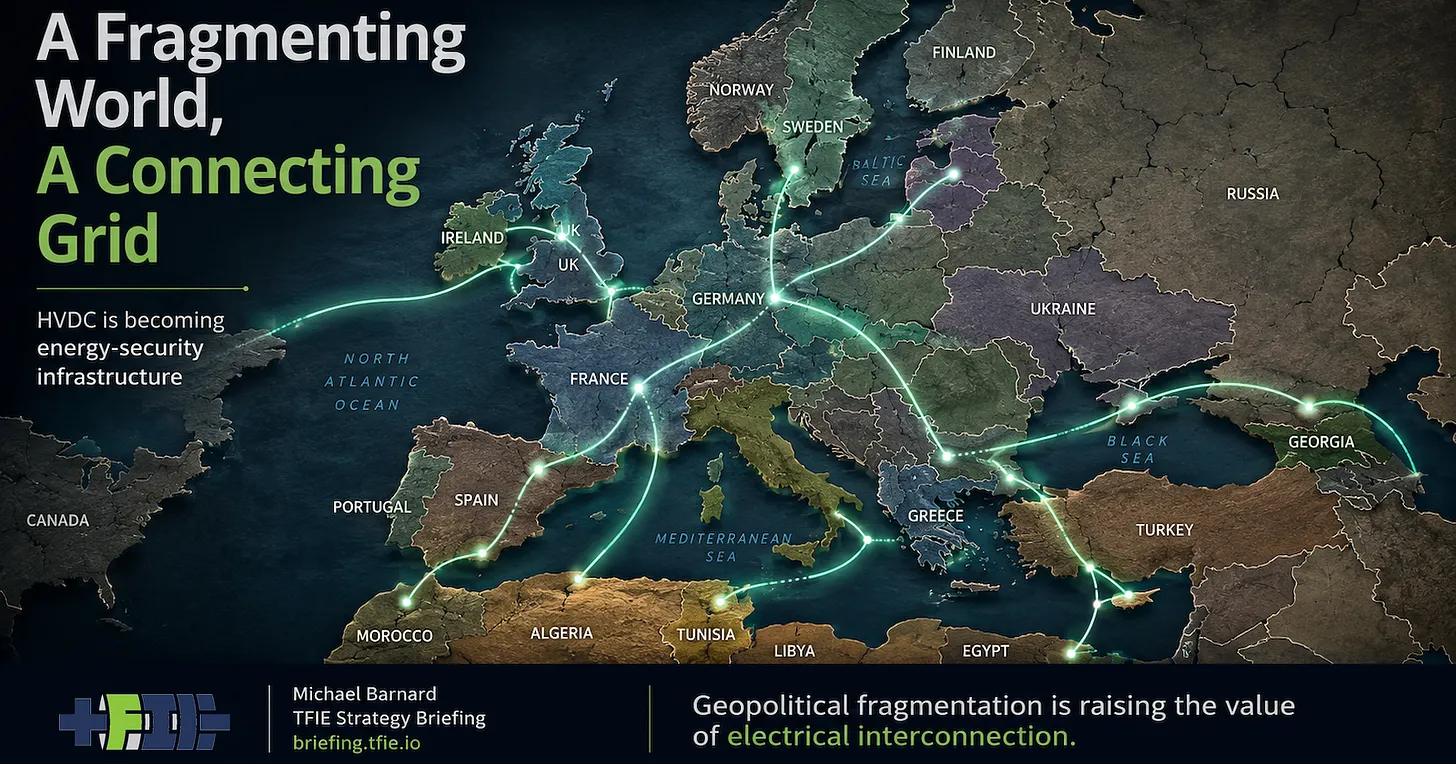
At the center of this evolution are high-voltage direct current (HVDC) cross-border electricity links. Far from retreating in the face of escalating global geopolitical tensions, international transmission infrastructure is expanding rapidly. Data from RTE International’s mid-2026 inventory highlights a robust pipeline of voltage-source-converter projects, featuring approximately 60 prospective international links concentrated heavily in Europe and its immediate periphery.
Unlike traditional fossil fuel imports—such as gas pipelines or liquefied natural gas (LNG) terminals, which leave importing nations continuously exposed to volatile commodity prices and geopolitical extortion—electricity interconnectors create reciprocal, bi-directional energy flows. They integrate power systems rich in diverse resources, including hydro, wind, solar, nuclear, and energy storage across varied weather systems and jurisdictions.
Policy bodies like the European Union Agency for the Cooperation of Energy Regulators (ACER) and national planners in countries like the United Kingdom are increasingly embedding international links into their security-of-supply frameworks. Interconnectors are no longer viewed merely as commercial tools for wholesale price arbitrage, but as vital assets for grid flexibility, renewable integration, and geopolitical resilience.
Chronology of a Paradigm Shift
To understand how cross-border transmission evolved from a market integration tool into a cornerstone of national security, it is necessary to trace the shifting geopolitical and regulatory landscape over the past several years:
- Pre-2022 (The Market Integration Era): Cross-border HVDC cables were primarily developed to optimize wholesale electricity markets, balance regional supply and demand, and help individual nations meet early decarbonization targets by sharing cheap renewable generation.
- Early 2022 (The Energy Shock): Following Russia’s invasion of Ukraine, European gas and electricity markets collapsed into chaos. The immediate political reflex was a pursuit of total energy independence, leading many to question reliance on cross-border infrastructure and foreign supply chains.
- 2023–2024 (The Realization of Interdependence): Analysts and grid operators recognized that total electrical isolation (autarky) was technically and economically unviable for a rapid clean energy transition. The debate shifted from ending all foreign ties to diversifying partners and securing robust, multi-directional electrical corridors.
- 2025 (Decoupling and Re-wiring): Regional milestones, such as the complete desynchronization of the Baltic states’ electricity grids from the Russian sphere and their subsequent alignment with continental European networks, demonstrated that strategic electrical realignment was both possible and imperative.
- July 2026 (Current Landscape): Comprehensive industry datasets—such as RTE International’s 2026 inventory and ACER’s updated monitoring reports—reveal a thriving pipeline of roughly 60 major cross-national HVDC projects. Concurrently, national frameworks like the UK’s Clean Flexibility Roadmap officially codify interconnectors as core components of national security and clean flexibility portfolios.
Supporting Data and Infrastructure Insights
The resilience value of cross-border electricity links is supported by hard data regarding project pipelines, technical distinctions, and risk management strategies.

The 2026 HVDC Project Pipeline
Despite tightening geopolitical fragmentation, cross-border transmission remains one of the most active infrastructure categories in regions facing heightened security concerns. RTE International’s inventory underscores a high concentration of voltage-source-converter (VSC) schemes slated for development through the late 2020s and 2030s.
A prime example is the ongoing advancement of the Baltic-German PowerLink. Even as regional security risks escalated following the Baltic states’ formal separation from the Russian electricity grid, Lithuania, Latvia, and Germany continued pushing the project toward formal EU Project of Common Interest (PCI) status. This proves that heightened threat levels are accelerating western electrical integration rather than halting it.
Fuel Pipelines vs. Electricity Interconnectors
The structural difference between importing fossil fuels and trading electricity underpins the modern argument for strategic interdependence:
| Metric / Feature | Fossil Fuel Import (Gas Pipeline / LNG) | Electricity Interconnector (HVDC) |
|---|---|---|
| Flow Direction | Unidirectional (Producer to Consumer) | Bi-directional (Dynamic exchange based on need) |
| Commodity Exposure | Highly vulnerable to global price spikes and supplier manipulation | Insulated from single-commodity market shocks; taps diverse generation mixes |
| System Integration | Delivers fuel; requires domestic combustion infrastructure to generate power | Directly merges generation, storage, and demand response across borders |
| Vulnerability Profile | Loss of supplier halts energy flow entirely; high geopolitical leverage | Loss of one link is a manageable contingency within a diversified portfolio |
Managing Concentration Risks
While interconnectors add immense resilience, energy experts emphasize that poorly designed interconnection can introduce new vulnerabilities. Relying on a single massive subsea cable creates a severe concentration risk. Furthermore, subsea cables are susceptible to physical damage or sabotage, and neighboring countries can experience correlated weather patterns (e.g., a continent-wide wind drought).
To mitigate these risks, modern grid planning relies on portfolio logic: multiple counterparties, diverse physical routes, robust domestic generation, localized energy storage, and flexible demand-side management. Interconnection is most effective when it supplements—rather than replaces—a well-balanced domestic grid.
Official Responses and Policy Frameworks
Regulatory bodies and national governments have formally updated their long-term strategies to reflect the changing role of international transmission lines.
ACER’s Regulatory Push
The European Union Agency for the Cooperation of Energy Regulators (ACER) has emerged as a leading voice for enhanced cross-border cooperation. In its recent monitoring and development reports, ACER explicitly argues for stronger interconnection across member states. The agency emphasizes that as renewable energy penetration accelerates, sharing flexibility across borders is no longer optional—it is a technical necessity to keep power systems stable, reduce fossil-fuel reliance, and insulate the bloc from external energy shocks.

The United Kingdom’s Clean Flexibility Roadmap
In the United Kingdom, the government’s Clean Flexibility Roadmap (including its July 2026 updates) repositions international interconnectors. Rather than treating them merely as market-balancing mechanisms, British energy policy now integrates subsea links directly into the national security-of-supply portfolio. Interconnectors are categorized alongside grid-scale battery storage and dynamic demand-side response as critical infrastructure that guarantees system flexibility in a decarbonized economy.
Implications for the Future of Global Energy
The transition from energy independence to strategic interdependence carries profound implications for geopolitics, engineering, and climate policy.
1. Redefining National Security in the Clean Energy Era
For decades, traditional national security in the energy sector meant hoarding fossil fuel reserves and achieving self-sufficiency. In a decarbonized world powered by wind, solar, and advanced storage, absolute self-sufficiency is inefficient and expensive. A country that attempts to build an entirely autarkic renewable grid would need massive, cost-prohibitive overcapacities in domestic generation and seasonal storage. Strategic interdependence allows nations to share balancing costs and natural resources, turning geographic diversity into a security asset.
2. The Evolution of Geopolitical Leverage
When energy supply relied on oil tankers and gas pipelines, exporting nations held disproportionate coercive power over importers. Electrical interconnections invert this dynamic. Because modern HVDC links enable bi-directional power flows, interconnected nations share mutual vulnerability and mutual support. Cutting off an interconnector hurts both sides economically and operationally, creating a powerful deterrent against hostile interference.
3. A Blueprint for Global Decarbonization
As the global community works toward mid-century net-zero targets, the success of Europe’s HVDC pipeline will serve as a global litmus test. If nations can successfully balance complex, multi-national grids while maintaining high levels of cyber and physical security, the model can be replicated across other regions—from North America to Asia-Pacific.
Ultimately, the most important shift in modern energy policy is not the move from dependence to isolation, but the evolution from vulnerable, continuously replenished fuel dependence toward a robust, diversified, and reciprocal electricity portfolio.
