By Architectural Digest Staff Special to Architecture & Design Review
Introduction: The Shape of American Space
Decades after his passing, Frank Lloyd Wright remains the towering titan of American architecture. Across a prolific career spanning nearly six decades, Wright did not merely design buildings; he fundamentally reconfigured how humanity conceptualized interior space, structural materials, and, most importantly, the relationship between the built environment and the natural world.
From the cantilevered, gravity-defying drama of Fallingwater in the Pennsylvania woodlands to the soaring, spiraling white concrete ribbon of the Solomon R. Guggenheim Museum in New York City, Wright’s architectural vocabulary shaped the landscape of modern design. His foundational philosophy—known as organic architecture—insisted that a structure should grow naturally out of its surrounding landscape rather than aggressively imposing upon it.
To understand why Wright remains a household name and an endless source of study for contemporary architects, one must examine the masterworks that defined his career, tracing a trajectory that revolutionized the American built environment.
Chronology of a Master: Key Milestones in Wright’s Career
To trace Frank Lloyd Wright’s career is to trace the evolution of modern architecture itself. His life (1867–1959) bridged the gap between 19th-century Victorian classicism and the sleek, boundary-pushing avant-garde of the mid-20th century.
1887–1893: Wright moves to Chicago, working initially for Joseph Lyman Silsbee before joining the legendary firm of Adler & Sullivan. Under the mentorship of Louis Sullivan—the "father of skyscrapers"—Wright hones his design sensibilities.
1893: Opens his independent architectural practice in Oak Park, Illinois, where he begins developing the tenets of the Prairie School.
1906–1909: Designs and builds the Frederick C. Robie House in Chicago, widely considered the ultimate masterpiece of his Prairie style.
1919–1922: Completes the Hollyhock House in Los Angeles, exploring his "Maya Revival" phase with patterned concrete textile blocks.
1935–1939: Designs Fallingwater for the Kaufmann family in Bear Run, Pennsylvania, and the Johnson Wax Administration Building in Racine, Wisconsin—marking a miraculous mid-career renaissance.
1943–1959: Works tirelessly on the Guggenheim Museum in New York City, which opens just months after his death in 1959.
The 10 Most Important Frank Lloyd Wright Buildings Everyone Should Know
While Wright designed more than 500 completed structures throughout his lifetime, certain projects stand head and shoulders above the rest. These foundational buildings illustrate his evolving genius and enduring relevance.
1. Fallingwater (Bear Run, Pennsylvania)
Perhaps the most famous private residence in the world, Fallingwater (1935) is the ultimate expression of organic architecture. Built directly over a natural waterfall in the Laurel Highlands of Pennsylvania, Wright used bold, horizontal cantilevered concrete terraces that stretch out over the rushing stream. Instead of placing the house next to the waterfall—where the owners could merely look at it—Wright placed them within the rushing cascade, integrating the sound of rushing water into the daily life of the home.
2. The Solomon R. Guggenheim Museum (New York City, New York)
Breaking entirely from the traditional box-like museum galleries of his era, Wright envisioned a temple of art shaped like a giant white ziggurat or an inverted nautilus shell. Completed in 1959, the Guggenheim invites visitors to take an elevator to the top and slowly wind their way down a continuous, gently sloping spiral ramp. The central rotunda bathes visitors in natural light from a massive glass dome, proving that the building itself could be just as breathtaking as the art housed within it.
3. The Frederick C. Robie House (Chicago, Illinois)
Located in the Hyde Park neighborhood of Chicago, the Robie House (1910) is the pinnacle of Wright’s Prairie School movement. Characterized by low-pitched roofs, overhanging eaves, long rows of art-glass windows, and strong horizontal lines, the home was designed to echo the flat, expansive landscape of the American Midwest. Inside, the open-plan layout eliminated traditional, walled-off box rooms, creating a fluid, unified living space that revolutionized residential interior design.
4. Unity Temple (Oak Park, Illinois)
Constructed between 1905 and 1908, Unity Temple is widely considered the first monolithic concrete building in the world and a masterpiece of modern sacred architecture. Because of a strict budget and a noisy urban site, Wright turned inward, creating a monumental concrete cube that illuminated its sanctuary entirely through skylights and high clerestory windows. The result is a serene, introspective space insulated from the chaotic sounds of the city streets outside.
5. Hollyhock House (Los Angeles, California)
Commissioned by oil heiress Aline Barnsdall, the Hollyhock House (1921) marked a dramatic stylistic shift for Wright. Built in the trendy Los Angeles neighborhood of Hollywood, the structure draws inspiration from ancient Mesoamerican architecture. Cast concrete blocks featuring stylized hollyhock flower motifs wrap around the exterior and interior, blending Mayan massing with California indoor-outdoor living through a series of private inner courtyards.
6. Taliesin West (Scottsdale, Arizona)
Serving as Wright’s winter home and desert laboratory from 1937 until his death, Taliesin West is a sprawling desert compound built directly into the foothills of the McDowell Mountains. Constructed using local desert rocks, sand, and redwood, the buildings are low-slung and rugged, designed to withstand the blistering Arizona sun while framing dramatic vistas of the desert floor.
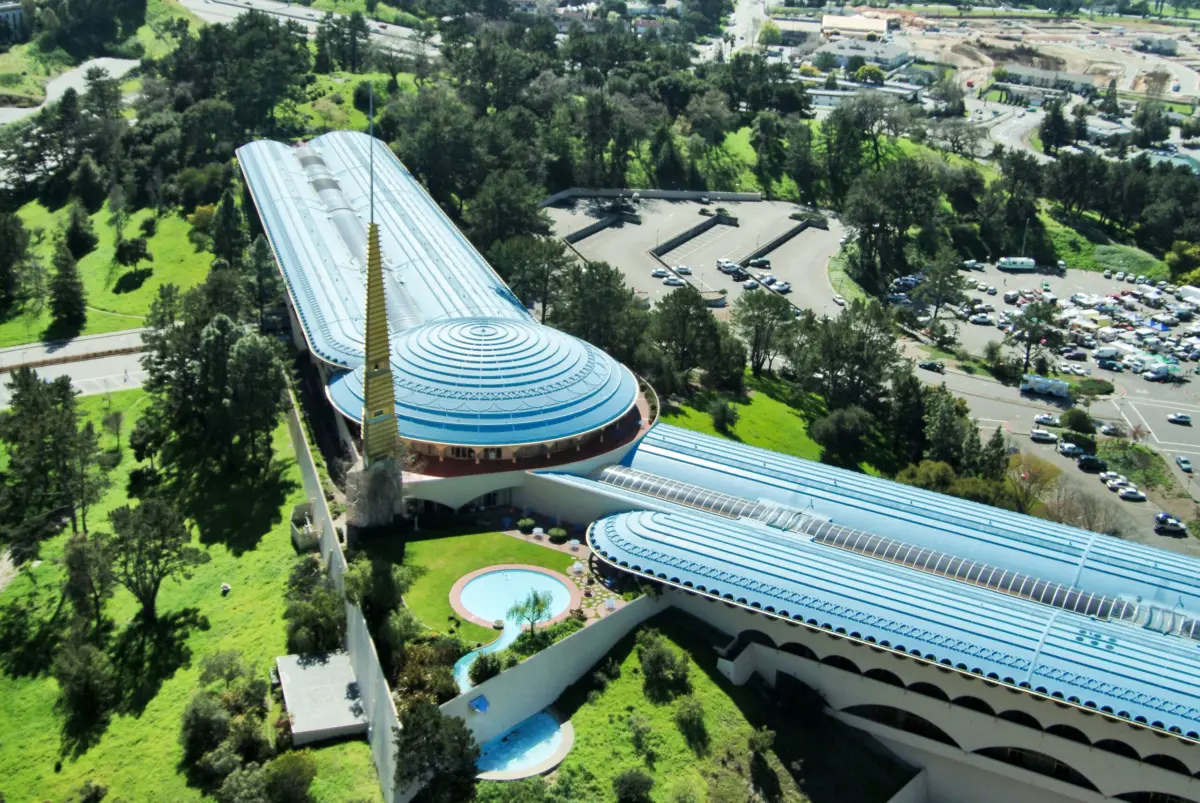
7. The Marin County Civic Center (San Rafael, California)
Commissioned in 1957, this sprawling government complex is Wright’s largest completed public project. Spanning two hills in San Rafael, California, the Marin Civic Center features cheerful light-blue roofs, dramatic semicircular arches, and golden balconies that feel simultaneously futuristic and classical. (Pop culture trivia: its iconic retro-futuristic corridors were famously used as a filming location in the sci-fi film Gattaca.)
8. The Johnson Wax Administration Building (Racine, Wisconsin)
Completed in 1939, Wright’s corporate headquarters for S.C. Johnson & Son shattered corporate architectural norms. The interior features a vast, column-free "Great Workroom" supported by slender, mushroom-like dendriform concrete columns that taper gracefully toward the floor. Natural light filters down through Pyrex glass tubing in the ceiling, creating an ethereal, uplifting work environment that prioritized employee well-being long before modern wellness architecture became a trend.
9. Ennis House (Los Angeles, California)
Perched high in the hills of Los Feliz, the Ennis House (1924) is the most theatrical of Wright’s "textile block" houses in Southern California. Constructed from nearly 27,000 patterned precast concrete blocks, the home resembles an ancient Mayan temple draped across the hillside. Its dramatic, deeply textured surfaces and sweeping views of the Los Angeles basin have made it a favorite backdrop for Hollywood filmmakers over the decades.
10. Taliesin (Spring Green, Wisconsin)
Wright’s primary estate and spiritual home, Taliesin was built in 1911 in the rolling hills of the Wisconsin river valley where his mother’s family settled. Named after a Welsh bard whose name means "shining brow," the rambling estate was deeply personal to Wright, serving as his architectural workshop, home, and experimental testing ground through triumphs and personal tragedies alike.
Supporting Data & Architectural Impact
To quantify Frank Lloyd Wright’s footprint on global culture, architectural historians often point to several staggering milestones:
UNESCO Recognition: In 2019, a collection of eight major Frank Lloyd Wright works—including Fallingwater, the Guggenheim, Unity Temple, and the Robie House—was inscribed as a UNESCO World Heritage Site, placing his contributions on par with the Pyramids of Giza and the Taj Mahal.
The Usonian Vision: Beyond his grand estates, Wright designed roughly 60 affordable, middle-class homes known as "Usonian" houses during the Great Depression and post-war era. These compact designs popularized open-plan kitchens, carports, and radiant floor heating—innovations that are now standard in modern suburban homebuilding.
Global Influence: Wright’s apprentices—such as Richard Neutra, John Lautner, and E. Fay Jones—carried his organic principles across the globe, influencing generations of international modernist architects.
Official Responses and Preservation Efforts
Preserving buildings constructed more than a century ago—often using experimental materials like reinforced concrete, early plastics, and unreinforced masonry—presents unique logistical hurdles.
Organizations such as the Frank Lloyd Wright Building Conservancy and the Western Pennsylvania Conservancy manage multi-million-dollar preservation campaigns to protect these fragile landmarks from environmental decay and urban encroachment.
"Frank Lloyd Wright did not design museum pieces; he designed living spaces meant to be experienced by human beings," notes structural preservationist Dr. Elena Vance. "Our responsibility is to ensure that future generations can walk through these spaces and feel the exact spatial choreography Wright intended."
Recent restoration projects, such as the painstaking multi-year overhaul of Unity Temple and structural reinforcements at Fallingwater, have utilized cutting-edge 3D modeling and materials science to stabilize deteriorating concrete cantilevers while preserving historical authenticity.
Implications: Why Wright Still Matters Today
As contemporary urban centers grapple with climate change, density, and alienation, Wright’s core philosophy feels more urgent than ever. His insistence that architecture must harmonize with nature—rather than conquer it—serves as a philosophical blueprint for sustainable, green building practices in the 21st century.
Furthermore, Wright’s rejection of rigid, compartmentalized floor plans paved the way for modern open-concept living, influencing how everyday families interact within their homes.
Decades after his passing, Frank Lloyd Wright remains an American original. Whether viewed through the lens of a drone soaring over Fallingwater or from the spiraling ramps of the Guggenheim, his buildings endure not just as monuments of stone and steel, but as living testaments to the power of human imagination grounded in the natural world.




.jpg)

.jpg)
.jpg)

.jpg)


