

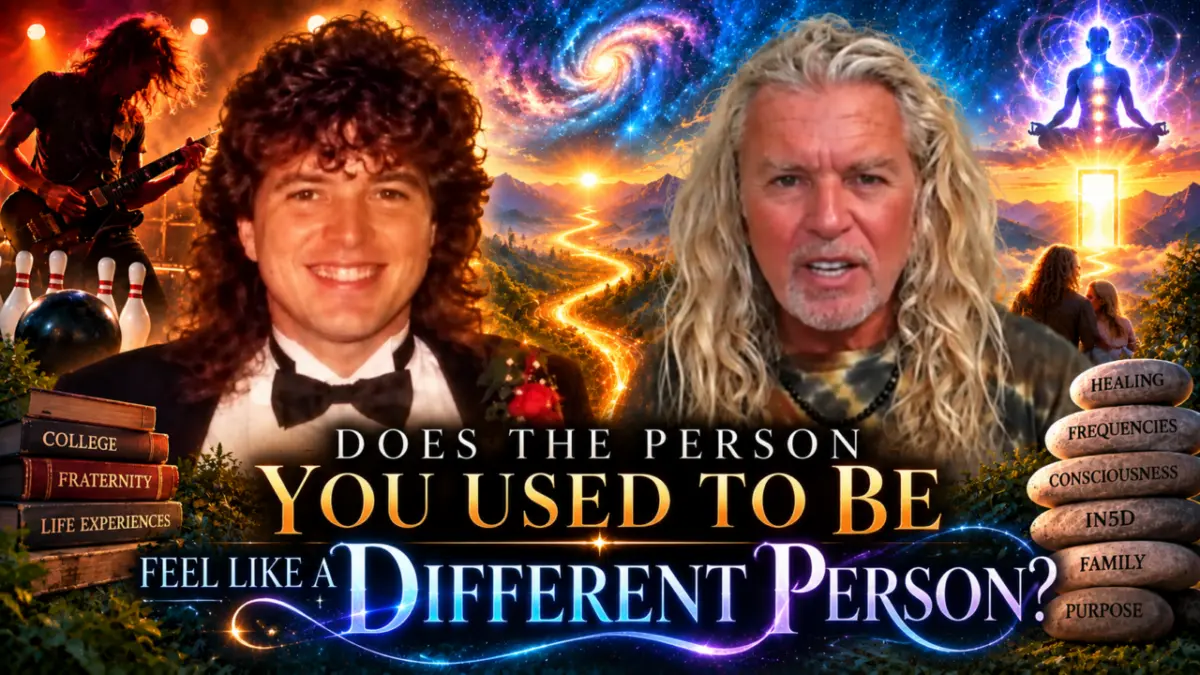
By Global Consciousness Desk
Published in association with In5D Media
Main Facts: The Mirror of Time and the Evolution of Self
At the intersection of aging, self-reflection, and spiritual evolution lies a fundamental human inquiry: Does the person you used to be feel like a completely different individual?
Gregg Prescott, M.S., founder, webmaster, and editor of the long-running metaphysical portal In5D.com, ignited a widespread philosophical debate across digital platforms following a side-by-side photographic comparison. Contrasting an image of himself from 1993 at age 32 with a contemporary portrait from 2026 at age 65, Prescott’s reflection serves as a microcosm for a broader sociological and metaphysical phenomenon.
While external markers—hair texture, physical stature, and chronological age—undergo inevitable biological shifts, the internal locus of identity often follows a cyclical path. Rather than charting a linear trajectory toward an entirely new persona, human life frequently operates as an expansive loop. Individuals spend their formative and middle decades accumulating societal conditioning, enduring trauma, mastering careers, and navigating relationships, only to potentially circle back to the core essence of who they were before external expectations intervened.
This retrospective exploration touches upon core themes of modern psychological development, generational astrology (specifically the Pluto in Virgo demographic), and the digital-age revival of esoteric philosophy.
Chronology: From Sunday School Rebel to Digital Metaphysician
The timeline of Prescott’s life—mirroring the spiritual awakening trajectories of millions within the Baby Boomer and Generation X cohorts—demonstrates how early childhood inclinations can be suppressed by conventional socialization before resurfacing with profound maturity.
1. The Formative Years: Inquiring Minds (Circa 1960s–1970s)
Long before the establishment of digital publishing platforms, Prescott’s metaphysical leanings manifested early. Raised within conventional societal structures, his childhood was marked by a relentless skepticism toward dogmatic institutions. At a young age, his persistent questioning during Sunday school classes reportedly prompted instructors to contact his parents, requesting that he cease disrupting lessons with theological inquiries.
By age 12, an encounter with a volume on "magic"—which ventured past stage illusions into the concepts of astral travel and non-physical dimensions—cemented an early intuitive understanding that consensus reality represented merely a fraction of existence.

2. The Divergence: Rock and Roll, Academia, and Conventional Milestones
As is common in the human lifecycle, the imperatives of youth temporarily overshadowed esoteric pursuits. Prescott’s adolescence and early adulthood were characterized by mainstream milestones: playing guitar in hard rock bands, pursuing higher education, and joining a collegiate fraternity. These years, while seemingly disparate from a metaphysical path, provided essential experiential data. They served as a crucible for interpersonal dynamics, resilience, and worldly understanding.
The birth of his daughter marked a pivotal emotional and psychological turning point, anchoring his perspective in unconditional love and responsibility while bridging his youthful curiosity with adult accountability.
3. The Catalyst: The Secret and the Birth of In5D (2006–2009)
A critical inflection point occurred when Prescott’s former wife introduced him to the trailer for the transformative documentary The Secret. This encounter acted as a catalyst, unlocking a doorway to quantum philosophy, the law of attraction, and advanced metaphysical concepts.
The momentum generated by this awakening directly inspired the launch of In5D.com in 2009. Conceived as a digital sanctuary for free thinkers, spiritual seekers, and those alienated by dogmatic systems, the platform rapidly expanded into a global hub for alternative consciousness, eventually encompassing multiple metaphysical radio networks (In5D Radio, WIN5D, and In5D Talks) and cultivating a following numbering in the hundreds of thousands across multiple social media ecosystems.
4. The Digital Renaissance: Developing Spiritual Technology (Present Day)
Entering his mid-sixties, Prescott’s trajectory has defied conventional retirement paradigms. Embracing technological innovation, he transitioned into software development, releasing In5D Infinite—an interactive spiritual journey application designed to track dreams, synchronicities, astrology, and numerology over time. Current development focuses on a suite of companion apps exploring Solfeggio frequencies, binaural beats, sacred geometry, and breathwork, bridging ancient metaphysical wisdom with modern digital utility.
Supporting Data: Generational Shifts and the Psychology of Identity
The philosophical questions raised by Prescott’s self-reflection intersect with established sociological frameworks regarding generational archetypes and psychological transformation.
Generational Astrology and Collective Timing
In metaphysical and astrological analysis, generational cohorts are frequently defined by outer planetary transits. Prescott identifies as part of the Pluto in Virgo generation (born roughly between 1957 and 1972), immediately following the Pluto in Leo cohort (1939–1957).
- Pluto in Leo Generation: Characterized by expressive creativity, individualism, and a reimagining of personal power within culture.
- Pluto in Virgo Generation: Associated with analytical precision, systemic reform, service, holistic health, and the practical application of spiritual philosophies into everyday structures.
From this perspective, generational progression is not merely chronological replacement, but a relay race of consciousness. One generation holds foundational societal space while the next gathers the operational experience required to construct alternative paradigms.

The Psychology of Dis-identification
Psychological studies on "ego continuity" suggest that individuals frequently experience a sense of utter detachment from their younger selves. Neurological research indicates that continuous neuroplasticity alters memory consolidation, meaning past memories are recalled through the emotional filter of the present moment. Consequently, a 65-year-old evaluating a 32-year-old photograph is engaging with a psychological construct: an actor in a past life chapter whose fears, ambitions, and daily stresses have dissolved into wisdom.
Official Responses and Public Engagement: The Digital Echo
The digital dissemination of Prescott’s comparative photographs via social media elicited a robust public response, registering hundreds of deeply reflective comments from a community of conscious seekers.
Spectrum of Public Sentiment
- The Discontinuity Camp: A significant portion of respondents reported feeling entirely disconnected from their younger identities. Many noted that the traumas, divorces, career shifts, and personal reinventions they endured rendered their younger selves unrecognizable—strangers whose naivety contrasted sharply with hard-won maturity.
- The Core Essence Camp: Conversely, another demographic echoed Prescott’s secondary hypothesis: that the core frequency of the individual remains immutable. These respondents argued that beneath the accumulated layers of societal conditioning, physical aging, and emotional scarring, the intrinsic child—characterized by innate wonder and existential curiosity—remains intact.
- The Integration Perspective: Mental health professionals and spiritual counselors observing the discourse noted that reconciling past and present selves is a hallmark of healthy psychological integration. Acknowledging the "good, the bad, and the ugly" of personal history without harboring regret allows individuals to achieve psychological coherence in later life.
Implications: Re-evaluating the Arc of Human Purpose
The philosophical implications of viewing life not as a linear departure from origin, but as a circular journey back to authenticity, offer a profound paradigm shift for personal development and spiritual awakening.
1. Re-framing Life’s "Detours"
Societal pressures often dictate a rigid timeline: education, career establishment, family, and peaceful retirement. When individuals experience mid-life crises, spiritual awakenings, or radical career shifts, society frequently labels these disruptions as failures or aberrations. However, a retrospective analysis suggests that detours—whether playing in rock bands, pursuing corporate milestones, or experiencing profound heartbreak—are not missteps. They are requisite data-gathering missions. Without the friction of worldly experience, abstract spiritual concepts risk remaining ungrounded theories.
2. The Integration of Play and Technology
Prescott’s pivot into app development at age 65 challenges ageist assumptions regarding technology and aging. It demonstrates that creative drive and a fascination with the metaphysical—traits often vibrant in early childhood—can be effectively merged with advanced modern tools (such as mobile applications centered on Solfeggio frequencies and sacred geometry). This synthesis implies that the quest for self-understanding evolves in sophistication rather than diminishing with age.
3. An Invitation to Self-Inquiry
The primary takeaway for observers of this cultural moment is an invitation to introspection. By examining photographic archives from decades past, individuals are encouraged to pose critical existential questions:
- What did that younger version of myself value above all else?
- Where did I compromise my authentic nature to appease external expectations?
- How much of my current daily reality aligns with the uncorrupted curiosity of my youth?
Ultimately, the journey through time is revealed not as a steady march toward obsolescence, but as an opportunity for recovery. The final, most vital question remains confronting the mirror of memory: Did you spend your life becoming someone new, or did you simply spend decades finding your way back home?
