

Main Facts
The European electric vehicle (EV) market is experiencing a profound transformation, driven directly by the European Union’s stringent clean car CO₂ emissions targets. According to a landmark progress report released by Transport & Environment (T&E), these regulatory benchmarks have successfully unlocked a wave of affordable battery-electric vehicles (BEVs), reshaping consumer choices and driving sales to unprecedented highs in 2026.
Key highlights from the report include:
- Explosive Sales Growth: Between January and August 2026, 1.64 million battery-electric vehicles were registered across the EU—a staggering 45% increase compared to the same period in 2025.
- A Historic Milestone: In the second quarter of 2026, BEVs officially outsold pure petrol cars across a full quarter for the first time in European history, capturing a 22% market share.
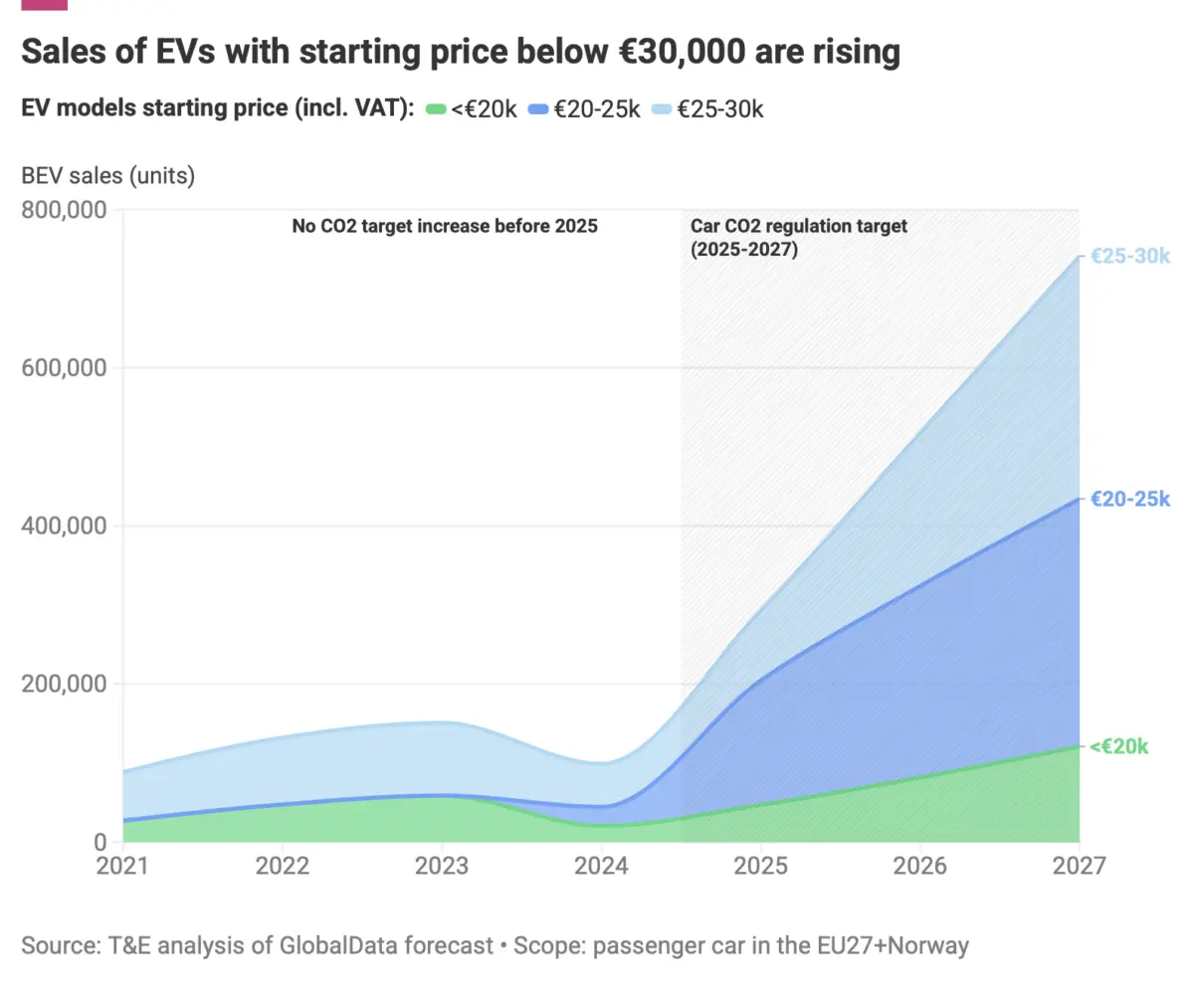
- The Rise of Sub-€25,000 Models: Sales of electric vehicles priced below €25,000 are projected to multiply sevenfold in 2026 compared to 2024 levels, directly dismantling long-held industry arguments that consumer demand for low-cost EVs did not exist.
- Surging Model Availability: Nearly 40 new electric models hit the market in the first half of 2026 alone, pushing the total number of mass-market BEVs past 150. By the end of the year, roughly 60 new models are expected to debut—nearly four times the historical average of 15 new models per year seen between 2021 and 2025.
- The Threat of Rollbacks: T&E warns that any political weakening of the upcoming 2030–2035 CO₂ targets would immediately halt the rollout of affordable small EVs, threatening Europe’s automotive competitiveness in the global clean energy race and locking millions of drivers into permanent fossil fuel vulnerability.
Chronology of the Transition: From Stagnation to Acceleration
To understand the current boom in European electromobility, it is essential to trace how policy frameworks have governed the automotive industry over the past decade.
2021–2024: The Era of Flat Targets and Limited Choice
During the initial rollout phase of modern electric vehicles, European carmakers faced relatively flat CO₂ compliance targets. Because regulatory pressure was low, traditional manufacturers had minimal financial or legal incentives to invest heavily in high-volume, low-margin, affordable electric vehicles. Instead, automotive strategies prioritized luxury and long-range SUVs—segments that offered higher profit margins per unit. During this four-year window, the European market saw an average of only 15 new electric models introduced annually. Consumer choice remained limited, prices stayed artificially high, and many mainstream buyers felt priced out of the transition.
2025–2026: The Regulatory Turning Point
The landscape shifted dramatically as tighter CO₂ fleet targets phased in for 2025 and 2027. Recognizing that compliance would require massive volume, European carmakers pivoted their product lines toward the mass market.
This policy pressure triggered an unprecedented product blitz:

- Early 2026: Almost 40 new electric models arrived in showrooms within the first six months, doubling the number of sub-€25,000 vehicle options available to European buyers.
- Spring 2026: Driven by the dual pressures of compliance mandates and soaring fossil fuel costs, Q2 2026 marked the historic tipping point where BEVs overtook internal combustion engine (ICE) petrol vehicles in quarterly market share.
- Mid-2026: Demand for sub-compact, budget-friendly EVs overwhelmed early supply chains. Volkswagen’s highly anticipated ID. Polo, for instance, became an instant phenomenon; it was rapidly sold out with over 40,000 confirmed customer orders and an extensive 10-month waitlist, illustrating that the primary barrier to mass adoption had never been a lack of consumer desire, but rather a lack of affordable supply.
Supporting Data: Economic Pressures and Market Performance
The acceleration of the European EV transition has not occurred in a vacuum. It has been catalyzed by severe geopolitical and macroeconomic disruptions in global energy markets, alongside quantifiable shifts in automotive manufacturing economics.
The Oil Price Shock and Fossil Fuel Vulnerability
The fragility of petroleum-dependent transport was violently underscored by escalating conflicts in the Middle East, notably surrounding the Iran war. This geopolitical friction triggered an oil price shock that collectively cost EU road users an estimated €53 billion.
By mid-September 2026, the financial burden on everyday drivers became acute:
- Fueling a standard 50-litre diesel tank cost approximately €30 more than it did prior to the outbreak of the crisis.
- Drivers who successfully transitioned to an electric vehicle at the onset of the oil shock saved roughly €350 in running costs alone by mid-September.
- Beyond immediate pump prices, electric vehicles have proven resilient against the chronic volatility of international oil cartels, offering predictable, domestically generated electricity as a primary power source.
Manufacturing and Sales Metrics
The correlation between strict regulation and manufacturing output is clear when examining production pipelines:
| Metric | 2021–2025 Average | 2026 Projection / Actual |
|---|---|---|
| New BEV Models Released / Year | ~15 models | ~60 models (expected by end of 2026) |
| Total Mass-Market BEV Options | Low | Over 150 models |
| Sub-€25,000 Model Sales Growth | Stagnant | 7x increase (2026 vs. 2024) |
| YTD BEV Registrations (Jan–Aug) | Moderate | 1.64 million (+45% year-over-year) |
| Q2 BEV Market Share | Single digits / low teens | 22% (Outselling pure petrol for the first time) |
Data indicates that all major European carmakers are currently on track to achieve compliance with the 2025–2027 interim targets. However, industry analysts stress that maintaining this momentum depends entirely on keeping the subsequent 2030 and 2035 emission reduction targets intact.
Official Responses and Stakeholder Perspectives
The release of T&E’s progress report has ignited intense debate among policymakers, environmental advocates, and automotive executives.

Transport & Environment (T&E)
Lucien Mathieu, cars director at T&E, forcefully dismissed historical claims made by legacy automakers regarding consumer readiness.
"European drivers are finally seeing more of the smaller and more affordable electric cars they have been waiting for," Mathieu stated. "The oil crisis has further fuelled the rush by European consumers for affordable small electric cars. VW’s ID. Polo was quickly sold out, with over 40,000 orders and a 10-month waitlist. European car makers were complaining about the lack of demand for a long time. Now we can clearly see: The issue was not the demand, but what they had to offer. The consumer’s appetite for small affordable electric cars proves the car makers’ claims wrong."
Mathieu further emphasized the existential risk of tampering with EU climate architecture:
"The EU’s car targets are expanding consumer choice, bringing down the cost of going electric and giving European manufacturers a chance to compete in the global EV race. Weakening the 2030 target now would choke off affordable models by nearly three-quarters just as they are reaching the market and lock millions across Europe into debilitating oil dependency."
The Automotive Industry Perspective
For years, various segments of the European automotive lobby argued that aggressive decarbonization timelines placed an unmanageable burden on legacy manufacturers, citing high battery production costs, supply chain bottlenecks, and a perceived reluctance among everyday motorists to abandon internal combustion engines.
However, the unprecedented consumer rush for vehicles like the Volkswagen ID. Polo has forced a strategic reckoning within corporate boardrooms. Rather than scaling back, major European brands are discovering that compliance is not merely an environmental obligation, but a commercial imperative. Facing fierce competition from low-cost imports—particularly from rapidly expanding Asian EV manufacturers—European legacy brands realize that mastering affordable mass-market electric vehicles is the only viable path to long-term survival.

Implications for Europe’s Economic and Environmental Future
The success of the EU’s clean car targets carries far-reaching implications that extend well beyond showroom floors, touching upon geopolitical security, industrial strategy, and consumer welfare.
1. Geopolitical Resilience and Energy Security
Europe has historically remained vulnerable to external shocks in global fossil fuel markets, transferring billions of euros out of the continent to oil-producing nations. By accelerating the adoption of domestic, renewable-powered electric vehicles, the EU is insulating its citizens from volatile fuel spikes. The savings generated by avoiding fossil fuels circulate back into the European economy, strengthening regional economic stability.
2. Global Industrial Competitiveness
The global automotive landscape is undergoing its most radical transformation since the invention of the assembly line. Emerging markets in Asia have established massive leads in battery supply chains and affordable EV manufacturing. If the European Union succumbs to political pressure to weaken its 2030–2035 climate targets, local manufacturers would lose their regulatory impetus to innovate. This would cede the entry-level global EV market to international competitors, potentially devastating Europe’s most vital manufacturing sector. Conversely, sticking to firm targets forces European engineering prowess to rise to the occasion, securing high-tech jobs and industrial leadership for decades to come.
3. Consumer Welfare and Social Equity
Historically, early-stage clean technologies have acted as luxury goods, accessible only to affluent buyers. The 2026 market pivot proves that structured public policy can successfully democratize green technology. By compelling manufacturers to design and deliver sub-€25,000 electric vehicles, policymakers are ensuring that lower- and middle-income households are not left behind in the green transition. Access to cheaper running costs protects vulnerable populations from future energy poverty and inflation.
Conclusion
The data from mid-2026 tells a definitive story: Europe’s clean car standards are working exactly as intended. They have successfully bridged the gap between automaker hesitation and consumer demand, resulting in record-breaking sales, plunging vehicle costs, and enhanced energy security. As policymakers weigh the future of the 2030 and 2035 targets, the evidence suggests that any retreat from these goals would be self-defeating—stifling innovation just as it bears fruit, and compromising Europe’s economic and environmental independence.
