

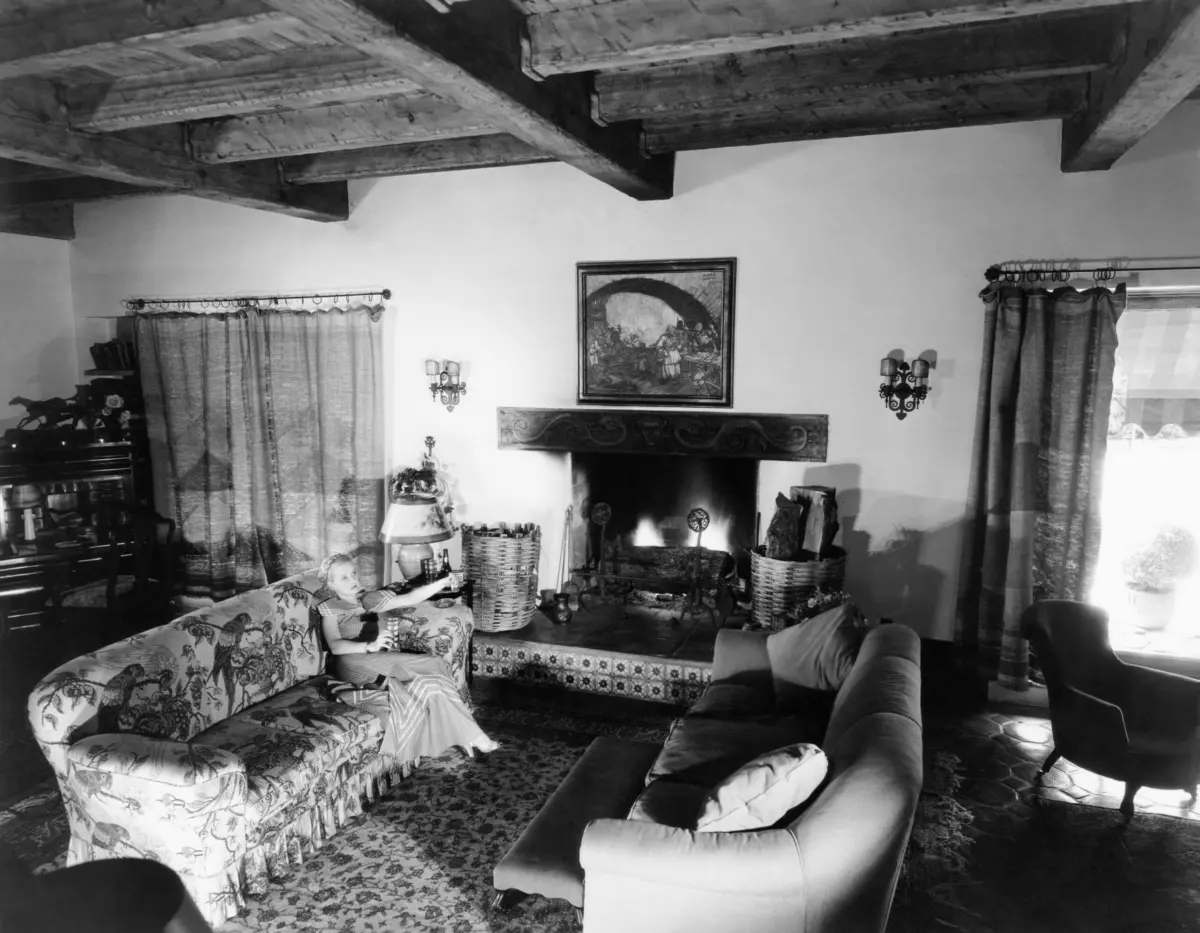
Main Facts: The Architecture of a Rebel
Bette Davis was an undisputed titan of the Golden Age of Hollywood—a magnetic, two-time Academy Award-winning actress renowned for her fierce intensity both on and off the camera. While her cinematic legacy is defined by her trailblazing refusal to play conventional leading ladies, opting instead for complex, unsympathetic, and unglamorous characters, her private life was anchored by an equally relentless passion: real estate.
In her first memoir, The Lonely Life, Davis famously encapsulated her larger-than-life persona: "I do not regret one professional enemy I have made. I suppose I’m larger than life. That’s my problem. Created in a fury, I’m at home in a tempest."

That comfort with chaos directly translated to a remarkably nomadic domestic existence. Over the course of her lifetime, Davis called at least 75 different residences home. For her, moving houses and nesting was not merely a lifestyle choice, but a deeply therapeutic pursuit. "Playing house is a childhood game I’ve never put away," she once reflected. "My home has always meant so much to me… Small wonder that when I could, I acquired houses as other women acquire jewels."
Chronology: A Journey Through Bette Davis’s Most Notable Homes
Davis’s domestic journey spanned from the tumultuous landscapes of her Massachusetts childhood to sprawling California estates, rustic ranches, beachside rentals, and coastal New England manors.

Early Life in Massachusetts and the Nomadic 1930s
Davis’s foundational years laid the psychological groundwork for her lifelong attachment to homes. When she was just seven years old, her father abruptly abandoned the family to be with his mistress. Reflecting on this upheaval in her memoir, she wrote: "My father’s cavalier disappearance from our home when I was a small child certainly has significance. Consider my quartette of marriages… My sister Bobby’s world went up in smoke. Mine shifted on its axis. It’s as simple as that."
This sudden disruption sparked a lifelong transient streak. By 1932—the year she married her first husband, Harmon Nelson, alongside her mother Ruthie and sister Bobby—Davis lived in at least four different properties. Early that year, the family resided near the ocean at Zuma Beach in Malibu. By December 1932, they settled into a charming, ivy-covered English cottage located at 1217 Horn Avenue in West Hollywood, complete with an accessory dwelling unit (ADU) in the back where her mother and sister resided.

Brentwood Heights and Animal Welfare
By 1933, Davis had expanded her household to include a menagerie of beloved pets. Known as a passionate animal advocate, she eventually served as the president of Tailwaggers, an organization dedicated to caring for lost and abandoned dogs. In the backyard of her Brentwood Heights home, she was frequently photographed with her canine companions, including her white Sealyham terrier, Sir Cedric Wogs, and her Scottish terrier, Tibby. "I’ve always loved dogs—my own, all dogs," she noted. "And it broke my heart to think of them homeless, unwanted, held as prisoners… when some of them are more human than we are."
1700 Coldwater Canyon Drive: Hollywood’s Croquet Capital
In 1937, Davis moved into a sprawling hacienda-style estate at 1700 Coldwater Canyon Drive. According to biographer Ed Sikov in Dark Victory: The Life of Bette Davis, the property featured a swimming pool, a tennis court, and an acre of land.

It was during this era that Davis embraced Hollywood’s obsession with croquet. Alongside industry luminaries like Orson Welles and Shirley Temple, Davis became heavily invested in the sport. Publications of the era dubbed her "the film colony’s champion croquet player," a title she frequently defended on the expansive lawns of her Coldwater Canyon retreat.
Despite the glamour of her Coldwater Canyon estate, Davis famously preferred intellectual solitude over social hobnobbing. Her intense dedication to reading scripts and literature often strained her personal relationships; her first husband, Harmon Nelson, cited her excessive reading habits as a contributing factor to their divorce, noting during legal proceedings that she would read manuscripts even while entertaining guests.

The Glendale Ranch and the Westward Shift
By 1942, Davis acquired 1705 Rancho Avenue in Glendale, California. Described in a 1943 New Yorker profile as "probably the only two-bedroom, two-acre estate in the film colony," this modest Tudor-style ranch offered a swimming pool, stables, and direct access to local equestrian trails, reflecting Davis’s growing desire for rural tranquility amidst her urban career demands.
The Malibu Beach House
Following her marriage in 1950 to actor Gary Merrill—her fourth husband, with whom she costarred in All About Eve—Davis sought a coastal retreat. Finding Merrill’s personal Malibu house too small for their blended family (which included a daughter from her previous marriage to William Grant Sherry and two adopted children), Davis rented and managed a larger oceanfront property. While Merrill was filming in Germany, Davis executed the logistical feat of moving their entire household—including Merrill’s extensive antique collection—into the new beachside dwelling.

Cape Elizabeth, Maine: "Witch-Way"
For the majority of the 1950s, Davis retreated to the East Coast, purchasing an Atlantic-facing, three-story white clapboard home on an eight-acre estate in Cape Elizabeth, Maine. The property was discovered entirely by accident after taking a wrong turn down a tree-lined lane.
With characteristic wit, Davis dubbed the estate "Witch-Way"—a playful nod to her cinematic persona and the winding approach to the property. Complete with a private ice-skating pond for winters, this coastal sanctuary offered Davis a rare, extended period of domestic peace away from the intense glare of Hollywood.

Final California Years
Before ultimately relocating to Westport, Connecticut, Davis occupied her final Los Angeles residence in 1967. Surrounded by vibrant bougainvillea, she embraced her inner gardener. Reflecting on her affinity for nature, she told biographer Charlotte Chandler in The Girl Who Walked Home Alone: "I always like men who sent me flowers… But I have to admit most of the flowers I’ve enjoyed in my life, I’ve bought for myself. A great many of them I grew. I’m a country mouse, you see."
Supporting Data: The Statistics of Mobility
- Total Residences: An estimated 75+ homes called home throughout her lifetime.
- Marriages: Four marriages (Harmon Nelson, Arthur Farnsworth, William Grant Sherry, and Gary Merrill), each heavily influencing her residential choices.
- Studio Confrontation: Sued Warner Bros. in 1936 over inferior script assignments, establishing a precedent for contractual independence among actors.
- Philanthropy: Served as president of Tailwaggers, championing animal welfare and the protection of stray animals across Southern California.
Official Responses and Archival Insights
Biographers, architectural historians, and archival institutions have continuously evaluated Davis’s distinct relationship with domesticity. Ed Sikov’s biographical work highlights how Davis’s houses served as protective fortresses against the intense public scrutiny of Hollywood.

Furthermore, statements preserved by institutions such as the Everett Collection and Getty Images underscore that Davis viewed her homes not as status symbols, but as lived-in sanctuaries. Her autobiographical writings in The Lonely Life reinforce that her domestic stability was hard-won, serving as an emotional counterweight to the instability introduced by her father’s abandonment in her youth.
Implications: The Legacy of a Domestic Pioneer
Bette Davis’s architectural journey offers a profound metaphor for her life and career. Her refusal to stay in one place mirrored her refusal to be pigeonholed by studio executives. By treating houses "as other women acquire jewels," Davis asserted financial independence and personal autonomy in an era when female stars were heavily controlled by studio contracts and societal expectations.

Ultimately, Bette Davis’s 75-plus homes reveal a multifaceted woman: a cinematic trailblazer, an avid reader, an animal rights advocate, and, above all, a "country mouse" who found ultimate solace in building her own havens amidst the tempests of Hollywood fame.
