

MILAN — For nearly a decade, Academy Award-nominated filmmaker Luca Guadagnino and visionary architect Stefano Baisi have been quietly, yet radically, redefining the intersection of spatial design, narrative cinema, and high fashion. Since Guadagnino formally enlisted Baisi in 2017 to spearhead his interior architecture practice, Studio Luca Guadagnino, the duo has consistently blurred the lines between the functional and the surreal.
Their collaborative portfolio reads like a masterclass in atmospheric world-building. Together, they have seamlessly integrated the Louvre’s iconic glass pyramid into a high-octane Dior runway show within the historic Jardin des Tuileries; constructed a deeply dreamy, hallucinatory vision of 1950s-era Mexico City for Guadagnino’s 2024 feature film Queer; and painstakingly transformed a 16th-century school building into an ultra-luxury boutique hotel, among countless other ventures.
Now, the creative partners are embarking on their most accessible yet ambitious venture to date. In an unprecedented collaboration with global retail titan Zara Home, Guadagnino and Baisi have debuted a massive, multidisciplinary collection comprising over 200 distinct pieces of furniture, lighting, and home decor, alongside a meticulously tailored ready-to-wear clothing line.
Bridging the gap between the rarefied world of high-end architectural design and mass-market commerce, the collection is positioned to transform everyday domestic spaces into cinematic backdrops. Yet, despite its commercial scale, the line refuses to compromise on the sharp, uncompromising aesthetic that has become the hallmark of the Studio Luca Guadagnino ethos.
The Genesis of a Creative Partnership: Chronology of an Architectural Evolution
To understand the weight of the Zara Home collaboration, one must trace the trajectory of Guadagnino and Baisi’s nearly ten-year creative symbiosis. While Guadagnino is globally celebrated for his lush, sensory-driven cinematic works—including Call Me by Your Name, Suspiria, and Challengers—his passion for physical spaces has always run parallel to his filmmaking.

Key Milestones in the Guadagnino-Baisi Collaboration:
- 2017: Filmmaker Luca Guadagnino formally taps architect Stefano Baisi to lead his multidisciplinary interior architecture firm, Studio Luca Guadagnino, setting the stage for a decade of cross-industry design ventures.
- 2018–2022: The studio completes a series of high-profile residential and commercial projects, earning international acclaim for blending historical restoration with avant-garde spatial interventions.
- 2023: The duo collaborates on temporary architectural installations and high-fashion presentations, including a striking integration of the Louvre’s pyramid for a Dior catwalk in Paris.
- 2024: Baisi designs the surreal, dreamlike sets for Guadagnino’s critically acclaimed feature film Queer, cementing their ability to translate cinematic fantasy into tangible environments. Concurrently, discussions begin with Zara Home.
- September 2025: The Studio Luca Guadagnino x Zara Home collection launches globally, accompanied by a star-studded short film and a high-profile public pop-up at La Pelota in Milan during Milan Fashion Week.
According to Guadagnino, the genesis of the Zara Home collection began in the most organic, decentralized way possible: by clearing a workspace and laying out years of accumulated visual stimuli.
"Our collaborative process for this project started by laying our many sources of inspiration—images saved on our phones, works of art, artists, intellectuals—out on the table," Guadagnino reflects. "From these references came deeper research that gradually guided us and gave coherence to the whole project."
A Constellation of Influences: Historical Depth Meets Modern Precision
While casual observers might spot passing nods to French Art Deco, Brazilian modernism, and the provocative jolts of Italian radical design within the sprawling catalog, the creators emphasize a much more specific historical lineage. The duo found themselves deeply captivated by the formal rigor and ornamental restraint of the Vienna Secession movement.
In particular, a modest yet exquisite object served as the emotional and aesthetic anchor for the entire project: a small silver and coral box designed by Koloman Moser, a foundational member of the Secessionist movement alongside Gustav Klimt and Josef Hoffmann.
"A small silver and coral box from this period designed by Koloman Moser had a particularly strong impact on the development of the collection," Guadagnino notes.

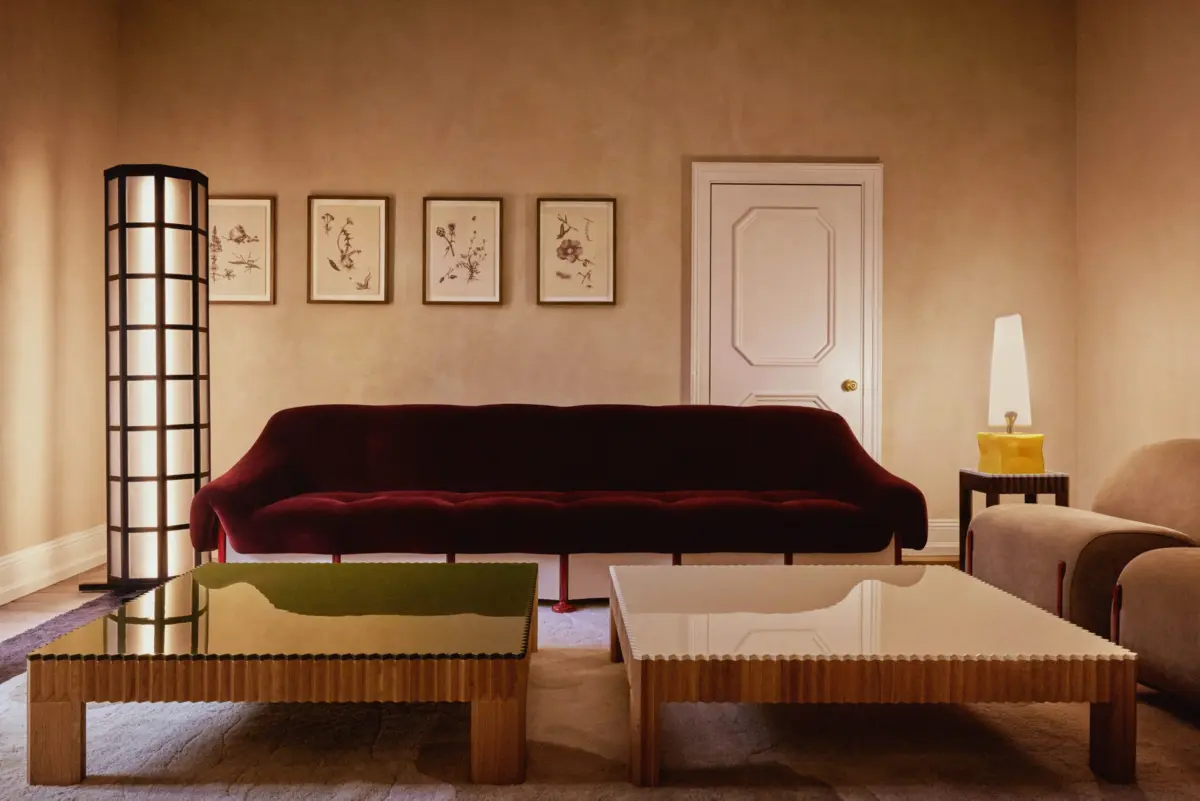
This historical reverence translates into a collection that is startlingly sharp, angular, and hard-edged. Rather than leaning into cozy, domestic softness, the pieces possess the crisp precision of impeccable sartorial tailoring. Stainless steel dining chairs, oak coffee tables topped with high-gloss lacquer, and the space-age Elsewhere table lamp—featuring a paper-thin, arching steel neck and a geometric triangular shade—exude a slick, cool confidence.
Even the upholstered furniture pieces stand at attention. The Bretonita sofa features a striking scallop-backed silhouette, draped in hunter-green flannel and accented with rich burgundy cord piping, striking a balance between stately authority and sturdy comfort. Across from it, the Uncollected sofa sits lower and longer, grounded by a dramatic black velvet cushion resting atop a warm sycamore wood base. The dining experience is equally rigorous, anchored by an octagonal table surrounded by ten architectural Purkersdorf chairs—an explicit nod to Josef Hoffmann’s famed Vienna sanatorium design.
Supporting Data and Commercial Architecture
The scale of the Studio Luca Guadagnino x Zara Home partnership is staggering for both parties. Spanning more than 200 distinct pieces, the collection represents one of Zara Home’s most comprehensive designer collaborations to date, bridging high-concept interior design with global supply chain accessibility.
Collection Overview & Financial Spectrum:
- Total Scope: Over 200 pieces, encompassing standalone furniture, sculptural lighting, dining ware, textiles, home decor, and a curated ready-to-wear apparel line.
- Price Point Range: Democratically structured to appeal to both casual shoppers and high-end collectors, with items ranging from $16.90 for smaller tabletop accessories to $18,400 for larger statement furniture pieces.
- Launch Date: September 26, available globally via zarahome.com and physical flagships.
- Exhibition Venue: A two-day immersive public pop-up installation at the iconic La Pelota in Milan, timed strategically during Milan Fashion Week.
To celebrate the release, Guadagnino orchestrated a high-concept cinematic short film written by acclaimed screenwriter Scott Z. Burns (Contagion, The Report). The narrative-driven promotional film stars an ensemble cast of celebrated actors, including Jamie Bell, Chase Sui Wonders, Michael Stuhlbarg, and Patricia Arquette, moving through spaces meticulously dressed by Baisi.
Official Responses and Creative Philosophy
The philosophical core of the collaboration rests on the idea of democratized authorship. While Studio Luca Guadagnino’s architectural projects are typically bespoke commissions reserved for elite private clients, this partnership allows their unique stylistic code to proliferate into the public sphere.

"Through working together, we found a shared stylistic code that is rooted in tradition while trying to find its own identity," architect Stefano Baisi explains.
Baisi expands on the democratic poetry of the mass-market drop, noting how the commercial reach alters the life cycle of their designs:
"What is exciting about this project is that the same object can now enter very different homes and become part of completely different lives. In a way, the collection can exist across many parallel worlds at the same time."
Guadagnino echoes this sentiment, viewing the expansive catalog not merely as a collection of retail goods, but as "a constellation of objects, rooms, parallel worlds." By treating consumer products as portal-like artifacts, the designers invite everyday buyers to co-author their domestic environments using the vocabulary of high modernist cinema and architectural history.
Broad Implications: The Democratization of Designer Interiors
The collaboration between Studio Luca Guadagnino and Zara Home highlights a broader, accelerating shift within the luxury and retail sectors. Over the past decade, high-street brands have increasingly bypassed traditional, trend-driven collaborations in favor of working with auteur directors, conceptual architects, and avant-garde fashion designers who treat home goods as conceptual art.

For Zara Home, partnering with figures of Guadagnino and Baisi’s stature elevates the brand’s cultural capital, positioning its catalog alongside high-end design houses found in Milan, Paris, and Vienna. For Guadagnino, whose cinematic universes are meticulously constructed down to the last fork and floorboard, the partnership offers a rare platform to disseminate his aesthetic ideology to a global audience.
As consumers increasingly seek out storytelling and historical narrative within their physical environments—fueled in part by a post-pandemic reevaluation of domestic space—the collection arrives at a cultural sweet spot. By making the intellectual rigor of the Vienna Secession and the sleek precision of contemporary architectural tailoring available at price points ranging from under twenty dollars to nearly twenty thousand, Guadagnino and Baisi have successfully shattered the barrier between cinematic fantasy and everyday life.
