

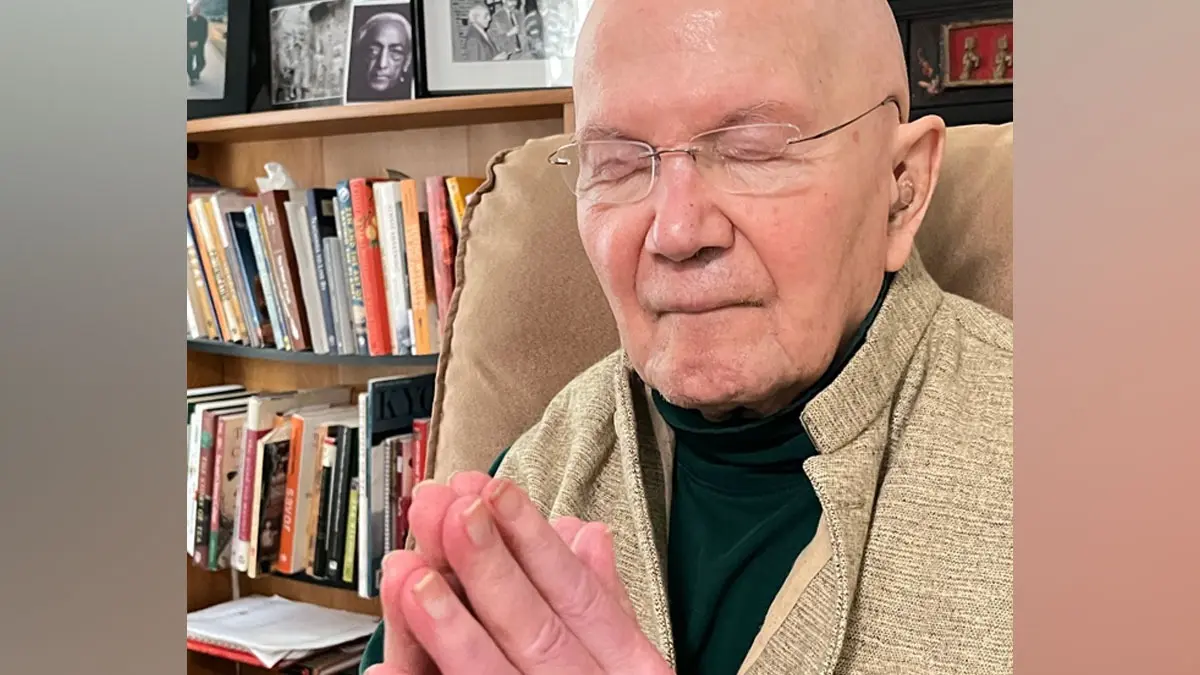
CAMBRIDGE, Mass. — As he approaches his 94th century of life this December, renowned Buddhist teacher and author Larry Rosenberg finds himself intimately re-evaluating his relationship with the fundamental realities of the human condition: aging, sickness, and mortality.
Founder of the Cambridge Insight Meditation Center and author of seminal spiritual works such as Breath by Breath and Living in the Light of Death, Rosenberg is offering his global community of students—known as the sangha—a raw, unvarnished look into the realities of advanced old age. In a recent update shared via a community-led support initiative, Rosenberg reflects on decades of rigorous spiritual training, the inevitable onset of physical decline, and the quiet, continuous labor of staying awake in the face of Parkinson’s disease and chronic pain.
His reflections provide a rare window into the lived experience of a lifelong spiritual practitioner confronting the ultimate limits of the human body, challenging romanticized notions of enlightenment while offering a grounded roadmap for peace.
Main Facts: The Reality of Suffering and the Practice of Wakefulness
At the core of Rosenberg’s recent reflections is a sobering clarification regarding the nature of meditation and spiritual liberation. Many seekers, he notes, approach the teachings of the Buddha with the expectation that sustained practice grants absolute immunity from suffering.
Rosenberg is quick to dispel this myth. Referencing a poignant insight by the late Vietnamese Zen master Thich Nhat Hanh, Rosenberg reminds his readers: "Even after he attained enlightenment, the Buddha suffered. But the difference is, the Buddha knew how to take care of his suffering."
For Rosenberg, decades of intensive Dharma practice have not erased physical pain, nor have they immunized him against the indignities of physical decline. Instead, his practice has equipped him with the mental stability required to recognize suffering when it arises, tend to it with awareness, and prevent it from spiraling into existential dread.
The core tenets of his current experience include:
- The Persistence of Pain: Physical ailments—such as advancing Parkinson’s disease and new, unfamiliar bodily pains—continue to emerge.
- The Cycle of Awareness: Rosenberg describes his daily mental state as a continuous oscillation: "waking up, going to sleep, waking up, going to sleep."
- The Illusion of Fear: When conditioned habits of mind creep in—fretting over future mobility or lamenting yesterday’s decline—he suffers. The moment he brings mindful awareness to those thoughts, the fear dissipates.
- The Value of Prior Preparation: The rigorous mental stability cultivated during his younger years serves as his primary anchor today.
Chronology: A Lifetime Dedicated to Confronting Mortality
To understand Rosenberg’s present-day resilience, one must look back at a lifetime dedicated not merely to philosophical musings on death, but to direct, visceral confrontation with it. While many individuals spend their lives pushing thoughts of mortality to the periphery, Rosenberg actively invited them into the center of his training.
Decades of Radical Training
Rosenberg’s engagement with mortality was physical, immersive, and unsparing:
- The Corpse Meditation in Mexico: During one intensive training retreat with a teacher in Mexico, Rosenberg spent an entire night in silent observation of a decomposing human corpse.
- The Mastery of Maranasati: Under the guidance of visiting meditation master Ajahn Suwat in the United States, Rosenberg spent months meditating intensively on the inevitability of physical decline, practicing maranasati (death awareness).
- Literary Exploration: These profound encounters eventually catalyzed the writing of his acclaimed book, Living in the Light of Death.
The Present Day: Confronting Advanced Age
Fast forward to the autumn of 2024. After a period earlier this year when Rosenberg’s energy waned and he remained largely out of the public eye, his caregivers—affectionately known as "Team Rosenberg"—report a resurgence in his vitality. This renewed energy has allowed him to articulate his current physical reality: navigating the daily challenges of Parkinson’s disease while living at home with his wife, Galina.
Supporting Data and Background: The GoFundMe and Community Support
The dissemination of Rosenberg’s recent teachings is closely tied to practical logistical realities. As is true for many aging spiritual teachers and elders in modern societies, the financial costs associated with around-the-clock at-home care are substantial.
A dedicated GoFundMe campaign, organized to facilitate the specialized health care needed by Rosenberg and his wife, serves as the primary conduit for these updates. The campaign has not only successfully mobilized financial resources from a deeply devoted international sangha, but it has also functioned as an informal digital sanctuary where followers can receive periodic dispatches from the teacher.
Profile: Larry Rosenberg
- Role: Founder, Cambridge Insight Meditation Center (Cambridge, Massachusetts).
- Notable Publications: Breath by Breath, Living in the Light of Death, Three Steps to Awakening.
- Featured Works: Subject of the book The World Exists to Set Us Free: Straight-Up Dharma for Living a Life of Awareness and the documentary film Larry Rosenberg: Long Path Home.
Official Responses and Reflections: Encounters with Great Teachers
Rosenberg’s humility regarding his own state of awareness is underscored by anecdotes from his interactions with other spiritual giants of the 20th century. He recalls asking the renowned philosopher and teacher J. Krishnamurti a direct question: "Krishnaji, are you awake all the time?"
Krishnagi’s response was immediate and disarming: "Of course not. I’m still human."
For Rosenberg, this anecdote serves as a liberating reminder that the spiritual path is not about achieving an impossible state of perpetual, superhuman perfection. It is about the willingness to return to the present moment, again and again, whenever the mind drifts into anxiety or sorrow.
Team Rosenberg, introducing his September update to the public, noted the significance of these reflections:
"After a period when Larry was simply not feeling up to it, his energy seems to have improved and we’re thrilled to offer new words here that Larry wishes to share with the sangha. They provide a window into how he’s been feeling this summer along with reflections on using his practice to face his challenges."
Implications: A Call to Action for Younger Practitioners
As Rosenberg faces what he describes as his potential "final graduation"—preparing for the inevitable moment when he must bid farewell to everything he loves—his message to younger generations of practitioners carries an urgent, foundational weight.
Why Early Practice Matters
Rosenberg observes that many spiritual practitioners fail to build sufficient mental stability during their youth and middle age. Consequently, when the body inevitably begins to break down, they find themselves unequipped to handle the psychological and emotional shock of aging and severe illness.
His advice to the younger generation is direct and unequivocal:
"Those of you practicing, especially when you’re young, please… do it now! Keep at it! Because it’s not just about now. When you take care of now, you take care of the future. You can increase the possibility that it will prepare you for what will come."
Redefining Helplessness at the End of Life
The broader implication of Rosenberg’s final months of teaching is a fundamental reframing of what aging and dying can look like in a culture that often pathologizes and hides both processes.
By refusing to shy away from his disabilities, and by treating every new pain as an invitation to wake up rather than an excuse to panic, Rosenberg demonstrates a profound autonomy. He concludes his latest update with a note of profound gratitude:
"I feel extremely fortunate in having this practice, because even facing the end, I really don’t feel helpless. I have the ability to take care of myself. And I know it’s possible for others to find the same peace."
For the thousands of students whose lives he has touched over the decades, Larry Rosenberg’s final lesson is not delivered from a lecture hall cushion, but through the quiet, luminous dignity with which he meets the setting of his own sun.
