


Published September 18, 2026
In the modern wellness landscape, yoga is frequently marketed through the lens of aesthetic perfection—deep binds, gravity-defying arm balances, and hyper-flexible splits. Yet, the foundational practices that truly sustain a lifelong practice often lie in quiet, unassuming asanas. One such pose is Uttanasana (Standing Forward Bend), a classic posture that has served as a cornerstone of intelligent sequencing for decades.
Drawn from Yoga Journal’s extensive historical archives—specifically an insightful instructional feature first published in the March–April 1988 issue—this deep dive explores Uttanasana not merely as a stretch, but as an intricate study in biomechanics, physiological release, and the profound art of transitions.
Main Facts: Deconstructing the "Intense Stretch Pose"
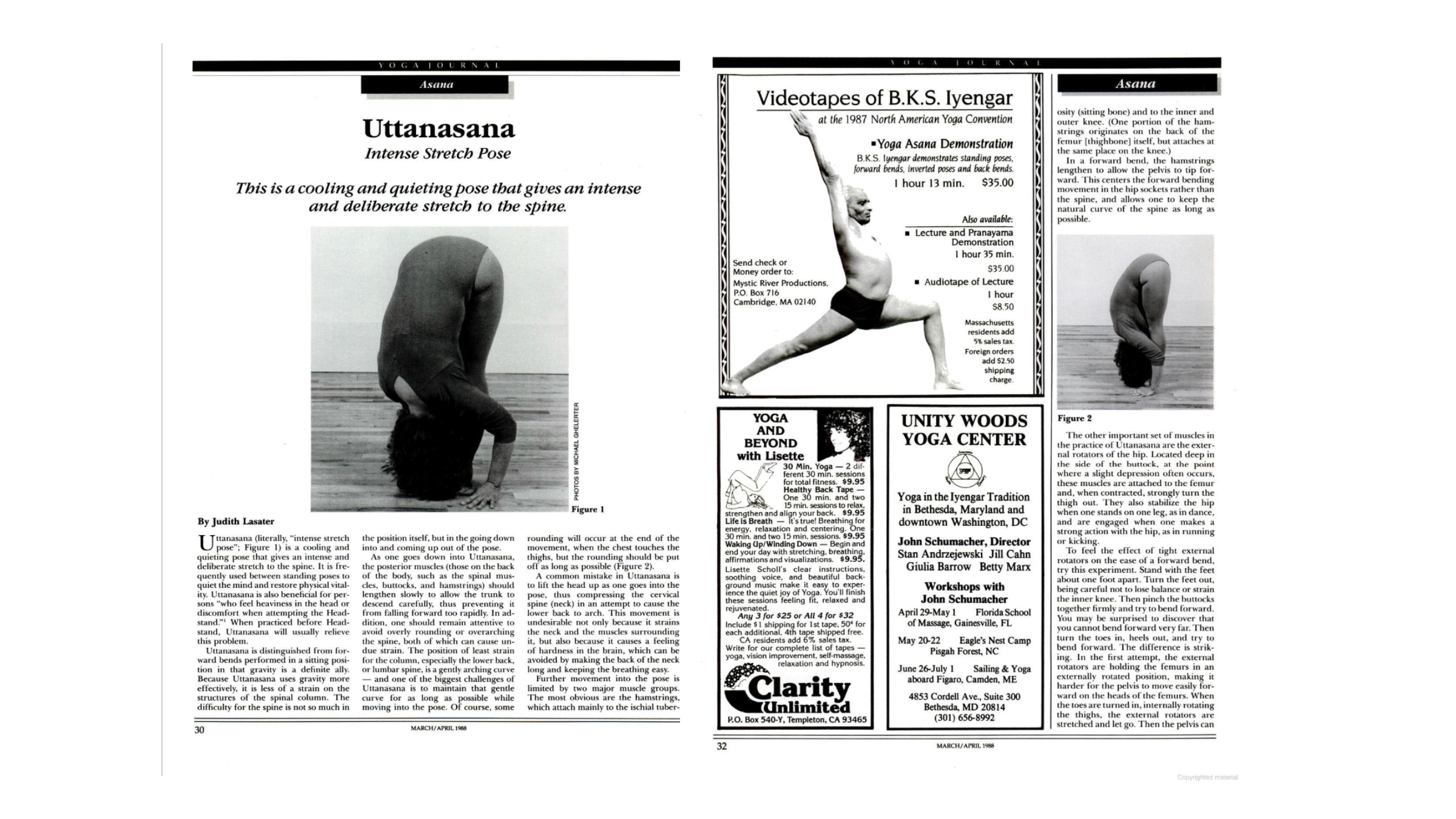
At its literal translation, Uttanasana means "intense stretch pose." Characterized as a cooling and quieting posture, it delivers a deliberate, elongated stretch to the entire spinal column while calming the nervous system. Frequently deployed between strenuous standing poses, Uttanasana acts as a physical and mental reset button, designed to restore vitality and quiet a racing mind.
The Headstand Connection
One of the historical yet lesser-known therapeutic applications of Uttanasana involves its relationship with inversions, specifically Sirsasana (Headstand). Traditional yoga methodology notes that practitioners who experience a sensation of heaviness in the head, localized discomfort, or vascular pressure when attempting a Headstand can frequently alleviate these symptoms by practicing Uttanasana immediately beforehand. By conditioning the cardiovascular and nervous systems through a mild forward inversion, the body prepares safely for more intense upside-down variations.
The Power of Gravity
Unlike seated forward bends, Uttanasana operates in a unique relationship with gravity. Because gravity actively assists the descent, it places significantly less strain on the structures of the spinal column compared to seated alternatives. However, this assistance is a double-edged sword: the true biomechanical challenge of Uttanasana does not lie in the static hold of the pose, but rather in the controlled descent into and ascent out of it.

Chronology: The Evolution of Forward-Bending Technique
To understand the modern pedagogical approach to Uttanasana, it is helpful to trace how teachers and anatomists have refined the movement over time.
- Pre-1980s (The Era of Forceful Stretches): Early Western adaptations of postural yoga frequently emphasized end-goal aesthetics—touching the toes or bringing the chest to the thighs at all costs. This often resulted in rounded lower backs, compressed lumbar discs, and overworked spinal erectors.
- The Late 1980s Paradigm Shift (The 1988 Yoga Journal Insight): Articles like the landmark 1988 Yoga Journal feature revolutionized instruction by shifting focus away from the hamstrings and toward the hip’s external rotators and lumbar spinal curves. Educators began teaching that forward bending originates at the hip sockets, preserving the natural lordotic curve of the lower back for as long as possible.
- Contemporary Practice (Mindful Transitions): Today, advanced sequencing incorporates props (blocks, chairs, blankets) and anatomical awareness. Practitioners are taught that entering and exiting an asana demands the same—if not more—mindful concentration as holding the static shape.
Supporting Data & Anatomy: It’s Not Just Your Hamstrings
For generations, yoga students have reflexively blamed tight hamstrings for their inability to execute a graceful forward bend. While hamstring flexibility is undeniably crucial, anatomical analysis reveals that another hidden muscle group plays an equally decisive role: the external rotators of the hip.
The Anatomy of the Hamstrings
The hamstrings primarily attach to the ischial tuberosity (the sitting bones) and to the inner and outer knee, with a portion originating on the back of the femur. In a forward bend, these muscles must lengthen to allow the pelvis to tip forward. This pelvic tilt centers the movement in the hip sockets rather than forcing the fragile lumbar vertebrae to take the brunt of the bend.
The Hidden Culprit: Deep Hip External Rotators
Located deep in the lateral gluteal region, the external rotators stabilize the hip during single-leg balance, running, and kicking. When these muscles are chronically tight or contracted, they lock the femur in an externally rotated position, physically blocking the pelvis from sliding smoothly forward over the heads of the thighbones.
The Rotator Experiment
You can test this biomechanical principle with a simple experiment:
- Stand with your feet about one foot apart and turn your toes outward, ensuring you do not strain your inner knees.
- Firmly pinch your buttocks together and attempt to fold forward. You will likely notice an immediate, restrictive wall that prevents deep pelvic tilting.
- Next, turn your toes inward (pigeon-toed) with your heels out, and try to fold forward.
- The difference is striking. Internal rotation stretches and releases the external rotators, allowing the pelvis to tip forward effortlessly.
Consequently, poses that target and stretch these rotators—such as standing and sitting twists, or Baddha Konasana (Bound Angle Pose) practiced with a forward fold—are often far more effective at improving your Uttanasana than isolated hamstring stretches.
Official Responses and Expert Instructional Guidelines
Executing Uttanasana safely requires strict adherence to alignment principles. Master instructors through the decades have outlined clear protocols for entering, holding, and exiting the posture.
How to Practice Step-by-Step
- Initiation: Stand with your feet together (or hip-width apart if you are a stiffer practitioner). Exhale and begin to hinge forward from the hip sockets.
- Maintaining the Curve: Keep the spinal column long. Newer students frequently commit the error of aggressively rounding the lower back to reach the floor; advanced students may overarch, losing abdominal support. The ideal path maintains a gentle, natural arch in the lumbar spine for as long as possible.
- Support and Depth: Descend only as far as your body comfortably permits. Beginners should rest their hands on shins, yoga blocks, a sturdy chair, or a folded blanket rather than straining to reach the mat.
- Neck and Breath Management: Avoid the common mistake of lifting the head to look forward, which compresses the cervical spine and induces a feeling of mental tension. Keep the back of the neck long, the jaw relaxed, and the breathing steady and easy.
The Crucial Ascent
Coming up out of Uttanasana is statistically more hazardous to the lower back than going down, because the body must move upward against gravity, increasing leverage on the lumbar spine.
- Abdominal Engagement: Contract the abdominal muscles slightly to protect the lower back.
- Arm Placement Variations:
- Lowest Strain: Keep the arms straight at your sides.
- Moderate Strain: Bend the elbows and grasp opposite hands, framing your head.
- Highest Strain: Extend the arms straight out in line with the ears (recommended only for experienced practitioners).
- Pacing: Inhale as you rise at a moderate, controlled speed. Rushing this movement—especially for individuals prone to low blood pressure—can cause dizziness or lightheadedness as blood rushes away from the brain. If you experience dizziness, rise in stages, pausing halfway at a chair before completing the ascent.
Implications: From the Mat to Daily Life
The true value of studying an asana like Uttanasana extends far beyond physical flexibility. Yoga philosophy posits that if our practice remains confined to the rubber mat, it loses its transformative power.
The Significance of Transitions
In a physical yoga class, students naturally focus on the static posture, treating the moments between poses as mere logistics. However, the transitional phases—entering and exiting an asana—are precisely where the mind is most vulnerable to distraction. With no stable shape to cling to, the ego tends to race ahead into the future.
By anchoring our awareness onto something stable during transitions—such as the sensation of the feet on the floor—we train the nervous system to remain present amidst change.
Life as a Series of Transitions
Physically, emotionally, psychologically, and spiritually, human existence is defined by transitions. By learning to cultivate an unshakeable center and quiet awareness during the micro-movements of Uttanasana, practitioners develop the emotional resilience required to navigate life’s larger, unpredictable shifts with grace, stability, and calm resolve.
