

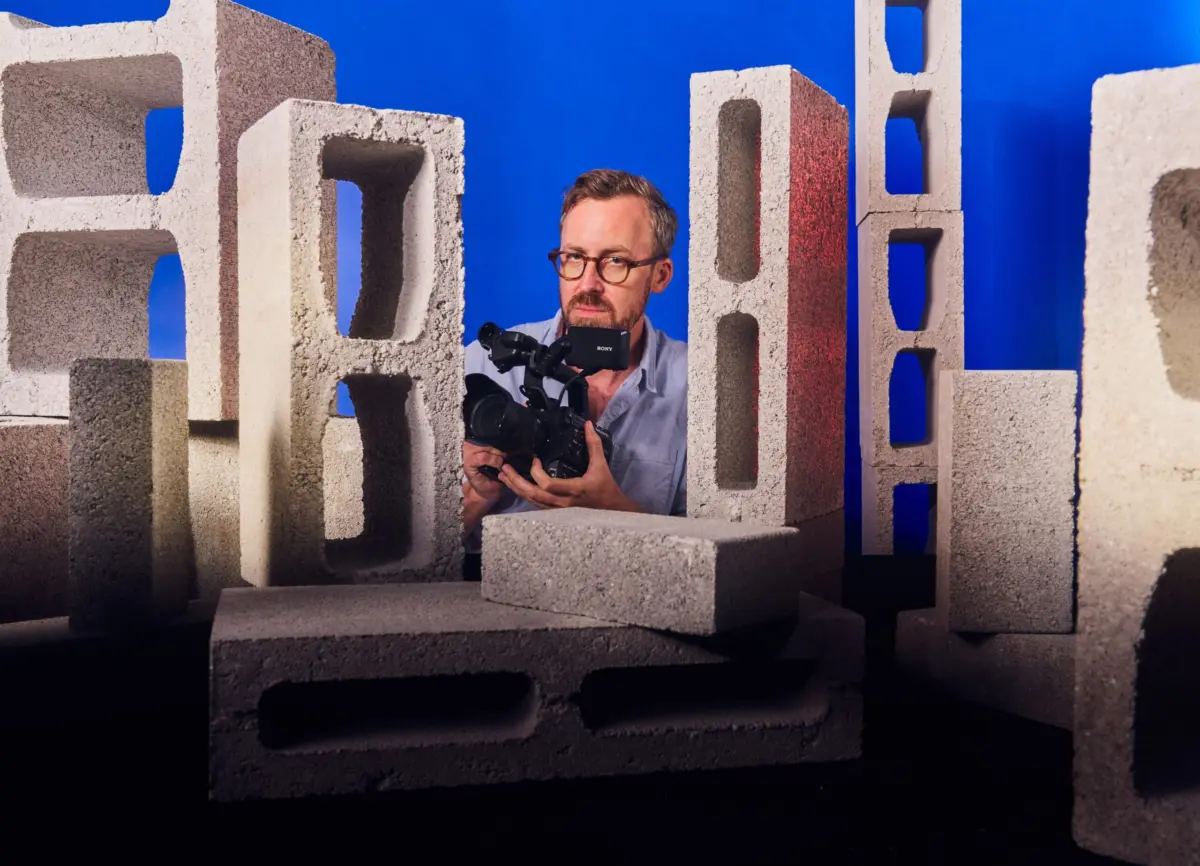
Seated high above the concrete canyons of Lower Manhattan on the 35th floor of One World Trade Center, filmmaker John Wilson contemplates the ubiquitous material that holds his adopted city together—and, increasingly, threatens to pull it apart.
Like most of the metropolitan grid, the tower where we sit worships at the altar of concrete. Its core, foundation, and monolithic floor slabs comprise enough of the grey composite to pave more than 4,000 New York City blocks. Concrete—the second-most-used substance on Earth, trailing only water—is the thematic bedrock that drew Wilson from his home in Ridgewood, Queens, to discuss his first-ever feature-length film, The History of Concrete.
Slated for a theatrical release on September 18, the movie promises to challenge how audiences view the mundane infrastructure beneath their feet. It will debut in cinemas nationwide, including at Low Cinema, a modest 40-seat venue in New York that Wilson recently rehabilitated alongside a business partner. Yet, true to form, the auteur’s exploration of stone and cement is merely an entry point into a much deeper, more existential interrogation of the built environment, municipal decay, and the high-stakes friction of making art under late capitalism.
Main Facts: Inside The History of Concrete
Clocking in at an hour and 40 minutes, The History of Concrete defies easy categorization. Wilson himself admits he is still figuring out how to describe a project he calls “a million things at once.”
On the surface, it is a documentary about the gray paste that defines our towers, sidewalks, streets, and houses. Beneath that veneer, however, it serves as a sprawling meditation on impermanence. It examines how our built world goes up, why it comes down, and why contemporary civilization seems content to inhabit a "50-year city" rather than striving for a millennium-long architectural legacy.

The project continues the idiosyncratic, observational style of filmmaking Wilson honed over the past decade and a half, most notably across three critically acclaimed seasons of his Emmy-nominated HBO series, How to With John Wilson. Utilizing his trademark disembodied voiceover to guide the viewer both physically and emotionally, Wilson serves as a modern-day Virgil through the chaotic labyrinth of urban existence.
Armed with a camera that captures the overlooked absurdities and poignant realities of city life—from the streets of New York to the aggressively mundane trade floors of Las Vegas—Wilson forces his audience to linger. He invites us to look past the superficial hustle and confront the glaring, systemic cracks in our municipal foundation.
Chronology: From a Leaky Ridgewood Patio to Ancient Rome
The conceptual journey of The History of Concrete began modestly and domestically: right in the backyard of Wilson’s home in Ridgewood.
The Catalyst: Domestic Disrepair
When a cracked foundation caused stormwater to gurgle up from the subterranean depths of his property, Wilson faced a choice common to homeowners everywhere. Most people, he notes, would simply hire a contractor and sign the check. Instead, Wilson dove down an obsessive rabbit hole.
He purchased a stack of academic texts, determined to understand concrete on a molecular level. He wanted to figure out what his house was made of and whether patching it himself would save him future headaches.

Armed with amateur tools, he attempted the repair himself, ultimately leaving behind a craggy, keloid-like scar on his patio.
Global Tracing and Ancient Durability
That localized frustration catalyzed a global inquiry. Wilson began tracing the history of the material back to its ancient origins, visiting sites in Italy where concrete structures erected nearly two millennia ago—long after the decline of the Roman Empire—remain entirely intact.
This historical juxtaposition sparked a disquieting question for the filmmaker: If ancient Roman concrete could survive the centuries, why was his own home falling apart? More broadly, why did everything else in the modern world seem to be crumbling alongside it?
Supporting Data: Infrastructure on the Brink
Wilson’s lens doesn’t stay confined to residential foundations; it sweeps across the systemic decay plaguing public works throughout New York City. The film catalogs failing municipal assets: neglected public pools, gum-spackled sidewalks, and structural nightmares like the triple-cantilever of the Brooklyn-Queens Expressway (BQE).
The BQE and Urban Vulnerability
The BQE is a crucial thoroughfare carrying roughly 130,000 vehicles per day. In the film, Wilson is joined by Sam Schwartz, New York’s former traffic commissioner and a legendary figure in transportation engineering (credited with coining the term "gridlock"). Standing beneath the expressway, Schwartz points directly to a patch of exposed, rusting rebar, warning that without massive, immediate intervention, catastrophic structural failure is merely a matter of time.

Billionaires’ Row and Luxury Vulnerability
Wilson also trains his camera on architectural fiascos, demonstrating that infrastructural decay spares no socioeconomic class. He explores the troubled engineering history of 432 Park Avenue, a supertall luxury tower on Manhattan’s Billionaires’ Row.
Units in the 11-year-old building routinely list for upwards of $80 million, yet the high-rise’s concrete core has been plagued by persistent cracking, and its facade has infamously dropped chunks of building material onto the street below. The ultra-wealthy residents of the skyline find themselves imperiled by the exact same material vulnerabilities as working-class tenants in the outer boroughs.
The NIMBY Milieu
Beyond what gets built poorly, Wilson is deeply fascinated by what never gets built at all. He describes The History of Concrete as "one of the most NIMBY movies I’ve ever seen," capturing the fractious, defensive posture of municipal town halls and protest groups. ("NIMBY" stands for "Not In My Back Yard"—a label given to residents who fiercely resist real estate or infrastructure projects slated for their immediate neighborhoods.)
In Wilson’s world—which is very much our own—affordable housing projects and public skate parks frequently fall into the crosshairs of local opposition. While nearly everyone at a community board meeting agrees that such initiatives are vital for society, vanishingly few residents are willing to cede their own convenience or property values to make them happen.
Official Responses and Municipal Action
The issues raised in Wilson’s film are not merely theoretical; they are playing out in real-time legislative battles and emergency engineering reports across New York.

Following the completion of the film’s final cut, the municipal government announced a sweeping, $4-billion, 10-year rehabilitation plan for the troubled section of the Brooklyn-Queens Expressway. City officials project that this massive capital injection will extend the aging corridor’s lifespan by another 40 years, though transit advocates remain skeptical about whether temporary patches can outpace systemic decay.
Simultaneously, the city has faced intense scrutiny regarding commercial real estate and adaptive reuse projects. Wilson points to the partial structural collapse of the Pfizer World Headquarters site during the summer—a high-profile casualty amidst Manhattan’s ambitious office-to-residential conversion pushes.
City planners and structural engineers have defended current building codes, emphasizing that rapid urbanization and climate pressures require constant structural monitoring. However, municipal responses often favor short-term political fixes over generational durability, reinforcing Wilson’s critique that modern society builds for decades rather than centuries.
Implications: The Urban Dérive and the Search for a Thousand-Year City
Though The History of Concrete is threaded with deadpan humor, its ultimate implications are sobering. Wilson is quick to clarify that he is not an architect; he jokingly refers to himself as a "Mr. Bean" type, wandering through the metropolis with an air of wide-eyed bewilderment.
Yet, this unassuming presentation is a carefully constructed aesthetic choice. Wilson’s storytelling relies on the dérive—a drifting, unplanned exploration of the urban fabric championed by Situationist theorists like Guy Debord. Beneath the surface of his folksy, accessible narration lies a decade-long immersion in urban planning theory.

Intellectual Influences
Wilson cites several foundational thinkers who shaped his worldview:
- Jane Jacobs: The legendary 20th-century urban activist whose seminal 1961 work, The Death and Life of Great American Cities, "lit a fire" under Wilson when he first encountered it in 2008. Jacobs taught him to respect the organic, street-level vitality of neighborhoods.
- James Howard Kunstler: Author of The Geography of Nowhere, whose critiques of car-centric sprawl and placeless American landscapes heavily inform Wilson’s view of modern suburban and urban decay.
- William H. Whyte: Author of the 1980 study The Social Life of Small Urban Spaces. Whyte observed human behavior in public squares the way a National Geographic ornithologist studied birds, proving that humans have deep, innate social needs that poorly designed urban architecture actively suppresses.
Architectural Samsara
Ultimately, Wilson leaves his viewers hanging on a profound philosophical question: Is the endless cycle of building, decay, structural failure, and rebuilding—our collective architectural samsara—a natural state of the physical world, or an insidious byproduct of modern capitalist economics?
A telling moment arrives early in the film when Wilson approaches actor Michael Imperioli (The Sopranos, The White Lotus), who is struggling to secure financing for his own independent projects. When Wilson asks what advice Imperioli would give to young filmmakers trying to break through, the actor answers without hesitation: "To make it as inexpensively as they can, and to get it done."
As Wilson’s masterwork demonstrates, the disposable nature of independent filmmaking mirrors the very places we have built for living. By compelling us to look closer at the gray paste holding our world together, John Wilson issues an urgent plea: Stop settling for the precarious, 50-year city, and start imagining what a thousand-year civilization could look like.
