

Main Facts: A Midcentury Time Capsule in the Heart of Ashrafieh
In the vibrant, cosmopolitan neighborhood of Ashrafieh, perched on a hill east of central Beirut, a 1952 residential building serves as the canvas for French dealer-turned-interior designer Guillaume Excoffier. Known for his keen eye and profound appreciation for historical cross-currents, Excoffier has crafted an apartment that functions simultaneously as a domestic sanctuary, a design archive, and a cultural crossroads.
Featuring soaring 13-foot ceilings and expansive loft-like dimensions, the flat offers a fluid transition between interior living spaces and verdant exterior terraces. Here, the boundaries of domestic architecture dissolve, opening onto panoramic views of a layered cityscape where traditional Ottoman-era structures—defined by their archetypal triple arches—stand in dialogue with midcentury apartment blocks and contemporary high-rises.

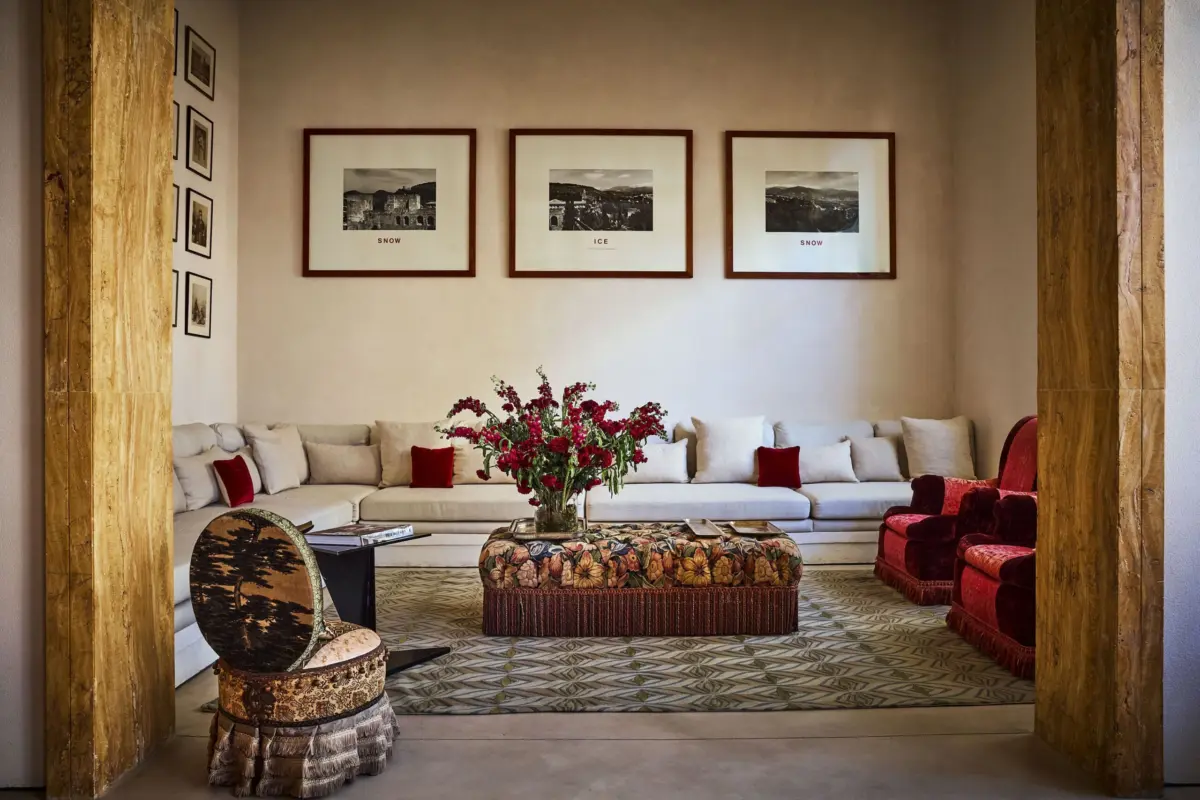
Rather than adopting a sterile, minimalist approach, Excoffier has populated the space with a meticulously curated collection of 20th-century avant-garde furniture, 19th-century antiques, and custom pieces fabricated by local Lebanese craftspeople. The residence features iconic pieces by design luminaries such as Philippe Starck, Josef Hoffmann, and Robert Mallet-Stevens, alongside historical anchor pieces like a circa-1810 Biedermeier cabinet and a 1983 postmodern cabinet by Aldo Rossi.
The apartment’s material palette is as varied as its provenance: walls are coated in a custom textural confection of white paint and sand, floors are anchored in raw poured concrete, and wet areas feature authentic Moroccan zellige tiles and Winckelmans ceramics. Punctuating these rigorous design statements are whimsical, hyper-local touches—most notably, a pair of oversized, faded ice cream cones procured directly from a neighborhood parlor, capturing the sun-bleached poetry of a Levantine summer.

Chronology: From Bordeaux to Beirut via Paris and Dubai
To understand Excoffier’s deep-seated fascination with Beirut’s architectural fabric, one must trace a trajectory that spans decades, continents, and shifting professional identities.
Formative Years and the Early Allure of Design
Born in Bordeaux to a judicial magistrate and an English teacher, Excoffier’s introduction to the global design community began not through travel, but through print. As an adolescent, he voraciously devoured international shelter and architecture magazines, peering into interiors that felt worlds away from his provincial upbringing. After an initial, brief foray into the contemporary art world, Excoffier formalized his footing in the design industry in the early 2010s by establishing a gallery in Paris bearing his own name.

The Lebanese Awakening
The pivotal turning point in Excoffier’s career occurred in the early 2010s when he first visited Beirut. Captivated by the city’s economic boom era spanning from the 1950s to the mid-1970s, he became transfixed by its under-appreciated modernist architectural heritage. He spent his days hunting down Brutalist office blocks, swooping concrete basilicas, and colorful residential complexes inspired by Le Corbusier’s Radiant City, which were engineered specifically for an emergent, progressive middle class.
Recognizing a shared passion for the region’s aesthetic dynamism, Excoffier teamed up with Nancy Gabriel—a former advertising and film producer based in Beirut—to launch the curatorial partnership Gabriel et Guillaume. Following their inaugural exhibition in the Lebanese capital in 2013, Excoffier made the definitive decision to split his time between Paris and Beirut.

Archiving Modernism
Excoffier’s deep academic and aesthetic engagement with the city culminated in a collaborative publishing project. Alongside acclaimed architectural photographer Matthieu Salvaing, Excoffier compiled these forward-looking, midcentury structural experiments into Modernist Beirut, published by Éditions Norma. The book documents a period when architects adapted international prefabrication techniques and materials to the Mediterranean climate, integrating functional shade structures, breezy verandas, and innovative climatic screens.
The 2023 Pivot and the Ashrafieh Apartment
In 2023, after a decade of operating Gabriel et Guillaume, Excoffier stepped away from the gallery to launch his independent interior design firm. Operating on an international scale with projects spanning Paris, Beirut, and Dubai, he formalized his physical stake in the city by acquiring the Ashrafieh apartment. Stripping away a series of uninspired, characterless renovations from previous decades, he reduced the flat to a raw, concrete-floored blank canvas, setting the stage for his most personal design project to date.

Supporting Data: Architectural Context and Furnishing Provenance
The historical and architectural weight of Excoffier’s Beirut project is anchored by a dense network of global design movements, local craftsmanship, and post-war socio-economic realities.
The Architectural Blueprint of Midcentury Beirut
- The Era of Rapid Growth: The mid-1950s to 1975 marked an unprecedented economic golden age in Lebanon, characterized by avant-garde construction and utopian civic planning.
- Climatic Adaptation: International modernist templates were aggressively re-engineered for the Middle Eastern climate. Structural innovations included deep breezeways, perforated concrete sunscreens, and elevated foundations to handle steep coastal slopes.
- Unrealized Utopias: Just as Excoffier’s apartment renovation faced stops and starts amid contemporary geopolitical friction, many of the region’s grandest midcentury visions—such as Oscar Niemeyer’s sweeping, unfinished Tripoli International Fairgrounds (begun in 1963)—remained perpetually incomplete due to shifting historical tides.
The Interior Inventory: A Dialogue of Eras
Excoffier’s living spaces function as a masterclass in cross-era juxtaposition, linking the precursors of modernism with radical late-20th-century design:

- Biedermeier & Postmodernism: A circa-1810 Biedermeier cabinet—celebrated for streamlining the opulent lines of French Empire furniture into cleaner, simplified geometries—shares a formal vocabulary with a 1983 postmodern cabinet designed by Italian architect Aldo Rossi.
- Radical Seating: The drawing room features a high-stakes visual conversation between Philippe Starck’s tubular Dr. Sonderbar chairs (1980s), Josef Hoffmann’s Viennese Purkersdorf chairs, André Dubreuil’s skeletal and curving Spine, and a traditionally embroidered slipper chair.
- Art and Lighting: The residence is anchored by blue-chip contemporary and modern art, including Richard Artschwager lithograph grids (Basket, Table, Door, Window, Mirror, Rug from 1976), John Baldessari photographs, David Rabinowitch triptychs, and a 1991 Franz West chandelier in the dining room.
- Local Fabrication: Balancing imported collector items, large-scale elements were commissioned from local Lebanese artisans, including a custom concrete dining table, plastered construction-brick bookshelves, and Arts and Crafts-inspired kitchen stools.
Official Responses and Creative Philosophy
Guillaume Excoffier’s design methodology challenges prevailing orthodoxies of contemporary minimalism, offering a philosophy rooted in historical synthesis, social hospitality, and material honesty.
Rejecting Minimalist Sterility
In interviews discussing his curatorial approach, Excoffier has been vocal about the limitations of hyper-minimalism, particularly when applied to the rich, communal fabric of Levantine culture.

"People believed in a brighter future," Excoffier notes, reflecting on the optimistic ethos embedded within midcentury Beirut architecture.
"Beirut is not about minimalism. Here, you might host 40 people, and that’s considered small."
The Ethics of Collecting
Excoffier resists the urge to treat historical antiques with reverential, untouchable fragility, aiming instead for an intellectual friction between centuries.

"Living with antiques doesn’t have to be froufrou and château-like," he explains. By placing sharp, disparate objects in direct eyeline with one another—such as pairing a 17th-century Spanish trestle table with a 1980s Philippe Starck cabinet—he fosters an environment of continuous visual discovery.
"My main interest in life is looking for things," he says of his relentless global sourcing habits, whether hunting for a monumental Jean Royère seating arrangement or a simple, utilitarian soap tray.
Implications: Preserving Heritage Amid Modern Uncertainty
Excoffier’s Ashrafieh apartment and his advocacy for Beirut’s architectural history carry profound implications for urban preservation, cultural memory, and design discourse in the 21st century.

Preserving Endangered Modernism
Beirut’s urban landscape is locked in a perpetual cycle of construction, destruction, and reconstruction. The city’s midcentury heritage—erected during decades of unchecked economic optimism—remains chronically vulnerable to aggressive real estate development, political instability, and infrastructural neglect. By documenting these structures in Modernist Beirut and anchoring his own life within a preserved 1950s residential block, Excoffier contributes to a vital conservation movement. His work urges historians, architects, and the global design community to view the Middle East not merely as a site of ancient ruins or contemporary conflict, but as a crucial epicenter of 20th-century architectural innovation.
The Counter-Narrative of Resilience
At a time when global headlines regarding Beirut are dominated by geopolitical strife, Excoffier’s home presents an alternative narrative: one of cultural resilience, aesthetic vitality, and enduring cross-cultural exchange. By seamlessly weaving French, Italian, Spanish, and Austrian design icons into a foundation built by Lebanese craftspeople, the apartment mirrors the city’s historical identity as a porous, welcoming gateway between East and West.

Ultimately, Excoffier’s sanctuary in Ashrafieh proves that design can serve as an act of defiance and preservation. By honoring the vision of midcentury architects who believed fiercely in a brighter future, his home stands as a testament to the fact that creativity, much like the city itself, refuses to be permanently unfinished.
