

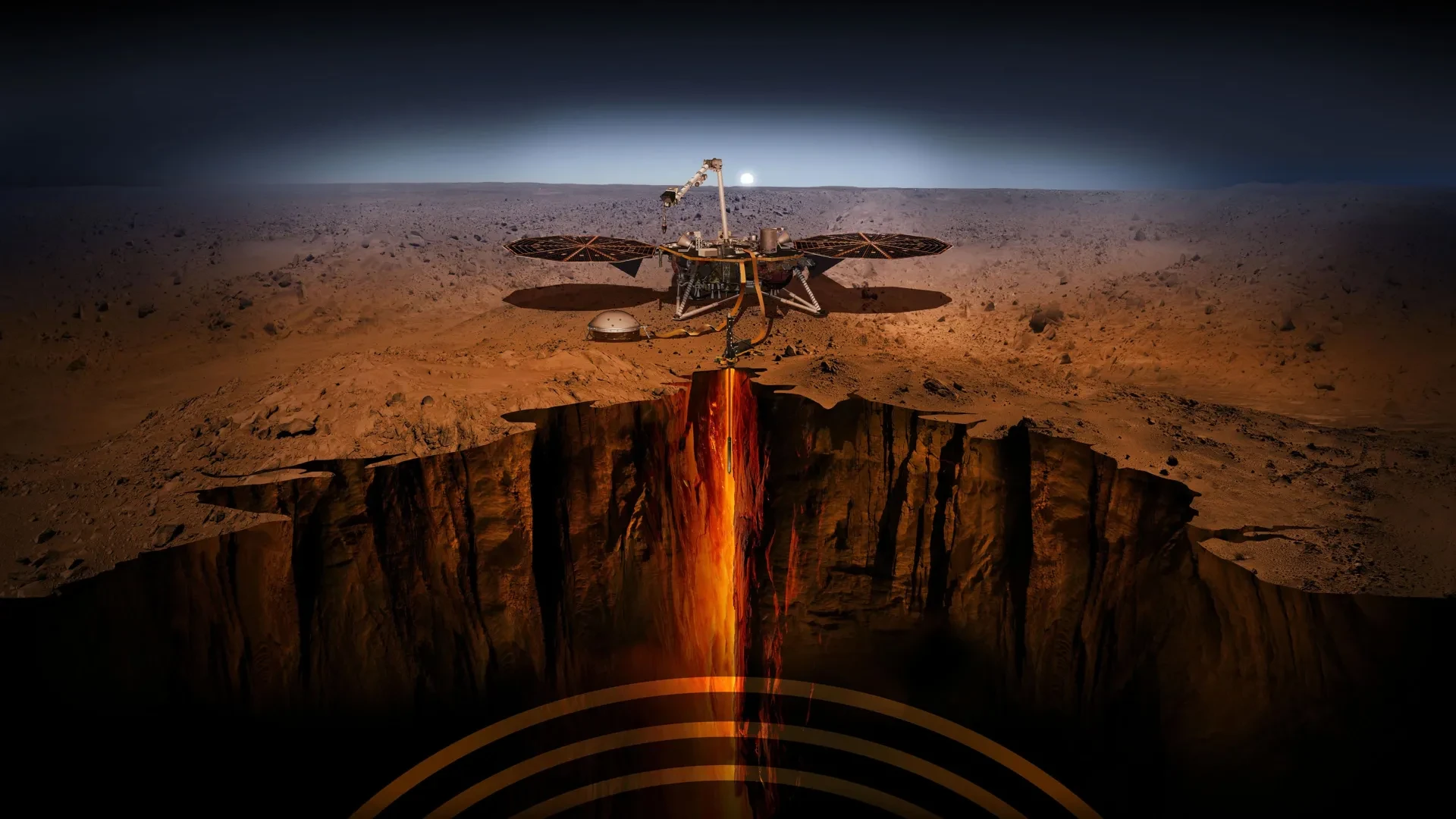
OXFORD, UK — In a discovery that upends decades of planetary science orthodoxy, researchers at the University of Oxford have uncovered compelling evidence that Mars may once have harbored colossal, Earth-like magmatic systems deep within its interior. Published in the prestigious journal Nature Astronomy, the findings challenge the long-held assumption that high levels of geological complexity and crustal evolution are exclusively tied to plate tectonics. By revealing that the Red Planet managed to internally process and fractionate vast volumes of molten rock without the shifting continental plates characteristic of Earth, the study opens exciting new horizons in our search for habitable worlds across the cosmos.
Main Facts: Rewriting the Martian Interior
For generations, planetary scientists have categorized Mars as a "stagnant lid" planet. Unlike Earth, whose dynamic outer shell is fractured into moving tectonic plates that continually recycle crustal material, build continents, and drive complex volcanism, Mars possesses a single, continuous, and seemingly inert outer shell. Because it lacks these sliding plates, the scientific consensus has long held that Martian geological history was relatively straightforward, characterized by simple, isolated volcanic outpourings rather than the deep, protracted chemical processing seen on Earth.
The groundbreaking Oxford study shatters this paradigm. Analyzing seismic data gathered by NASA’s retired InSight lander, the research team identified a mysterious, planet-wide geological boundary located precisely 24 kilometers beneath the Martian surface. Through rigorous thermodynamic modeling and statistical analysis, the researchers determined that this boundary separates two distinct rock regimes: an underlying "ultramafic" layer rich in iron and magnesium, and an overlying "mafic" layer boasting higher concentrations of silica.
This chemical stratification provides the first direct seismic evidence of "transcrustal magmatism" on Mars—a continent-building, multi-layered magmatic process previously believed to be entirely unique to Earth. According to the study, this buried layer is not a localized anomaly; it potentially spans hundreds, if not thousands, of kilometers across the Martian northern hemisphere, suggesting a planet historically driven by vast, interconnected underground magma chambers.
Chronology: How the Discovery Unfolded
The path to rewriting Martian history began years before the publication in Nature Astronomy, tracing a precise scientific timeline from data collection on the Martian plains to advanced statistical modeling in British laboratories.
- November 2018: NASA’s Interior Exploration using Seismic Investigations, Geodesy and Seismic Heat Transport (InSight) mission successfully lands on Elysium Planitia, deploying the first-ever high-sensitivity seismometer on the Martian surface. Over the course of its operational lifetime, InSight listens intently to the "heartbeat" of Mars, recording hundreds of marsquakes and seismic waves generated by meteoroid impacts.
- Early Research Phases: As seismologists parse through InSight’s telemetry, an anomalous and unexplained boundary deep within the Martian crust—roughly 24 kilometers down—is flagged. While detected in earlier preliminary analyses, its precise origin, mineralogical composition, and geological significance remain deeply debated.
- Collaborative Investigation: Researchers from Oxford’s Departments of Earth Sciences and Statistics join forces, combining geophysical data with advanced computational power. They construct hundreds of hypothetical rock compositions to test against the seismic signatures.
- Thermodynamic and Statistical Modeling: The multidisciplinary team applies complex thermodynamic models to simulate how rocks melt, crystallize, and separate under Martian pressures and temperatures. By matching these simulations against the InSight seismic velocity profiles, they pinpoint the exact chemical transition occurring at the 24-kilometer mark.
- Publication: Armed with conclusive data pointing to large-scale crustal fractionation, the team publishes their findings in Nature Astronomy, instantly generating ripples throughout the global planetary science community.
Supporting Data: Decoding the 24-Kilometer Boundary
The strength of the Oxford study lies in its rigorous methodology, which bridges the gap between raw seismic wave velocities and planetary-scale geochemistry.
When a marsquake ripples through the planet or a meteoroid strikes the surface, the seismic waves travel through the crust at speeds dictated by the density, temperature, and mineral composition of the rocks they traverse. By analyzing how these waves altered their velocity at specific depths, the Oxford team was able to map the interior architecture of Mars with unprecedented fidelity.
The data revealed a stark contrast across the 24-kilometer boundary:
- Below 24 km: The seismic velocity profiles aligned perfectly with ultramafic materials. These rocks are densely packed with iron and magnesium, possessing very low silica content.
- Above 24 km: The properties shifted dramatically, displaying characteristics consistent with mafic rocks, which carry a significantly higher proportion of silica.
To explain this vertical distribution, the researchers modeled a process of extensive fractional crystallization. They deduced that ancient Mars must have hosted colossal pools of molten rock trapped deep underground. Over immense spans of geological time, these magma reservoirs underwent slow cooling. Denser, iron- and magnesium-rich crystals precipitated out and settled toward the bottom of the column, while lighter, chemically evolved, silica-rich melts buoyantally ascended toward the upper crust.
This vertical separation—operating across a transcrustal scale—indicates that Mars was capable of internally recycling and refining its crustal materials on a massive scale, mimicking the geochemical differentiation that forged Earth’s continents.
Official Responses: Perspectives from the Research Team
The implications of the discovery have drawn enthusiastic commentary from the study’s primary authors, who emphasize how profoundly this changes our understanding of terrestrial planet evolution.
Dr. Tobermory Mackay-Champion, lead author of the study who conducted the research while at the University of Oxford’s Department of Earth Sciences and is now based at the University of Bristol, highlighted the shift in perspective regarding Martian volcanism.
"We’ve traditionally assumed that volcanism on Mars was relatively simple compared to that on Earth," Dr. Mackay-Champion noted. "But this discovery suggests Mars could sustain large, long-lived systems where molten rock evolved and reprocessed itself throughout the entire crust. It raises exciting possibilities for how common such systems might be on rocky planets beyond our solar system."
Co-author Professor Jon Wade, also from Oxford’s Department of Earth Sciences, pointed to the broader philosophical and astrobiological questions the paper addresses. For decades, the uniqueness of Earth has been a central pillar of astrobiology, with plate tectonics often cited as a non-negotiable prerequisite for complex planetary habitability. Professor Wade challenged that notion:
"One of the big questions in planetary science is whether Earth is unique. If Mars could develop this kind of complex crust without plate tectonics, then maybe the conditions needed for habitability can emerge on more planets than we realized, including those previously dismissed based on size or their apparent lack of tectonic activity."
The research also underscores the enduring legacy of NASA’s InSight mission. Designed to study the deep interior of Mars, the mission has once again proven that looking downward into a planet’s crust can yield insights as revolutionary as looking outward into the stars.
Implications: A New Framework for Planetary Habitability
The revelation that Mars once hosted complex, continent-style magmatic differentiation without plate tectonics carries profound ramifications for astrobiology and the search for life in the universe.
Redefining Habitable Zones
On Earth, plate tectonics is the ultimate engine of habitability. By constantly recycling crust, driving the carbon-silicate cycle, and releasing volatile gases like water vapor and carbon dioxide into the atmosphere, tectonic activity regulates the global climate and maintains stable surface environments over billions of years.
Because scientists assumed these crucial regulatory functions required plate tectonics, many exoplanet hunters have automatically written off "stagnant lid" planets as geologically dead, sterile worlds incapable of supporting long-term climates or sustaining surface water.
The Oxford study shatters this restrictive framework. If a stagnant lid planet like ancient Mars can achieve deep crustal recycling, fractionate silicates, and sustain complex magmatic plumbing systems through internal processing alone, then the pathways to planetary evolution are far more diverse than previously imagined. Worlds that lack moving tectonic plates may still possess the internal machinery necessary to support dynamic atmospheres, complex mineral environments, and potentially, the precursors to life.
Implications for Exoplanet Exploration
As space telescopes like NASA’s James Webb Space Telescope (JWST) and upcoming characterization missions turn their lenses toward rocky exoplanets orbiting distant stars, astronomers are tasked with assessing which worlds deserve priority in the search for biosignatures.
If complex geological activity—once thought the exclusive domain of plate-tectonic worlds—can occur on planets of varying sizes and tectonic configurations, the number of potentially habitable targets in the galaxy multiplies exponentially. Planetary scientists can no longer rely on the presence of tectonic plates as a mandatory screening criterion for habitability.
The Mystery of Martian History
While the findings illuminate the deep history of Mars, they also raise compelling new questions. If Mars was once geologically sophisticated enough to run planet-spanning transcrustal magmatism, why did it ultimately stall? What caused the massive magmatic engines to cool, the magnetic field to fade, and the thick ancient atmosphere to strip away, leaving behind the cold, arid desert we observe today?
Answering these questions will require further analysis of InSight’s archival seismic data, alongside future robotic and human exploration missions capable of drilling deep beneath the Martian regolith. What is certain, however, is that Mars has once again surprised us. Beneath a seemingly quiet and unmoving exterior lies a history of fiery, complex internal dynamics—proving that in the study of planetary evolution, we should never judge a world simply by its lid.
