

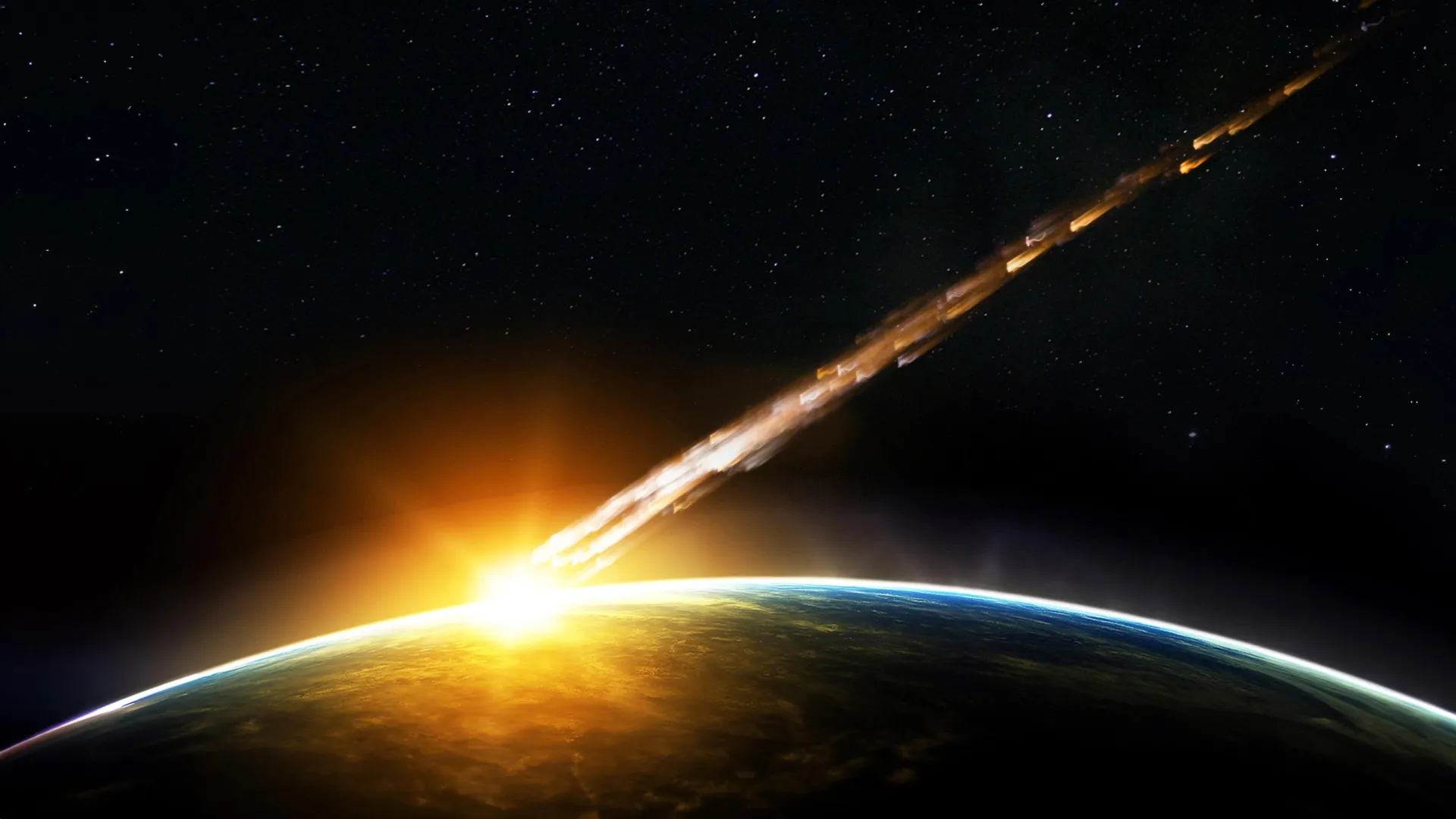
EDINBURGH — A scientific debate that has spanned more than two decades has finally reached a definitive conclusion. An international team of researchers has officially confirmed that the enigmatic Silverpit Crater—hidden deep beneath the sediment of the North Sea—was carved out by an asteroid or comet impact between 43 and 46 million years ago.
The breakthrough discovery transforms a long-standing geological anomaly into one of Earth’s rarest and best-preserved submarine impact structures. By combining cutting-edge seismic imaging, microscopic rock analysis, and advanced computer modeling, the research team has successfully laid to rest competing theories involving salt tectonics and volcanic collapse, cementing Silverpit’s place in the annals of planetary geology.
The findings, funded by the UK’s Natural Environment Research Council (NERC), were published in the peer-reviewed journal Nature Communications.
Main Facts
The Silverpit Crater is located approximately 700 meters (2,300 feet) beneath the floor of the southern North Sea, roughly 80 miles off the Yorkshire coast of England. First discovered during commercial seismic surveys in 2002, the structure immediately captivated and confounded geologists.
Key attributes of the site include:
- Dimensions: The inner crater spans approximately 3 kilometers (1.9 miles) across.
- Fault Rings: It is encircled by a much larger ring of concentric circular faults extending outward to roughly 20 kilometers (12 miles).
- Impactors: Analysis reveals the striking object was an asteroid approximately 160 meters (525 feet) wide.
- Age: The cataclysm occurred during the Eocene epoch, roughly 43 to 46 million years ago.
- Rarity: It is one of only about 33 confirmed impact craters hidden beneath the world’s oceans, joining a global catalog of roughly 200 confirmed terrestrial impact sites.
Chronology of the Silverpit Mystery
The path to confirming the Silverpit Crater’s extraterrestrial origins has been a winding, contentious journey marked by shifting scientific consensus over the span of twenty-two years.
2002: Discovery Beneath the Seabed
While analyzing seismic data acquired for oil and gas exploration in the southern North Sea, geologists stumbled upon a concentric, bullseye-like ring structure buried deep in the seabed. Its uncanny symmetry and central peak bore a striking resemblance to impact craters observed on other terrestrial bodies and the Moon. Researchers dubbed it the "Silverpit Crater" after the Silver Pits, a nearby submarine valley.
2002–2009: The Great Geological Debate
Almost immediately, the scientific community fractured into rival camps. While some geologists championed the hypervelocity impact hypothesis, others argued that the geological context made an asteroid strike unlikely. Alternative theories suggested that the crater formed through the dissolution and movement of deeply buried Zechstein salt deposits (salt tectonics), or that it was the result of a localized volcanic collapse.
2009: The Formal Vote
The controversy grew so intense that geologists formally debated and voted on the crater’s origin during a dedicated scientific meeting. According to a report in the December 2009 issue of Geoscientist magazine, the majority of participating experts rejected the impact explanation, favoring subterranean salt movement instead. The impact hypothesis was largely sidelined, treated as an intriguing but unproven possibility.
Modern Era: Advanced Technology and the "Silver Bullet"
The deadlock was finally broken thanks to a technological leap in geophysical imaging and persistent detective work. Researchers secured high-resolution 3D seismic data and extracted crucial physical samples from a nearby oil exploration borehole. By uniting these modern datasets with high-powered computer simulations, the research team uncovered definitive mineralogical proof, completely overturning the 2009 consensus and validating the original 2002 impact hypothesis.
Supporting Data and Methodology
To build an unassailable case, the research team—led by Dr. Uisdean Nicholson of Heriot-Watt University—utilized a three-pronged methodological approach: seismic imaging, mineralogical analysis, and numerical impact modeling.
Ultrasound for the Earth
Seismic imaging functions similarly to a medical ultrasound. By bouncing controlled sound waves off underground rock strata and measuring how long they take to return, scientists can map subsurface geology in exquisite detail. The newly available seismic data provided an unprecedented look at the internal architecture of the Silverpit structure, revealing disrupted rock layers consistent with a massive downward explosion and subsequent collapse.
The "Needle-in-a-Haystack" Mineral Discovery
The true smoking gun, however, came from the microscopic analysis of rock fragments retrieved from an oil exploration well drilled near the site.
Dr. Nicholson and his colleagues discovered rare "shocked" quartz and feldspar crystals at the exact geological depth corresponding to the crater floor. These microscopic mineral grains exhibit specialized planar deformation features—internal fracture patterns that can only be generated by the instantaneous, unimaginably high pressures of a hypervelocity impact.
"We were exceptionally lucky to find these—a real ‘needle-in-a-haystack’ effort," Dr. Nicholson noted. "These prove the impact crater hypothesis beyond doubt, because they have a fabric that can only be created by extreme shock pressures."
Official Responses and Expert Insights
The resolution of the Silverpit debate has brought profound satisfaction to the geologists who spent decades arguing for an extraterrestrial origin.
Dr. Uisdean Nicholson, a sedimentologist at Heriot-Watt University’s School of Energy, Geoscience, Infrastructure and Society, emphasized the violence of the ancient event. "Our evidence shows that a 160-meter-wide asteroid hit the seabed at a low angle from the west," he explained. "Within minutes, it created a 1.5-kilometer-high curtain of rock and water that then collapsed into the sea, creating a tsunami over 100 meters high."
Professor Gareth Collins of Imperial College London, a veteran of the contentious 2009 debate who developed the numerical models used to simulate the strike, expressed relief at finally finding vindication.
"I always thought that the impact hypothesis was the simplest explanation and most consistent with the observations," Professor Collins said. "It is very rewarding to have finally found the silver bullet. We can now get on with the exciting job of using the amazing new data to learn more about how impacts shape planets below the surface, which is really hard to do on other planets."
Broader Implications and Planetary Science
While the asteroid that formed Silverpit was far smaller than the 10-kilometer-wide leviathan that spelled doom for the non-avian dinosaurs 66 million years ago (associated with Mexico’s famous Chicxulub Crater), its localized effects were cataclysmic. A 160-meter asteroid striking a shallow sea would have instantly excavated millions of cubic meters of sediment, generating a towering tsunami exceeding 330 feet in height—easily clearing many modern skyscrapers—and hurling pulverized rock and vaporized seawater into the upper atmosphere.
Beyond historical reconstruction, the confirmation of Silverpit holds significant value for modern geology and planetary defense.
Earth is an intensely active planet. Plate tectonics, relentless weathering, and wind and water erosion constantly churn the crust, erasing the scars of its violent past. Consequently, while countless space rocks have struck the globe throughout its 4.5-billion-year history, only about 200 impact craters have been confirmed on land, with a mere 33 identified beneath the world’s oceans.
"Silverpit is a rare and exceptionally preserved hypervelocity impact crater," Dr. Nicholson emphasized. "Because the Earth is such a dynamic planet, plate tectonics and erosion destroy almost all traces of most of these events. We can use these findings to understand how asteroid impacts shaped our planet throughout history, as well as predict what could happen should we have an asteroid collision in future."
By joining elite company alongside Chicxulub and the recently confirmed Nadir Crater off the coast of West Africa, Silverpit provides scientists with an invaluable natural laboratory. Researchers can now study how marine impacts alter submarine stratigraphy and test computer models of planetary collisions, sharpening humanity’s ability to model future cosmic threats and better understand geological processes across our solar system.
