

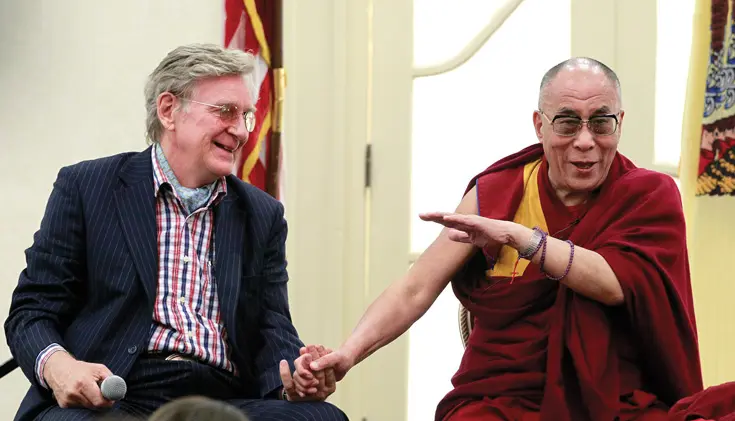
WOODSTOCK, NEW YORK — In the serene and mist-veiled Catskill Mountains, family, close friends, international scholars, and spiritual leaders gathered to bid a final farewell to Robert "Bob" Thurman. Widely recognized as the preeminent American Buddhist scholar of our era, Thurman passed away peacefully at his home in Woodstock, New York, on June 16 at the age of 84.
Months after his passing, the global Buddhist community continues to grapple with the loss of a man who bridged the ancient wisdom of the Himalayas with the modern intellectual landscape of the West. Thurman was a titan of academic translation, a lifelong confidant of the Dalai Lama, a fierce advocate for Tibetan human rights, and, above all, a deeply cherished husband, father, and grandfather.
Main Facts: The Legacy of an American Bodhisattva
Robert Thurman’s contributions to modern spirituality and academia are as vast as they are transformative. As a scholar, translator, author, and activist, Thurman reshaped how Western society engages with Buddhist thought.
His multifaceted career was defined by several monumental achievements:
- Academic Pioneer: Thurman broke traditional academic molds by bridging rigorous Indo-Tibetan scholarship with practical, lived Buddhist spirituality, notably serving as the Jey Tsong Khapa Professor of Indo-Tibetan Buddhist Studies at Columbia University.
- Master Translator: He translated numerous complex, sacred Tibetan texts into vibrant, accessible English, stripping away esoteric barriers to make the philosophy resonant for contemporary readers.
- Cultural Preservation: Alongside his wife, Nena, he co-founded Tibet House US in New York City, an institution dedicated to preserving the endangered cultural heritage of Tibet.
- Global Humanitarian: A close, personal friend of the 14th Dalai Lama, Thurman spent decades as a tireless advocate for Tibetan freedom, self-determination, and human rights on the international stage.
To those who worked alongside him—including publishers, spiritual practitioners, and human rights advocates—Thurman’s life was not merely defined by his resume, but by his relentless dedication to a single guiding principle: benefiting others. In Buddhist philosophy, a "bodhisattva" is an individual who attains profound awakening yet vows to remain in the cycle of suffering to guide all sentient beings toward liberation. For those who knew him, Thurman embodied this definition completely.
Chronology: The Concluding Rites and the 49-Day Bardo
The memorial proceedings for Robert Thurman unfolded through a deeply symbolic blend of personal remembrance and ancient Tibetan Buddhist ritual.
The Passing and the 49-Day Ceremony
Following his death on June 16, family and associates initiated the traditional Tibetan Buddhist death rites. On August 3—which coincidentally would have been Thurman’s 84th birthday—a major memorial service and traditional 49-day ceremony (puja) was held at the Menla Retreat and Spa in Phoenicia, New York. Menla is the renowned Buddhism and wellness center established by Bob and Nena Thurman.
In Tibetan Buddhist tradition, the 49 days following physical death represent the time the consciousness spends traversing the bardo—the intermediate state between death and rebirth. The milestone is traditionally marked by a special ritual designed to help the deceased navigate the bardo safely, attain ultimate liberation (enlightenment), or secure a fortunate subsequent rebirth.
The Memorial Program
Monks from the prestigious Sera Jey Monastery in India presided over the morning rituals, chanting sacred texts and filling the Catskill air with the resonant vibrations of horns and cymbals.
Following the puja, an emotional afternoon gathering took place. Colleagues, family members, students, and prominent Buddhist leaders stepped forward to share reflections. Speakers highlighted Thurman’s instrumental role in establishing academic frameworks for Buddhist studies, his infectious enthusiasm for esoteric Tibetan texts, and his uncanny ability to make complex philosophical ideas universally understandable through his lectures and books.
Yet, amidst the tributes to his public persona, a recurring theme emerged from his family: despite his demanding global schedule, his academic accolades, and his high-profile activism, Bob Thurman always reserved his highest valuation for his roles as a husband, father, and grandfather.
Supporting Data and Collaborative Impact
Robert Thurman’s influence extended deep into modern media, publishing, and global advocacy. Over the years, his collaborations with cultural institutions helped bring Eastern philosophy into mainstream Western discourse.
Key partnerships underscored his far-reaching influence:
- Lion’s Roar Collaboration: Thurman maintained a decades-long relationship with Lion’s Roar foundation, contributing essays, teachings, and editorial guidance that shaped contemporary Western understanding of mindfulness, compassion, and philosophy.
- The Dalai Lama Global Vision Summits: In his later years, Thurman worked closely with his son, Ganden Thurman, alongside Kira and Beata at Tibet House, to produce the annual Dalai Lama Global Vision Summits. These massive digital convenings brought the Dalai Lama’s message of universal responsibility and secular ethics to hundreds of thousands of participants worldwide.
- The Menla Enterprise: Menla Retreat and Spa stands as a physical manifestation of Thurman’s vision—a space where holistic health, Tibetan medicine, environmental stewardship, and Buddhist practice intersect.
Collaborators noted that navigating projects with Thurman was rarely a standard bureaucratic process. Discussions were typically characterized by intense intellectual rigor, humor, and passion. However, negotiations invariably converged on a single yardstick: How much positive benefit will this create for humanity?
Official Responses and Tributes
The global outpouring following Thurman’s passing reflected the profound breadth of his relationships across religious, academic, and political lines.
- The Office of His Holiness the Dalai Lama: While the Dalai Lama maintains a quiet, prayerful stance regarding the passing of close friends, Tibetan officials in Dharamsala have repeatedly acknowledged Thurman as one of the West’s most loyal, articulate, and effective defenders of the Tibetan cause during its darkest historical hours.
- Academic Institutions: Columbia University and various international bodies of Asian studies released statements mourning the loss of a foundational scholar. Colleagues remembered him not just as an intellectual giant, but as a dynamic educator who captivated lecture halls with his booming voice, sharp wit, and encyclopedic knowledge of Asian history.
- Publishing and Cultural Communities: Representatives from Tibet House and Buddhist publishing houses emphasized that Thurman’s legacy cannot be measured merely in books written or lectures given, but in the institutional foundations he built—institutions designed to outlive him and continue protecting a displaced culture.
Melvin McLeod, editor-in-chief emeritus of Lion’s Roar, reflected on his long friendship with Thurman:
"Bob always made me smile. What I learned during our lively discussions and negotiations was that Bob was ultimately motivated by only one thing: how to create the most possible benefit. I think that’s the definition of a bodhisattva: someone who amid all the challenges and eccentricities of this human life is concerned with one thing—creating benefit. Bob Thurman wanted only to create benefit, and he succeeded, in a big way."
Implications: The Future of Western Buddhism Without Its Pioneer
The passing of Robert Thurman marks the twilight of a pioneering generation of Western scholars who personally studied under Tibetan lamas who fled Tibet following the 1959 Chinese invasion.
As Buddhism continues to evolve in the West, Thurman’s departure leaves a significant vacuum. His career proved that rigorous academic scholarship does not need to be sterile, and that spiritual practice does not need to divorce itself from social justice and environmental activism.
Key Takeaways for the Future:
- Institutional Resilience: Through Tibet House US and Menla, Thurman helped anchor Tibetan culture permanently within the American landscape, ensuring that future generations have physical spaces for study and sanctuary.
- Secular and Interreligious Dialogue: Thurman’s work demonstrated the viability of integrating Buddhist psychological insights into modern psychology, neuroscience, and secular ethics—a path heavily championed by the Dalai Lama.
- The Bodhisattva Ideal in Modern Life: Perhaps his most enduring legacy is his personal demonstration that modern professionals, academics, and family members can live lives completely dedicated to the alleviation of suffering without retreating to distant monasteries.
As the smoke from the 49-day Sera Jey Monastic prayers cleared over the Menla Retreat center, those who gathered did not mourn with despair. Instead, they celebrated a life fully realized—a testament to the enduring reality of compassion, joy, and intellectual fearlessness. Robert Thurman’s voice may be physically silent in the halls of academia and the mountains of Woodstock, but the ripples of his vast, benevolent impact will continue to shape the global consciousness for generations to come.
