

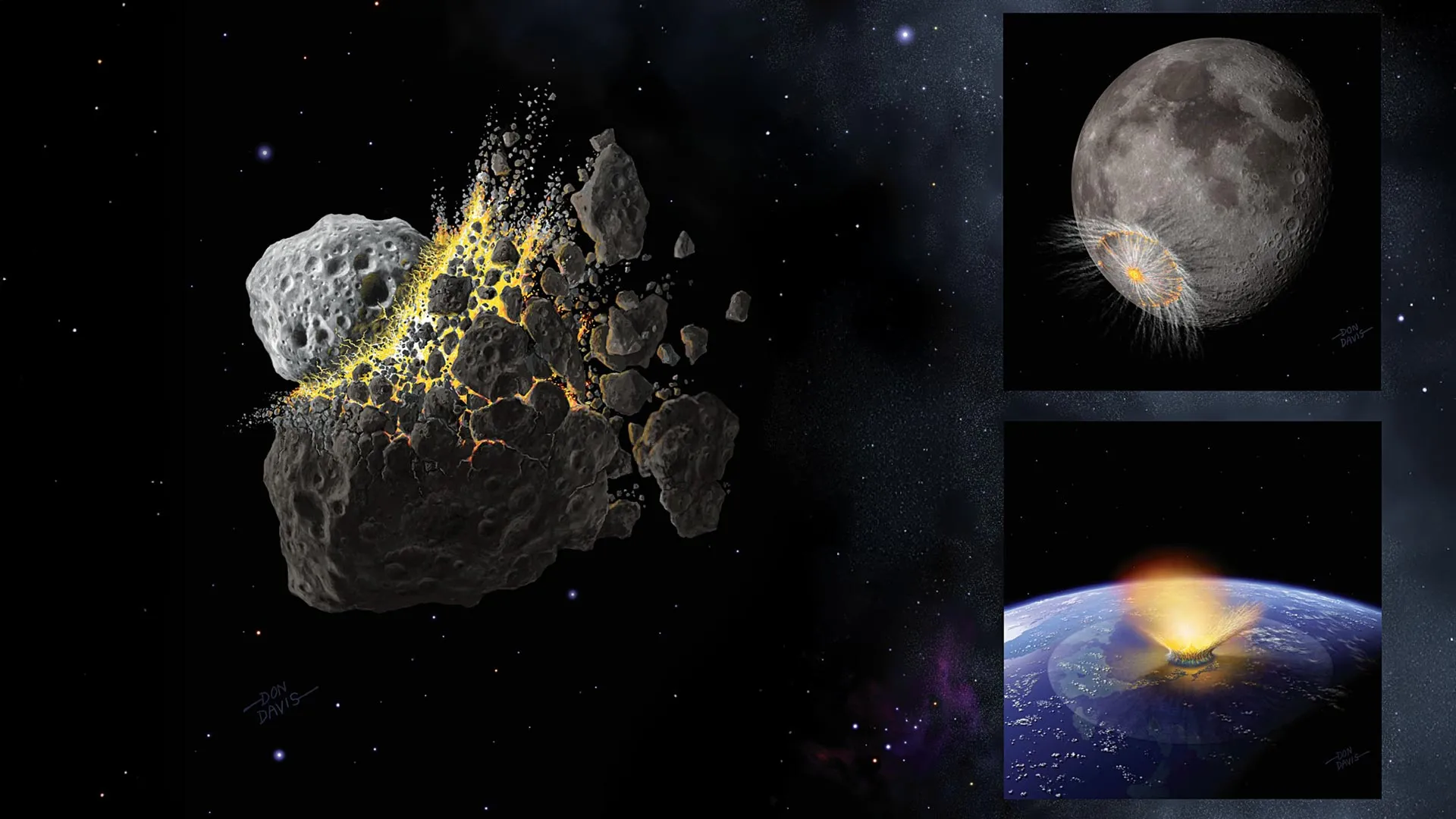
BOULDER, COLORADO — In the grand tapestry of planetary history, catastrophic cosmic impacts are often viewed as isolated tragedies—singular, violent brushstrokes that forever alter the destiny of worlds. The most famous of these, the Chicxulub impact event that struck the Yucatán Peninsula 66 million years ago, sealed the fate of the nonavian dinosaurs and abruptly ended the Cretaceous period. Yet, according to groundbreaking new research led by the Southwest Research Institute (SwRI), Chicxulub may have merely been a late echo of a far grander, system-wide bombardment.
New dynamic models and cosmic forensics suggest that a colossal, violent collision within the main asteroid belt approximately 800 million years ago unleashed a prolonged wave of destruction across the inner solar system. This ancient cataclysm—triggered by the breakup of the parent body that formed the Eulalia asteroid family—sent millions of high-speed fragments hurtling toward Earth, the Moon, and Mars.
Far from being a localized space event, this sweeping interplanetary barrage likely altered the geological features of multiple rocky worlds, shook Martian foundations, and may have even played a pivotal role in shaping Earth’s climate, ocean chemistry, and the very trajectory of early biological evolution.
Main Facts: Uncovering the Asteroid Belt’s Darkest Hour
The core finding of the SwRI-led study centers on a missing chapter of terrestrial and lunar history. While scientists have long recognized that the Moon’s heavily cratered landscape preserves a chronological archive of ancient impacts, matching those scars to specific events in the solar system has remained an elusive challenge.
Through advanced computer simulations and collisional modeling, researchers have successfully linked a documented surge in lunar cratering from roughly 800 million years ago to a single, catastrophic source: the destruction of the parent body of the Eulalia asteroid family.
- The Culprit: A primitive, carbonaceous chondrite-like object residing in the main asteroid belt between Mars and Jupiter.
- The Event: A high-speed, catastrophic collision that shattered the parent body into countless fragments.
- The Location: The breakup occurred precisely on the edge of the gravitational $3:1$ mean motion resonance with Jupiter—a notorious orbital "escape hatch."
- The Scope of Destruction: The resulting bombardment slammed into Earth, the Moon, and Mars over a protracted period lasting between 100 and 150 million years.
- Earth’s Toll: Because of Earth’s much larger mass and stronger gravitational pull, scientists calculate that for every large impact crater formed on the Moon during this period, approximately twenty similarly sized or larger objects struck Earth.
"The role impacts have played in shaping the origin and evolution of life in our solar system is poorly understood," said Dr. William Bottke, an executive director in SwRI’s Solar System Science and Exploration Division in Boulder, Colorado, and lead author of the study. "The heavily cratered surface of the Moon serves as a reminder of the large impacts in Earth’s past, but so far, only the Chicxulub impact event 66 million years ago has been strongly linked to a specific effect on life, namely the mass extinction of the dinosaurs."
Chronology: Reconstructing an 800-Million-Year-Old Timeline
Reconstructing events that occurred nearly a billion years ago requires a blend of orbital mechanics, geochemical analysis, and planetary geology. Because Earth’s dynamic surface constantly recycles its crust, direct physical evidence of impacts older than 650 million years has been largely erased. To bridge this gap, researchers looked to the Moon and the physics of the asteroid belt.
Phase 1: The Pristine Record of the Moon
Unlike Earth, the Moon lacks active plate tectonics, flowing rivers, or a dense, weather-bearing atmosphere. Its surface functions as a slow-aging cosmic museum, preserving craters and impact glass—material melted by extreme heat during a collision and rapidly cooled into glass beads containing precise chemical and chronological timestamps.
Previous analyses of Apollo mission samples and crater-counting methodologies revealed an undeniable spike in lunar impact rates around 800 million years ago. However, the mechanism driving this sudden influx of space debris remained a mystery until Bottke’s team applied advanced dynamical models to the problem.
Phase 2: The Cosmic Forensics of the Eulalia Breakup
Using computer simulations of the main asteroid belt, the "cosmic forensics" team traced the dynamical pathways of ancient asteroid families. They identified the Eulalia family—composed of primitive, carbonaceous chondrites rich in water-bearing minerals and organic compounds—as the ideal candidate.
The critical factor was location. The parent body did not just break apart anywhere; it shattered on the precipice of the J3:1 orbital resonance with Jupiter. In this gravitational configuration, an asteroid completes precisely three orbits around the Sun for every single orbit completed by the gas giant.
Phase 3: The J3:1 Escape Route and the Yarkovsky Effect
Repeated gravitational nudges from Jupiter within the J3:1 resonance act like a cosmic accelerator. Immediately following the initial collision, roughly half of the newly formed Eulalia fragments were thrown directly into this resonance, which violently scattered them into elongated, planet-crossing orbits.
The bombardment, however, did not happen all at once. During the subsequent 100 to 150 million years, an additional 25% of the debris gradually drifted into the J3:1 resonance via the Yarkovsky effect—a subtle phenomenon where an asteroid absorbs sunlight and reradiates it as infrared energy. Because heat is expelled unevenly as the asteroid rotates, it creates a minute, continuous thermal thrust that can slowly alter an asteroid’s orbit over millions of years. This steady migration fed a prolonged, multi-million-year asteroid shower into the inner solar system.
Supporting Data: Numbers Behind the Interplanetary Barrage
The credibility of the SwRI model rests on rigorous statistical mechanics and planetary scaling laws.
- Impact Disproportionality: Due to its immense gravitational cross-section, Earth acts as a primary magnet for stray debris. For every large projectile that managed to pierce the lunar surface, Earth absorbed an estimated twentyfold equivalent impactors.
- Temporal Overlap: The 100-to-150-million-year window of the Eulalia-induced asteroid shower correlates remarkably well with terrestrial geological data showing a dramatic shift in climate and ocean chemistry during the Cryogenian period—an era famous for extreme global glaciation (often referred to as "Snowball Earth").
- Martian Concurrency: On Mars, the timing of the barrage aligns with periods of intense seismic activity and localized volcanic surges, suggesting that high-energy impacts were capable of fracturing planetary crusts and triggering internal tectonic or volcanic responses.
Official Responses and Expert Perspectives
The scientific community has received the study with a mixture of intrigue and cautious evaluation, acknowledging the elegance of the modeling while highlighting the inherent difficulties in proving ancient, extraterrestrial causes for terrestrial evolutionary shifts.
Dr. Bottke emphasizes that while the chronological alignment between the asteroid shower and Earth’s changing biosphere is striking, establishing a definitive causal link requires further interdisciplinary research.
"Given that the peak of this barrage coincides with a period of widespread cooling and major shifts in our biosphere, it is tempting to suggest that the former produced the latter," Bottke noted. "On Mars, these impacts would have triggered substantial episodes of seismic shaking and can be linked in time with a surge in volcanic activity. Together, this showcases how certain catastrophic collisions in the main belt could have had far-reaching consequences for the history of the terrestrial planets."
Other planetary scientists and geologists point out that a continuous shower of carbonaceous chondrite material—objects rich in volatiles, water, and prebiotic organic molecules—would have significantly altered the chemical inventory of the inner planets’ surfaces and shallow atmospheres. Whether this influx of extraterrestrial material acted as a toxic disruptor or a fertilizer for nascent biological systems remains an open and fascinating question for astrobiologists.
Implications: A New Paradigm for Planetary Evolution
The implications of the SwRI study extend far beyond the historical timeline of ancient impacts. Traditionally, planetary scientists evaluated Earth, the Moon, Mars, and Venus largely through the lens of their own internal geological engines—plate tectonics, mantle plumes, and atmospheric circulation.
This research underscores a vital, external counter-narrative: that the evolutionary history of the inner solar system is fundamentally intertwined with the chaotic, mechanical dynamics of the main asteroid belt. A single, well-placed collision near a Jovian resonance can send shockwaves across millions of miles of space, turning a quiet epoch into an era of widespread planetary transformation.
As researchers continue to analyze samples returned from modern asteroid sample-return missions—such as JAXA’s Hayabusa2 and NASA’s OSIRIS-REx—our understanding of primitive carbonaceous bodies like the Eulalia family will only sharpen. Future lunar exploration initiatives, including upcoming crewed and robotic Artemis missions, will also yield higher-resolution chronological data from lunar regolith and impact glasses, testing the limits of Bottke’s impact models.
Ultimately, the revelation that an 800-million-year-old asteroid smashup rained destruction across Earth, the Moon, and Mars serves as a humbling reminder of our cosmic neighborhood’s interconnected nature. We are not isolated islands floating in a serene void; we are part of a dynamic, interconnected planetary system whose deepest history was forged—and perhaps catalyzed—by the violence of deep space.
