

Published: September 3, 2026
Series: Yoga Journal Archives (Originally published in January–February 1982)
Main Facts
Yoga practitioners often conceptualize their practice through the lens of physical mechanics—muscles stretching, joints rotating, and bones reorienting within physical space. However, foundational teachings preserved in Yoga Journal’s historic archives reveal that advanced asana practice transcends pure biomechanics. It serves as an intricate methodology for balancing internal bio-energies.
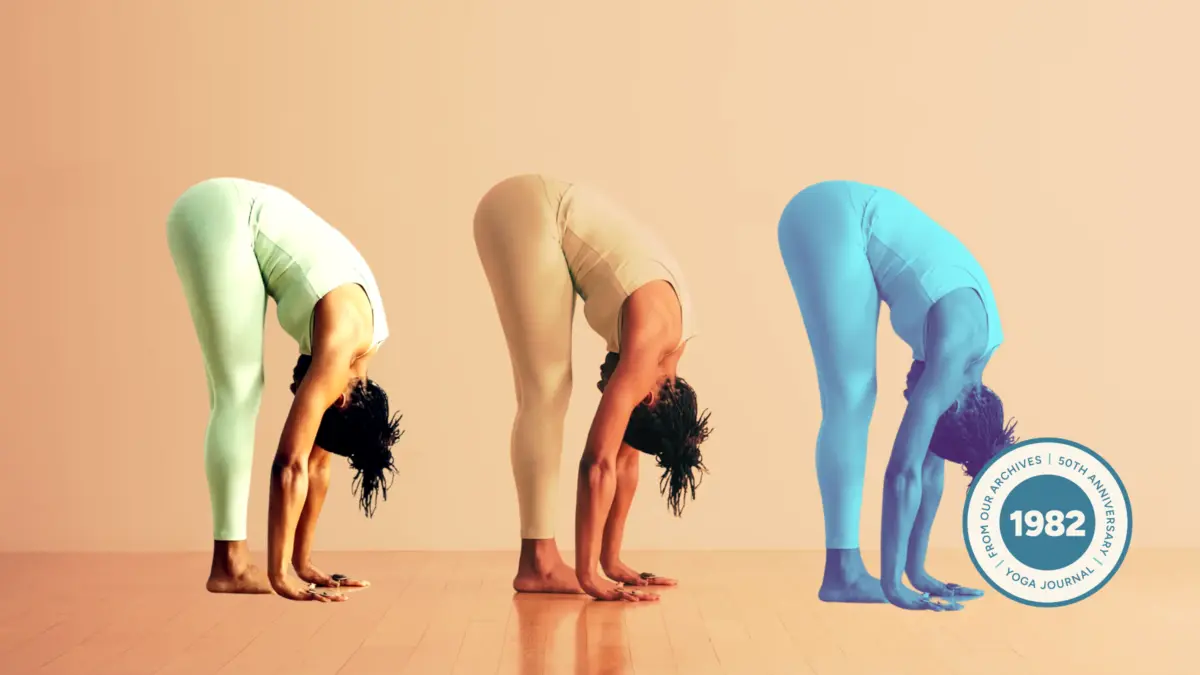
A prime example of this energetic and physical synthesis is Uttanasana (Standing Forward Bend). While the pose presents an outward appearance of intense physical stretch along the spine and posterior chain, its internal execution yields a profound, restorative sense of stillness. Drawing from ancient hatha yoga philosophy and the structural methodologies of legendary teacher B.K.S. Iyengar, the posture bridges dynamic solar energy with cooling lunar energy, achieving a delicate equilibrium between the active and the passive.
Chronology: From Ancient Philosophy to Modern Application
- Pre-1975 (Vedic & Classical Roots): Ancient yogic traditions conceptualized dynamic, heating forces as solar energy (surya) and restorative, cooling forces as lunar energy (chandra). The core purpose of hatha yoga—where ha represents the sun and tha represents the moon—was to unite these opposing forces through disciplined posture.
- January–February 1982 (Yoga Journal Print Edition): Yoga Journal originally published a landmark instructional feature detailing the anatomical nuances of Uttanasana, highlighting how outer-edge and inner-edge body imbalances skew energetic flow.
- Decades of Western Adaptation: Modern Western practitioners increasingly identified structural roadblocks stemming from solar-dominant habits—such as outer-leg gripping, overdeveloped calf muscles, and hyperextended knees—which limited the therapeutic benefits of forward bends.
- September 3, 2026 (Digital Archive Release): Yoga Journal officially re-releases this foundational archival text into its digital ecosystem, allowing contemporary yogis to reexamine classical alignment techniques in light of modern biomechanical understanding.
Supporting Data & Anatomical Insights
To understand how Uttanasana restores equilibrium, practitioners must examine the distribution of energy and muscle engagement across the body’s vertical axis. According to B.K.S. Iyengar’s insights detailed in The Tree of Yoga, energy pathways correspond directly to anatomical edges:
- Solar Pathways: Run along the outer edges of the body, which face the external world. In Western populations, solar energy overwhelmingly dominates daily movement.
- Lunar Pathways: Travel along the inner edges, closer to the body’s physical core. Neglecting these lines leads to structural imbalances.
- The Median Line: Represented by the central bones, acting as the stabilizing axis between outer solar intensity and inner lunar receptivity.
Common Structural Biases in Western Practitioners
- Upper Body Dominance: Raising arms overhead by lifting from the outer arms rather than the inner arms, resulting in hunched shoulders and restricted thoracic mobility.
- Lower Body Imbalance: Distributing body weight consistently onto the outer legs and feet, which causes the feet to flare outward, tightens the outer buttocks, and creates bulky, rigid outer calf muscles while leaving the inner calves underdeveloped.
- Hyperextended Knees: Jamming shinbones backward without lifting the thighs places excessive pressure on the knee joints, causing chronic pain and bowing the lower legs.
Official Perspectives & Methodological Responses
Mastering Uttanasana requires targeted interventions to counteract habitual physical misalignments. Archival methodologies outline several precise variations to correct these imbalances:
1. Strengthening the Inner Calves
- Execution: Begin in Tadasana (Mountain Pose) with feet a few inches apart. Inhale to lift through the crown of the head; exhale to roll the pubic bone back between the thighbones, lengthening the spine forward. Place two fists between the inner calves just below the knees. Firm the inner calf muscles against the fists while keeping the heads of the thighbones wide.
- Benefit: Shifts the center of gravity forward so hips align directly over the ankles, effectively engaging underdeveloped inner lower-leg muscles.
2. Stabilizing Hyperextended Knees
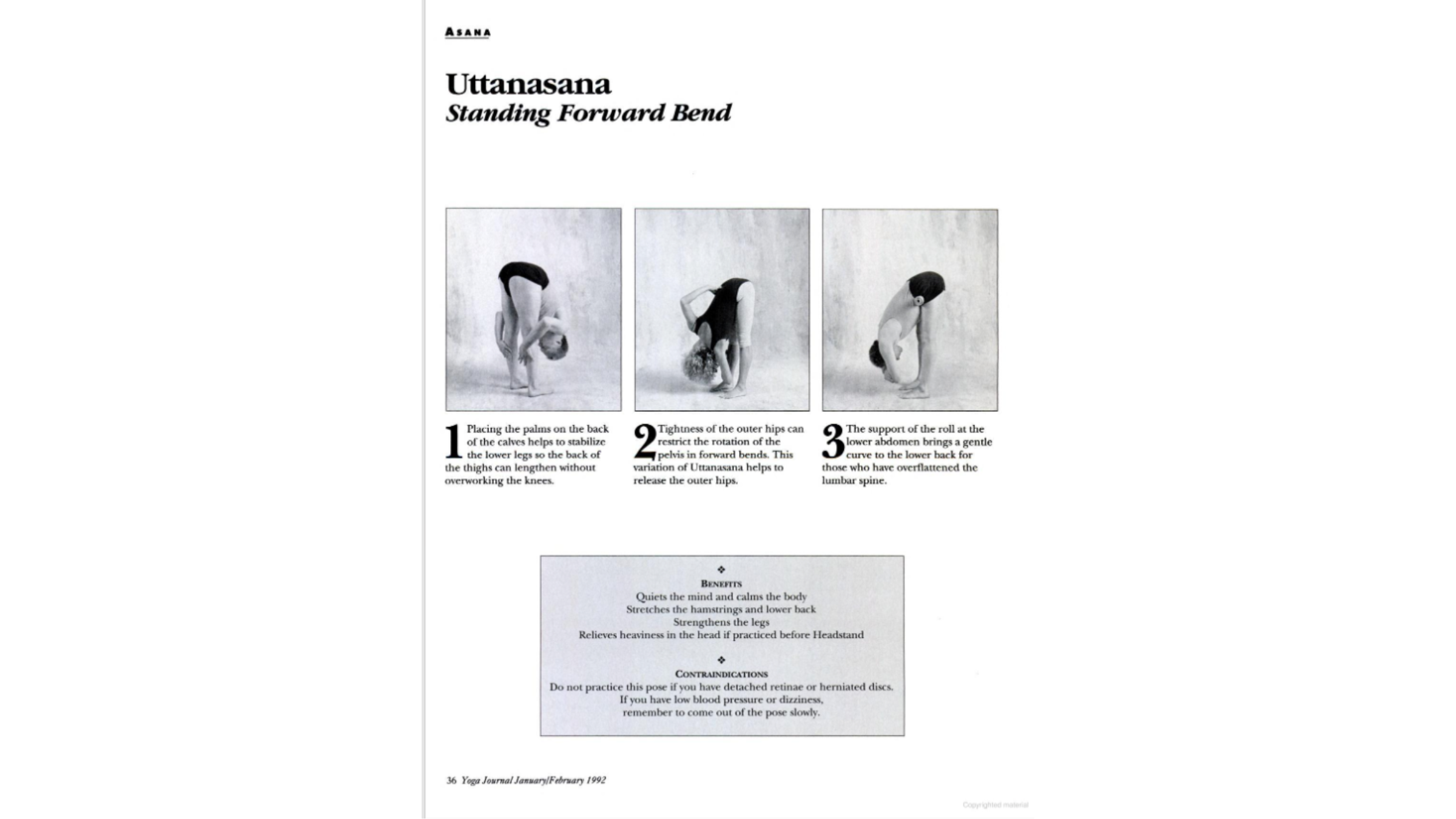
- Execution: Stand with feet under hip sockets. Lift the outer arches and lengthen the inner thighs into the forward fold. Place palms on the back of the calves just below the knee creases, broadening the hands against the muscle mass. Stretch the hamstrings upward away from the knee joints.
- Benefit: Prevents the knee joint from locking past its natural range of motion, alleviating pressure on the kneecap and back-of-knee tendons.
3. Releasing the Outer Hips and Sacroiliac Joints
- Execution: Avoid the common pitfall of squeezing the buttocks and tucking the tailbone in Tadasana, which creates backward tension on the pelvis. Instead, place hands on the outer hips during the descent, manually rolling the flesh toward the front hipbones to broaden the outer hip muscles.
- Benefit: Relieves chronic lower back and sacroiliac strain, creating adequate pelvic clearance for a deeper, unhindered forward fold.
4. Utilizing a Lower Abdomen Roll
- Execution: Place a firm 3-inch roll (such as a rolled sticky mat or towel) against the front hip crease. As you fold forward, press the roll slightly upward so the lower abdomen drapes over it rather than getting trapped underneath.
- Benefit: Corrects over-flattened lumbar spines caused by excessive tailbone-tucking. It awakens deep abdominal stabilizers and shifts the physical center of balance.
5. The Wall Hang Variation
- Execution: Stand with heels roughly 18 inches from a wall. Fold forward, placing a rolled mat under the arches of the feet while resting the buttocks against the wall. Extend the fingertips to the floor, lengthening the inner arms as the sitting bones press firmly into the vertical surface.
- Benefit: Allows the inner groins to completely soften, offering an optimal precursor for seated forward bends like Paschimottanasana.
Implications for Modern Yoga Practice
The archival preservation and re-examination of Uttanasana carry profound implications for contemporary movement culture. In an era dominated by high-intensity fitness regimes and sedentary desk work, modern bodies frequently suffer from tight hamstrings, compressed lumbar spines, and over-stimulated nervous systems.
By integrating classical alignment cues—such as balancing outer solar effort with inner lunar awareness—practitioners can transition from mechanical stretching to mindful embodiment. As the archives remind us, the ultimate objective of yoga is not merely physical flexibility, but total systemic balance: bridging the left and right sides of the body, harmonizing outer productivity with inner stillness, and ultimately awakening the transformative, transcendent energy traditions refer to as kundalini.
