

As international policymakers, corporate leaders, and scientists continually refine strategies to combat global climate change, attention remains overwhelmingly concentrated on carbon dioxide ($textCO_2$). While $textCO_2$ is undeniably the dominant long-term driver of planetary warming, a vital piece of the climate puzzle is frequently sidelined or muddled in translation: methane ($textCH_4$).
A landmark scientific study published recently in Communications Earth & Environment by researchers Konstantin Weber, Prof. Reto Knutti, and Dr. Cyril Brunner argues for a fundamental shift in how we model and manage greenhouse gas emissions. The researchers demonstrate that pairing net-zero $textCO_2$ goals with strict, dedicated methane reduction targets is not merely beneficial—it is an absolute prerequisite if humanity hopes to hold peak global warming well below 2°C, let alone the aspirational 1.5°C threshold of the Paris Agreement.
Main Facts: The Methane Dilemma and the Flaws of "$textCO_2$ Equivalent"
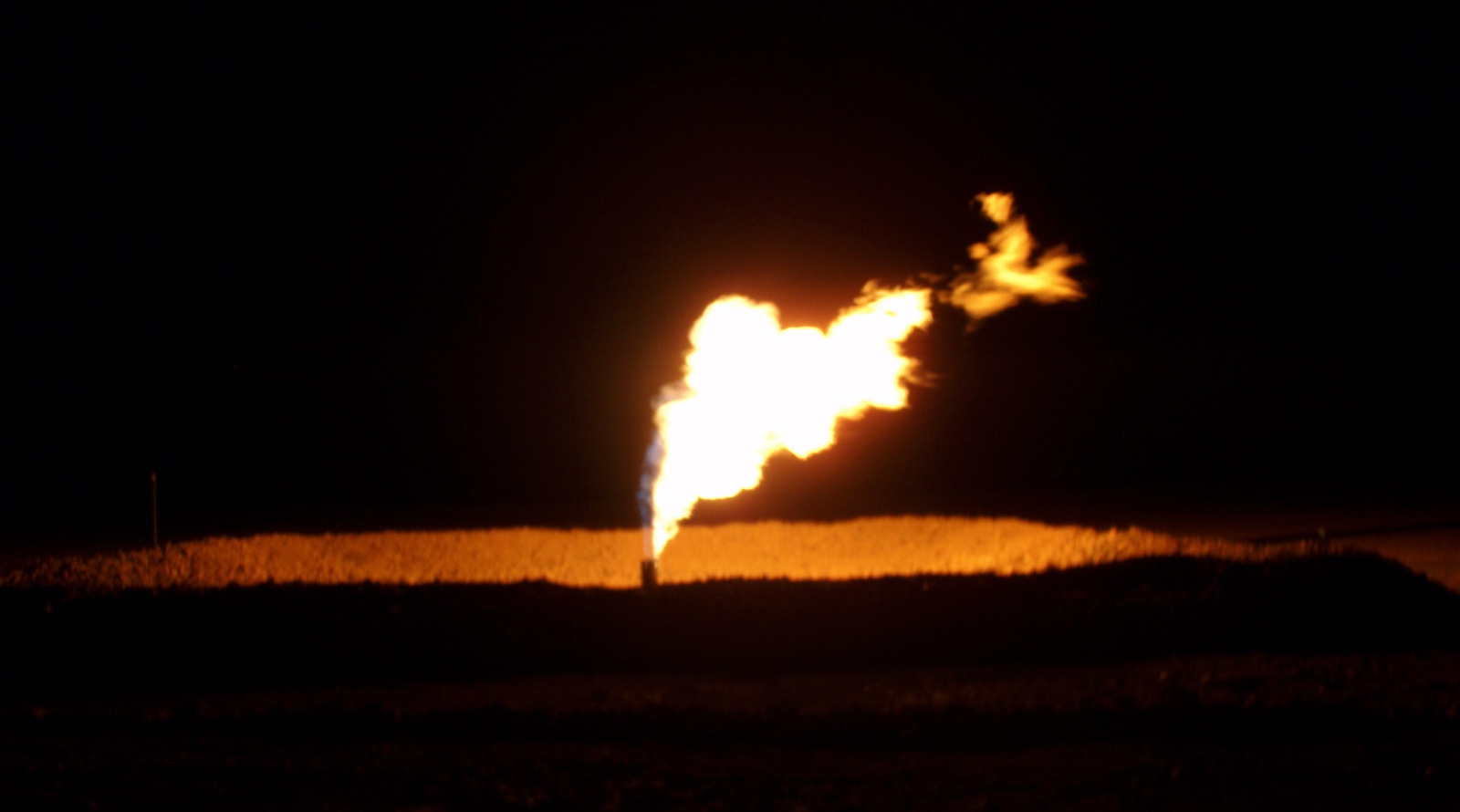
Methane is the second-largest contributor to global warming after $textCO_2$, primarily originating from agriculture, fossil fuel operations (such as leaky natural gas infrastructure and venting), and waste management. Physically and chemically, methane operates under entirely different rules than carbon dioxide:
- Potency: Methane traps heat in the atmosphere far more efficiently than $textCO_2$, packing a massive near-term warming punch.
- Lifespan: Unlike $textCO_2$, which lingers in the atmosphere for centuries, methane has a relatively short atmospheric lifespan, breaking down after roughly a decade.
Because of these distinct characteristics, cutting methane emissions offers a powerful, fast-acting lever to suppress near-term global temperatures. However, climate models and national reduction strategies routinely mask these dynamics by bundling all greenhouse gases into a single metric: “$textCO_2$ equivalent” ($textCO_2texte$).
Using $textCO_2texte$ forces scientists and policymakers to equate apples to oranges—or, as the study’s authors aptly put it, asking "how much spaghetti equals a chicken?" Because conversion formulas rely heavily on subjective time horizons and arbitrary baselines, calculating emissions in $textCO_2texte$ can make aggressive methane mitigation look like an urgent, life-saving priority in one model, yet practically unnecessary in another. Furthermore, Integrated Assessment Models (IAMs) that generate future emissions pathways are typically driven by cost-optimization, rendering real-world, messy, non-cost-effective policy choices virtually invisible.
The new research cuts through this methodological fog by "decoupling" $textCO_2$ and methane. Instead of relying on a flawed conversion metric, the study takes global warming limits as its foundational starting point, calculating the exact level of methane cuts required to stay beneath a targeted temperature ceiling.
Chronology: From the Paris Agreement to a New Paradigm in Climate Modeling
To understand how we arrived at this methodological crossroads, it is helpful to trace the evolution of global climate policy and scientific consensus regarding short-lived climate pollutants:
- Pre-2015 (The $textCO_2$ Monoculture): Global climate architectures, most notably early Intergovernmental Panel on Climate Change (IPCC) reports and the Kyoto Protocol framework, prioritized carbon dioxide reductions almost exclusively. While other gases were acknowledged, reduction timelines were universally synchronized through Global Warming Potential (GWP) metrics.
- The Paris Agreement Era (2015–2020): Nations committed to holding global warming to "well below 2°C" while pursuing efforts to limit it to 1.5°C. As climate modeling advanced, scientists realized that even if net-zero $textCO_2$ was achieved, failing to address short-lived climate pollutants would cause near-term temperature spikes to breach safe planetary boundaries.
- The Global Methane Pledge (COP26, 2021): Over 150 countries signed the Global Methane Pledge, committing to cut global methane emissions by at least 30% by 2030 relative to 2020 levels. However, many major emitters still lacked binding domestic enforcement mechanisms.
- The IPCC Sixth Assessment Report (2021–2023): Scientists solidified remaining carbon budget estimates (roughly 1,000–1,150 gigatonnes of $textCO_2$ by 2025 for a 2°C limit), but these budgets implicitly baked in assumed methane reductions of 27% to 35% by 2050—assumptions that were rarely scrutinized or decoupled.
- The Weber et al. Study (2026): Published in Communications Earth & Environment, Weber, Knutti, and Brunner introduced an expanded scenario space that completely separates methane and $textCO_2$ trajectories. By mapping out linear pathways starting in 2025, the authors mapped out the precise minimum methane cuts required for various peak warming ceilings, rewriting the rulebook on how climate targets should be formulated.
Supporting Data: What the Numbers Tell Us
The findings presented by the ETH Zurich researchers starkly illustrate the dangers of ignoring methane or relying on business-as-usual projections.
1. The Cost of Inaction
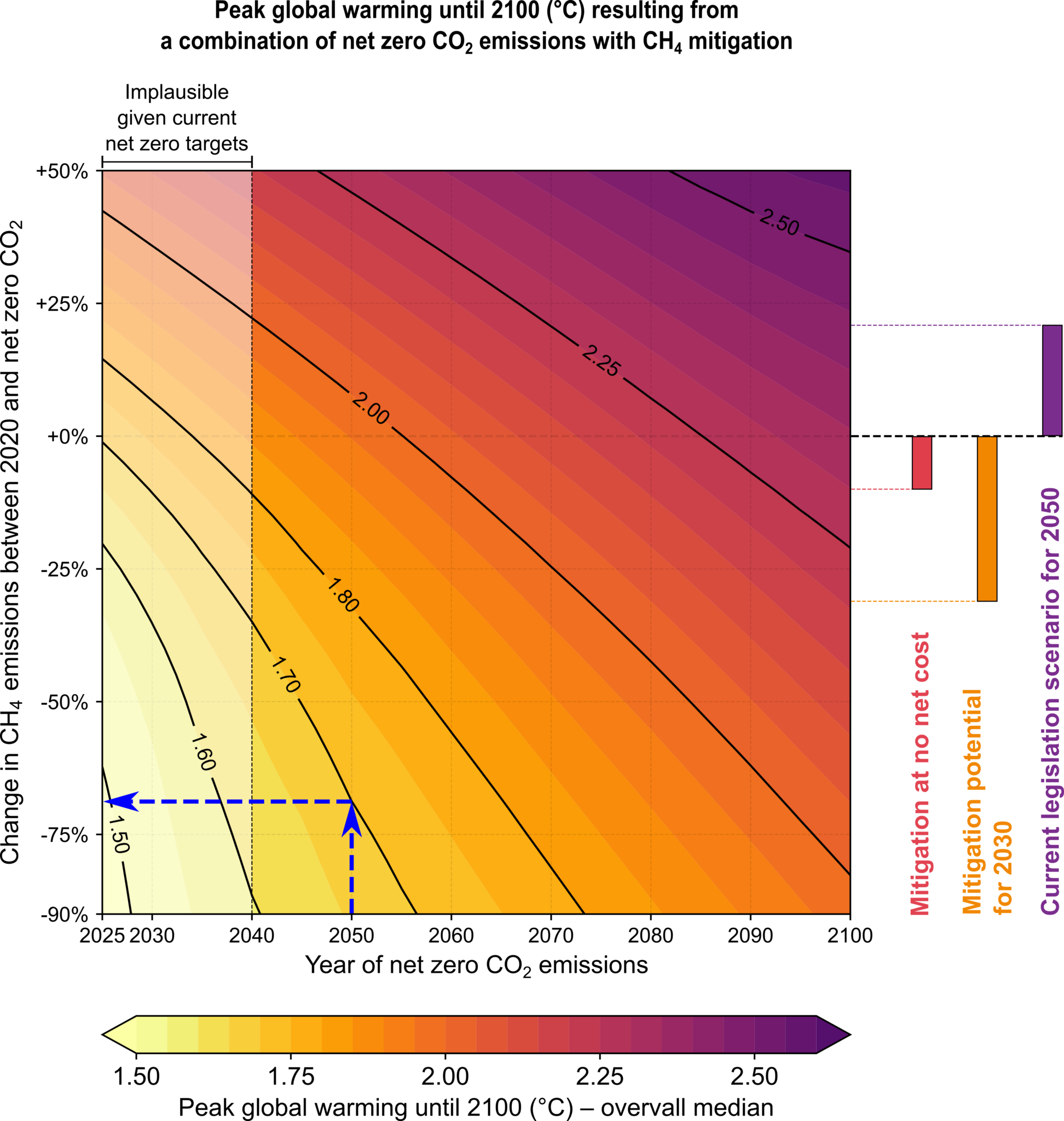
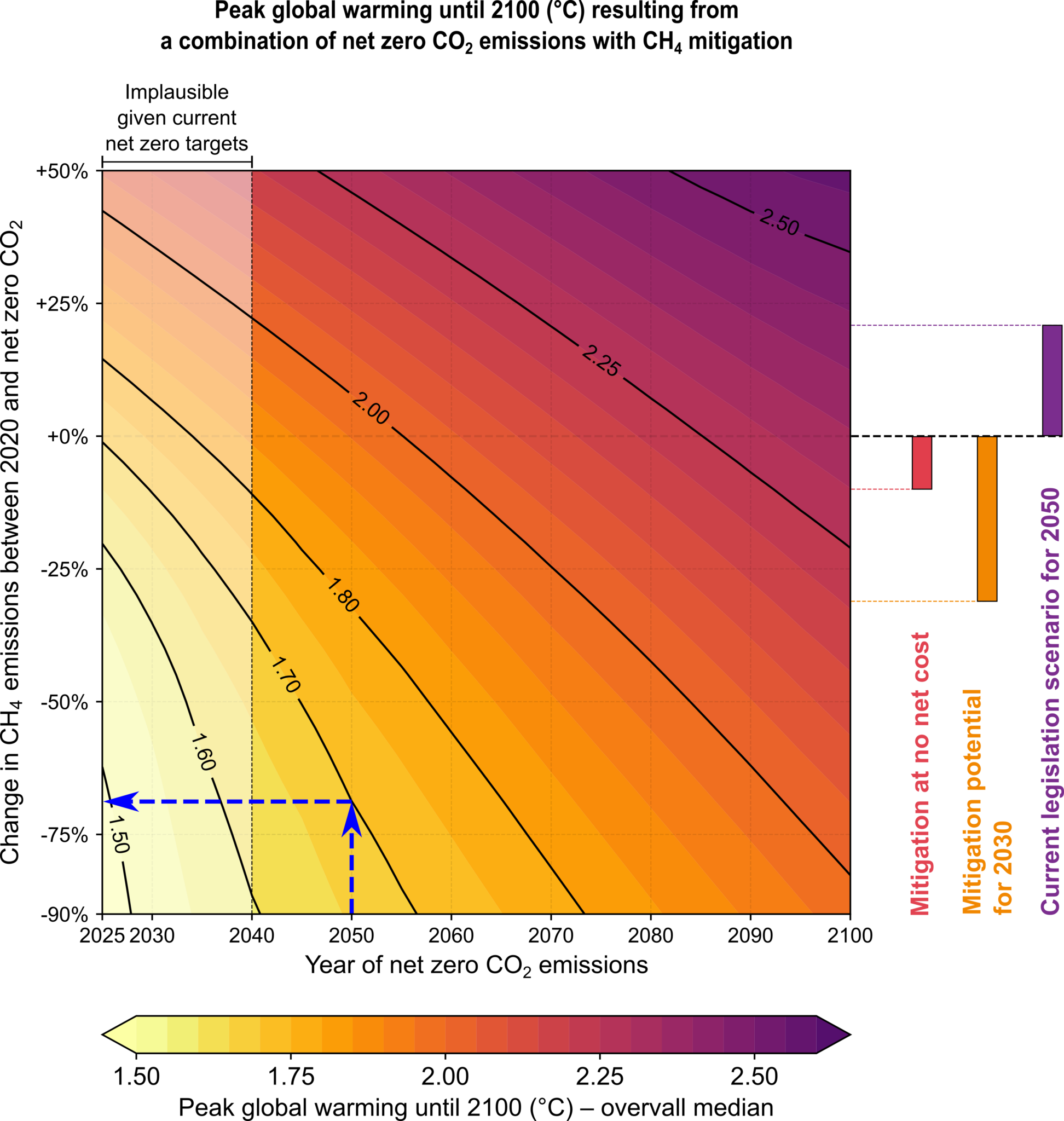
Under current global policies, methane emissions are projected to increase by roughly 20% by 2050 relative to 2020 levels. The study reveals that if this trajectory persists, global peak warming will exceed 2°C by 2050—even in a hypothetical scenario where global $textCO_2$ emissions successfully reach net-zero by that same year.
Furthermore, if global methane emissions remain locked at 2020 levels while net-zero $textCO_2$ is delayed until 2040 or later, warming will reliably surpass 1.85°C, shattering the safety margins envisioned by the Paris Agreement. Under such an unmitigated methane scenario, the remaining carbon budget for holding warming to 1.7°C has, for all practical purposes, already been exhausted.
2. The Math of Mitigation
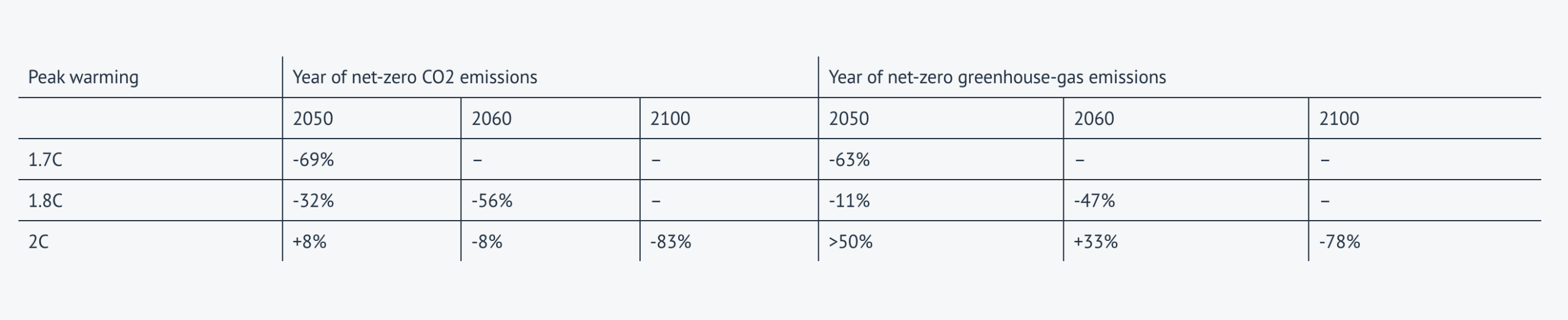
To limit peak warming to 1.7°C under a 2050 net-zero $textCO_2$ timeline, the data shows that methane emissions must fall by at least 69% by 2050 (relative to 2020). If an organization or country operates under a net-zero target that explicitly covers all greenhouse gases rather than $textCO_2$ alone, required methane cuts sit at a slightly lower 63%—though still extraordinarily steep.
| Peak Warming Level (50% likelihood) | Minimum Methane Cut (for 2050 $textCO_2$ Net-Zero) | Minimum Methane Cut (for 2050 All-GHG Net-Zero) |
|---|---|---|
| 1.7°C | 69% reduction | 63% reduction |
| 1.8°C | 44% reduction | 35% reduction |
| 2.0°C | — (Not feasible without deeper cuts) | — |
Note: Data adapted from Weber et al. (2026).
3. Low-Hanging Fruit: The 2030 Horizon
The good news is that profound methane reductions are technically feasible and economically viable today. Cutting global methane emissions by roughly one-third by 2030—directly matching the Global Methane Pledge—reduces peak warming by 0.15°C.
- Remarkably, 0.05°C of that cooling can be achieved via interventions that come at zero net cost, primarily through repairing leaky fossil fuel infrastructure, capturing fugitive gas, and eliminating routine flaring where the captured gas can be monetized.
- The remaining reductions require deploying readily available technologies in agriculture (e.g., feed additives for ruminants, improved manure management) and municipal waste handling (e.g., capturing landfill gas).
Official Responses and Industry Perspectives
The scientific community has largely rallied around the perspective that decoupling short-lived and long-lived climate pollutants provides a much-needed diagnostic tool for policymakers.
International bodies such as the United Nations Environment Programme (UNEP) and the International Energy Agency (IEA) have increasingly emphasized that methane mitigation cannot be treated as an optional auxiliary benefit. In recent reports, the IEA has underscored that over 40% of current fossil fuel methane emissions could be avoided at no net cost, given that the market value of the captured gas outweighs the capital expenditure required for mitigation technology.
However, resistance remains entrenched in specific economic sectors. Agricultural lobbies in major meat- and dairy-producing nations have historically pushed back against binding methane targets, often arguing that biological methane cycles (such as biogenic emissions from cattle) behave differently than fossil-fuel-derived methane. While scientific nuances like the GWP metric do account for the fact that steady livestock populations do not add* new warming at the same rate as growing fossil emissions, the new study underscores that any future expansion—or even failure to draw down absolute volumes—still severely threatens strict peak temperature caps.

Despite these hurdles, a vanguard of governments—including Japan, Mexico, and South Korea—have begun explicitly separating methane targets from their broader nationally determined contributions (NDCs), serving as early adopters of the policy architecture advocated by Weber and his colleagues.
Implications: Rewriting Corporate and National Climate Strategies
The publication of this research carries profound implications for how corporations, municipalities, and sovereign nations design their climate roadmaps:
- Abandoning the Single-Metric Trap: Companies and governments can no longer hide behind opaque "net-zero GHG" targets that lump all emissions into a single $textCO_2texte$ bucket. Transparency demands distinct, trackable sub-targets for carbon dioxide and methane.
- Prioritizing Near-Term Survival: Because $textCO_2$ accumulates and stays in the atmosphere for centuries, long-term net-zero goals address the ceiling of ultimate warming. However, methane controls the slope of the curve over the next three decades. Without aggressive methane cuts, the world risks overshooting tipping points—such as Arctic permafrost thaw or Amazon rainforest degradation—before net-zero $textCO_2$ dates are ever reached.
- Recalibrating Carbon Budgets: As the study proves, humanity’s remaining carbon budget depends entirely on assumptions made about methane. If the global community fails to enforce the Global Methane Pledge and subsequent reductions, remaining carbon budgets for 1.7°C and 2°C must be drastically downsized, forcing an impossibly rapid and economically disruptive acceleration of fossil fuel phase-outs.
Conclusion
The message from Weber, Knutti, and Brunner is clear: treating methane as a secondary variable in climate models is a dangerous gamble. To keep global temperature increases safely below catastrophic thresholds, the international community must discard lazy conversion metrics, embrace decoupled climate planning, and aggressively target methane emissions alongside carbon dioxide. The tools, technologies, and economic justifications to cut methane already exist—what is required now is the political and corporate will to implement them before near-term warming outpaces our long-term ambitions.
