

Main Facts
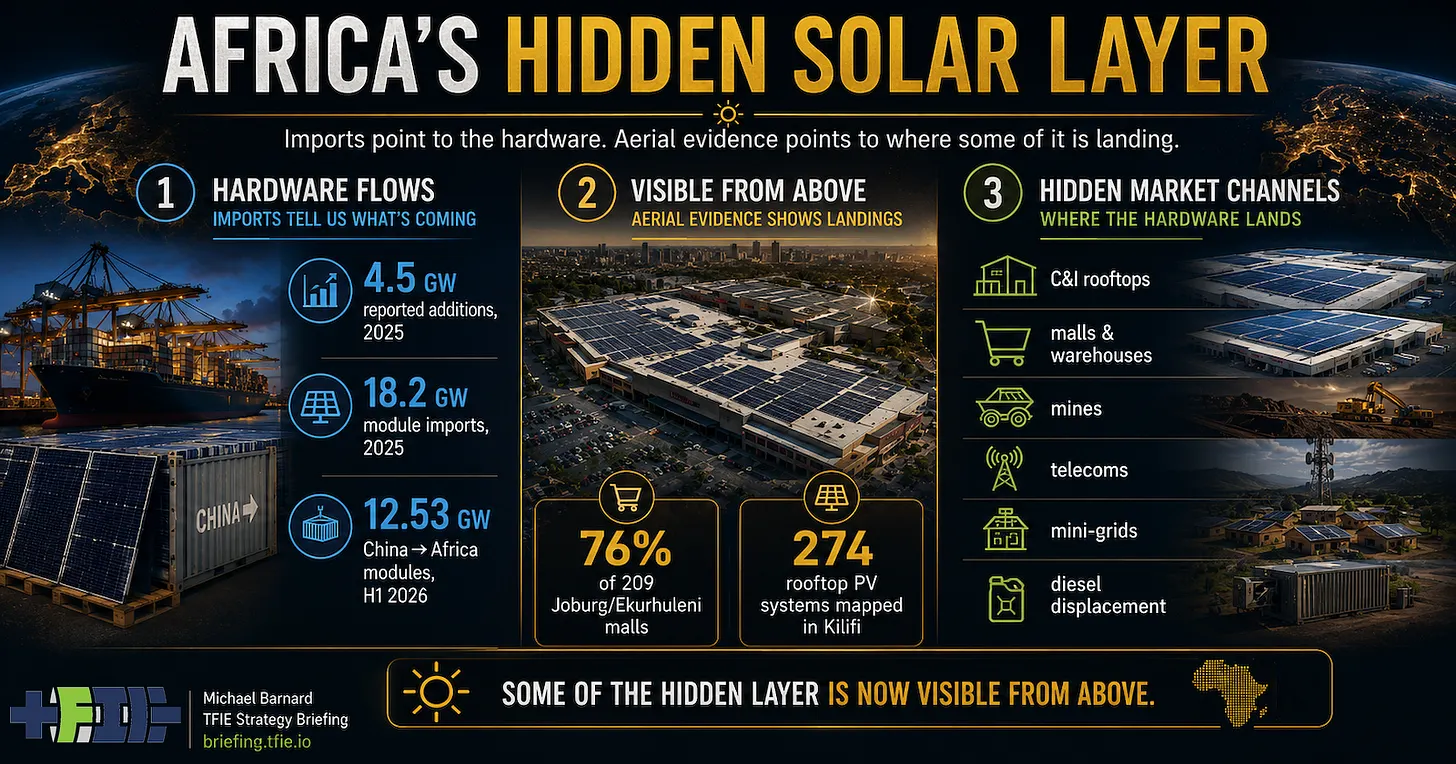
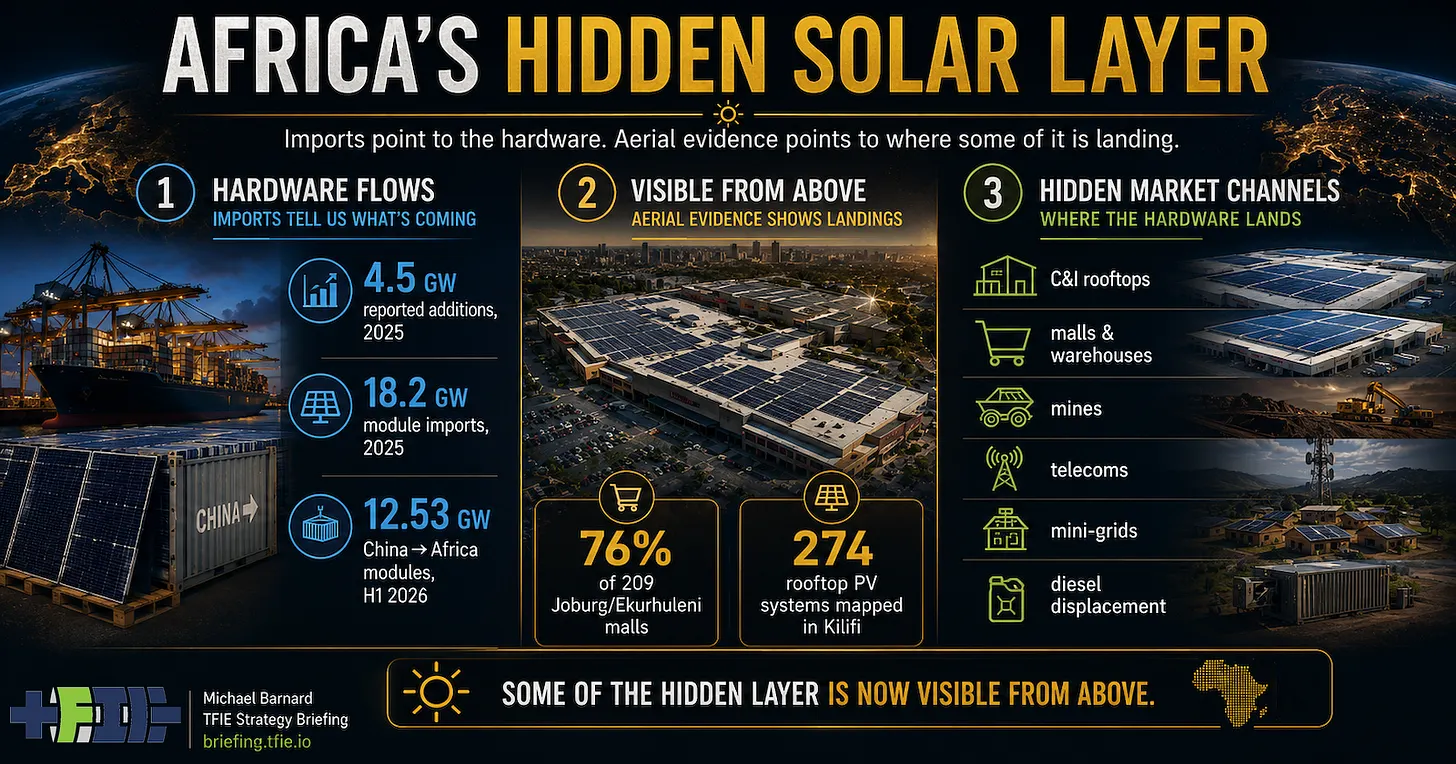
Official energy statistics are severely undercounting Africa’s renewable energy transition. While government and utility tracking systems report modest figures—such as the roughly 4.5 gigawatts (GW) of official solar capacity added across the continent in 2025—customs data and hardware supply chains tell a radically different story.
During that same year, African nations imported approximately 18.2 GW of solar modules. This massive influx did not slow down: by the first half of 2026, an additional 12.53 GW of finished Chinese solar modules had been shipped directly to various African markets. While not every imported panel is immediately put into service—some inevitably sit in warehouses, ports, or distribution hubs—the sheer magnitude of the gap defies traditional accounting explanations.
Independent market analysts, energy economists, and spatial data scientists are increasingly recognizing that a massive, decentralized "hidden solar layer" is taking root across the continent. Rather than relying on centralized utility-scale projects announced by ministries of energy, this new wave of solar deployment is driven by customer-side, behind-the-meter installations.
Mines, manufacturing plants, agricultural operations, commercial shopping centers, telecommunications towers, and urban households are taking energy security into their own hands. Faced with chronic grid unreliability, frequent load-shedding, and the persistently high cost of diesel generation, these commercial and industrial (C&I) entities are writing the checks, buying the hardware, and quietly transforming Africa’s energy landscape from the ground up.
Chronology of an Undercounted Boom
To understand how traditional energy reporting missed this massive wave of renewable adoption, it is necessary to trace the convergence of economic pressures and hardware supply chains over recent years.
The Turning Point: 2025
Throughout 2025, official government registries continued to log minor incremental additions to national grids, typically focusing on large-scale solar farms tied into state-owned transmission infrastructure. However, international trade data captured an unprecedented surge in photovoltaic (PV) module imports into major African entry points, spearheaded by sharp declines in global solar manufacturing costs driven by Chinese producers.
Early 2026 Predictions
At the beginning of 2026, energy analysts watching market structures made aggressive forecasts—such as the projection that Africa would absorb roughly 20 GW of solar capacity over the course of the year. This prediction was not derived from a pipeline of announced utility projects, but rather from a hard-nosed assessment of market fundamentals: cheap solar hardware, falling battery storage prices, and exorbitant diesel fuel costs rendering centralized grids entirely unreliable for business continuity.
Mid-2026: Satellite Verification
As import data continued to validate the high-absorption thesis through the first two quarters of 2026, skeptics pointed out that hardware imports do not automatically equate to operational megawatts. That narrative shifted when spatial analysts and data organizations began publishing high-resolution satellite imagery studies. By peering down from orbit, researchers were finally able to locate thousands of commercial and industrial rooftops blanketed in photovoltaic panels—visual proof that the imported hardware was actively being deployed across the continent’s economic hubs.
Supporting Data and Spatial Evidence
The divergence between official metrics and ground-level reality is best illustrated by a combination of trade statistics, spatial mapping, and localized pilot studies.
The Import-Capacity Gap
- 2025 Official Additions: ~4.5 GW of tracked utility and registered capacity.
- 2025 Module Imports: ~18.2 GW of solar hardware entering African ports.
- H1 2026 Imports: An additional 12.53 GW of finished Chinese modules delivered in just the first six months.
Aerial Insights from South Africa
The most robust public aerial evidence currently available comes from South Africa, where spatial research organizations DataDesk and The Outlier conducted a comprehensive satellite audit of 209 major shopping malls across the economic heartlands of Johannesburg and Ekurhuleni.
The findings were striking: 76% of the surveyed shopping malls featured rooftop solar installations.
Shopping centers represent the ideal vanguard for an invisible, market-driven energy transition. They possess massive, unobstructed roof surfaces, high daytime electricity demand profiles (precisely when solar generation peaks), and corporate balance sheets capable of financing capital equipment. Furthermore, shopping mall operators experience direct economic pain from unstable municipal grids and expensive backup diesel generators. The proliferation of rooftop solar across these commercial centers represents a decentralized market response: private capital bypassing bureaucratic grid constraints to secure uninterrupted power.
Comparing Regional Booms: Africa vs. Pakistan
While observers have occasionally compared Africa’s trajectory to Pakistan’s explosive, highly visible residential and commercial solar surge—where millions of households and small businesses rapidly covered entire neighborhoods with imported panels—the African dynamic exhibits distinct structural differences.
In Africa, the boom is noticeably more concentrated in commercial, industrial, and institutional applications. Rather than a purely residential phenomenon, the primary drivers are factories, mines, agricultural processors, and corporate real estate portfolios seeking shelter from power quality issues and diesel price volatility.
Official Responses and Blind Spots
Traditional energy statistics systems—managed by national utilities, ministries, and international energy agencies—are structurally ill-equipped to track distributed, behind-the-meter assets.
The Utility Bias
Most official energy databases rely heavily on:
- Interconnection requests submitted to state-owned grid operators.
- Government-tendered utility-scale solar farms.
- Officially registered independent power producer (IPP) projects.
These mechanisms capture large-scale, centralized infrastructure effectively. However, they are virtually blind to systems installed behind the meter. When a commercial warehouse installs a 500-kilowatt rooftop array paired with lithium-ion batteries to offset daytime factory loads, it rarely requires formal utility approval if it operates entirely off-grid or via a zero-export configuration. Consequently, the transaction bypasses official administrative registries entirely.
Limitations of Satellite Mapping
While aerial and satellite imagery provides a revolutionary new layer of verification, it is not a silver bullet. Remote sensing comes with inherent limitations:

- Identification Challenges: Large, clean commercial flat roofs are relatively easy for algorithms and analysts to spot; however, smaller residential setups, rural micro-grids, agricultural water pumps, and remote telecom towers are easily missed.
- Obstructions: Panels obscured by tree canopies, architectural overhangs, or industrial smoke plumes evade standard optical satellite scans.
- Operational Uncertainty: A panel visible from space confirms the presence of hardware, but it cannot definitively verify whether the underlying inverters, balance-of-system wiring, and battery banks are fully commissioned and operational.
Despite these limitations, satellite data serves as an invaluable reality check against official undercounting, proving that thousands of commercial entities are actively deploying the hardware captured in customs manifests.
Broader Implications of Africa’s Hidden Solar Layer
The confirmation that tens of gigawatts of solar hardware are quietly absorbing into Africa’s economic machinery carries profound implications for the continent’s energy future, industrial competitiveness, and macroeconomic stability.
1. Reshaping Grid Demand and Utility Revenues
As large industrial and commercial consumers generate their own electricity during peak daylight hours, the nature of demand placed on state-owned utilities changes fundamentally. While this relieves pressure on strained national grids, it also risks eroding utility revenues if institutional customers reduce their grid reliance. Utilities must adapt their business models to manage fluctuating baseloads and provide complementary balancing power rather than bulk generation.
2. Displacing Diesel Generation
For decades, African businesses have relied on expensive, highly polluting diesel generators to bridge the gap left by unreliable national grids. The massive influx of solar panels—increasingly paired with cost-effective battery energy storage systems (BESS)—is systematically cutting into fossil fuel demand. This transition significantly lowers operating expenses for businesses, insulating them from global oil price shocks and drastically reducing carbon emissions across the industrial sector.
3. Enhancing Industrial Competitiveness
High energy costs and frequent power outages have historically crippled the manufacturing and processing sectors in many African nations, making local goods less competitive globally. By taking power generation into their own hands through cheap solar technology, factories and agricultural processors can stabilize their energy costs, improve product quality, and protect machinery from damaging power surges.
4. Rewriting the Narrative of Transition Speed
For years, international discourse surrounding Africa’s energy transition focused heavily on the need for massive concessional finance, multilateral development bank loans, and lengthy government-to-government negotiations to build utility-scale capacity.
The hidden solar boom demonstrates that private enterprise, market forces, and commercial self-interest are moving far faster than official policy frameworks. Africa’s energy transition is not merely waiting for institutional approval—it is being actively financed, built, and operated on rooftops and industrial sites across the continent, proving that when the economic imperative is strong enough, the market will find a way to power itself.
