

By Karen Greenspan
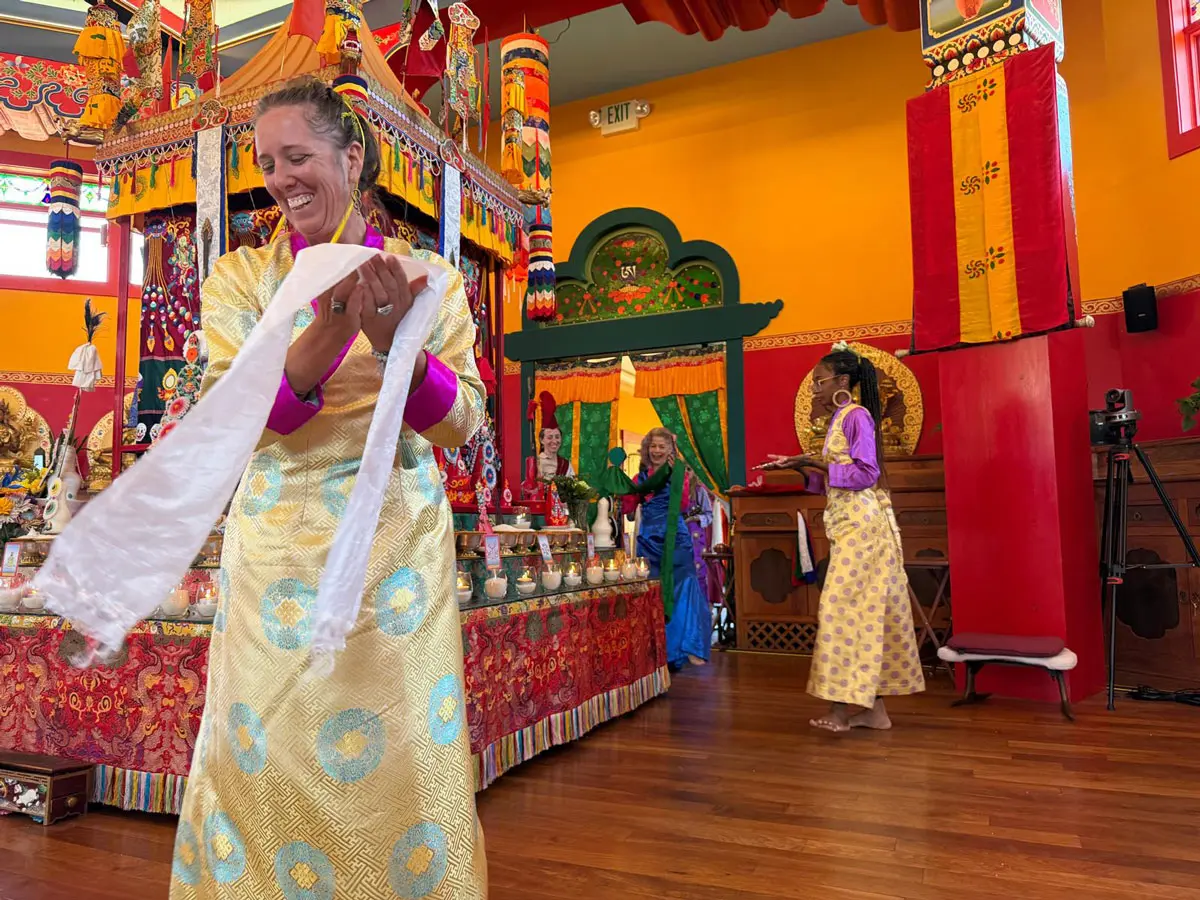
Dressed in long, brightly colored Tibetan silk gowns, dancers weave a graceful grapevine step around the ritual mandala in the prayer hall at Tara Mandala. Each participant holds an object of sensory enjoyment mounted on a vibrant ceremonial scarf—musical instruments, delicate flowers, rare perfumes. This moving tableau is part of an elaborate inner offering known as Chötreng (Garland of Offerings), performed during the communal White Dakini Drupchen.
As a chant master leads the congregation in evocative verses, everyone performs precise hand mudras, visualizing the offering and receiving of sixteen splendid gifts. These offerings are mentally multiplied and delivered by celestial Wisdom Goddesses. In the esoteric ecosystem of Vajrayana Buddhism, the dancers do not merely represent these figures; through movement, breath, and visualization, they become them.
“The offering of dance to enhance the energy around an occasion is a frequent part of Buddhist life in the Himalayas,” says dance journalist and practitioner Karen Greenspan. From royal processions in Bhutan to contemporary dharma centers in the West, sacred dance (cham) serves as an embodied bridge between the human and the divine, transforming movement itself into a profound spiritual virtue.
Main Facts: The Anatomy of Vajrayana Sacred Dance
At its core, sacred Buddhist dance is not performance art designed for public entertainment; it is an active ritual technology. Vajrayana Buddhism teaches that everything in human experience can be alchemized into spiritual practice. As the revered Nyingma master Thinley Norbu Rinpoche (1931–2011) once noted, “In the precious Vajrayana tradition, in which the offering of dance is practiced, everything is turned into virtue, including all movement.”
The primary mechanics of these dances rely on three main pillars:
- The Body, Speech, and Mind Integration: Dancers engage physical postures and mudras (body), chanting and liturgical recitation (speech), and complex visualization (mind).
- Multiplication of Offerings: Through mental projection, physical gifts like flowers or music are multiplied infinitely to generate immeasurable spiritual merit.
- Cultivation of Generosity: Offering dance directly addresses and subdues attachment, acting as a living embodiment of the paramitas (transcendent virtues), particularly generosity.
Whether welcoming high lamas, invoking deities, or increasing the auspiciousness of an entire region, movement acts as a magnet for divine qualities. As a Bhutanese cham master famously explained to Greenspan, “Everyone—gods and humans alike—love dance—just as they love flowers. No one can resist the beauty.”
Chronology: From Vedic Roots to Modern Monastic Practice
The roots of sacred ritual movement stretch far deeper into history than institutional Buddhism itself, evolving through centuries of South Asian and Himalayan history.
- 1500–1200 BCE (The Vedic Period): The early Hindu Vedas, particularly the Yajur Veda, establish a cultural framework where music, rhythmic recitation, and physical offering formulas are woven directly into spiritual contemplation and cosmic understanding.
- Mid-8th Century CE (Introduction to Tibet): The Indian tantric master Guru Padmasambhava (Guru Rinpoche) brings Tantric Buddhism to Tibet and Bhutan, integrating indigenous movement practices into newly established ritual structures.
- Circa 700 CE Onward (Systematization of Deity Yoga): Indian commentators formalize deity yoga, cementing the practice of chanting Sanskrit offering formulas alongside symbolic mudras to invite divine presence.
- 11th to 13th Century CE (The Lineage Masters): Great figures like the yogi Milarepa and treasure revealers such as Chokyi Wangchuk (1212–1270) codify songs of realization (gurma) and visionary dance-prayers (terma) that continue to be performed in Nyingma and Kagyu monasteries today.
- The Last Two Decades (A Historic Shift): Traditionally performed exclusively by male monastics due to the demographics of Himalayan institutions, dakini cham and complex offering dances are increasingly opened to female practitioners in both Eastern nunneries and Western dharma hubs.
Supporting Data & Regional Manifestations
Sacred dance takes on distinct cultural characteristics depending on the geography, lineage, and specific ritual occasion. Across the Himalayas, several key forms dominate the liturgical calendar:
1. Welcoming the Sacred: Jipai Pawo Cham and Zheng Zhik Pema
In Bhutan, honoring visiting lamas, kings, and dignitaries requires the Jipai Pawo Cham (Majestic Hero’s Dance). Performed by two to four pawo (heroes) flanking the guest, the dancers leap and bound with raised arms while rattling damaru (hand drums).
Similarly, Zheng Zhik Pema is performed during Tsechu (Guru Rinpoche Day) celebrations. Dancers costumed as dakas and dakinis spin and jump to a liturgy believed to have been given directly by Guru Rinpoche to his foremost disciple, Yeshe Tsogyal, as a means of summoning him instantaneously.
2. Amplifying Auspiciousness: The Drukpa Kagyu Nuns
Under the guidance of figures like His Holiness the Twelfth Gyalwang Drukpa, monastics frequently integrate high-energy movement into major events. At Druk Amitabha Mountain in Kathmandu, Nepal, the nine-day Avalokiteshvara Drupchen is heavily punctuated by peaceful and dramatic cham dances designed to raise communal energy and focus collective reflection.
Additionally, the nuns perform gurma (songs of realization) paired with folksy choreographies to celebrate the completion of long-term retreats, temple consecrations, and lineage anniversaries. Returning retreatants are often welcomed with the repa sash—the white cotton wrap of advanced tantric yogis—draped over their monastic robes while peers perform dynamic dances.
3. The Newar Charya Nritya Tradition
In the Kathmandu Valley, the indigenous Newar people preserve charya nritya ("dance as a spiritual discipline"), practiced by non-monastic vajracharya priests for over a millennium. Within this tradition, performers execute Sodasha Lasya (sixteen expressions of grace), acting out the sixteen offering goddesses. They mime playing lutes, beating drums, placing garlands, and sending plumes of fragrant incense wafting through the air—a direct historical cousin to the Rigma Chudruk Cham (Dance of the Sixteen Wisdom Goddesses) found in Tibetan traditions.
Official Responses and Perspectives
The preservation and global transmission of sacred Himalayan dance have generated considerable dialogue among scholars, monastic leaders, and practitioners.
Monastic authorities emphasize that these dances must not be secularized or reduced to mere cultural folklore. Traditional leaders maintain that cham retains its spiritual efficacy only when anchored in proper lineage, sacred motivation, and internal visualization. Without the "inner architecture" of meditation and refuge, the external choreography loses its transformative power.
At the same time, contemporary Western practitioners and Asian monastic leaders alike have championed the expansion of these traditions to include women. Opening dakini dances to female monastics and lay practitioners—as witnessed at centers like Tara Mandala and within Himalayan nunneries—is viewed by modern teachers not as a departure from tradition, but as an authentic adaptation that mirrors the sacred feminine deities being embodied.
Karen Greenspan notes that witnessing or participating in these dances offers modern seekers a vital antidote to disembodied spirituality. “Just as generosity is a transcendent virtue,” Greenspan writes, “so too are the dances that deliver its boundless goodness.”
Implications for Modern Spirituality and Cultural Preservation
The enduring vitality of Himalayan sacred dance carries broad implications for both the preservation of intangible cultural heritage and the evolution of global Buddhism.
- Sustaining Intangible Heritage: As modernization encroaches upon isolated Himalayan valleys, the rigorous transmission of ritual arts like cham, charya nritya, and gurma acts as a crucial anchor for regional identity, linguistic preservation, and traditional artistic craftsmanship (including mask-making, brocade tailoring, and sacred instrument construction).
- Embodiment in Western Dharma: Western Buddhist practitioners, often critiqued for favoring intellectualized or purely seated meditation, find in sacred dance an indispensable bridge toward an embodied dharma. The philosophy that "all movement can be turned into virtue" invites practitioners to infuse daily life with mindfulness and generosity.
- Gender Equity in Monastic Arts: The integration of female practitioners into once-exclusive male sacred dance roles signals a progressive structural shift within Vajrayana institutions. By embodying wisdom goddesses, female monastics step visibly into leadership and ritual roles that actively reshape the institutional landscape of contemporary Buddhism.
Ultimately, whether performed under the crisp mountain air of a Bhutanese tsechu or within the sunlit prayer halls of Western retreat centers, sacred dance remains an inexhaustible fountain of auspiciousness. By integrating body, speech, and mind, dancers sweep away negativity, stir up boundless joy, and send an eternal message echoing across the mandalas of the world: How delightful and joyful!
