

Main Facts
In the early 1920s, the visionary Parisian interior decorator Jean-Michel Frank invited the celebrated French poet and playwright Jean Cocteau into his Left Bank apartment. What Cocteau encountered inside was so radically stripped back that it prompted a playfully savage review, one that would echo down through the annals of design history: “This fellow is charming. Very charming, really. What a shame he’s been burglarized.”
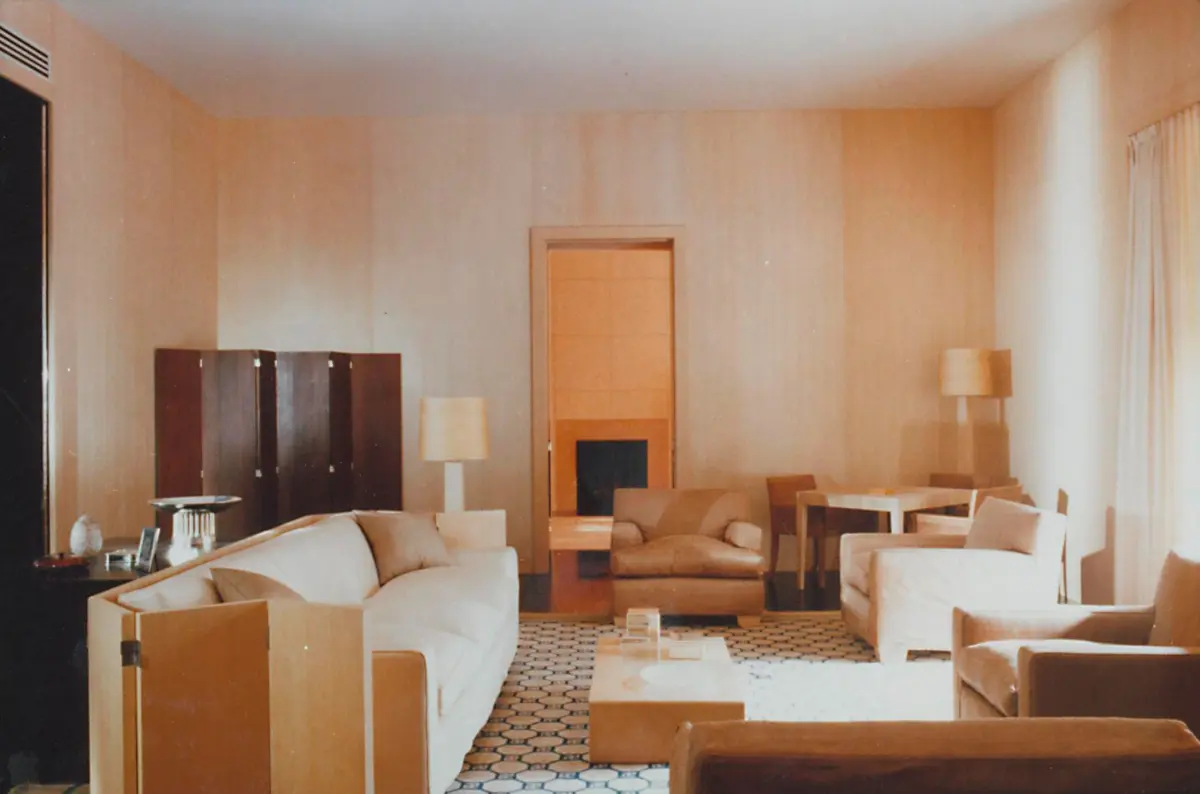
Cocteau was reacting to Frank’s ultra-minimalist living quarters, which had been intentionally purged of conventional artworks, heavy decorative moldings, and the vast majority of furniture. It was an uncompromising aesthetic that another of Frank’s high-profile clients, the author François Mauriac, memorably dubbed the “strange luxury of nothingness.”
At the heart of this minimalist philosophy was a distinct paradox: Frank created spaces that felt entirely vacant, yet every single element within them was meticulously curated. The few pieces of furniture he did allow into his own home—and into the residences of his wealthy, daring clientele—followed a sparse, elemental ethos. Among his most enduring contributions is an upholstered-back armchair first conceived in 1923.
Produced by his principal cabinetmaker, Adolphe Chanaux, the chair is a masterclass in understated restraint. Constructed from solid oak with beveled feet and a blocky, low-slung silhouette, it could be sheathed in anything from plush shearling and supple leather to humble wool. Despite its luxurious materials, the chair practically disappears into a room due to its sheer simplicity.

Nearly a century later, this ghost-like chair—and the wider catalog of Jean-Michel Frank—continues to captivate top-tier interior designers, collectors, and design historians. Following the acquisition of the historic Parisian design brand Ecart in 2024 by AD100 interior designer Pierre Yovanovitch, Frank’s radical vision is experiencing a major contemporary renaissance. From a newly opened Paris gallery showcasing rare Frank suites to coastal retreats in Sag Harbor, the "GOAT of chairs" proves that extreme minimalism never truly goes out of style.
Chronology of an Icon
The 1920s: The Birth of Radical Minimalism
- Early 1920s: Jean-Michel Frank establishes his signature Left Bank apartment in Paris, shocking visitors like Jean Cocteau with its radical absence of ornamentation.
- 1923: Frank designs his iconic upholstered-back armchair in collaboration with master craftsman Adolphe Chanaux. The chair features a blocky, rectilinear form softened by high-end upholstery like shearling, wool, or leather.
- Late 1920s: Frank’s portfolio rapidly expands among the avant-garde elite. His furniture is commissioned for the Parisian salon of legendary arts patrons Charles and Marie-Laure de Noailles, as well as the lavish San Francisco penthouse of American scion Charles Templeton Crocker.
The Mid-20th Century: Eclipse and Preservation
- 1940s–1970s: Following Frank’s tragic death in 1941 and the shifting geopolitical and aesthetic landscapes of the mid-20th century, his stark minimalist aesthetic largely recedes from mainstream public consciousness, overshadowed by mid-century modernism and expressive post-war movements.
- 1978: Recognizing the historical importance of Frank’s work—alongside other neglected early-20th-century masters—legendary French designer Andrée Putman founds Ecart. The brand is established specifically to rescue, reproduce, and reissue the timeless furniture designs of Jean-Michel Frank, ensuring his legacy survives for future generations.
The Contemporary Revival
- 2024: AD100 interior designer Pierre Yovanovitch acquires Ecart, taking the reins of the storied brand and injecting new energy into the stewardship of Frank’s design archive.
- Present Day: Ecart inaugurates a brand-new gallery space in Paris, placing Frank’s original designs back into the cultural conversation. Contemporary designers, such as Neal Beckstedt, champion the 1923 armchair in modern residential projects, cementing its status as an enduring masterpiece.
Supporting Data & Design Analysis
To understand why a blocky, unadorned armchair designed over a century ago still commands reverence, one must examine its proportions and material DNA.
Materiality and Craftsmanship
- The Maker: Adolphe Chanaux was Frank’s indispensable collaborator, translating the designer’s paper sketches into physical reality. Chanaux utilized heavy, structural woods like solid oak, grounding the pieces while maintaining clean architectural lines.
- Textural Contrast: Frank balanced the stark rigidity of his spatial designs by wrapping his armchairs in tactile, sensory materials. Early iterations utilized natural wools, rich leather, and opulent white shearling, offering a visceral warmth that offset the severity of the room.
- The Silhouette: Characterized by its low center of gravity, unembourged frame, and subtle beveled feet, the armchair defies the ornate, gilded traditions of the Louis XVI style from which it abstractly evolved.
The Evolution of Placement
- Historical Installations:
- The Noailles Salon (Paris): Placed among cutting-edge modern art and minimalist surfaces, serving as a quiet focal point.
- The Crocker Penthouse (San Francisco, 1929): Integrated into sprawling American wealth, proving that Frank’s Parisian minimalism could translate to international high society.
- Modern Transformations:
- Neal Beckstedt’s Sag Harbor Beach House: Beckstedt acquired a pair of vintage Frank chairs at auction, reupholstering them in casual blue linen to soften their formal edges for a relaxed coastal environment.
Official Responses & Industry Perspectives
The enduring appeal of Jean-Michel Frank’s work is perhaps best articulated by the modern masters who live with, sell, and reinterpret his creations today.
Pierre Yovanovitch, the acclaimed AD100 designer who acquired Ecart in 2024, points out the paradoxical nature of Frank’s brilliance. Discussing the design’s resistance to shifting trends, Yovanovitch notes:

"The style is so sharp—at the end there’s actually no style, which is what makes it so timeless. Every time we put one [of Frank’s chairs] in the window [at the new Paris gallery], people stop, come in, and say, ‘What is that?’"
This magnetic yet understated quality has earned the chair fierce loyalty among contemporary interior architects. AD100 designer Neal Beckstedt, who famously integrated a pair of vintage Frank armchairs into his Sag Harbor retreat, offers high praise for the piece’s ergonomics and aesthetic dominance:
"On a comfort scale of 1 to 10, it’s a 20. Perfect proportions; perfect comfort—it’s the GOAT of chairs."
These testimonials highlight a crucial shift in contemporary luxury: true sophistication no longer relies on loud branding, excessive ornamentation, or visual clutter. Instead, it aligns with Frank’s century-old philosophy that restraint is the ultimate form of elegance.

Implications for Modern Interior Architecture
The resurgence of Jean-Michel Frank’s design ethos—spearheaded by the 2024 Ecart acquisition and the renewed visibility of pieces like his 1923 upholstered armchair—carries profound implications for the future of interior design.
1. The Fatigue of Maximalism
In an era dominated by digital visual saturation, fast-paced trend cycles, and maximalist "cluttercore" revivals, consumers and designers alike are experiencing aesthetic fatigue. Frank’s "strange luxury of nothingness" offers an antidote: a visual sanctuary where the mind can rest. The modern craving for calm, tactile, and uncluttered spaces directly mirrors the cultural conditions that gave birth to Frank’s minimalist rebellion in the 1920s.
2. Archival Stewardship as Innovation
The transition of heritage brands like Ecart into the hands of contemporary visionaries like Pierre Yovanovitch proves that the future of design lies in honoring the past. Rather than constantly inventing new shapes for the sake of novelty, today’s top designers are looking backward to find blueprints that are inherently sustainable, functional, and immune to obsolescence. Reissuing archival pieces reduces the impulse for disposable design by offering objects built to last multiple lifetimes.
3. Redefining Comfort and Luxury
For decades, luxury furniture was synonymous with hand-carved gilding, brocade fabrics, and visible markers of wealth. Frank’s armchair shattered that paradigm by wrapping supreme ergonomic comfort in a deceptively simple, humble package. As modern homeowners increasingly prioritize wellness, sensory grounding, and emotional well-being in their living spaces, Frank’s philosophy redefines luxury not as what is added to a room, but what is bravely and intentionally left out.
